
The number is staggering. Between 2017 and 2024, North Korean state-sponsored hacking groups stole approximately $3 billion in digital assets across 58 separate cyberattacks. This isn’t just criminal activity; it’s a systematic national strategy to bypass international sanctions and fund weapons of mass destruction. For the cryptocurrency industry, these heists have forced a complete rethink of how platforms secure funds and how regulators write rules. The stakes are no longer just about lost money-they are about global security and the future of digital finance.
The Scale of the Theft: From $660 Million to $1.5 Billion
To understand why this matters, you need to look at the acceleration. In 2023, North Korean hackers stole roughly $660 million across 20 incidents. That was already alarming. But in 2024, that figure more than doubled to $1.34 billion across 47 incidents. Then came February 2025. A single attack on the Dubai-based exchange Bybit resulted in the theft of nearly $1.5 billion worth of Ether. According to blockchain analysis experts at Chainalysis, this was the largest cryptocurrency theft in history.
This single heist exceeded the combined value of all 47 robberies throughout 2024. It demonstrates a terrifying trend: the scale of North Korean operations is not just growing; it is exploding. These groups, tracked under names like Lazarus Group, TraderTraitor, Jade Sleet, and Slow Pisces, are not random criminals. They are highly organized units with state backing, unlimited resources, and a clear mission: extract wealth from the global financial system without triggering traditional banking alerts.
How They Do It: Social Engineering Over Brute Force
You might expect hackers to break through firewalls with complex code. While they use malware, their most effective weapon is human error. The technical sophistication of these operations centers on advanced social engineering tactics rather than just brute-force decryption.
Consider the May 2024 attack on the Japanese platform DMM, which resulted in a $308 million loss. The attackers didn’t smash the door down. They knocked politely. Masquerading as recruiters on LinkedIn, they targeted employees at Ginco, a Japan-based enterprise cryptocurrency wallet software company. They sent victims a malicious Python script disguised as a pre-employment test hosted on GitHub. Once an employee clicked it, the attackers compromised their session cookies. They then impersonated that employee to access Ginco’s unencrypted communications system. Finally, they manipulated a legitimate transaction request by a DMM employee. The entire operation took months, showing patience and methodical planning rather than opportunistic greed.
This pattern repeats across other major incidents. In June 2023, TraderTraitor stole $100 million from Atomic Wallet, $60 million from Alphapo, and $37 million from CoinsPaid. Each time, the entry point was often a compromised employee account or a manipulated business process. The lesson is clear: technology alone cannot stop these threats if the human element is ignored.

The Laundering Machine: Cross-Chain Complexity
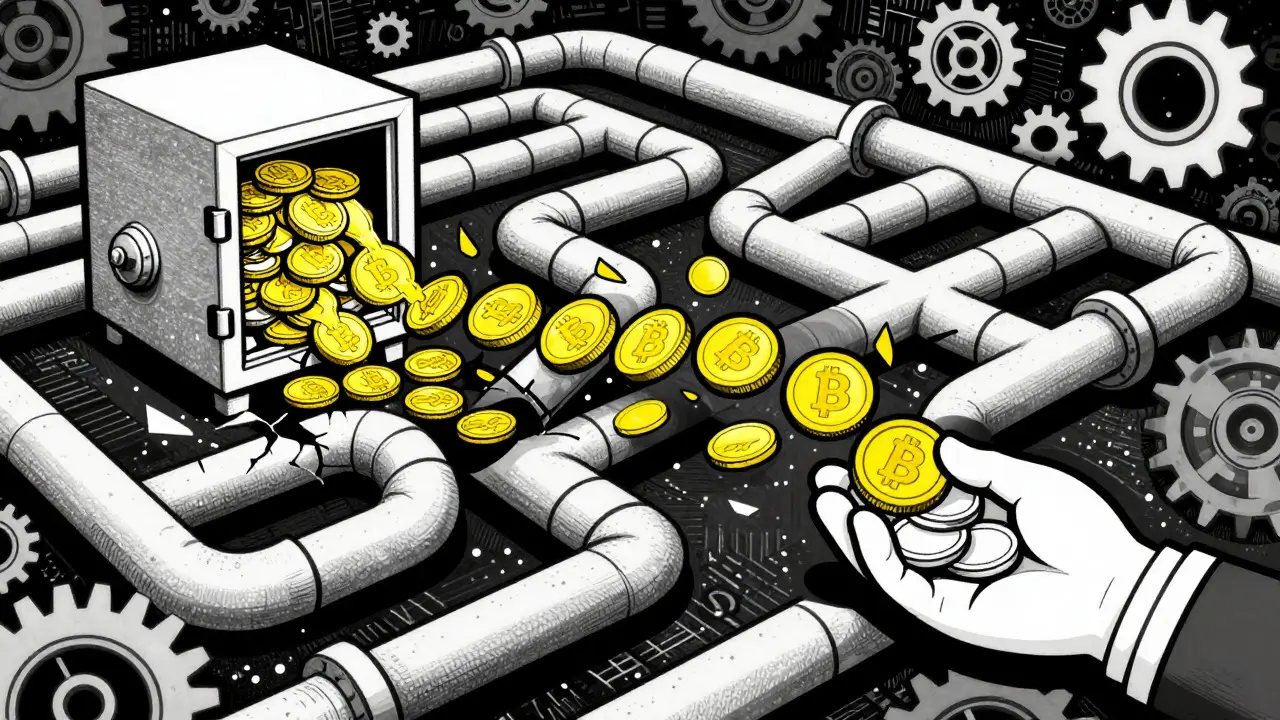
Stealing the crypto is only half the battle. The real challenge for law enforcement is tracking where the money goes. North Korean hackers have become masters of laundering. After the Bybit hack, the FBI revealed that hackers were rapidly converting stolen Ether into Bitcoin and other digital currencies. They utilized decentralized exchanges (DEXs) and cross-chain bridges to move funds across different blockchains.
Why does this matter? Because traditional bank freezes don’t work here. By dispersing funds across multiple virtual wallets and using privacy-enhancing tools, they obscure the origins of the assets. TRM Labs analysis shows that this rapid conversion makes tracing efforts incredibly difficult. The goal is to turn stolen, traceable tokens into clean, anonymous cash or stablecoins that can be used to buy supplies for the regime’s military programs.
| Date | Target | Amount Stolen | Methodology |
|---|---|---|---|
| June 2023 | Atomic Wallet | $100 Million | Social Engineering / Malware |
| May 2024 | DMM (via Ginco) | $308 Million | LinkedIn Recruitment Scam / Session Hijacking |
| Feb 2025 | Bybit | $1.5 Billion | Multi-stage Compromise / Cross-Chain Laundering |
Why Restrictions Are Becoming Stricter
The sheer volume of theft-accounting for 61% of all cryptocurrency stolen globally in 2024 despite being only 20% of total incidents-has triggered a regulatory backlash. Governments realize that lax crypto rules are funding geopolitical adversaries. As a result, we are seeing a rapid tightening of restrictions.
Regulators are now demanding more than just basic Know Your Customer (KYC) checks. They want continuous monitoring. Exchanges are being forced to implement multi-signature wallets, enhanced employee training programs, and real-time blockchain monitoring systems. The cost of doing business in crypto has skyrocketed. Insurance costs for platforms have increased due to the higher risk profile. User confidence has wavered, leading to stricter compliance requirements to maintain licenses.
In the United States, the Department of Defense Cyber Crime Center and the FBI have established clear attribution methodologies. They link specific technical indicators and operational patterns to North Korean threat actors. This means that if your platform gets hacked by Lazarus Group, it’s not just a financial loss; it’s a national security incident. This classification brings federal scrutiny and potentially harsher penalties for inadequate security measures.
What Platforms Must Do Now
If you run a crypto platform, or even if you are an individual holding significant assets, the old rules no longer apply. Here is what needs to change immediately:
- Assume Breach is Possible: Perimeter defense is not enough. Implement zero-trust architecture where every user and device must be verified continuously.
- Train Employees on Social Engineering: The DMM hack started with a LinkedIn message. Train staff to recognize fake recruiters, suspicious links, and unexpected file attachments. Simulate phishing attacks regularly.
- Use Multi-Signature Wallets: Never allow a single key to move large sums. Require multiple approvals from different people located in different places.
- Monitor Off-Chain Activity: Watch for unusual login patterns, new devices accessing internal systems, or changes in communication channels before a transaction occurs.
- Collaborate with Intelligence Firms: Subscribe to feeds from firms like Chainalysis or TRM Labs to identify known North Korean wallet addresses and block transactions to them proactively.
The Future Outlook: Escalation is Inevitable
As international sanctions intensify and traditional revenue sources for North Korea become more restricted, their reliance on cybercrime will only grow. Cybersecurity experts predict that North Korean operations will continue expanding in scope and sophistication. They will target larger platforms, develop more advanced laundering techniques, and likely refine their social engineering scripts to be even more convincing.
The February 2025 Bybit incident was a wake-up call. It showed that even top-tier exchanges with robust security teams are vulnerable. The gap between attacker capability and defender preparedness is widening. Until the industry adopts a unified, aggressive stance on security and until governments enforce stricter cross-border data sharing for investigations, the flow of billions out of the global economy and into Pyongyang’s coffers will continue.
The question is no longer if another massive hack will happen. The question is who will be next, and whether the current restrictions are enough to stop them.
Who are the main North Korean hacking groups?
The primary groups include Lazarus Group, TraderTraitor, Jade Sleet, UNC4899, and Slow Pisces. These are state-sponsored entities that operate with high sophistication and direct backing from the DPRK government.
What was the largest single crypto hack by North Korea?
The February 2025 hack of the exchange Bybit, where nearly $1.5 billion worth of Ether was stolen. This remains the largest single cryptocurrency theft in history.
How do North Korean hackers typically gain access to systems?
They primarily use social engineering, such as fake job offers on LinkedIn, to trick employees into running malicious scripts. They then hijack sessions and manipulate legitimate business processes to move funds.
Why is it hard to recover stolen crypto?
Hackers use decentralized exchanges, cross-chain bridges, and multiple wallet transfers to launder funds quickly. This obscures the trail and makes it difficult for law enforcement to freeze or trace the assets.
What should crypto exchanges do to prevent these hacks?
Exchanges should implement multi-signature wallets, rigorous employee training against social engineering, zero-trust network architectures, and real-time blockchain monitoring services.

6 Comments
amy miranda
It is absolutely disgraceful that our governments allow this digital looting to continue with such impunity. The sheer audacity of a rogue state siphoning billions from hardworking citizens while hiding behind lines of code is morally bankrupt. We are watching the erosion of global financial integrity in real-time, and the response has been pathetic at best. These aren't just 'hackers'; they are state-sponsored thieves funding weapons of mass destruction. If we do not hold these platforms accountable for their lax security, we are complicit in the crime. The human cost of this negligence cannot be overstated.
Every dollar stolen is a dollar that could have gone to legitimate innovation or savings. Instead, it fuels tyranny. It makes one sick to think about the lack of oversight. The regulatory bodies need to stop playing nice and start enforcing consequences that actually hurt. Until then, we are all just sitting ducks waiting for the next massive breach.
Subhash Kashyap Dm
typical mainstream narrative trying to simplify complex geopolitical cyber warfare into a simple good vs evil story but they miss the deeper truth. the so-called 'social engineering' is just the tip of the iceberg. these groups like Lazarus are essentially operating as private military contractors for the regime using blockchain as their supply chain. the fact that they use LinkedIn is irrelevant because the vulnerability isn't the employee it's the entire centralized structure of web2 infrastructure which was designed to be fragile by design.
think about it why would a government spend billions on nukes when they can steal $3 billion in crypto without firing a shot? it's asymmetric warfare 101. the 'regulators' mentioned in the article are part of the problem because they enforce KYC which creates honeypots of data for these actors to exploit. the solution isn't better firewalls it's decentralization and anonymity coins which the elites hate because they can't track them. wake up sheeple the banksters want you poor and tracked.
Pernelia Wahkan
The DMM/Ginco incident described here is a masterclass in patience and psychological manipulation, reminiscent of a slow-burning thriller where the villain wins through sheer persistence rather than brute force. It’s fascinating, albeit terrifying, how they masqueraded as recruiters on LinkedIn, turning the professional networking site into a hunting ground for session cookies. This highlights a critical blind spot in modern cybersecurity: we obsess over firewall penetration tests while ignoring the human firewall, which is often the thinnest layer of defense.
One must consider the operational security (OpSec) required to maintain such a deception for months. The attackers didn’t just need technical skills; they needed social intelligence to mimic corporate culture perfectly. This suggests that North Korean hacking units likely employ sociologists or behavioral psychologists alongside their coders to craft these narratives. The implication for businesses is profound: your most expensive software license is useless if your junior developer clicks a link sent by a charming fake recruiter. We need to treat employee training not as an HR checkbox but as a core component of national security infrastructure.
Ed Wallace
There is a strange poetic justice in the idea that a nation isolated by concrete walls and barbed wire is now reaching out through the invisible ether of the internet to reshape the global economy. It forces us to ask whether our current definition of 'security' is merely a comforting illusion. We build higher digital walls, yet the intruders simply knock on the door dressed as friends.
This shift from physical borders to digital permeability changes the nature of sovereignty itself. If a state can bleed another state’s economy dry without crossing a single border, what does that mean for international law? It seems we are entering an era where trust is the scarcest resource, more valuable than gold or oil. Perhaps the true lesson here isn't just about multi-signature wallets, but about rebuilding a sense of communal vigilance in a fragmented world.
SUBHAM CHOUDHURY
Hey everyone! Let’s look at this challenge as an opportunity to level up our collective game! 🚀 Yes, the numbers are huge, but every expert who reads this is now smarter and more prepared than yesterday. The key takeaway here is empowerment through knowledge. When we understand the tactics-like the LinkedIn scams or cross-chain laundering-we take away the element of surprise from the attackers.
Don’t let fear paralyze you; let it motivate you to check your own security settings today. Enable two-factor authentication, verify those weird emails, and talk to your team about social engineering. We’ve got this! Together, we can build a more resilient community. Keep pushing forward and stay sharp! 💪✨
Billy Cunningham
I feel drained just reading about the complexity of these laundering techniques 😩. Why does it have to be so hard to keep our money safe? It feels like we are always one step behind. 📉