
Imagine trying to open a coffee shop in Manhattan, but before you can pour a single espresso, you must pass a six-month government audit, hire a dedicated compliance officer, and prove your cash register is secure against cyber-attacks. That’s essentially what the BitLicense is for cryptocurrency businesses in New York. It’s not just another permit; it’s one of the strictest regulatory frameworks for digital assets in the United States. If you’re running a crypto exchange, wallet service, or trading platform that touches New York residents, this license isn’t optional-it’s the price of admission.
But why does New York care so much? And more importantly, is the hassle worth it? This guide breaks down exactly what the BitLicense entails, who needs it, how much it actually costs (spoiler: way more than the application fee), and whether you should bother applying or just block New York users altogether.
What Exactly Is a BitLicense?
The BitLicense, formally known as the Virtual Currency Business Activity License, is issued by the New York State Department of Financial Services (NYDFS). Created in 2015 under Superintendent Benjamin Lawsky, its goal was simple: bring order to the wild west of early crypto. The state wanted to prevent money laundering, protect consumers from fraud, and ensure financial stability in a market that was growing faster than regulators could track.
You don’t need a BitLicense if you’re just buying Bitcoin for yourself. You need it if your business performs specific "Virtual Currency Business Activities" involving New York or New Yorkers. These activities fall into five main buckets:
- Transmitting virtual currency: Sending crypto on behalf of others (like PayPal for Bitcoin).
- Custody services: Holding crypto for customers, like a bank vault.
- Buying and selling: Acting as a dealer for customer trades.
- Exchange services: Running a marketplace where users trade crypto for fiat or other coins.
- Issuing or controlling: Creating new tokens or managing a network’s governance.
If your app lets a user in Brooklyn buy Ethereum with their credit card, you are likely subject to these rules. The definition of "New York resident" is broad, covering anyone residing, located, or conducting business in the state.
The Application Process: A Marathon, Not a Sprint
Don’t expect a quick turnaround. The average BitLicense application takes between 12 and 18 months to process. Some have dragged on for years. The process is divided into seven formal steps, starting with a pre-application meeting where you outline your business model. From there, you submit a massive checklist of documents detailing everything from your cybersecurity protocols to your anti-money laundering (AML) procedures.
Here’s where it gets expensive. The official application fee is only $2,500. But that’s just the cover charge. Industry estimates suggest the total cost to get licensed ranges from $100,000 to $500,000. Why? Because you’ll need specialized legal counsel, background checks for all key personnel, and significant infrastructure upgrades to meet NYDFS standards.
| Cost Component | BitLicense Estimate | Standard MTL Estimate |
|---|---|---|
| Application Fee | $2,500 | $2,500 |
| Legal & Consulting | $75,000 - $150,000 | $10,000 - $30,000 |
| Compliance Infrastructure | $50,000 - $100,000 | $5,000 - $15,000 |
| Background Checks | $10,000+ | $2,000+ |
| Total Estimated Cost | $100k - $500k+ | $20k - $50k |
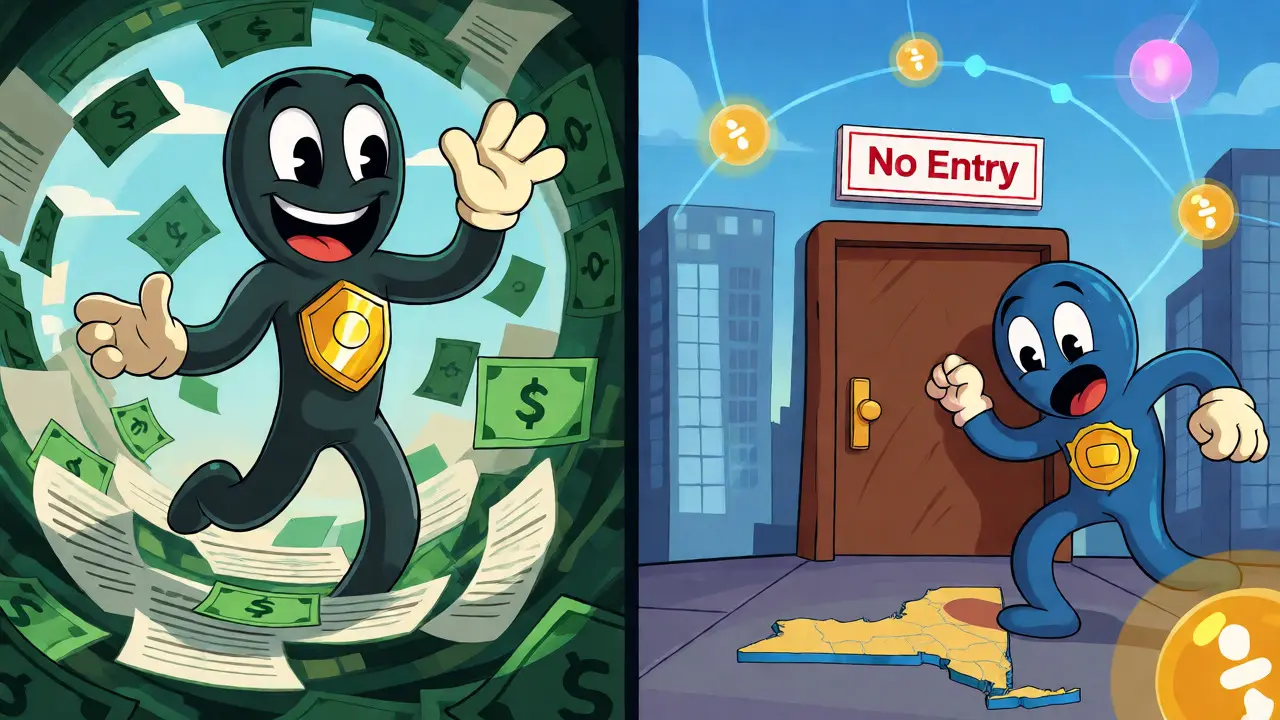
Who Has One? The Big Players and the Holdouts
As of late 2023, fewer than 50 entities had secured a BitLicense. This small number tells you something important: it’s hard to get. Major players like Coinbase, Circle, and Paxos have licenses. They view the cost as an investment in trust. When Coinbase got its license in 2017, it signaled to institutional investors that the company wasn’t going anywhere.
On the flip side, many companies chose to skip New York entirely. Kraken, ShapeShift, and Binance.US initially blocked New York users to avoid the compliance burden. For smaller startups, blocking New York is often cheaper than licensing. After all, if New York represents only 5% of your revenue, spending $200,000 annually on compliance might eat up your entire profit margin from that region.
Ongoing Compliance: It Doesn’t End at Approval
Getting the license is just step one. Keeping it requires constant vigilance. Licensed entities must maintain minimum capital reserves, which vary by business type. For example, pure wallet services need $50,000 in reserves, while custody services managing over $50 million in assets may need up to $1 million.
You also face rigorous reporting requirements. NYDFS mandates real-time transaction monitoring to spot suspicious patterns. This usually means integrating expensive blockchain analytics tools like Chainalysis or Elliptic, which can cost $100,000 to $500,000 per year. Additionally, you must conduct annual proof-of-reserves audits, costing another $50,000 to $150,000 each time.
Is it worth it? Proponents argue yes. A survey by Dilendorf Law Firm found that 63% of licensees reported increased customer trust after obtaining the BitLicense. Institutional clients often prefer working with regulated entities because it reduces their own risk. However, 89% of those same licensees admitted the compliance costs were disproportionate to their New York revenue.

Should You Apply or Block New York?
This decision comes down to your growth stage and target audience. Here’s a simple heuristic:
- Apply if: You want institutional clients, plan to offer stablecoins, or believe New York is a critical market for long-term brand credibility.
- Block if: You are a small startup with limited capital, your primary users are outside the US, or your product doesn’t involve holding customer funds.
New developments might change the calculus. In 2024, NYDFS launched a "BitLicense Express" pilot for startups with under $1 million in New York revenue, aiming to cut processing times to 90 days. While promising, no approvals have been granted under this program yet, so proceed with caution.
Frequently Asked Questions
Do I need a BitLicense if my server is outside New York?
Yes. The location of your servers doesn’t matter. What matters is whether you serve New York residents. If a user in New York accesses your platform to trade or store crypto, you are subject to NYDFS regulations regardless of where your data centers are located.
How long does it take to get a BitLicense?
The average processing time is 12 to 18 months. However, complex applications or those with incomplete documentation can take longer. The NYDFS has introduced a pilot program for smaller startups aiming for 90-day approvals, but this is still in early stages.
Can I operate without a BitLicense in New York?
You can choose not to serve New York residents. Many exchanges implement geo-blocking software to prevent New York IP addresses from creating accounts. This avoids the licensing requirement but limits your potential customer base.
What happens if I violate BitLicense rules?
Violations can lead to fines, suspension, or revocation of your license. The NYDFS takes consumer protection seriously. Repeated failures to report transactions or maintain capital reserves can result in heavy penalties and loss of operational status in the state.
Does a BitLicense allow me to issue stablecoins?
Not automatically. Issuing stablecoins requires additional approval and strict adherence to reserve requirements. As of 2023, NYDFS requires 100% cash or cash-equivalent reserves for stablecoins issued by BitLicense holders, making it a separate and highly scrutinized activity.
