Crypto Forgery Risk Assessment Tool
This tool estimates potential legal consequences of using fake IDs for crypto exchange access. Note: Actual legal outcomes depend on many factors including jurisdiction, evidence, and attorney expertise. This is not legal advice.
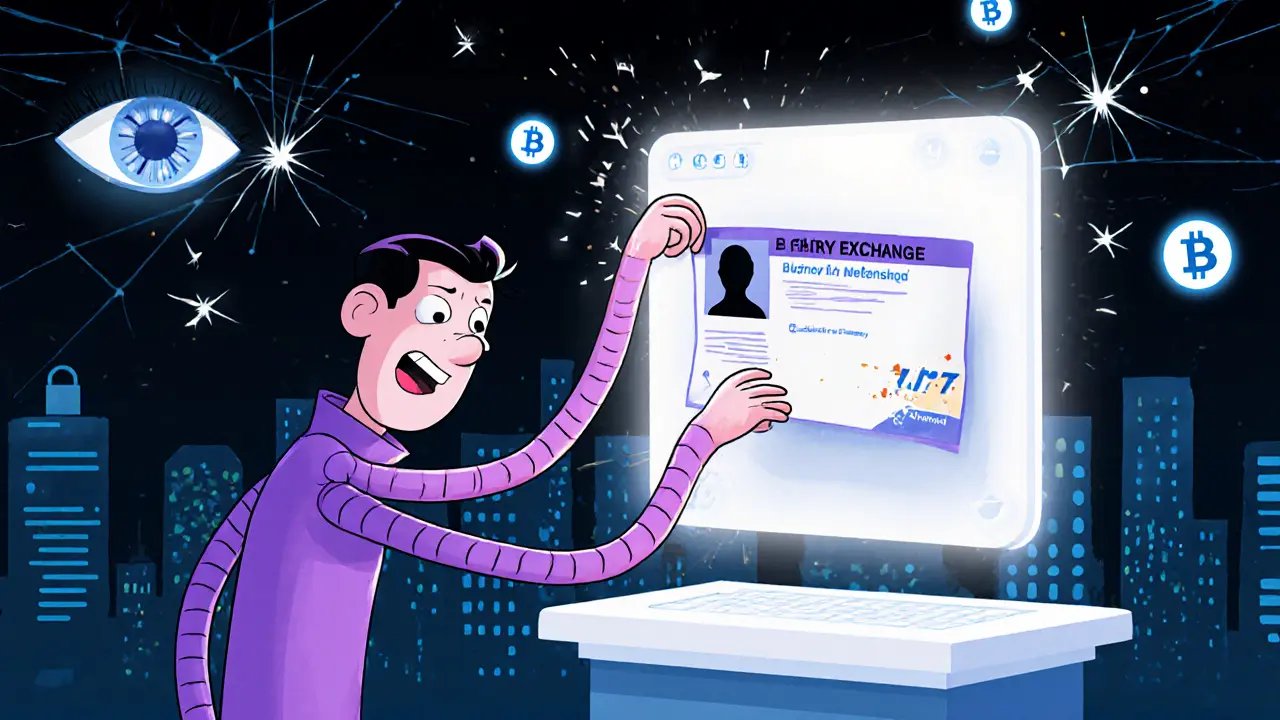
Using fake IDs to get into a crypto exchange isn’t a clever hack-it’s a federal crime with real prison time. If you think forging a driver’s license or using a deepfake video to bypass KYC checks is a victimless workaround, you’re dangerously wrong. The system isn’t just watching-it’s building traps designed to catch you, and the penalties are getting worse every year.
How Document Forgery Actually Works in Crypto
It’s not just slapping a Photoshop edit on a passport anymore. Today’s fraudsters use AI tools to generate entire identity packages: fake government IDs, utility bills with real addresses, even synthetic video clips that mimic blinking and head movement to fool live verification systems. These aren’t cheap-some dark web vendors sell full identity kits for $150 to $500, complete with background checks and fake social security numbers. The goal? To slip through automated KYC systems on exchanges that haven’t upgraded their security since 2020.Deepfake videos are the new gold standard. Instead of uploading a static photo, fraudsters use AI to animate stolen images, making the person in the video look like they’re speaking, turning their head, and even reacting to prompts from the exchange’s verification bot. Some systems still rely on simple photo matching. Those are the ones getting hit. But the smarter exchanges? They’ve moved on.
Who’s Really Being Hurt?
You might think, “I’m just trying to trade Bitcoin-no one gets hurt.” But that’s not how it works. Every fake account drains resources from legitimate users. Exchanges spend millions on fraud detection, and when they get hit, they raise fees, delay withdrawals, or shut down services entirely to fix the holes. The real victims? Ordinary traders who lose access to their funds because the platform got overwhelmed by fraud.Worse, these fake accounts are often used to launder stolen crypto. Someone steals $100,000 in Bitcoin from a wallet, moves it through 20 fake exchange accounts, and suddenly it’s clean. That’s money laundering-and you’re part of the chain if you helped create those accounts. You don’t need to know the source of the funds to be guilty. Just using forged documents to access the platform is enough.
Federal Charges You Didn’t Know Existed
This isn’t a misdemeanor. In the U.S., document forgery tied to crypto exchanges triggers multiple federal crimes at once:- Wire fraud-using electronic systems (like exchange platforms) to commit fraud. Up to 20 years per count.
- Securities fraud-if you’re using fake IDs to access trading platforms that handle tokens classified as securities by the SEC.
- Money laundering-if the funds moved through your account originated from theft or illegal activity.
- Identity theft-even if you didn’t steal the real person’s data, using fake documents with real personal info counts.
Prosecutors don’t pick one charge-they stack them. In 2024, a man in Florida got 14 years for creating 87 fake crypto accounts using forged IDs. He didn’t steal crypto himself, but he enabled others to do it. The court called it a “critical enabler of financial crime.”
Exchanges Aren’t Innocent Either
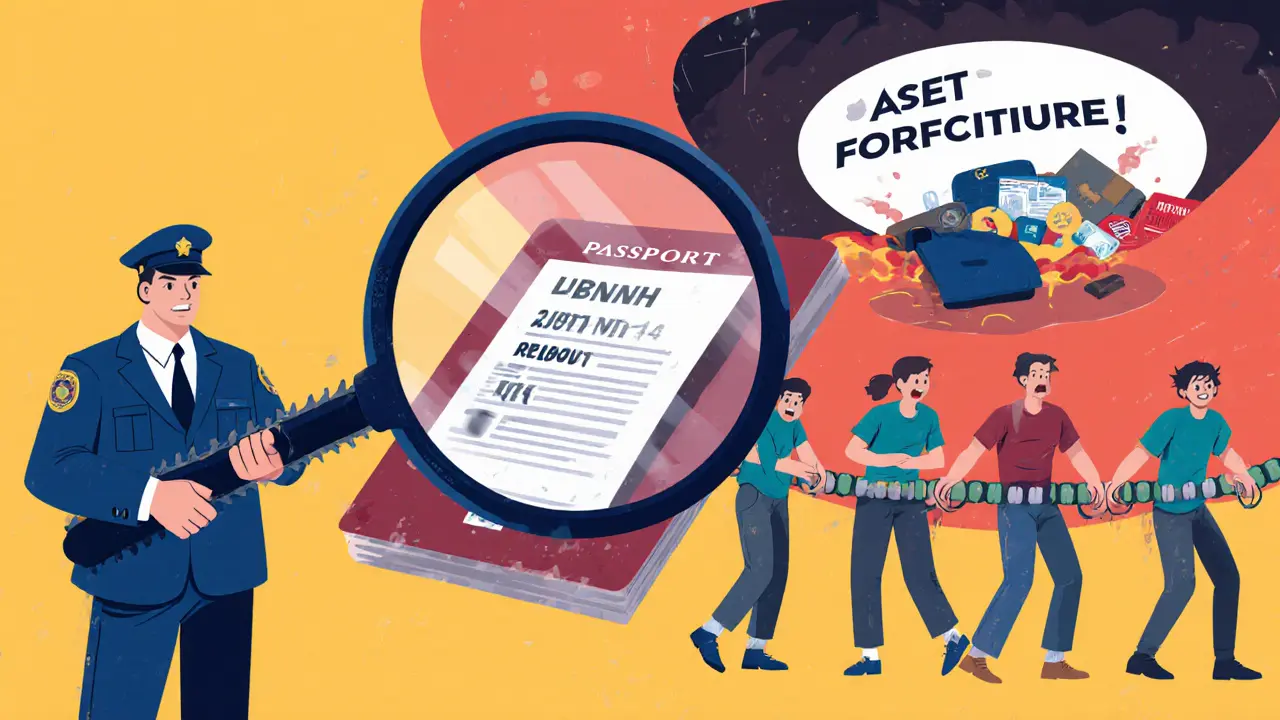
You think the exchange is just a passive platform? Think again. If they know or should have known about fake accounts and did nothing, they’re legally liable. The SEC and FinCEN don’t just go after users-they go after the platforms. In 2022, Kraken paid $30 million to settle with OFAC for letting users from sanctioned countries access the platform using fake documents. That wasn’t a fine for users-that was a fine for the exchange’s failure to stop them.Regulators now expect exchanges to use multi-layered verification: document analysis, facial recognition, liveness detection, and cross-checking with government databases. If your exchange only asks for a selfie and a driver’s license? That’s not compliance-it’s negligence. And if you use that exchange knowing it’s weak? You’re not a victim. You’re a target.
How Detection Systems Are Winning
Modern KYC tools don’t just check if the ID looks real. They check if it’s physically possible. They analyze:- Light reflections in the eyes-AI-generated faces don’t reflect light like real skin.
- Blinking patterns-humans blink asymmetrically. AI blinks too evenly.
- Background noise in photos-fake IDs often have mismatched textures or cloned elements.
- Document metadata-many forged PDFs still carry traces of the original template software.
One exchange in Texas recently flagged a forged passport because the font size on the expiration date was 0.2 millimeters off. That’s invisible to the human eye. But the system? It caught it instantly. And that forgery got added to their AI training database-so next time, even a slightly different version gets blocked.
Why This Isn’t Going Away-It’s Getting Worse
As AI gets cheaper, forgery gets easier. But so does detection. The gap between fraud and defense is narrowing, and the side with the law on its side is winning. The DOJ has created specialized crypto fraud units. The SEC is hiring former blockchain developers. FinCEN is pushing new rules that force exchanges to report suspicious activity within 24 hours.And here’s the kicker: if you’re caught, you won’t just face jail. The government can seize everything-your car, your house, your bank accounts-even if you didn’t profit from the fraud. Asset forfeiture laws don’t care about intent. If your phone was used to upload a fake ID, they can take it.
What Happens If You Get Caught?
You’ll get a visit from federal agents. Not a warning. Not a fine. They’ll show up at your door with a search warrant. They’ll take your laptop, phone, and any external drives. They’ll pull your financial records. They’ll trace every crypto transaction you made since you created that account.Defense lawyers say the hardest part to fight isn’t the evidence-it’s proving you didn’t know what you were doing. But if you used a tool advertised on a dark web forum as “KYC bypass,” that’s intent. If you paid for a fake ID in Bitcoin, that’s intent. If you used the same email and address across multiple exchanges, that’s intent.
There’s no “I didn’t know it was illegal” defense that works anymore. The law assumes you knew-or should have known.
The Real Cost Isn’t Jail-It’s Your Future
Even if you avoid prison, a federal fraud conviction follows you forever. You can’t get a job in finance, tech, or even retail. You can’t travel to most countries. You can’t get a mortgage. You’ll be on probation for years. Your name will be in public court records. Your social media? Gone. Employers check. Banks check. Landlords check.And you didn’t even get the crypto you wanted.
What Should You Do Instead?
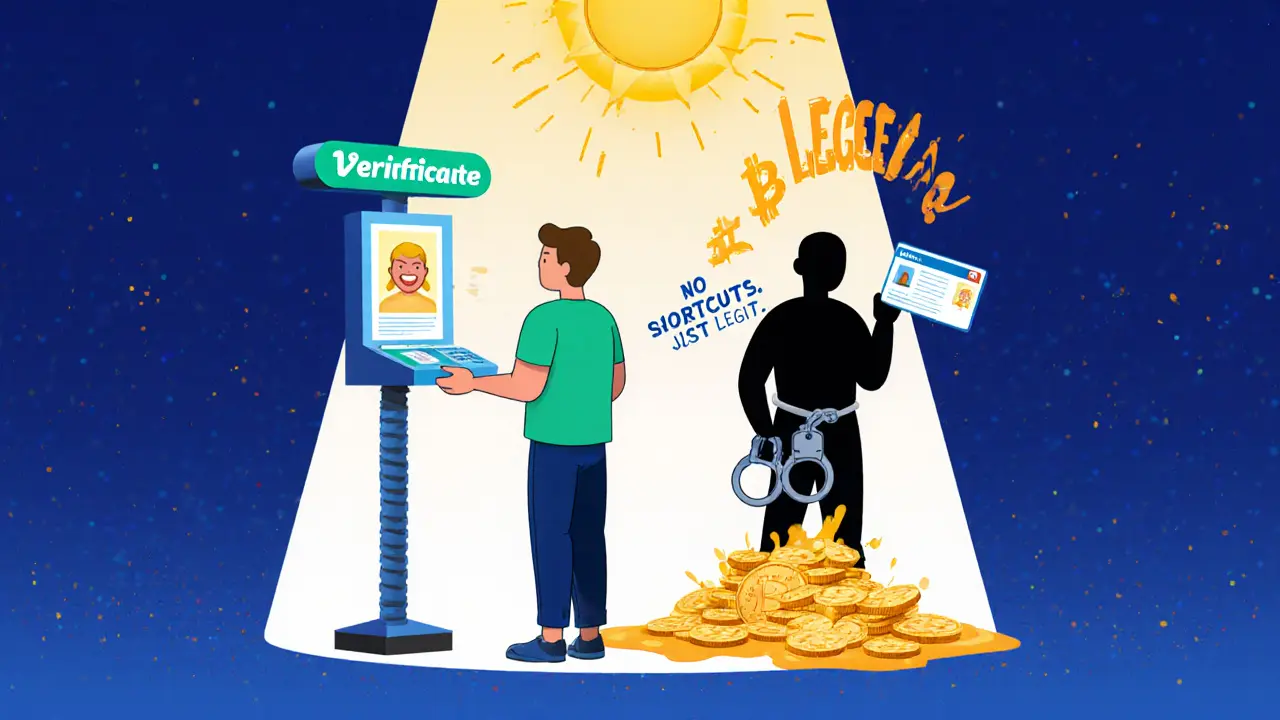
If your ID got lost or you’re in a country with limited access to government documents? Use legitimate pathways. Some exchanges offer alternative verification: bank statements, notarized letters, video calls with compliance officers. It takes longer. It’s more annoying. But it’s legal.Or wait. Most exchanges now support identity verification through government-issued digital IDs in over 40 countries. If you’re in the U.S., you can verify using your state’s digital driver’s license through secure apps. It’s faster than forging anything.
There’s no shortcut that doesn’t end in handcuffs. The crypto world is growing up. The rules are clear. And the consequences? They’re no longer theoretical.
Can I get in trouble for using a fake ID on a crypto exchange if I didn’t steal any money?
Yes. You don’t need to steal crypto to be charged. Simply using forged documents to bypass KYC rules is enough for federal wire fraud and identity theft charges. The law focuses on intent to deceive a regulated financial system, not whether you walked away with cash.
What if I didn’t know the ID was fake?
Ignorance doesn’t protect you. If you bought the ID from a third party, used it to access an exchange, and didn’t verify its authenticity, courts will consider that willful blindness. Prosecutors only need to prove you knowingly used a document you suspected might be false. That’s easier than you think.
Are some crypto exchanges safer to use fake IDs on than others?
No. All U.S.-based exchanges and those serving U.S. users are required to comply with federal AML/KYC rules. Even offshore exchanges that accept U.S. customers are subject to U.S. jurisdiction if they process transactions through U.S. banks or payment processors. There’s no “safe” exchange for fraud.
Can I be charged even if I used someone else’s real documents?
Yes. Using another person’s real ID without their permission is identity theft, a separate federal crime. Even if the documents are genuine, using them fraudulently to access financial services is illegal. You’re not helping the owner-you’re putting them at risk of being investigated for crimes they didn’t commit.
How long do these investigations take?
They can take months to years. Federal agencies track patterns across multiple exchanges and jurisdictions. If you used the same fake ID on three platforms over six months, they’ll connect the dots. By the time you’re contacted, they already have your digital footprint.
Is there any way to fix this if I already used a fake ID?
Contact a lawyer immediately. Do not delete anything. Do not contact the exchange. Self-reporting before being investigated may reduce penalties, but only if done correctly through legal counsel. Waiting until you’re charged makes things worse.

10 Comments
Wilma Inmenzo
Oh wow, so now the government wants us to believe that AI-generated eyelashes on a fake ID are a federal offense? 😏 Next they'll arrest me for using a Photoshop-edited selfie where I made my hair look less greasy... they're not catching fraudsters-they're catching people who can't afford $200 verification fees. And don't get me started on how Kraken paid $30M... but the real criminals? Still sipping margaritas in the Caymans. 🤡
priyanka subbaraj
This is not about freedom. It is about control. They want you compliant. They want you afraid. And they will use every law, every algorithm, every pixel to break you.
George Kakosouris
Let’s deconstruct this: the real issue isn’t document forgery-it’s regulatory arbitrage failure. Exchanges are operating on legacy KYC stacks while fraudsters deploy GAN-based adversarial networks with 97.3% evasion rates. The DOJ’s response? Throw more statute at the problem instead of funding real-time biometric liveness detection with federated learning models. Classic misalignment between enforcement and tech evolution. Also, asset forfeiture is just state-sanctioned robbery with a warrant. 📉
Tony spart
USA is getting soft. Back in my day, if you wanted to trade crypto, you just did it. No forms, no selfies, no ‘deepfake this’ nonsense. Now we got cops chasing kids with fake driver’s licenses while the real crooks run hedge funds in Manhattan. And don’t even get me started on how the government lets banks launder billions but locks up some guy for using his cousin’s expired ID. Pathetic. 🇺🇸
Mark Adelmann
Hey, if you’re reading this and thinking about using a fake ID-stop. Seriously. I’ve seen too many smart people ruin their lives over this. There are legit ways to verify, even if you’re in a country with shaky docs. Talk to support, ask about alternative methods, wait a few days. It’s annoying, yeah-but jail? Probation? Losing your car? That’s not worth a few months of inconvenience. You’re smarter than this. I believe in you. 💪
SHASHI SHEKHAR
Bro, the real story here isn’t the fraud-it’s the asymmetry of power. AI makes forgery cheaper than ever, but detection? That’s still locked behind corporate firewalls and proprietary ML models that cost millions. The average person can’t afford to verify their identity legally if they’re from a developing country, so they turn to dark web vendors. Meanwhile, exchanges profit from fees and blame users. It’s not about morality-it’s about access. And if you think the system is fair? 🤔 You’re not seeing the whole picture. Also, I’ve seen fake IDs that were better than my actual passport 😅
Vijay Kumar
You’re not a victim. You’re a liability. Stop pretending ignorance is innocence.
Vance Ashby
They caught that guy in Florida for 87 fake accounts? lol. I bet half of them were bots. Also, if you're using a deepfake, you're already using a service that's probably run by the feds. Everything's monitored. Everything. 😎
Grace Zelda
So let me get this straight: the same government that lets Wall Street rig markets with algorithmic trading and insider deals is now playing superhero because someone used a fake driver’s license to buy Dogecoin? 🤡 The hypocrisy is thicker than Kraken’s compliance department’s payroll. You want to stop fraud? Start by regulating the banks. Then maybe we’ll talk about my ID.
Sierra Myers
Wait so if I use my mom’s real ID and she didn’t give me permission, that’s identity theft? But if I use a fake one I made myself, that’s just forgery? So the crime gets worse if I steal someone’s identity? That makes zero sense. Who wrote this law? A robot?