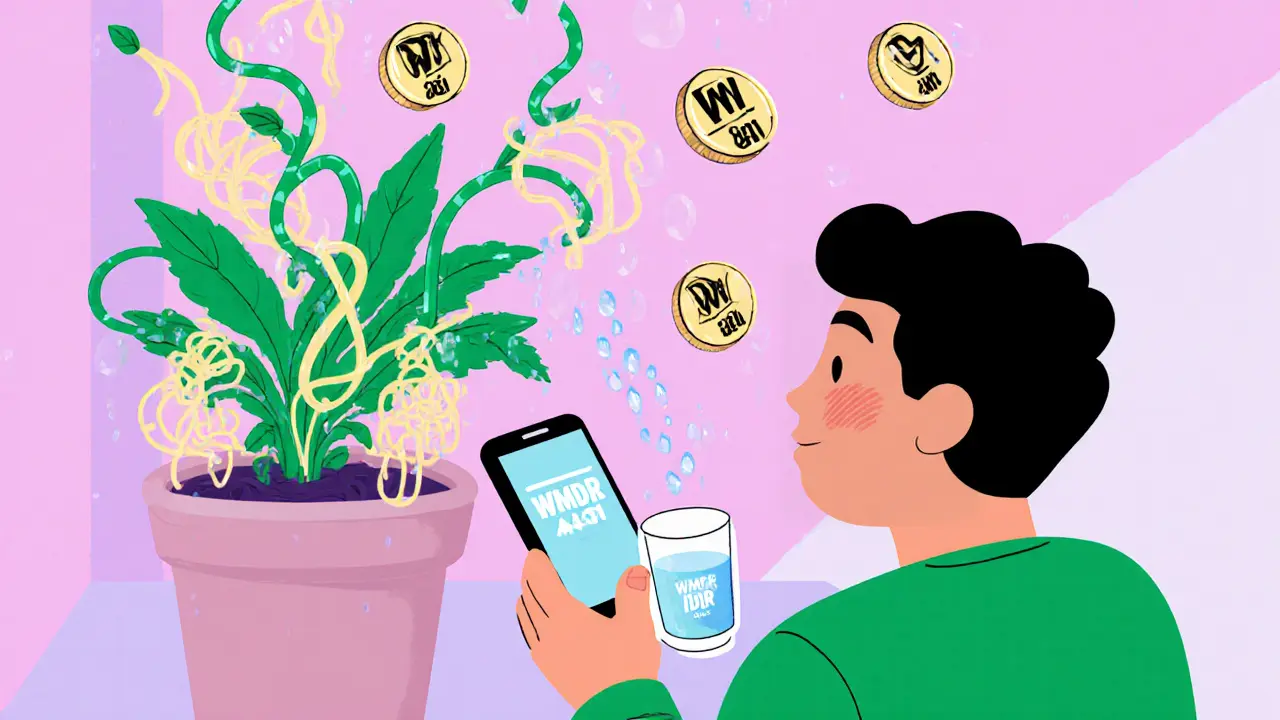
WaterMinder (WMDR) isn’t a cryptocurrency in the way Bitcoin or Ethereum is. It’s a token tied to a mobile app that rewards you for drinking water. If that sounds too good to be true, you’re right. As of November 2025, WMDR trades at around $0.000264, with a market cap under $330,000 - barely more than the cost of a used laptop. It’s listed on just five exchanges, has zero real-world use outside its own app, and has no verifiable team behind it. This isn’t a health innovation. It’s a speculative microcap with high risk and almost no utility.
How WaterMinder (WMDR) actually works
The WaterMinder app, available only on iOS, uses your phone’s camera to record you drinking water. It doesn’t just check if you poured liquid - it tries to detect gulping patterns using AI. If it thinks you’re drinking, you earn WMDR tokens. You need to hit 10,000 points (worth about $2.64 at current prices) before you can even withdraw your tokens to a Solana wallet like Phantom or Sollet.
That’s the entire system. No mining. No staking. No blockchain-based governance. Just a phone app that gives you a crypto token for drinking water. And here’s the catch: the AI is unreliable. Users on Reddit and the App Store report the app mistakes pouring water into a plant as a valid drinking session. Others say it rejects perfectly good drinking videos. One user, u/SolanaSkeptic, documented how the app accepted a video of someone sipping from a glass while sitting in front of a mirror - the reflection fooled the AI.
Why the token has almost no value
WMDR’s entire value depends on one thing: how many people keep using the app. But the numbers don’t add up. There are only 1,340 verified holders of WMDR, according to CoinMarketCap. Compare that to Sweatcoin, which has over 100 million users. WaterMinder’s daily trading volume is around $2,000. That’s less than what some meme coins make in an hour.
The tokenomics are broken. All 999.99 million WMDR tokens were released at launch, with 100% allocated to user rewards. There’s no treasury. No development fund. No reserve. That means if users stop drinking water for tokens, the price crashes - and there’s no safety net. That’s why experts at Hacken gave it a 2.3/10 security score. No audits. No code transparency. Just a smart contract with no backup plan.
The Android problem
More than 70% of smartphone users worldwide run Android. WaterMinder doesn’t support it. The app is iOS-only. That’s not a technical limitation - it’s a business decision. Building an Android version would cost money. And the team behind WaterMinder hasn’t shown any signs of spending money on development. The GitHub repo hasn’t been updated since August 2023. The official Twitter account deleted its last post about a planned ‘WMDR V2 with NFT integration.’ No details. No timeline. Just vapor.
Without Android, the user base is capped at a fraction of potential users. And even among iOS users, the app has a 2.1-star rating on the App Store. Over 70% of reviews are one-star. Common complaints? Points disappearing. Withdrawals taking over two weeks. Battery draining fast. And customer support that takes three days to reply.
It’s not a health app - it’s a loyalty program with crypto branding
Real health-focused crypto projects like Lympo (LYM) or Stepn (GMT) have real-world partnerships. Lympo worked with clinics. Stepn integrated with sneakers you actually wear. Even Coin partners with 12,000 gyms. WaterMinder? Zero partnerships. Zero integrations. Zero commercial use.
It’s a loyalty program disguised as a blockchain project. You earn points (tokens) for doing something you should already be doing - drinking water. But unlike Starbucks Rewards, you can’t use WMDR to buy anything. Not coffee. Not groceries. Not even a gym membership. The only way to cash out is to sell it on a low-volume exchange. And even then, you need to jump through hoops: set up a Solana wallet, pay gas fees, and hope the price hasn’t dropped since you earned the tokens.
Why experts say it’s a trap
CryptoSlate’s analyst Maria Shin called WMDR a ‘high-risk speculative token’ because its value relies entirely on new users signing up - not on real demand or utility. If the app stops growing, the price collapses. And growth has stalled. App downloads have dropped since mid-2023. The Reddit community has 347 members and averages just over one post per day.
Bitget’s price prediction says WMDR could hit $0.0026 by 2031. That’s a 992% increase. Sounds exciting - until you read the disclaimer: ‘Investors must closely monitor market performance and be aware of associated risks.’ Translation: we’re not making a prediction. We’re just giving you a fantasy.
Delphi Digital’s 2023 report gives WMDR an 89% chance of falling below $0.0001 in the next year. CoinGecko rates it ‘Extreme Risk’ in every category - liquidity, team transparency, development activity, and token utility. That’s the highest risk tier possible.
What you’ll actually get if you try it
If you download the WaterMinder app today, here’s what happens:
- You install it on your iPhone (iOS 14+ required).
- You set up a Solana wallet (Phantom or Sollet).
- You start recording yourself drinking water.
- You get rejected half the time because the AI is flawed.
- After three weeks, you might have earned $4 worth of WMDR.
- You try to withdraw - but you need 10,000 points, and it takes 10-14 days to process.
- When it finally arrives, the price has dropped 15%.
- You sell it on MEXC or Bitget - paying fees and taxes on a $3 profit.
And that’s the best-case scenario.
More likely? You get frustrated. Your battery dies. You miss a few days. Your points vanish. You stop caring. And you’re left with nothing but a dead app and a few hundred worthless tokens.
Is WaterMinder a scam?
It’s not technically a scam - no one’s stolen your money directly. But it’s a classic pump-and-dump setup wrapped in health branding. The team is anonymous. There’s no whitepaper. No roadmap. No accountability. The token’s value is entirely artificial, sustained only by people hoping someone else will buy it later.
The SEC has already warned about ‘app-coin’ models where tokens are used as loyalty points without real utility. WaterMinder fits that description perfectly. If regulators step in, the token could be classified as an unregistered security - meaning exchanges might delist it overnight.
Bottom line: Don’t touch it
WaterMinder (WMDR) is not an investment. It’s not a health tool. It’s not even a decent app. It’s a low-effort crypto experiment with no foundation, no future, and no reason to exist beyond attracting speculative buyers.
If you want to track your water intake, use a free app like WaterMinder (the original, non-crypto one) or Apple Health. If you want to earn crypto for healthy habits, look at projects with real users, audits, and partnerships - not ones that rely on AI to guess if you’re drinking.
WMDR won’t make you rich. It won’t even make you hydrated. It’ll just waste your time - and maybe your trust in crypto.
Is WaterMinder (WMDR) a real cryptocurrency?
No. WaterMinder is a token built on Solana, but it has none of the features of a real cryptocurrency. It’s not decentralized, doesn’t have a community-driven network, and has no utility outside its own app. It’s a loyalty point system with crypto branding.
Can I make money with WMDR?
Technically, yes - but not realistically. You’d need to drink water consistently for weeks to earn a few dollars’ worth of tokens. Then you’d have to sell them on a low-volume exchange, pay fees, and pay taxes. Most users lose money after accounting for time, battery drain, and price drops. The odds of turning a profit are near zero.
Why is WMDR only on iOS?
Because the team chose not to build an Android version. Android has over 70% of the global smartphone market. Skipping it limits the app to a tiny fraction of potential users - suggesting the project isn’t serious about growth. It’s likely a cost-cutting move, not a technical one.
Is WaterMinder safe to use?
No. The smart contract has never been audited. The app drains battery life and has unexplained bugs that cause users to lose points. There’s no customer support. And the anonymous team could disappear tomorrow - taking all token value with them. It’s one of the riskiest crypto projects listed today.
What’s the future of WMDR?
The future is bleak. With no development activity since mid-2023, no Android app, no partnerships, and declining user numbers, WMDR is on a path to collapse. Experts predict an 89% chance it falls below $0.0001 in the next year. It’s not a project with potential - it’s a dead end.

7 Comments
jeff aza
Let’s be real - WMDR is a glorified loyalty card with a blockchain sticker slapped on it. The AI drinking detector? More like a glitchy parlor trick. I tried it for a week. My cat drank from the sink, and the app credited me 500 points. Then it rejected my actual water intake because I ‘didn’t gulp audibly enough.’ No audits. No team. Just a Solana smart contract that’s basically a digital slot machine for people who think crypto = easy money. And don’t get me started on the withdrawal delays - it’s like asking for a refund from a ghost.
Vijay Kumar
You think this is bad? Wait till you see how people treat blockchain like a spiritual experience. This isn’t about water. It’s about people wanting to believe in magic. They’ll drink tap water for tokens while ignoring their own thirst for meaning. The app doesn’t hydrate you - it exploits your hope. And the fact that it’s iOS-only? That’s not a bug. It’s a feature. They don’t want mass adoption. They want a cult.
Vance Ashby
Same. I downloaded it because I thought ‘hey, maybe I’ll finally drink more water.’ Ended up with 2.37 WMDR after 18 days. Battery died twice. App crashed mid-sip. Tried to cash out - took 11 days. By then, price dropped 18%. Lost $1.50 after fees. And now I’m stuck with 200 tokens I can’t even use to buy a damn bottle of water. 😑
Brian Bernfeld
Look - I’ve reviewed dozens of these ‘health-to-earn’ projects. WMDR isn’t just bad - it’s a textbook case of crypto vaporware. Zero transparency. No whitepaper. No roadmap. No Android. And yet people still think it’s ‘the future.’ The real future? You’re paying $3 in gas fees to earn $2.50 worth of tokens that no exchange wants to list after the team vanishes. This isn’t innovation - it’s financial malpractice wrapped in a hydration app. The SEC’s warning? That’s not a heads-up. That’s a death sentence waiting to be served.
And the worst part? People are proud of it. ‘I earned WMDR!’ Like it’s a badge. It’s not. It’s a digital scar. Don’t let your health goals become someone else’s exit liquidity.
Grace Zelda
So you’re telling me I can’t even get paid for drinking water unless I’m on an iPhone and have a Solana wallet and know how to avoid a mirror? This isn’t crypto. It’s a glitchy game show where the prize is disappointment and a drained battery. And the host? Probably a guy in his basement with a GitHub repo that hasn’t been touched since 2023. I’m not mad. I’m just… tired.
Sam Daily
Y’all need to stop treating this like it’s a startup. It’s a digital lemon. A glitter-covered brick. A TikTok trend that got a blockchain upgrade. The only thing WMDR is good for? Teaching you how NOT to invest. I used to think crypto was wild. Now I just feel sorry for the people who still believe in it. 🙃 But hey - if you wanna waste 3 weeks and 12GB of battery chasing $3… go for it. Just don’t cry when your tokens turn into digital confetti.
Kristi Malicsi
It’s not a scam if you never paid anything. Just downloaded the app. Used your own water. Got a few tokens. Sold them for less than a coffee. So what? It’s a weird experiment. Maybe it’s stupid. Maybe it’s genius. Either way - I’m still hydrated. And I didn’t lose money. So I’m calling it a win. 🍃