
Gas Fee Calculator: Uniswap v4 on Base vs v3 on Ethereum
Calculate how much you could save on gas fees by switching from Uniswap v3 on Ethereum to Uniswap v4 on Base Network. Based on real data from the article.
Your Estimated Savings
Why this matters:
Creating a new token pair used to cost $500 in gas on Ethereum. Now it's under $0.05 on Base - that's a 99.99% reduction.
Uniswap v4 on Base isn’t just another upgrade. It’s the first time a decentralized exchange has truly become a platform-not just a swap tool. Launched in late January 2025, Uniswap v4 isn’t trying to beat centralized exchanges like Binance or Coinbase at their own game. Instead, it’s rewriting the rules of what a DEX can do, and Base Network is the perfect playground for it.
Why Base Network Matters
Base isn’t just another Layer 2. It’s Coinbase’s official blockchain, built for scale, speed, and simplicity. Transaction fees on Base are a fraction of Ethereum’s, often under $0.01. That’s critical because Uniswap v4’s biggest innovation-customizable hooks-only works if users can afford to test, tweak, and use them daily. On Ethereum mainnet, experimenting with a new liquidity strategy might cost $50 in gas. On Base? It’s $0.15. That difference turns theoretical ideas into real-world trading.
Base also has a built-in user base. Millions of Coinbase users already have wallets, know how to buy crypto, and are looking for ways to trade without giving up control. Uniswap v4 on Base gives them that. No more complex seed phrases or third-party apps. Just tap into the familiar Coinbase ecosystem and start swapping with full decentralization.
What Makes Uniswap v4 Different
Uniswap v3 was a breakthrough. It let liquidity providers set custom price ranges, boosting capital efficiency by up to 4,000% compared to v2. But it was rigid. Every pool was its own smart contract. Creating a new trading pair meant deploying a new contract-expensive, slow, and messy.
v4 fixes that with the singleton contract. Instead of thousands of individual pool contracts, all liquidity now lives in one. That cuts deployment costs by 99.99%. Think about that: creating a new token pair used to cost $500 in gas. Now? It’s under $0.05. That’s not an improvement-it’s a revolution.
Then there’s flash accounting. In older versions, every token transfer had to be recorded individually. If you swapped ETH for USDC, then swapped USDC for DAI, then DAI back to ETH, the system tracked every single step. That meant high gas bills for complex trades. v4 uses transient storage to track only the net result. You pay for what changes, not every intermediate step. For traders doing arbitrage or multi-step strategies, this cuts gas by 30-50% on average.
And yes-no more WETH. You can now swap ETH directly for any ERC-20 token. No wrapping. No extra steps. That alone saves users time and reduces the risk of failed transactions.
The Hook System: Uniswap’s Secret Weapon
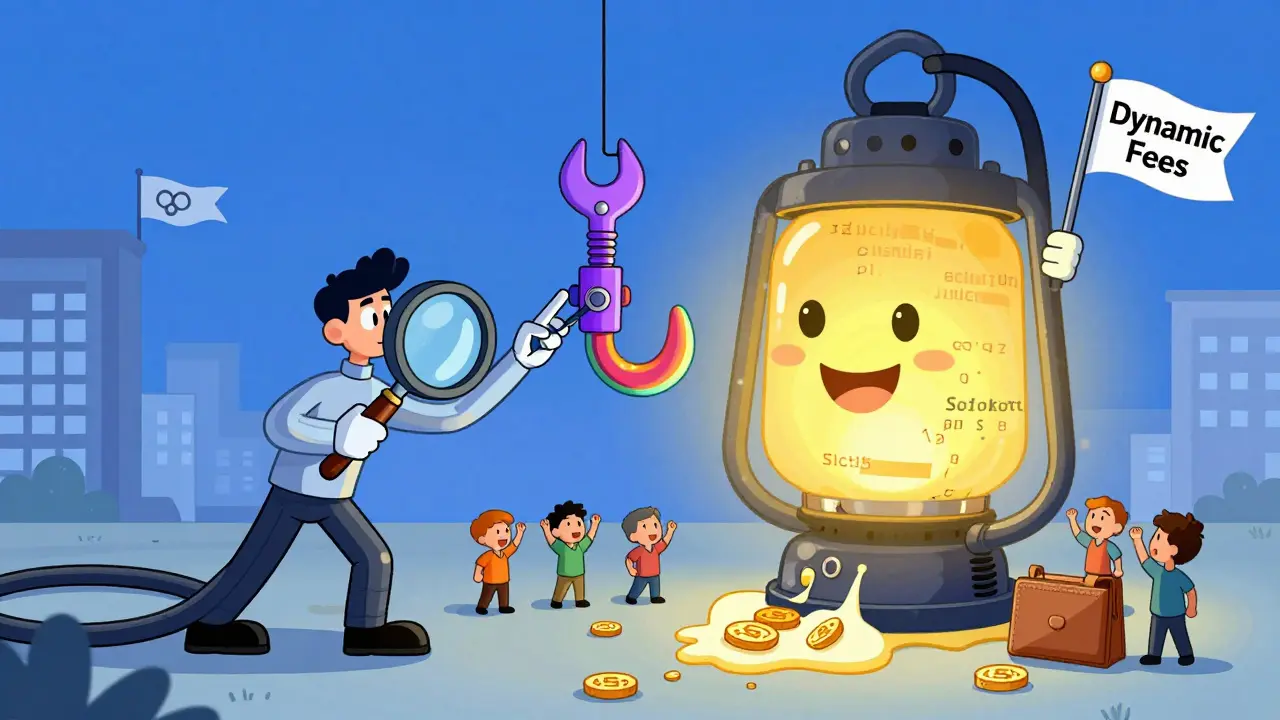
If the singleton and flash accounting are the engine, hooks are the brain. Hooks are modular plugins that let developers inject custom logic into any pool. Want a pool that increases fees when volatility spikes? Hook. Want liquidity to auto-rebalance every hour based on price movement? Hook. Want to reward long-term LPs with bonus fees? Hook.
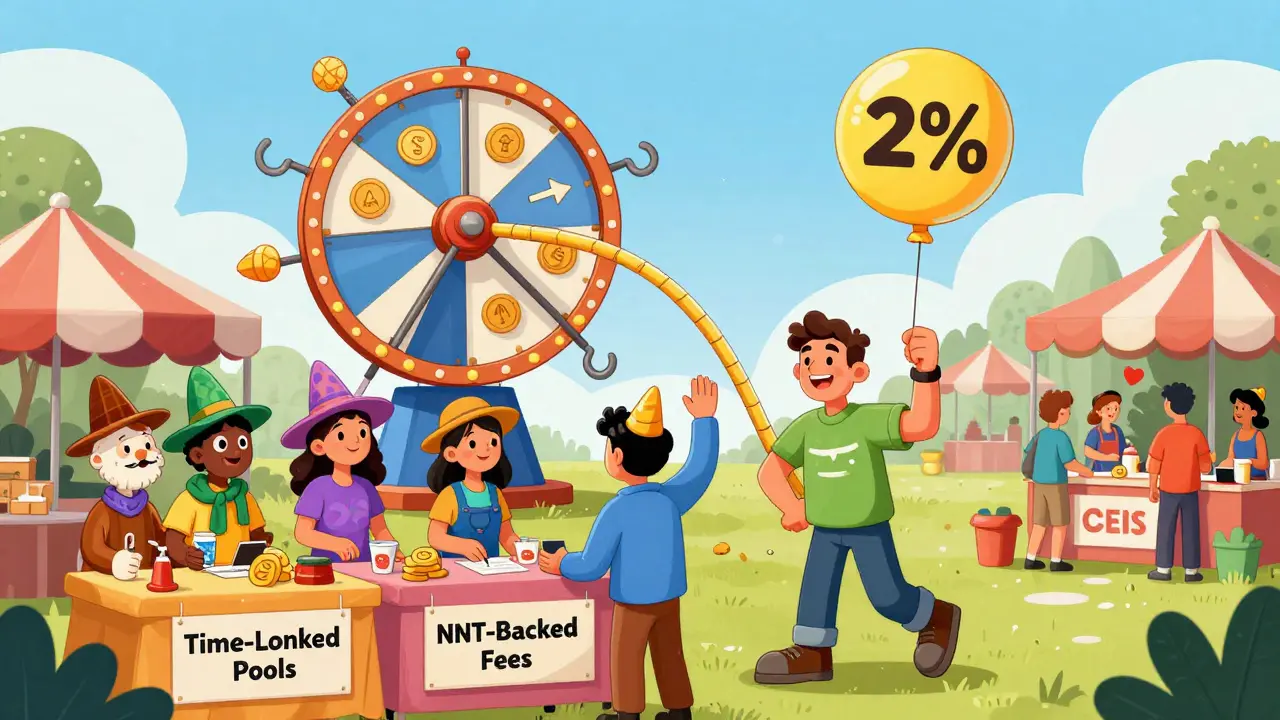
Within weeks of launch, over 150 hooks were built. Projects like Bunni, Angstrom, and Cork Protocol are already using them to create entirely new types of markets. One hook lets you lock liquidity for 30 days and earn a 2% bonus fee. Another lets you create pools that only open during certain hours-perfect for trading during high-volume periods like U.S. market open.
These aren’t gimmicks. They’re real tools that let traders and liquidity providers build strategies that were impossible before. On centralized exchanges, you’d need a professional trading desk and API access. On Uniswap v4, a single developer with Solidity skills can build it-and anyone can use it.
How It Works for You
If you’re just swapping tokens, you won’t notice much has changed. The Uniswap web app still looks familiar. Connect your wallet, pick your tokens, click swap. Done. But now, the backend is faster, cheaper, and more reliable.
Liquidity providers still add funds the same way. But now, they can choose from pools built with hooks. A pool with dynamic fees might offer higher returns during market swings. A time-based pool might lock your funds but pay you more. You’re not forced into one-size-fits-all liquidity anymore. You pick the strategy that fits your risk profile.
And because everything runs on Base, you’re not paying $10 in gas to add $100 of liquidity. You’re paying $0.03. That changes everything for small providers. You can now make money with $500, not $5,000.
Who’s Winning? Who’s Losing?
Centralized exchanges still win on fiat on-ramps, customer support, and regulatory compliance. If you want to buy crypto with your bank card, Binance and Coinbase are still easier. But if you want to trade, earn yield, or build custom strategies? Uniswap v4 on Base is now the best option.
Other DEXs like PancakeSwap and SushiSwap are stuck with old architectures. They can’t match the cost savings or customization of v4. They’re trying to add features, but they’re building on a foundation that wasn’t designed for this. Uniswap v4 was built from the ground up for flexibility.
Even other Layer 2s like Arbitrum and Polygon are watching. They have liquidity and users, but they don’t have the hook ecosystem. That’s the real moat. Once 1,000 hooks exist, no one can copy them overnight. Each hook attracts more users, which attracts more developers, which builds more hooks. It’s a flywheel.
Is It Safe?
Yes. Uniswap v4 underwent nine independent security audits. The bug bounty program paid out $15.5 million before launch. And it’s inherited v2 and v3’s perfect security record-zero hacks in over five years of operation. The singleton design actually improves security by reducing attack surface. Fewer contracts mean fewer places for bugs to hide.
That said, hooks are new. Some may have flaws. Always check if a pool uses a well-known hook (like those from Bunni or Angstrom) before depositing funds. Avoid experimental hooks with low TVL. Stick to the ones with clear documentation and community trust.
What’s Next?
Uniswap v4 on Base is just getting started. Swapping is live. Liquidity provision is live. But the real magic-the custom pools, the automated strategies, the new fee models-is still rolling out. Developers are building fast. More hooks are coming every week.
Expect to see:
- Pools that auto-adjust fees based on on-chain sentiment
- Liquidity pools tied to NFT ownership or staking rewards
- Time-locked pools with progressive fee increases
- Multi-chain hooks that sync liquidity between Base and Ethereum
This isn’t just an upgrade. It’s the beginning of a new era in decentralized finance-one where users aren’t just traders, but co-creators of the market.
Is Uniswap v4 on Base better than Uniswap v3?
Yes, for almost every use case. v4 is cheaper, faster, and infinitely more customizable. The singleton contract cuts deployment costs by 99.99%. Flash accounting reduces gas fees on complex trades by up to 50%. Native ETH support removes the WETH step. And hooks let you build custom strategies that v3 can’t support. If you’re still using v3, you’re using an older version of the same tool.
Do I need to do anything to use Uniswap v4 on Base?
No, if you’re just swapping. The Uniswap app automatically routes you to v4 pools on Base. If you’re a liquidity provider, your old v3 positions are still active, but new liquidity should go into v4 pools for better returns and lower fees. You can migrate manually if you want, but it’s not required.
Can I lose money using Uniswap v4?
Yes-just like any DEX. Impermanent loss still exists. But v4 reduces risks through better fee structures and more transparent hooks. Always check the pool’s details: what hooks are active, what the fees are, and how much liquidity is locked. Avoid pools with no documentation or unknown developers. Stick to trusted hooks like Bunni or Angstrom until you understand the risks.
Why is Base better than Ethereum for Uniswap v4?
Base has lower fees, faster confirmations, and a direct link to Coinbase’s user base. On Ethereum, gas fees make small trades and frequent adjustments impractical. On Base, you can test new strategies for pennies. Plus, Coinbase’s backing means more users will discover Uniswap v4 without leaving their familiar wallet.
Are there any downsides to Uniswap v4?
The main downside is complexity for developers. Building hooks requires Solidity skills. For regular users, there’s no downside-but you need to be careful about which pools you use. Some hooks may be experimental. Always research before depositing funds. Also, while v4 is secure, the ecosystem is new. Some third-party interfaces may not support it fully yet.

9 Comments
Nina Meretoile
Uniswap v4 on Base is like giving a painter a canvas that draws itself 🎨✨
Hooks? More like magic wands. I just swapped ETH for DAI and felt like I was in the future. No WETH? Yes please. This isn’t just DeFi-it’s DeFi 2.0.
Base fees are so low I’m tempted to swap my coffee money just to see what happens. 😆
And honestly? I didn’t even need to read the docs. It just… worked. That’s the real win.
Adam Bosworth
lol this is just crypto bros hyping up another ‘revolution’
base is just coinbase’s shill chain and v4 is just v3 with extra steps
you think hooks are genius? they’re just smart contracts with extra gas fees when they break
wait till the first rug pull with a ‘dynamic fee hook’
then we’ll see who’s laughing
Elizabeth Miranda
Adam, I get your skepticism-but the security audits and $15.5M bug bounty aren’t just marketing.
Uniswap v4’s singleton design reduces attack surface, and the fact that hooks are opt-in means users aren’t forced into risky code.
Also, $0.03 gas for liquidity provision? That’s not hype-that’s accessibility.
Small providers can finally compete without six-figure capital. That’s real innovation, not just tech theater.
Chloe Hayslett
Oh wow, a ‘platform’-because now you can swap ETH for USDC without wrapping it? Groundbreaking.
Meanwhile, the rest of the world is using actual banks and real money.
But sure, let’s all celebrate how we’re saving 0.02 cents on gas while our crypto portfolio’s worth less than our Netflix subscription.
👏👏👏
Manish Yadav
This is why crypto is dangerous. People think they’re smart because they use ‘hooks’ and ‘singleton contracts’.
But in India, we know real value-gold, land, education.
Why waste time on something that can vanish in a tweet?
Uniswap v4 won’t feed your family. Real work will.
Vincent Cameron
There’s something poetic about this. For decades, finance was a cathedral-guarded, expensive, exclusive.
Now, with Uniswap v4, it’s become a public square.
Anyone can build a stall. Anyone can trade. Anyone can tweak the rules.
It’s not about efficiency or gas fees-it’s about agency.
For the first time, the average person isn’t just a customer-they’re a co-architect.
That’s not just a protocol upgrade.
That’s a cultural shift.
And it’s happening on a blockchain built by a company that used to make ATM machines.
History is weird.
Noriko Robinson
I tried a hook that auto-rebalances every hour-kinda scary at first, but it actually made me more money than my v3 pool.
Still, I don’t trust any hook without a clear README and at least 50k TVL.
Also, the app still glitches sometimes on mobile. Hope they fix that soon.
But yeah… I’m excited. This feels like the first time DeFi actually feels usable.
Yzak victor
Just want to say-this is the first time I’ve actually understood what a DEX upgrade does without needing a PhD in Solidity.
Base is low-key genius. No one talks about how Coinbase’s user base is basically a ready-made audience for DeFi.
And the no-WETH thing? That’s a small thing, but it saved me 3 failed swaps last week.
Also, hooks are wild. One guy made a pool that only opens at 9 AM EST. I’m not even joking.
People are building stuff. Real stuff.
Not just memes.
It’s kinda beautiful.
Josh Rivera
Oh wow, you’re all acting like this is the second coming.
Let me guess-next you’ll say the ‘hook system’ is the reason crypto will save the world?
Newsflash: 90% of these hooks are going to get hacked or rug-pulled.
And the ‘singleton contract’? That’s just a single point of failure waiting to happen.
You people are so desperate to believe in magic you’ll ignore every red flag.
Wake up. This isn’t innovation-it’s gambling with better UI.