
Most crypto coins are built on speculation - hype, memes, or abstract tech promises. But ETHIX is different. It’s not just another token floating in the blockchain ether. ETHIX is tied to real dirt, real coffee beans, and real farmers in Mexico who’ve never had access to a bank. This isn’t a coin you buy to flip. It’s a coin you use to fund food systems, earn returns, and support communities that traditional finance ignores.
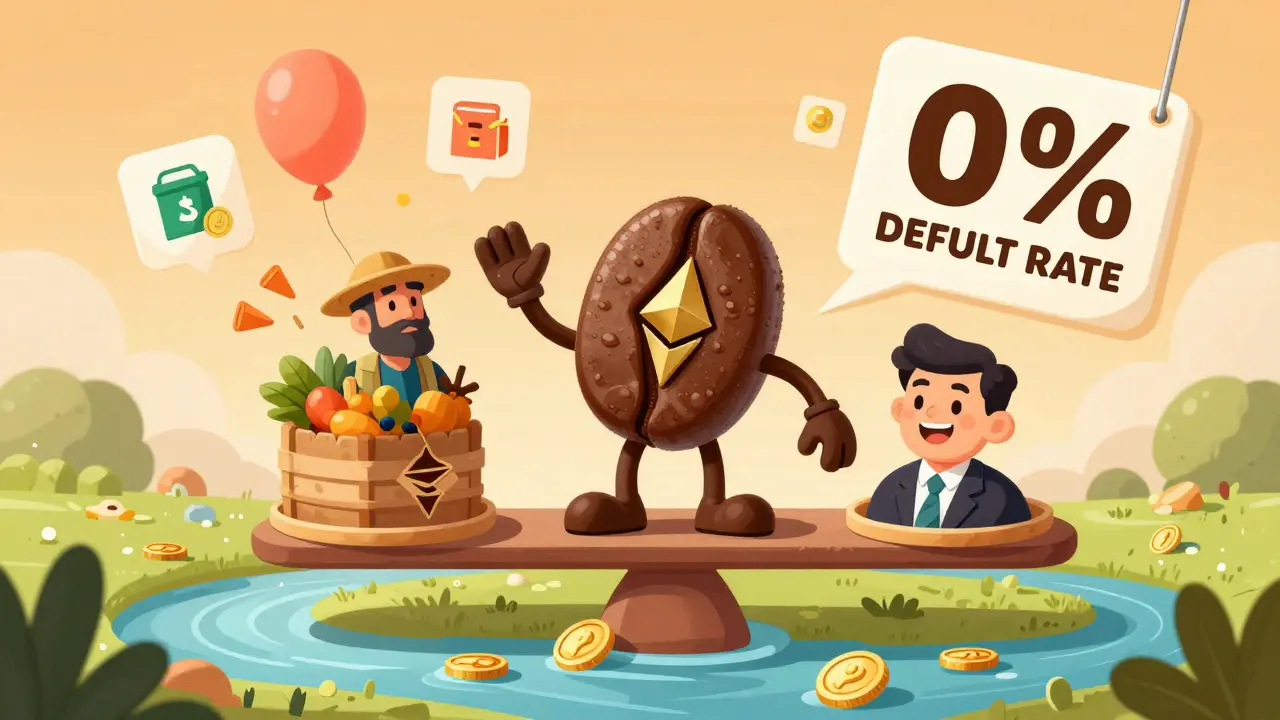
Launched in 2018, EthicHub started as a simple idea: let global crypto investors directly lend money to small-scale farmers. No banks. No middlemen. Just blockchain-backed loans. Today, it’s one of the few crypto projects with a 0% default rate across 30 months of operations. That’s not luck. It’s a system designed differently - and it’s working.
How ETHIX Actually Works
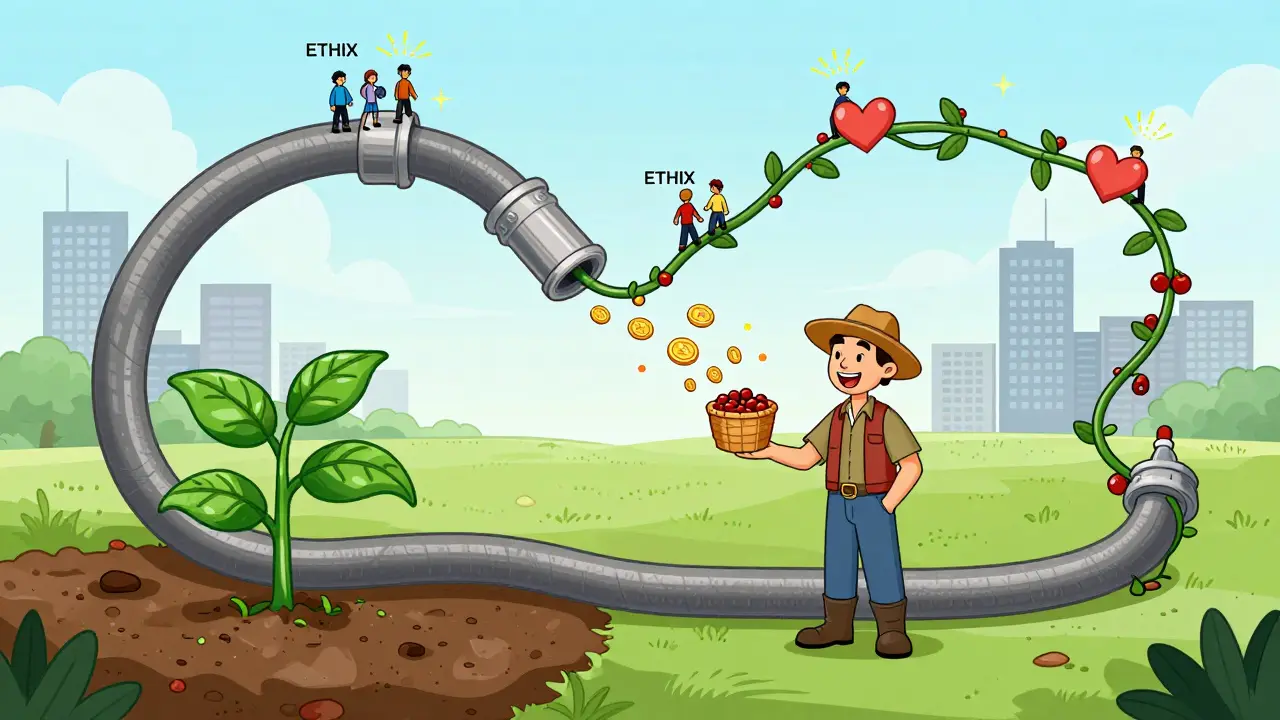
Imagine a coffee farmer in Oaxaca, Mexico. She needs $2,000 to cover planting costs, fertilizer, and shipping her harvest to buyers. Traditional lenders won’t touch her - no credit history, no collateral, no bank account. EthicHub steps in. A crypto investor from Berlin, Tokyo, or Boulder stakes ETHIX tokens to back her loan. The loan is funded. She grows her crop. She sells it. She pays back the loan. And the investor earns up to 9% interest.
Here’s what makes it unique:
- No upfront fees - EthicHub only takes a commission when the loan is fully repaid. If the farmer can’t pay, the platform earns nothing. That’s the opposite of every other lender.
- Human risk checks - Instead of an algorithm scoring her credit, a local EthicHub partner - someone who’s known her family for years - vouches for her. This personal trust system is why defaults are zero.
- Real assets - Your money isn’t just floating in DeFi pools. It’s directly funding crops, harvests, and export logistics.
Since 2018, EthicHub has moved over $3 million to farmers. Half a million of that came directly from crypto investors using ETHIX. And every single loan was paid back.
What Is ETHIX, Really?
ETHIX is the native token of EthicHub. It’s not just a currency - it’s the engine that makes the whole system work. Here’s what it does:
- Staking collateral - To lend money, you must lock up ETHIX tokens. These act as a safety net. If a loan defaults (which has never happened), the staked ETHIX covers the loss.
- Governance rights - Hold ETHIX, and you vote on platform changes. Should we expand to cocoa farms in Ghana? Should we lower interest rates? Token holders decide.
- Revenue sharing - Every time a loan is repaid, a fee is taken. A portion of that fee is distributed to ETHIX stakers. The more you stake, the more you earn.
- Discounted coffee - ETHIX holders can buy premium, ethically grown coffee directly from the farmers they’ve funded - at prices up to 40% below retail.
- Liquidity mining - You can add ETHIX to liquidity pools on decentralized exchanges like Balancer and earn extra yield.
There are exactly 100 million ETHIX tokens in existence - no more, no less. That’s it. No inflation. No surprise dumps. The supply is fixed.
Price and Market Reality (February 2026)
ETHIX isn’t a top-10 coin. It’s not on Coinbase’s main page. It trades around $0.25-$0.26 as of early 2026. That’s down 92% from its all-time high of $1.95. But here’s the thing: price doesn’t tell the whole story.
The market cap is roughly $11 million. It ranks #2730 globally. Trading volume is thin - sometimes under $20,000 in 24 hours. That means low liquidity. Don’t expect to buy $10,000 worth and sell it the next day without moving the price.
But volatility doesn’t mean failure. ETHIX has held steady through market swings. In a week where the broader crypto market dropped 4.4%, ETHIX only fell 3.9%. That’s not a coincidence. It suggests the token’s value is being anchored by real-world utility, not just speculation.
Compare that to most DeFi tokens that crash 80% when Bitcoin dips. ETHIX doesn’t react the same way. Why? Because its value isn’t tied to hype. It’s tied to farmers getting paid.
Who Uses EthicHub?
There are over 2,000 active users - EthicHubbers - who are either lending, staking, or buying coffee. Most are crypto natives who care about impact. They’re not day traders. They’re teachers, engineers, retirees - people who want their money to do more than just grow.
One user from Portland told me: "I started with $500. Now I get coffee delivered to my door every month. My returns are steady. And I know the name of the farmer who grew it." That’s the model.
EthicHub isn’t trying to compete with Binance or Coinbase. It’s building something quieter, slower, and more meaningful: a financial bridge between the global crypto economy and the 1.7 billion unbanked people on Earth.
How to Get Started
If you want to try ETHIX, here’s how:
- Get an Ethereum-compatible wallet (MetaMask, Trust Wallet, or a hardware wallet like Ledger).
- Buy ETH or USDC on a centralized exchange like Coinbase or Kraken.
- Send it to your wallet.
- Use a decentralized exchange like Balancer or Uniswap to swap ETH/USDC for ETHIX.
- Stake your ETHIX on EthicHub’s platform to start lending or earn rewards.
The ETHIX token contract is on Ethereum: 0xfd09911130e6930bf87f2b0554c44f400bd80d3e. You can verify transactions on Etherscan. The platform’s website - ethichub.com - is the only official source for lending, staking, and coffee orders.
The Bigger Picture: Why This Matters
Most crypto projects talk about "decentralizing finance." EthicHub actually does it. It cuts out banks, brokers, and credit bureaus. It replaces them with code, community, and personal accountability.
This isn’t charity. It’s economics. Farmers get fair rates. Investors get real returns. The planet benefits from regenerative farming. And the system only works if everyone wins.
Traditional microfinance often traps borrowers in debt cycles with high interest. EthicHub’s model flips that: the platform profits only when the farmer profits. That alignment - where the lender’s success depends on the borrower’s success - is rare. And it’s powerful.
With climate change and food insecurity rising, projects like EthicHub aren’t niche. They’re necessary. It’s not just about crypto. It’s about rebuilding financial systems that serve people, not just profit.
Risks to Know
ETHIX isn’t risk-free:
- Low liquidity - You might not be able to sell large amounts quickly.
- Price volatility - Even with real utility, crypto prices swing. Don’t invest money you can’t afford to lose.
- Geographic concentration - Most loans are in Mexico. Diversification is limited.
- Regulatory uncertainty - Cross-border crypto lending isn’t clearly regulated anywhere yet.
- Agricultural risk - Droughts, pests, or price crashes could affect repayment - though the 0% default rate so far shows the system is resilient.
But here’s what’s missing: no scams. No rug pulls. No anonymous teams. EthicHub’s code is public. Its partners are named. Its loans are tracked. You can see every transaction on-chain.
| Attribute | Value |
|---|---|
| Token Name | ETHIX |
| Blockchain | Ethereum |
| Total Supply | 100,000,000 |
| Current Price (Feb 2026) | $0.25-$0.26 |
| All-Time High | $1.95 |
| Market Cap | $10.97M |
| Contract Address | 0xfd09911130e6930bf87f2b0554c44f400bd80d3e |
| Default Rate | 0% |
| Loans Funded | $500,000+ USD |
| Annual Return (max) | Up to 9% |
| Primary Use Case | Micro-lending to smallholder farmers |
Frequently Asked Questions
Is ETHIX a good investment?
ETHIX isn’t a speculative asset - it’s a participation token. If you’re looking for quick gains, it’s not for you. But if you want to earn steady returns while supporting ethical agriculture, it’s one of the few crypto projects with proven, real-world results. The 0% default rate and fixed supply make it uniquely stable among DeFi tokens.
Can I really get coffee from farmers I fund?
Yes. EthicHub runs a direct coffee commerce arm. When you stake ETHIX or lend to farmers, you unlock access to buy premium, shade-grown, organic coffee at discounted prices. The beans are shipped directly from the farms - you can even see which farmer grew them.
Is EthicHub regulated?
No - and that’s intentional. EthicHub operates as a decentralized autonomous organization (DAO). It doesn’t have a headquarters, CEO, or legal entity controlling it. Instead, governance is handled by ETHIX holders. This avoids traditional financial regulations but also means there’s no central authority to turn to if something goes wrong.
Why does ETHIX have such a low market cap?
Because it’s not marketed as a trading coin. Most people who hold ETHIX are long-term users - farmers, lenders, coffee buyers - not speculators. The token’s value is tied to utility, not hype. Low trading volume reflects its purpose: it’s meant to be used, not traded.
Can I use ETHIX outside of EthicHub?
You can hold ETHIX in any Ethereum wallet, and trade it on DEXs like Balancer or Uniswap. But outside EthicHub’s ecosystem, it has no other use case. It’s not accepted by merchants, not listed on major exchanges, and not used in other DeFi protocols. Its value is entirely tied to EthicHub’s lending and governance systems.
Final Thoughts
ETHIX doesn’t need to be the next Bitcoin. It doesn’t need to hit $10 or $100. It just needs to keep working - one loan, one harvest, one farmer at a time.
It’s rare to find a crypto project that’s not just talking about change, but building it. EthicHub isn’t trying to disrupt Wall Street. It’s helping a woman in Mexico plant her next crop. And that’s worth more than any price chart.

9 Comments
Gaurav Mathur
This is literally just microfinance with blockchain glitter on it. 0% default rate? Sounds like they're cherry-picking farmers who already have family networks. No regulation? That's not innovation. That's a legal loophole waiting to explode.
Brittany Meadows
I'm not saying this is fake but... who's REALLY behind the "local partners"? 🤔 Are they just contractors for Big Ag? I've seen this before. "Ethical" crypto turns out to be a front for hedge funds buying land under the guise of "helping farmers." 🌱💸 #NotBuyingIt
Jeremy Lim
I read the whole thing... and honestly? I'm just... tired. The coffee thing sounds nice. The 9% return? Meh. I'm not risking my crypto on something that requires me to care about Oaxacan soil. 🤷♂️
John Doyle
This is actually kind of beautiful. Imagine knowing the name of the person who grew your coffee. That’s more than most of us can say about anything we buy. I staked $200 last month. Got my first bag last week. Tasted like hope. ☕❤️
kelvin joseph-kanyin
YESSSSSS!!! This is the crypto we need!!! 🚀🌱 Not another memecoin. Real impact. Real returns. Real farmers. I told my whole Discord group about this. We're all staking now. Let’s make this go mainstream!!! 💪
Elizabeth Choe
Okay but the coffee??? I just ordered a bag of Sumatra beans from a farmer I funded. The flavor profile is insane-dark chocolate, orange zest, and a hint of smoke. I’m not even a coffee snob and I’m obsessed. If you’re even remotely curious, just try it. You’ll be hooked. 🌟
Grace Mugambi
I appreciate the intention. But I wonder if this model scales. What happens when you expand to regions with less stable governance? Or when climate events disrupt harvests? The 0% default rate is impressive-but is it sustainable? Or just a lucky run? I hope it lasts. But I also hope they’re preparing for the storm.
Crystal McCoun
I checked the contract address. Verified the transaction history on Etherscan. Every loan is traceable. Every repayment is recorded. No red flags. No anonymous wallets. And the farmers’ names? They’re listed with photos. This isn’t vaporware. It’s documented. If you’re skeptical like I was, go look. It’s real. 📜
Elijah Young
I’m not a crypto guy. I don’t even know what staking means. But I read this and thought-what if we built systems like this for housing? For healthcare? For clean water? Maybe the real innovation isn’t the token. It’s the idea that profit and purpose don’t have to be enemies.