
You bought that rare digital artwork. You paid the premium for the 'blue chip' status. But here is the uncomfortable truth: if the server hosting the image goes down, your expensive token might just point to a broken link. This isn't a hypothetical scenario; it has happened to thousands of collectors. The core issue isn't the blockchain itself-it's where the actual file lives.
When you mint an NFT, the blockchain only stores a reference (a URI) to the asset, not the asset itself. That reference points to either a Centralized Server or a decentralized network like IPFS. Choosing between these two storage methods determines whether your digital ownership is permanent or fragile. Let's break down why this choice matters more than you think.
The Illusion of Control in Centralized Storage
Most early NFT projects relied on traditional cloud providers like AWS, Google Cloud, or private servers. This approach feels familiar because it’s how the rest of the internet works. You upload a file to a specific URL, and everyone accesses it from there. It’s fast, easy to set up, and usually cheap in the short term.
However, this convenience comes with a massive hidden cost: single points of failure. When you store NFT metadata on a centralized server, you are trusting a single company to keep that data alive forever. If that company goes bankrupt, changes its terms of service, or gets hacked, your asset disappears. We’ve seen this happen with major platforms shutting down services overnight, leaving holders with tokens that point to empty voids.
Consider the risk of censorship. A centralized provider can remove content at any time due to legal pressure, policy changes, or even a simple administrative error. For an NFT collector, this means the 'immutable' nature of the blockchain is undermined by the mutable nature of the storage layer. You own the receipt, but the store burned down.
How IPFS Changes the Game
InterPlanetary File System (IPFS) is a peer-to-peer hypermedia protocol designed to make the web faster, safer, and more open. Instead of storing files on one server, IPFS distributes them across a global network of computers called nodes. When you add a file to IPFS, it gets split into chunks and stored across multiple devices.
The magic happens through content addressing. In traditional web storage, you find a file by its location (like a street address). In IPFS, you find it by its content hash (like a fingerprint). If anyone tries to change even a single pixel in your NFT image, the hash changes, and the file becomes unrecognizable to the network. This guarantees integrity. You know exactly what you’re seeing because the math proves it hasn’t been altered.
This structure eliminates central control. No single entity can take down your NFT unless every node in the network decides to stop hosting it simultaneously-which is practically impossible. For artists and collectors who value true decentralization, IPFS aligns perfectly with the ethos of blockchain technology.
| Feature | Centralized Storage | IPFS (Decentralized) |
|---|---|---|
| Data Integrity | Vulnerable to alteration without notice | Guaranteed via cryptographic hashing |
| Censorship Resistance | Low (provider can delete content) | High (distributed across many nodes) |
| Uptime Reliability | Dependent on single server health | Resilient to individual node failures |
| Cost Structure | Predictable monthly fees | Variable; depends on pinning services |
| Technical Complexity | Low (easy integration) | Medium (requires understanding of CIDs) |
The Pinning Problem: Why IPFS Isn't Perfect
If IPFS is so superior, why doesn’t everyone use it? The answer lies in a concept called pinning. IPFS is designed as a transient network. Nodes download files temporarily to serve requests, but they don’t necessarily keep them forever. If no one 'pins' (permanently stores) your file, it can eventually disappear from the network as nodes prune their storage.
To solve this, most users rely on Pinning Services like third-party platforms that guarantee long-term storage of IPFS data. Companies like Pinata, nft.storage, and Filebase act as dedicated nodes that promise to keep your data available. While this solves the availability issue, it reintroduces a form of centralization. You are now trusting a third-party company to keep your IPFS data pinned. If Pinata shuts down tomorrow, does your data vanish?
This creates a gray area. Technically, your data is on IPFS, but practically, its survival depends on a centralized business model. True decentralization requires self-hosting nodes or using incentive-layer protocols like Filecoin or Arweave, which pay miners to store data permanently. These solutions are more robust but also more complex and often more expensive to implement correctly.
Metadata: The Hidden Vulnerability
Many creators focus on the image but ignore the metadata. Metadata includes the title, description, attributes, and rarity traits of your NFT. This data is often stored separately from the image. If the image is on IPFS but the metadata is on a centralized server, you still have a weak link.
Imagine buying a rare card because it has 'Legendary' status. If the metadata host goes offline, your wallet might show the image but display no stats, or worse, incorrect stats. This breaks the utility and value proposition of the NFT. Best practice dictates that both the media file and the JSON metadata file should be hosted on IPFS (or a similar decentralized system) and referenced by the smart contract.
On-Chain Storage: The Ultimate Solution?
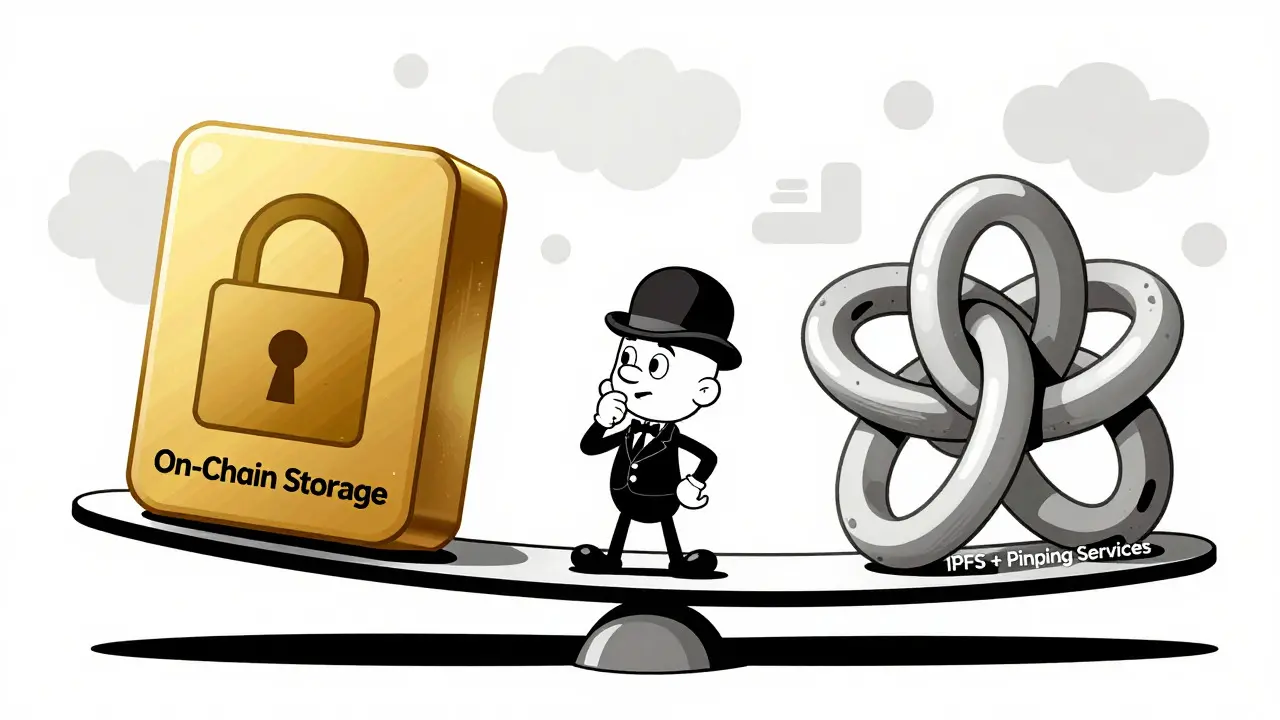
For maximum permanence, some projects opt for on-chain storage, where the entire asset and metadata are written directly onto the blockchain. This is the gold standard for immutability. As long as the blockchain exists, your NFT exists. There are no external servers, no pinning services, and no hashes to lose.
However, this approach is prohibitively expensive for large files. Storing a high-resolution image on Ethereum can cost hundreds or thousands of dollars in gas fees. Therefore, on-chain storage is currently limited to small text-based NFTs or low-resolution images. For most visual art, a hybrid approach-using IPFS for the heavy lifting and perhaps Arweave for guaranteed permanence-is the current industry sweet spot.
Making the Right Choice for Your Project
So, which path should you take? If you are launching a serious, long-term NFT collection, avoid pure centralized storage. The risk of 'link rot' is too high. Start with IPFS. Use a reputable pinning service for ease of setup, but consider diversifying by pinning to multiple providers or integrating with Filecoin/Arweave for redundancy.
For collectors, check the source before you buy. Look at the token URI. Does it point to `ipfs.io` or a generic `aws.amazon.com` link? If it’s the latter, ask yourself if you’re willing to trust a corporation with your investment’s longevity. The market is maturing, and projects that ignore decentralized storage risks will likely suffer from diminished value over time.
What happens if my NFT is stored on a centralized server that goes down?
The blockchain record remains intact, but the link to the actual image or metadata breaks. Your wallet will show a blank space or an error message instead of the artwork. Effectively, you own a receipt for something that no longer exists online, significantly reducing the NFT's value.
Is IPFS truly permanent?
Not automatically. IPFS is a protocol for finding data, not a guarantee of storage. Without active 'pinning' by nodes or services, data can be pruned from the network. To ensure permanence, you must use dedicated pinning services or incentive layers like Filecoin or Arweave.
Why do some NFTs still use centralized storage?
It is cheaper and easier to implement initially. Developers familiar with traditional web development find AWS or Google Cloud interfaces intuitive. However, this convenience often leads to long-term fragility, which is why the industry is shifting toward decentralized alternatives.
Can I move my NFT from centralized storage to IPFS later?
Generally, no. The URI is embedded in the smart contract on the blockchain, which is immutable. Once deployed, you cannot change the storage location unless the contract was specifically coded with an upgradeable proxy pattern, which is rare for standard ERC-721 tokens.
What is the difference between IPFS and Arweave?
IPFS is a protocol for addressing and retrieving data, relying on users to host it. Arweave is a storage platform that uses a one-time payment model to fund permanent storage. With Arweave, you pay once, and the endowment ensures the data is stored forever, whereas IPFS requires ongoing maintenance or pinning commitments.
