
You send Bitcoin to a friend, type in their public address, and hit send. It feels simple, almost like sending an email. But behind that string of letters and numbers lies a complex mathematical fortress. If you’ve ever wondered why your money doesn’t vanish or get stolen by someone who just guesses your address, the answer isn’t luck. It’s cryptography.
The relationship between keys and addresses is the backbone of every blockchain transaction. Misunderstanding this link is how people lose funds. You might think your address is your password, or that your private key is just another name for your wallet. They aren’t. To keep your digital assets safe, you need to understand exactly what each piece does, how they connect, and why one can be shared while the other must stay secret.
The Core Trio: Private Keys, Public Keys, and Addresses
Think of your crypto setup as a three-part system. Each part has a specific job, and they are mathematically locked together. You cannot change one without breaking the others.
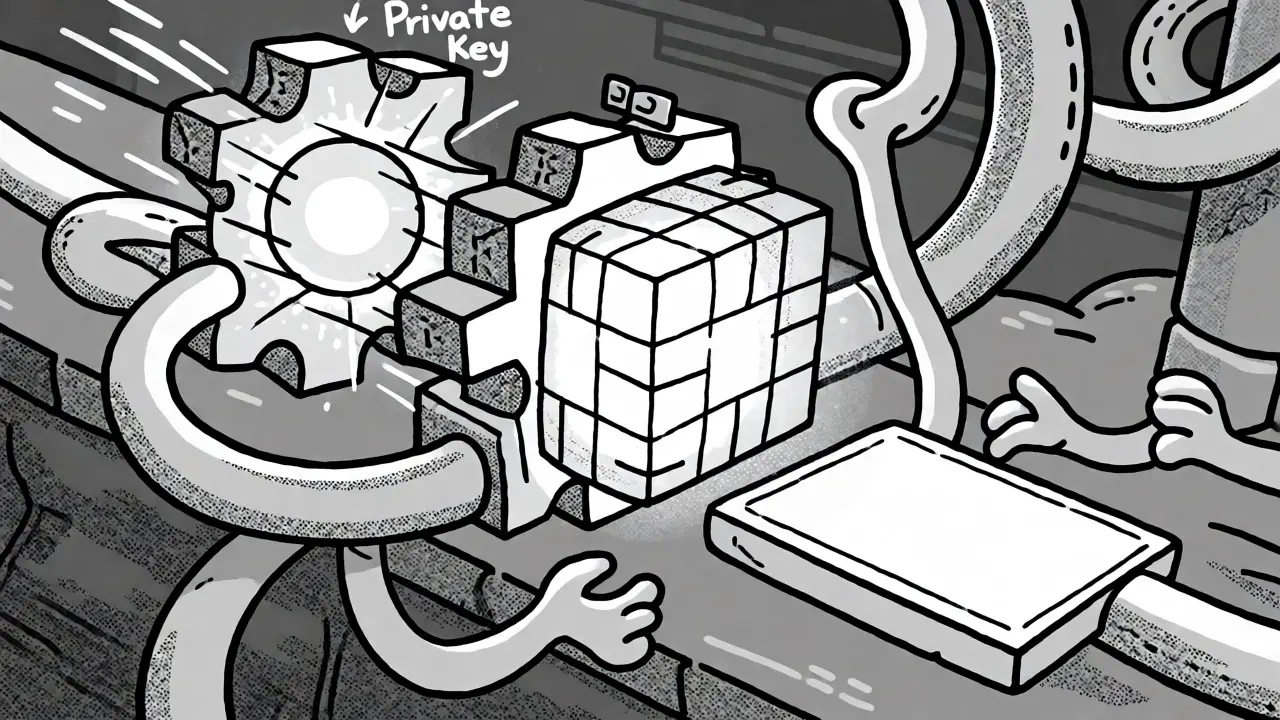
First, there’s the Private Key. This is the most critical piece of data you own. It’s essentially a randomly generated number-so large and random that no supercomputer could guess it by trying every possibility. In Bitcoin, this number is 256 bits long. The probability of two people generating the same private key is astronomically low. Your private key proves ownership. It signs transactions. If someone steals your private key, they own your coins. Period. There is no "undo" button on the blockchain.
Next comes the Public Key. This is derived directly from your private key using a mathematical function called Elliptic Curve Digital Signature Algorithm (ECDSA). Here’s the trick: you can easily calculate the public key from the private key, but you cannot reverse the process. You can’t figure out the private key just by looking at the public key. This one-way street is what keeps the network secure. The public key is used to verify signatures, proving that a transaction was authorized by the owner of the corresponding private key.
Finally, we have the Address. This is what you actually share with the world. It’s a shorter, more user-friendly version of your public key, created by hashing the public key. Why bother? Because raw public keys are long, ugly strings of characters prone to typos. An address is designed to be easy to read and copy-paste. When you send Bitcoin to an address, you’re effectively locking those coins so that only the person with the matching private key can unlock them later.
How the Math Protects Your Money
You might ask, "If everything is public on the blockchain, how is anything secret?" The magic lies in asymmetric encryption. Unlike traditional passwords where you and the server both know the secret, here, the "secret" (private key) never leaves your device. The public side handles verification.
When you spend cryptocurrency, you create a digital signature. This signature is a unique code generated by combining your private key with the transaction details. Anyone on the network can take that signature, look at your public key, and use math to confirm two things: first, that the signature matches the transaction; second, that it was created by the holder of the private key. Crucially, they learn nothing about the private key itself. It’s like showing someone a photo of your fingerprint to prove you touched a glass, without giving them your actual finger.
This process prevents double-spending. If you try to spend the same coin twice, the network checks the signatures. Since the private key can only sign a valid transaction once per unspent output, the second attempt fails. No central bank needs to check this; the math does it automatically across thousands of computers worldwide.
Hierarchical Deterministic Wallets: One Seed to Rule Them All
In the early days of Bitcoin, wallets stored individual private keys. If you had ten addresses, you had ten separate keys to back up. Lose one, lose those coins. Today, we use Hierarchical Deterministic (HD) wallets. This technology changed everything for usability.
An HD wallet generates all your keys and addresses from a single master seed, often represented as a 12- or 24-word mnemonic phrase. This phrase is your ultimate backup. From this seed, the wallet derives a hierarchy of keys. You can generate millions of addresses from one seed, and if you restore your wallet using that seed on a new device, it will find all your past and future balances automatically.
This structure relies on Extended Public Keys (xPub) and Extended Private Keys (xPriv). Your xPub allows anyone to watch your balance and generate new receiving addresses without knowing your private keys. This is useful for merchants who want to generate unique payment addresses for customers without exposing their spending power. However, the xPriv gives full control over the entire tree of keys. Treat your mnemonic phrase with the same caution you’d give a house key.
Security Pitfalls and Best Practices
Most losses in crypto aren’t due to broken cryptography. They happen because humans mishandle keys. Here is where things go wrong:
- Storing seeds online: Taking a photo of your seed phrase and saving it to your phone gallery is risky. Cloud backups sync these images to servers. If your cloud account is hacked, your crypto is gone. Keep seeds offline.
- Reusing addresses: While you can reuse addresses, creating a new one for each transaction improves privacy. It makes it harder for outsiders to link all your transactions to a single identity.
- Ignoring checksums: Most modern addresses include a checksum-a small error-detection code. If you typo an address, the wallet usually rejects it. But not always. Always double-check the first and last few characters before sending.
For serious storage, paper is fragile. Fire, water, and fading ink are real threats. Many experienced users punch their seed phrases into stainless steel plates. These survive house fires and floods, ensuring your access remains intact even if disaster strikes.
Comparing Key Types Across Networks
While Bitcoin popularized this model, other blockchains implement similar relationships with slight variations. Ethereum uses addresses that are slightly different formats (starting with '0x'), and XRP Ledger uses its own encoding. Yet, the core logic remains: Private Key → Public Key → Address.
| Feature | Private Key | Public Key | Address |
|---|---|---|---|
| Visibility | Secret (Never share) | Semi-Public (Used for verification) | Public (Share freely) |
| Primary Function | Sign transactions, prove ownership | Verify signatures | Receive funds, identify destination |
| Derivation | Generated from randomness or seed | Derived from Private Key | Derived from Public Key |
| Risk if Lost | Total loss of funds | Can regenerate from Private Key | Can regenerate from Public Key |
| Risk if Stolen | Thief controls funds | No direct risk (privacy leak possible) | No direct risk (privacy leak possible) |

Why You Can’t Reverse the Process
A common question is whether you can derive a private key from an address. The short answer is no. The path is strictly one-way: Private Key → Public Key → Address. Going backward requires solving the Discrete Logarithm Problem, which is computationally infeasible with current technology. Even quantum computers, which threaten some forms of encryption, would need significant advancements to break standard elliptic curve cryptography efficiently in the near term.
This irreversibility is a feature, not a bug. It allows you to publish your address publicly without fear that strangers can deduce your private key. It enables the open nature of blockchain networks. You don’t need permission to participate; you just need to generate a key pair and start transacting.
Frequently Asked Questions
Is my public address the same as my public key?
No, they are related but distinct. The public key is a longer string used for cryptographic verification. The address is a hashed, shortened version of the public key designed for human readability and error checking. You share the address to receive funds, while the public key is used internally by the network to validate your transaction signatures.
What happens if I lose my private key?
If you lose your private key (and your backup seed phrase), you lose access to your funds forever. There is no customer support team in decentralized blockchains who can reset your password. The coins remain on the blockchain, but no one can move them because no one possesses the key required to sign a transaction.
Can I change my Bitcoin address?
Yes, and you should. HD wallets allow you to generate unlimited new addresses from the same seed. Using a new address for each transaction enhances privacy by making it harder for observers to track your total balance and transaction history. Restoring your wallet with the original seed will recover all these addresses.
Is it safe to store my seed phrase on paper?
Paper is better than digital storage because it is offline, protecting it from hackers. However, paper is vulnerable to physical damage like fire, water, or rot. For high-value holdings, consider metal backup solutions that offer greater durability against environmental hazards.
Do different cryptocurrencies use the same keys?
Not necessarily. While many blockchains use similar elliptic curve algorithms, the derivation paths and address formats differ. A Bitcoin private key is not automatically compatible with Ethereum. Some multi-chain wallets manage multiple sets of keys for different networks, but you generally need to import the correct private key for the specific blockchain you are using.
Troubleshooting Common Issues
If you’re struggling to access your funds, check these common scenarios:
- Wrong Network: Sending ETH to a BTC address format (or vice versa) can result in lost funds if the networks aren't compatible. Always ensure you're selecting the right chain in your wallet.
- Typo in Address: If a transaction is stuck, verify the address character-by-character. Remember, transactions are irreversible.
- Software Glitch: If your wallet app crashes, try restoring your seed phrase in a different, reputable wallet software. This isolates whether the issue is the app or the keys themselves.
Understanding the distinction between keys and addresses transforms crypto from a black box into a manageable tool. Keep your private keys secret, your addresses public, and your backups durable. That’s the formula for staying in control of your digital wealth.
