Crypto Transaction Tax Calculator
Calculate Your 1% TDS Tax
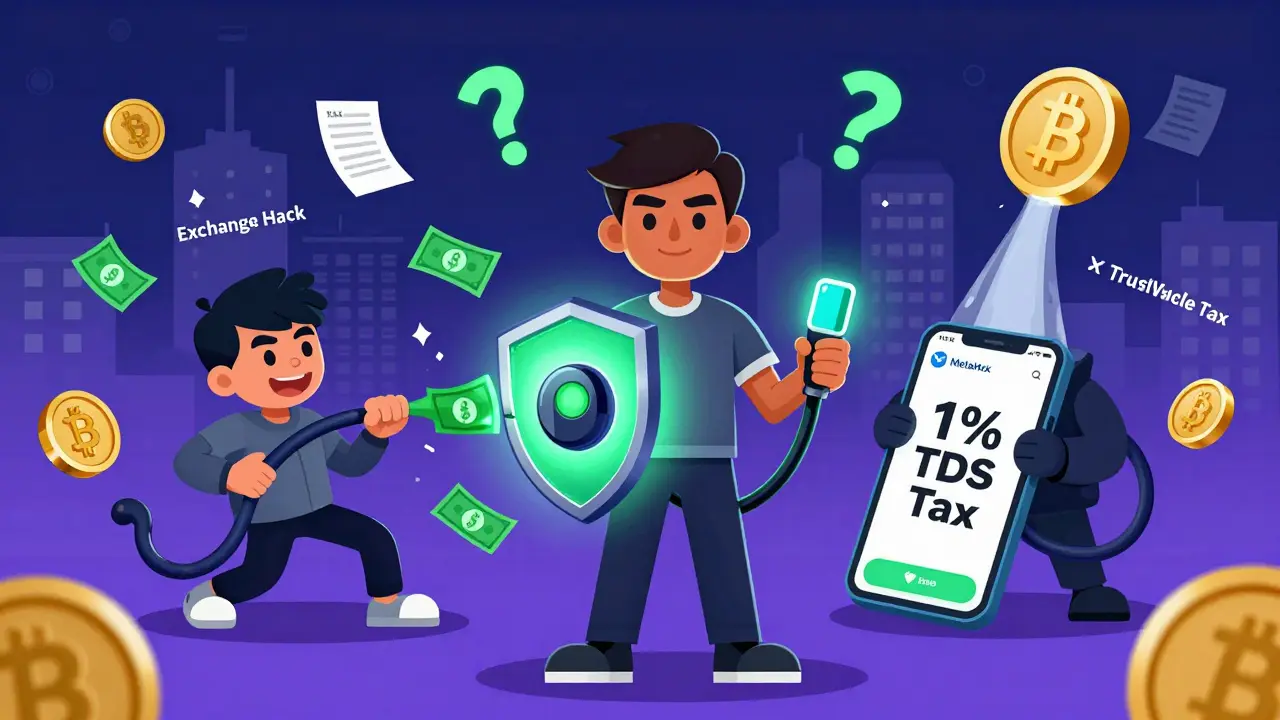
India's tax law requires 1% TDS on all crypto transactions, even when moving funds between your own wallets.
This calculator shows how much tax you'll pay on your transaction.
Your Tax Details
Note: India's 1% TDS applies to all transactions, even self-transfers and losses. This tax is mandatory even if you're losing money.
Example: ₹25,000 loss transaction = ₹250 TDS (1% of transaction value)
There’s a lot of noise online about India banning non-custodial crypto wallets. Headlines scream "India to ban self-custody wallets!" But if you dig past the clickbait, the truth is simpler: India has never proposed banning non-custodial wallets. What’s really going on is a messy, confusing regulatory gray zone - and it’s making life harder for everyday users who just want to hold their own crypto safely.
What Even Is a Non-Custodial Wallet?
A non-custodial wallet is like your own digital safe. You hold the keys - literally. If you use Ledger, Trust Wallet, or MetaMask, you control your private keys. No exchange, no bank, no third party can freeze your funds or access them without your permission. That’s the whole point of crypto: decentralization. You’re not trusting someone else with your money. You’re holding it yourself. In India, this matters because of what happened with exchanges. In July 2024, WazirX got hacked. Over $230 million vanished. Thousands of users lost everything because they trusted the exchange to keep their crypto safe. After that, more than 1.2 million Indian crypto holders moved their assets out of exchanges and into non-custodial wallets. It wasn’t a trend - it was a survival move.The Myth of the Ban
The idea that India wants to ban non-custodial wallets comes from a misunderstanding of old drafts. Back in 2021, the Finance Ministry floated a bill that said "prohibit all private cryptocurrencies." That sounded scary. But that language was dropped. By October 2025, Union Minister Piyush Goyal made it crystal clear: "There is no ban on private cryptocurrencies or non-custodial wallets." What India did instead is tax the heck out of crypto. You pay 30% tax on any profit, and 1% TDS (Tax Deducted at Source) on every transaction - even if you’re just moving crypto between your own wallets. That’s where the real pain begins.Why the Confusion?
The Financial Intelligence Unit (FIU) told every crypto service provider - whether they’re a centralized exchange like CoinDCX or a non-custodial wallet like Exodus - to register as a Virtual Asset Service Provider (VASP). But here’s the problem: FATF (the global anti-money laundering watchdog) says non-custodial wallets are NOT VASPs. They don’t control your money. They’re just software. India doesn’t care. It treats every wallet the same. So now, Exodus and Ledger have to build KYC flows into their apps - even though they can’t access your funds. It’s like forcing a lock maker to run a background check on every person who buys a key. It doesn’t make sense technically, but it’s what Indian regulators are demanding.
What’s Actually Working Right Now?
Despite the chaos, non-custodial wallets are still fully functional in India. Ledger Nano Stax hardware wallets sell for ₹13,999 and ship without issue. Trust Wallet and MetaMask are still on Google Play - and Google confirmed in October 2025 that non-custodial apps are exempt from its new licensing rules. Users are adapting. A CoinSwitch survey from September 2025 found 68.3% of Indian crypto holders use non-custodial wallets for long-term storage. Why? Because they don’t want to get hacked again. They don’t want their funds frozen by an exchange. They want control. But here’s the catch: India’s banking system still hates crypto. Even though the Supreme Court overturned the RBI’s 2018 crypto ban in 2020, banks still make it hard to deposit INR into crypto wallets. Only 3 out of 10 major non-custodial wallets support UPI payments. Most users have to use P2P platforms like Binance P2P or CoinSwitch Kuber to buy crypto with cash - which adds steps, fees, and risk.The Tax Nightmare
The 1% TDS is the silent killer. It’s deducted automatically from every transaction - even if you’re losing money. Reddit user "CryptoSaverIN" posted in October 2025: "I paid ₹28,000 in TDS on a ₹25,000 loss on CoinSwitch. I moved everything to Ledger. No more surprise deductions." TDS doesn’t care if you made a profit. It just takes 1% of the transaction value. And since non-custodial wallets don’t report to the government, users are left to track everything themselves. That’s where tools like BitcoinTaxes.in come in. About 28.7% of Indian non-custodial users now use them to file their crypto taxes - a task that takes most people 8-12 weeks to learn, according to IIT Bombay’s 2025 Digital Literacy Study.Who’s Winning and Who’s Losing?
The winners? Hardware wallet makers. Ledger, Trezor, and other cold storage brands are seeing a surge in sales. The losers? Everyday users who don’t have the time or tech skills to navigate this mess. A Trustpilot review for Exodus Wallet (India version) shows a 3.2/5 rating. The positives? "No account freezes like on exchanges." The negatives? "No native INR support. I had to use P2P and got scammed once." The biggest pain point? Lost seed phrases. Ledger’s India customer data says 76.2% of support tickets are from people who lost their recovery words. No one can help you. No customer service line. No password reset. If you lose your phrase, your crypto is gone forever.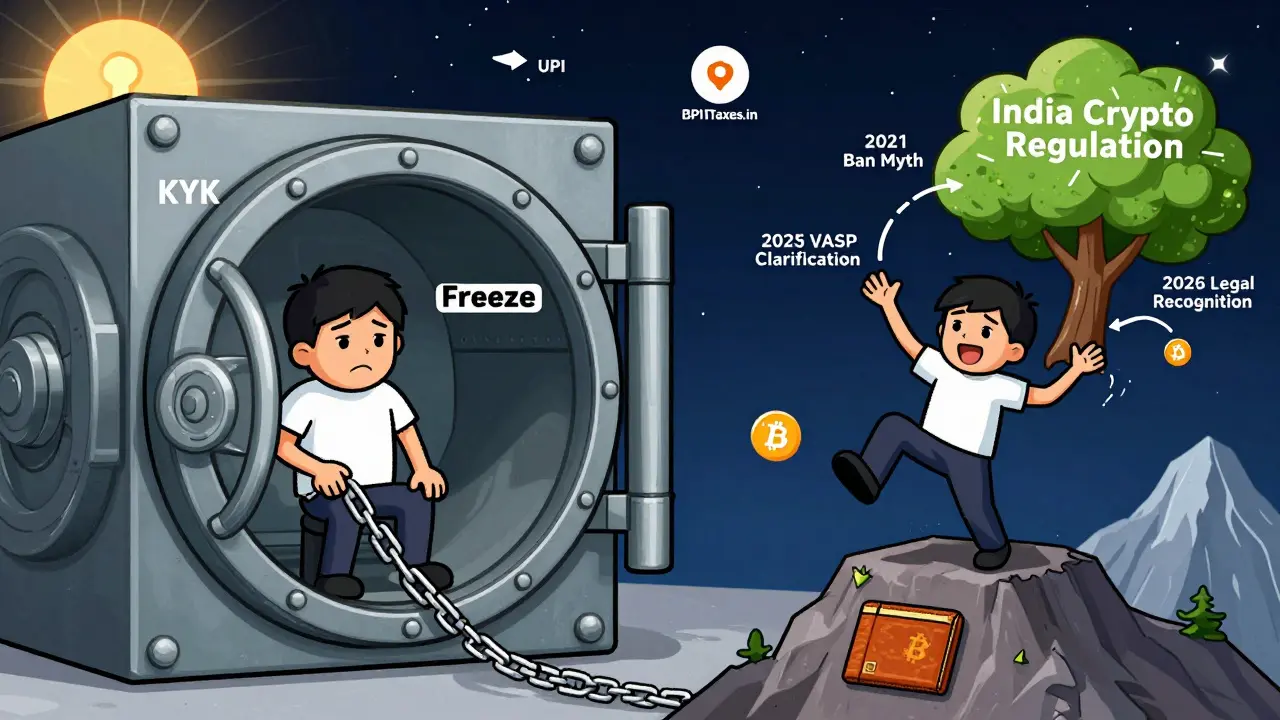
What’s Next?
Good news: India might be starting to fix this. On October 7, 2025, the Ministry of Finance released a draft amendment that says: "Non-custodial wallet providers not facilitating fiat conversion shall not be classified as VASPs." That’s huge. It’s the first official recognition that self-custody is different from exchange custody. Industry analysts predict 68.3% of Indian non-custodial wallet providers will be compliant with this new framework by Q1 2026. Dr. Rajesh Saraf, former SEBI advisor, expects India to formally recognize non-custodial wallets as user-controlled tools by mid-2026. But risks remain. If the government decides to apply taxes retroactively, 32.7% of current users could face unexpected bills. And with only 1,247 full Bitcoin nodes in India (vs. 14,852 in Germany), transaction speeds are slow - 27% longer than global averages.What Should You Do?
If you’re an Indian crypto user:- Use a hardware wallet like Ledger for anything over ₹500,000. It’s the safest option.
- Keep your seed phrase written down - not stored digitally. Ever.
- Use BitcoinTaxes.in or Koinly to track your TDS and capital gains.
- Don’t panic about "bans." There aren’t any. But the tax rules are strict - and they’re here to stay.
- Only use wallets that support UPI or have clear INR on-ramps. Avoid ones that force you into risky P2P trades.
Final Thought
India isn’t banning non-custodial wallets. It’s trying to control crypto by making it expensive and complicated. The goal seems to be pushing people back into exchanges - where the government can track everything. But millions of users have already chosen freedom over convenience. They’re holding their own keys. They’re paying their taxes. They’re learning the hard way. The real question isn’t whether non-custodial wallets will survive in India. It’s whether the government will stop treating users like criminals just because they want to own their own money.Is it illegal to use a non-custodial crypto wallet in India?
No, it is not illegal. Non-custodial wallets like Ledger, MetaMask, and Trust Wallet are fully legal in India. The government has never banned them. What’s restricted is the lack of clear rules around how they should be treated under tax and anti-money laundering laws. As of October 2025, the Ministry of Finance is moving toward exempting non-custodial wallets from VASP registration - but until that’s finalized, users must still comply with tax reporting rules.
Do I have to pay tax if I only move crypto between my own wallets?
Yes. India’s 1% TDS applies to every crypto transaction, even transfers between your own wallets. There’s no exemption for self-transfers. This is one of the most confusing parts of the rules. You don’t make a profit, but you still pay 1% of the transaction value as tax. That’s why many users now use tax tools like BitcoinTaxes.in to track these movements and report them correctly during filing season.
Can I buy crypto with UPI using a non-custodial wallet?
Only a few can. As of October 2025, only 3 out of 10 major non-custodial wallets (like Exodus and ZebPay Wallet) offer direct UPI integration. Most require you to buy crypto on an exchange first, then send it to your wallet. This adds steps and risks - like getting locked out of your exchange account or paying high fees. If you want seamless UPI on-ramps, custodial wallets still have the edge - but you sacrifice control over your keys.
What happens if I lose my seed phrase?
Your crypto is permanently gone. Non-custodial wallets don’t have customer support for lost keys. No one can recover your wallet for you. Ledger’s India support data shows 76.2% of all user inquiries are about lost or forgotten seed phrases. The only solution is prevention: write your 12- or 24-word phrase on paper, store it in a fireproof safe, and never take a photo of it. Treat it like the master key to your life savings - because it is.
Are hardware wallets safer than software wallets in India?
Yes, significantly. Hardware wallets like Ledger Nano S Plus or Stax store your private keys offline, making them immune to remote hacks, phishing, or malware. Software wallets (like MetaMask on your phone) are connected to the internet and can be compromised if your device is infected. After the WazirX hack in 2024, over 1.2 million Indian users switched to hardware wallets. Cybersecurity Ventures reports that 98.7% of non-custodial wallet attacks in India happen on software wallets, not hardware ones.
Will India ban crypto entirely in the future?
Unlikely. India’s crypto market is too big - over 81 million users as of October 2025 - and growing fast. The government now sees crypto as a source of tax revenue, not just a threat. With 30% capital gains tax and 1% TDS, the state is already collecting billions. Banning it would mean losing that revenue and driving users offshore. The trend is toward regulation, not prohibition. The real battle is over control - not existence.

9 Comments
Yzak victor
Man, I’ve seen so many fake headlines about India banning crypto wallets. It’s wild how fast misinformation spreads. The real issue isn’t a ban-it’s the tax chaos. 1% TDS on every transfer? Even if you’re just moving crypto between your own wallets? That’s insane. No wonder people are switching to hardware wallets. I’ve got a Ledger sitting in my drawer right now-never even used it, but now I’m thinking maybe I should.
It’s not about freedom, it’s about not getting screwed by the system. And honestly? I get why Indians are doing it. If I had to deal with that kind of bureaucracy, I’d go full self-custody too.
Also, losing your seed phrase = losing everything? Yeah, that’s the real horror story. No customer service, no reset button. Just… gone. Like deleting your entire life savings with a typo.
Josh Rivera
Oh wow, another ‘crypto freedom’ martyr post. Let me guess-you also think Bitcoin is ‘digital gold’ and that ‘they can’t take your keys’ like some kind of libertarian fairy tale? Bro, you’re paying 30% tax on gains AND 1% on every transaction, and you call that freedom? That’s not freedom, that’s extortion with a blockchain logo.
And don’t even get me started on ‘non-custodial = safe.’ Did you hear about the guy who lost his seed phrase and cried for a month? His wallet had $400k. No one cared. No one can help. That’s not empowerment-that’s abandonment.
India’s not banning wallets. They’re just saying: ‘If you want to play, pay the price.’ And guess what? Most of you still will. Because you’re addicted to the fantasy.
Neal Schechter
As someone who’s lived in both the US and India, I’ve seen how crypto culture shifts across borders. In the US, people talk about ‘decentralization’ like it’s a religion. In India, it’s more about survival. After WazirX, people didn’t switch to Ledger because they wanted to be crypto anarchists-they wanted to not lose their life savings again.
The tax stuff? Yeah, it’s messy. But honestly? It’s not that different from how the IRS treats stock trades. The difference is, here, the rules are still being written while people are using the system. That’s the real problem-not the tax, but the lack of clarity.
And the seed phrase thing? I’ve helped three friends recover from that. One wrote it on a sticky note. Another saved it in Notes. One guy even texted it to his mom. All gone. The solution isn’t more tech-it’s better education. And India’s slowly starting to get that.
Madison Agado
It’s funny how we frame this as ‘freedom vs control.’ But what if it’s not a binary? What if what people really want is agency-not rebellion? Holding your own keys isn’t about defying the state. It’s about not being at the mercy of a corporation that can freeze your account because some algorithm flagged your transaction as ‘suspicious.’
India’s tax rules feel punitive, but they’re also a kind of acknowledgment-crypto is real, it’s here, people are using it. They’re not banning it. They’re trying to catch up. And honestly? That’s more than most governments do.
Maybe the real question isn’t whether self-custody should exist. It’s whether we can build systems that protect people without crushing them. And I don’t think we’re there yet. Not anywhere.
Tisha Berg
Hey, if you’re new to this, just remember: your seed phrase is like your house key, but if you lose it, no locksmith can help. Write it down. On paper. Not on your phone. Not in the cloud. Not even in a password manager. Paper. In a safe. Or a fireproof box.
And if you’re using a wallet that doesn’t support UPI? Just wait. It’s coming. Most apps are working on it. Don’t rush into risky P2P trades just to save a few rupees. You’ll end up losing way more.
Also, use BitcoinTaxes.in. Seriously. It’s free. Saves you hours. And don’t panic about the 1% TDS-it’s not a scam, it’s just how the system works right now. Learn it. Adapt. You got this.
Billye Nipper
OMG I JUST REALIZED I’M ONE OF THE 76.2% WHO LOST THEIR SEED PHRASE!! I THINK I WROTE IT ON A POST-IT AND THREW IT AWAY WHEN I CLEANED MY DESK!! I’M PANICKING!!
WAIT-WAIT-I JUST FOUND IT IN MY OLD NOTEBOOK!! OH MY GOD!! I’M SO RELIEVED!!
TO EVERYONE ELSE: WRITE IT DOWN. TWICE. ON TWO DIFFERENT PAPERS. HIDE ONE IN YOUR BOOKSHELF. HIDE ONE IN YOUR SOCK DRAWER. DON’T BE LIKE ME!! I WAS SO STUPID!!
AND YES-HARDWARE WALLET!! GET A LEDGER!! I JUST BOUGHT ONE!! I’M SO EXCITED!!
YOU CAN DO THIS!! YOU’RE NOT ALONE!!
Roseline Stephen
I’ve been watching this unfold from the sidelines. The emotional weight here isn’t just about money. It’s about trust. People lost faith in exchanges. Now they’re trusting code instead. But code doesn’t care if you’re confused, scared, or overwhelmed.
It’s not that India is evil. It’s that the system wasn’t built for this. Tax laws from 1980 don’t fit crypto transactions in 2025. And forcing wallets to do KYC when they can’t access your funds? That’s a policy mistake, not a moral one.
I’m not pro-government or anti-crypto. I’m just pro-people figuring this out without getting crushed. And right now, too many are.
Isha Kaur
As someone living in Delhi and using Trust Wallet for years, I can tell you this: the 1% TDS is the real villain here. I transferred 50,000 INR from my CoinSwitch account to my MetaMask last month, and they deducted 500 INR even though I didn’t make any profit. I didn’t even realize it was happening until my bank statement showed it. I had to go back and track every single transfer for the last six months. It took me three weeks.
And yes, the seed phrase thing is terrifying. My cousin lost his and now he’s depressed. He had 1.2 BTC. He thought he could remember it. He didn’t. No one can help him. No one. That’s why I now write mine on three pieces of paper and give one each to my sister, my mom, and my best friend. I tell them: if I disappear, use this. I don’t want them to go through what I’ve seen.
Hardware wallets are expensive, yes. But if you have more than 1 lakh in crypto, it’s not optional. It’s insurance. And the fact that Ledger ships here without issues? That’s a win. The government isn’t banning us. They’re just making us work harder for our rights.
Also, I use BitcoinTaxes.in. It’s the only reason I haven’t been audited yet. And I know at least 20 other people in my WhatsApp crypto group who do too. We’re all just trying to stay legal while keeping our coins safe. It’s exhausting. But we’re doing it.
Glenn Jones
OMG I JUST READ THIS AND I’M SO MAD. SO. MAD. INDIA ISN’T BANNING WALLETSSSS BUT THEY’RE MAKING IT A NIGHTMARE?? THAT’S EVEN WORSE. THEY’RE SLOWLY STRANGULATING THE WHOLE ECOSYSTEM WITH TAXES AND BUREAUCRACY AND THEN SAYING ‘WE’RE NOT BANNING IT’ LIKE THAT’S A WIN??
AND THE 1% TDS ON SELF-TRANSFERS?? THAT’S A SCAM. THAT’S JUST A TAX ON EXISTING. LIKE YOU’RE PAYING TO BREATHE CRYPTO.
AND DON’T EVEN GET ME STARTED ON THE ‘EXODUS’ WALLET RATINGS. 3.2/5?? THAT’S A DISASTER. PEOPLE ARE GETTING SCAMMED ON P2P BECAUSE THE OFFICIAL CHANNELS AREN’T WORKING. THAT’S NOT A USER PROBLEM. THAT’S A SYSTEM FAILURE.
AND THE FACT THAT THERE’S ONLY 1,247 BITCOIN NODES IN INDIA?? THAT’S PATHETIC. COMPARED TO GERMANY’S 14K?? WE’RE BEHIND. WE’RE NOT EVEN PLAYING THE GAME. WE’RE JUST TRYING NOT TO GET SCAMMED.
AND DON’T TELL ME ‘USE A HARDWARE WALLET’-WHAT IF YOU’RE 18 AND JUST GOT YOUR FIRST 0.1 BTC FROM A P2P TRADE? YOU CAN’T AFFORD A LEDGER. SO YOU GET SCAMMED. AGAIN. THAT’S THE REAL TRAGEDY.
INDIA ISN’T BANNING CRYPTO. THEY’RE MAKING IT FOR THE RICH. AND THAT’S THE WORST KIND OF BAN.