
Imagine hiring a brilliant remote developer who undercuts every other bid by 30%, passes a technical test with flying colors, and agrees to start immediately without a signed contract. It sounds like a dream for any startup founder, but it's actually a common entry point for a state-sponsored operation. North Korean IT workers is a sophisticated network of overseas professionals deployed by the Democratic People's Republic of Korea (DPRK) to generate foreign currency through fraudulent employment. These operatives aren't just freelancers; they are agents of a regime using crypto laundering schemes to bypass UN sanctions and fund weapons of mass destruction (WMD).
The Mechanics of the Infiltration
The process starts with a carefully crafted lie. Operatives don't just apply for jobs; they build entire digital personas. They use Virtual Private Networks (VPNs) to hide their location and forged identity documents to pass basic background checks. To beat the modern video interview, they've started using AI-powered deepfake software to mimic the face and voice of a person living in a Western country.
Once they get their foot in the door, they usually target roles in software development or cybersecurity. They are often deployed via facilitators like the Chinyong Information Technology Cooperation Company, which was sanctioned by the U.S. Treasury in July 2025. By offering to work for significantly lower rates-often 20-30% below the market average-they make themselves an irresistible choice for companies looking to cut costs.
How the Money is Laundered
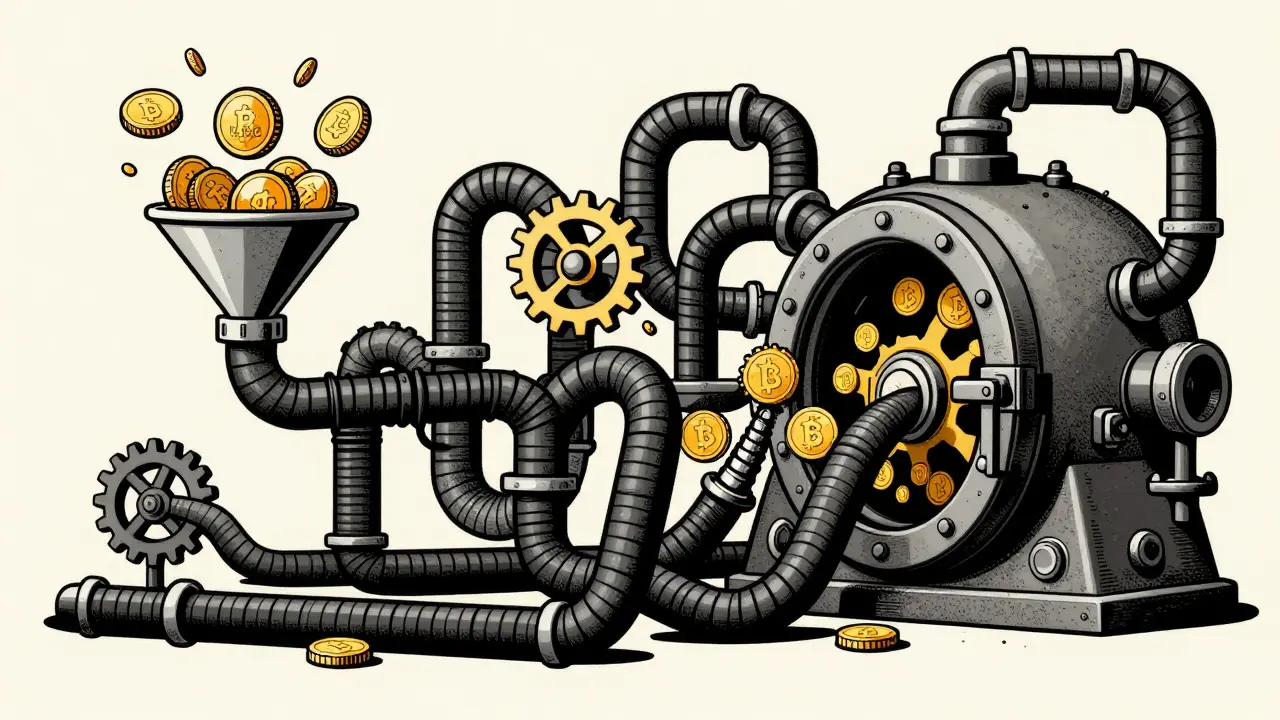
The real magic, or rather the crime, happens during payroll. These workers almost always insist on being paid in Stablecoins is cryptocurrencies pegged to a stable asset like the US Dollar to avoid volatility. Specifically, they request USDC or USDT (Tether). Why? Because these coins are incredibly easy to move and highly compatible with over-the-counter (OTC) traders who can swap digital assets for hard cash (fiat currency).
On-chain data shows a predictable pattern: regular payments of around $5,000 hitting wallets on a monthly basis. But the money doesn't stay in one place. It moves through a fragmented web of wallets, bouncing between dozens of addresses to break the trail. Eventually, these funds are consolidated and sent to senior operatives, such as the sanctioned individuals Kim Sang Man and Sim Hyon Sop.
| Feature | IT Worker Scheme | Ransomware/Heists |
|---|---|---|
| Revenue Model | Steady, monthly salaries | Large, one-time thefts |
| Risk Profile | Lower detection risk | High visibility/Immediate alarm |
| Primary Goal | Long-term currency generation | Rapid accumulation of funds |
| Payment Method | Stablecoins (USDC/USDT) | Mixed crypto (ETH, BTC, etc.) |
The Role of Global Infrastructure
This isn't just a North Korean problem; it's a global logistics operation. To hide the money trail, the regime relies heavily on infrastructure in Russia and the UAE. They use fake documentation and IP addresses from these regions to make the transactions look like legitimate business dealings. In some cases, they use fictitious accounts on mainstream exchanges or rely on specialized money launderers, like the facilitator known as "Lu," who was sanctioned by the U.S. in late 2024.
The scale is staggering. Between January and September 2025, these operations generated at least $1.65 billion. While they make a steady living from salaries, they also use their insider access to pull off massive hits. For instance, a single $1.4 billion heist from the Bybit exchange occurred in February 2025, proving that these "employees" are often Trojan horses for larger cyber-attacks.
Real-World Impact on Businesses
For a company, the damage goes beyond the lost salary. One tech startup reported losing $280,000 over six months to a worker who used AI deepfakes during video calls. The pattern is usually the same: the worker performs well for 3 to 6 months to build trust, and then they either steal sensitive company data, plant a backdoor for future hacks, or disappear entirely after a large payment.
According to the Canadian Anti-Fraud Centre, the average loss per incident is about $47,000. In nearly 80% of these cases, the payment was made via cryptocurrency, making the funds almost impossible to recover once they hit the blockchain.

How to Spot and Stop Fraudulent Hires
If you're hiring remotely, you need a protocol that goes beyond a simple Zoom call. Standard background checks aren't enough when 92% of these fraudulent applications use forged credentials. You have to be more aggressive with verification.
First, stop paying remote contractors in cryptocurrency. This is the biggest red flag. If a candidate insists on USDC or USDT and refuses traditional bank transfers, be extremely cautious. Second, use "multi-modal" verification. This means conducting a video interview while simultaneously communicating via a different platform. Operatives often struggle to maintain a consistent AI deepfake response across two different streams of communication.
- Verify degrees directly with the issuing university, not via a provided PDF.
- Check for inconsistencies in their professional history-look for gaps that don't make sense.
- Be wary of candidates who bid 20-30% lower than everyone else.
- Demand a signed, legally binding contract before any work begins.
The Future of the Fight
Governments are catching up. The U.S. Treasury's FinCEN is developing a prototype system for 2026 that can identify DPRK-linked wallet clusters with 89% accuracy. When you combine this with improved AI detection tools that can spot deepfakes in real-time, the "easy money" era for these operatives is closing.
However, the regime is adaptable. As blockchain analytics get better, they will likely move toward more obscure privacy coins or more complex layering techniques. The fight is now a race between the AI used to deceive and the AI used to detect. For businesses, the best defense remains a simple rule: if a deal seems too good to be true-especially when it involves crypto payments-it probably is.
Why do North Korean workers prefer stablecoins like USDT?
Stablecoins provide a consistent value pegged to the US Dollar, avoiding the volatility of Bitcoin or Ethereum. This makes it easier for the regime to budget and for OTC traders to convert the assets into fiat currency without losing value during the transaction process.
Can I really be fooled by an AI deepfake in a video interview?
Yes. Modern AI software can map a face and voice in real-time, making the person on your screen look and sound like someone else. To catch this, ask the person to turn their head sideways or wave their hand in front of their face; these movements often cause the AI mask to "glitch" or slip.
What are the biggest red flags when hiring remote IT talent?
The most significant warnings include: a request for payment in cryptocurrency, bidding significantly below market rates, using a VPN that doesn't match their claimed location, and inconsistent professional or educational histories that cannot be verified with the source institution.
What happens to the money stolen through these schemes?
The funds are typically laundered through a series of fragmented wallets and then converted to fiat currency. These millions of dollars are then funneled into the DPRK's state programs, specifically for the development of ballistic missiles and weapons of mass destruction.
How can companies recover funds paid to fraudulent workers?
Recovering cryptocurrency is extremely difficult because transactions are irreversible. Your best bet is to report the incident to the FBI (IC3) or the RCMP and provide the specific wallet addresses used. While the money is hard to get back, this helps law enforcement map the laundering network.

6 Comments
Lex Harley
Wild how they use deepfakes for the on-boarding process... total madness.
Actually’ve seen some weird stuff with L2 solutions and mixing services lately, but this level of state-sponsored opsec is next level. Poor startups just think they're getting a deal on a senior dev when they're basically funding a missile program. Just crazy how the infra for stablecoins makes it so seamless for them to move the loot without the slippage of BTC.
Bevon Findley
Quite an amateur mistake to fall for this. :)
Arti Jain
Typical Western incompetence. My country's tech sector operates with actual honor and transparency, unlike these naive firms.
VIVEK SINGH
Oh, wonderful. Let's all pretend that only one regime uses "remote consultants" to siphon funds. The irony of talking about "security" while paying someone in USDT is just chef's kiss. Truly a masterclass in corporate delusion.
Lloyd I
I think we can all learn from this and build better verification standards together! It's a tough lesson, but if we share our checklists for vetting remote talent, we can protect the whole community. Let's turn this into a positive move toward safer hiring practices for everyone involved. We've got this!
Harvey Alford
I bet the founders of those startups are losing sleep over this. I can practically feel their panic through the screen.