
Imagine you’re deep in the Ethereum ecosystem, hunting for a specific ERC20 token that’s barely moving on the big exchanges. You need liquidity, speed, and low fees, but the giants like Binance or Coinbase feel too broad, too cluttered. Enter Resfinex, a niche centralized exchange that has been quietly operating since 2019 with a singular focus: making Ethereum-based tokens tradeable at scale.
If you’ve heard whispers about Resfinex and are wondering if it’s a hidden gem or just another ghost town in the crypto graveyard, you’re in the right place. We dug into the data, checked the volumes, and looked at the regulatory footprint to give you a straight answer. Spoiler alert: It’s not for everyone, but for a specific type of trader, it might actually be useful.
What Exactly Is Resfinex?
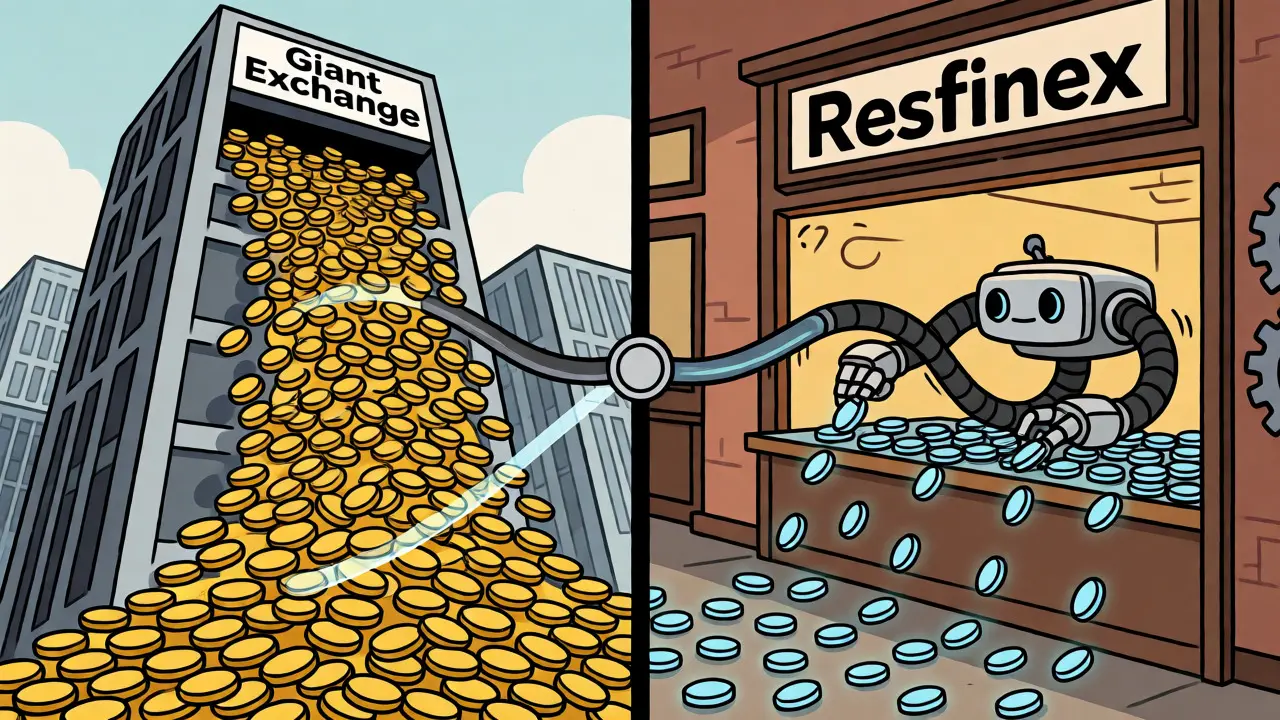
Resfinex is a centralized digital asset exchange founded in 2019, headquartered in the British Virgin Islands, that specializes exclusively in trading ERC20 tokens within the Ethereum network. Unlike generalist exchanges that try to support Bitcoin, Solana, Cardano, and every new altcoin under the sun, Resfinex carved out a specific lane. They wanted to be the go-to hub for traders who live and die by the Ethereum blockchain.
The platform operates with a remote-first culture, relying on a small, agile team rather than a massive corporate bureaucracy. This structure suggests flexibility, but it also raises questions about long-term stability and resource depth. The core value proposition here is specialization. By focusing only on ERC20s, they aim to provide deeper liquidity pools for these specific assets compared to broader platforms where your favorite mid-cap token might have thin order books.
Trading Volumes and Liquidity Reality Check
Let’s talk numbers, because in crypto, volume equals life. According to recent data from their official website as of late 2026, Resfinex reports a daily trading volume of approximately $109.7 million. That sounds impressive, doesn’t it? But context matters.
Compare this to industry leaders like Binance, which routinely handles billions in daily volume. While $100 million isn’t nothing, it places Resfinex firmly in the "mid-tier" or "niche" category. For most retail traders looking for Bitcoin or Ethereum pairs, this volume is sufficient. However, if you are trying to move millions of dollars in a single obscure ERC20 token, you might still face slippage issues.
- Daily Volume: ~$109.7 Million
- Weekly Volume: ~$390.2 Million
- Monthly Volume: ~$470.0 Million
The weekly and monthly figures show consistent activity, suggesting that while the user base isn’t massive, it is active. Traders aren’t just signing up and leaving; they are executing trades. This consistency is a good sign for anyone worried about the exchange becoming illiquid overnight.
Fees, API Access, and Technical Features
One area where Resfinex seems to compete aggressively is on fees. They utilize a dynamic pricing model, meaning the more you trade, the lower your fees drop. This is standard practice now, but their implementation aims to attract high-frequency traders and bots.
Speaking of bots, Resfinex offers robust API capabilities. They provide WebSocket feeds for real-time market data, which is critical for algorithmic traders who need millisecond-level accuracy. If you’re building a trading bot in Python or JavaScript, having access to reliable APIs without hitting rate limits quickly is a major plus. Many smaller exchanges struggle here, throttling users or providing buggy documentation, but Resfinex appears to prioritize technical infrastructure for power users.
However, there is a catch. Because the platform is specialized, the number of available trading pairs is naturally limited compared to a full-service exchange. You won’t find direct fiat gateways for every currency, and the selection of non-ERC20 assets is virtually zero. If you want to trade Solana or Avalanche directly, you’ll need to wrap them or use a different platform.
The RES Token: A Cautionary Tale?
Like many exchanges, Resfinex launched its own native utility token, RES (Resfinex Token). Launched in 2019 on the Ethereum platform, the token was intended to offer fee discounts and governance rights. But here is where things get murky.
As of October 2026, the RES token trades at roughly $0.0169. On paper, with a maximum supply of 995.25 million, the market cap sits around $1.5 million. But look closer at the trading volume. Data from aggregators shows a 24-hour trading volume of merely $21 USD. Yes, twenty-one dollars.
| Metric | Value | Analysis |
|---|---|---|
| Price | $0.0169 | Stable but low valuation |
| Max Supply | 995.25 Million | Fixed supply model |
| Market Cap | ~$1.57 Million | Micro-cap asset |
| 24h Volume | $21 USD | Extremely low liquidity |
| Global Rank | #176 | Niche presence |
This discrepancy between the exchange’s $100M+ daily volume and the RES token’s $21 daily volume is a red flag. It suggests that the token itself is not widely traded or held by the community. Some data sources even report the circulating supply as zero, indicating potential burns or locked supplies that haven’t been clearly communicated. Do not buy RES expecting significant price appreciation based on exchange growth alone; the token seems to lack independent market interest.
Security and Regulatory Jurisdiction
Resfinex is registered in the British Virgin Islands (BVI). This is a common jurisdiction for crypto businesses seeking regulatory flexibility. BVI laws are generally favorable to crypto operations, allowing for faster setup and less bureaucratic overhead compared to jurisdictions like the US or EU.
However, this comes with trade-offs. Users in stricter regulatory environments (like the US or parts of Europe) may find fewer consumer protections. There is no mention of FDIC insurance or equivalent government-backed guarantees. Security protocols are described as "comprehensive," but public details on cold storage percentages, audit firms, or proof-of-reserves are sparse. In an era where trust is paramount, the lack of transparent third-party audits can be a hurdle for cautious investors.
The team operates remotely, which aligns with modern tech trends but makes physical verification of the entity difficult. There are no known major hacks reported for Resfinex since its inception, which is a positive track record, but the absence of widespread media coverage means incidents could potentially fly under the radar.

User Experience and Community Feedback
Finding genuine user reviews for Resfinex is surprisingly hard. Major platforms like Trustpilot don’t feature extensive pages for it, and Reddit discussions are scarce. The exchange maintains a presence on Telegram and Medium, but engagement levels appear modest. This silence is double-edged: it means there aren’t thousands of complaints about withdrawal delays or customer service horror stories, but it also means there isn’t a large, vocal community validating the platform’s reliability.
For new users, the onboarding process follows standard KYC (Know Your Customer) procedures. You will likely need to provide identification documents before withdrawing significant amounts. Support response times are unknown due to the lack of public metrics, but the emphasis on "customer service excellence" in their mission statement suggests they prioritize responsiveness, possibly through ticket systems or chat features.
Who Should Use Resfinex?
So, should you sign up? Here is the breakdown.
You should consider Resfinex if:
- You are an active trader specifically focused on ERC20 tokens.
- You are building trading bots and need reliable API/WebSocket access.
- You prefer a platform with lower fee tiers for high-volume trading.
- You are comfortable with offshore jurisdictions and self-custody principles.
You should probably skip Resfinex if:
- You want to trade Bitcoin, Solana, or other non-Ethereum assets directly.
- You require strict regulatory oversight from agencies like the SEC or FCA.
- You plan to hold the RES token as a long-term investment.
- You need a simple, beginner-friendly interface with educational resources.
Final Verdict
Resfinex is a tool, not a destination. It serves a specific function well: providing a venue for ERC20 liquidity with competitive fees and solid technical infrastructure. It is not trying to be the next Binance, and that’s fine. Its strength lies in its narrow focus.
However, the low liquidity of its native token and the lack of transparent security audits mean it carries higher risk than established giants. Treat it as a secondary exchange in your portfolio. Keep your main holdings on a larger, audited platform, and use Resfinex for specific arbitrage opportunities or niche token trades where its fee structure or liquidity profile gives you an edge.
Is Resfinex safe to use?
Resfinex has operated since 2019 without major publicly reported hacks, which is a positive sign. However, being based in the British Virgin Islands means it lacks the strict regulatory oversight of US or EU exchanges. Always enable two-factor authentication and consider using hardware wallets for long-term storage rather than keeping funds on the exchange.
Does Resfinex support Bitcoin and Ethereum?
While the primary focus is on ERC20 tokens, Resfinex typically supports ETH as a base currency for trading pairs. Direct BTC trading pairs may be limited or non-existent depending on current listings, as the platform prioritizes Ethereum ecosystem assets. Always check the live listing page for the most current supported assets.
What is the RES token used for?
The RES token is the native utility token of the exchange, designed to offer trading fee discounts and potential governance benefits. However, its market liquidity is extremely low, with minimal daily trading volume, making it risky as a standalone investment vehicle.
Are there withdrawal limits on Resfinex?
Withdrawal limits generally depend on your KYC verification level. Unverified accounts usually have lower limits, while fully verified users can withdraw larger amounts. Specific limits can change, so consult the help center for the latest figures before attempting large transfers.
How do Resfinex fees compare to competitors?
Resfinex uses a dynamic fee structure that rewards high-volume traders with lower rates. For average users, fees are competitive with mid-tier exchanges but may be higher than top-tier giants like Binance during promotional periods. High-frequency traders often benefit most from their tiered system.
