
Imagine you spend hours solving a difficult puzzle. When you finally crack it, you get paid. In the world of cryptocurrency, a digital currency system secured by cryptography and decentralized networks, that puzzle is a block of transactions, and the payment is called a block reward, the compensation given to miners or validators for adding a new block to the blockchain ledger. It is the heartbeat of every blockchain network. Without this financial incentive, no one would bother securing the network, verifying transactions, or keeping the lights on.
If you have ever wondered why people buy expensive hardware to mine Bitcoin, the first and largest cryptocurrency by market capitalization, created in 2009 or why they lock up coins to stake Ethereum, a programmable blockchain platform that supports smart contracts and decentralized applications, the answer is always the same: the block reward. But what exactly goes into that reward? Is it just free money printed out of thin air? Not quite. It is a carefully engineered economic mechanism designed to balance security, supply, and user costs.
The Two Parts of a Block Reward
To understand how these payouts work, you need to look under the hood. Every block reward consists of two distinct parts. The first part is the block subsidy, newly minted cryptocurrency coins created as part of the protocol's monetary policy. This is the "new" money entering circulation. The second part is the sum of all transaction fees, payments made by users to prioritize their transactions within a block included in that specific block.
Think of the block subsidy as your base salary. It is guaranteed if you do the job correctly. Transaction fees are like tips. They vary depending on how busy the network is and how much users are willing to pay to get their transfers processed quickly. In the early days of Bitcoin, the block subsidy was massive compared to fees. Today, as the subsidy shrinks, those "tips" are becoming increasingly important for miners' survival.
How Bitcoin Handles Block Rewards and Halvings
Bitcoin, the pioneering cryptocurrency operating on a proof-of-work consensus mechanism uses a strict schedule for its block subsidy. When Satoshi Nakamoto launched Bitcoin in 2009, the reward for finding a block was 50 BTC. To control inflation and mimic the scarcity of gold, the protocol automatically cuts this reward in half every 210,000 blocks, which happens roughly every four years. This event is known as the Bitcoin halving, a programmed event that reduces the block subsidy by 50% to control the issuance rate of new bitcoins.
Here is how the history looks:
- 2009-2012: 50 BTC per block
- 2012-2016: 25 BTC per block
- 2016-2020: 12.5 BTC per block
- 2020-2024: 6.25 BTC per block
- 2024-Present: 3.125 BTC per block (following the April 2024 halving)
This predictable reduction means there will only ever be 21 million Bitcoins. By around the year 2140, the block subsidy will effectively reach zero. At that point, Bitcoin miners will rely entirely on transaction fees to secure the network. This transition is critical. If fees aren't high enough to cover electricity and hardware costs, miners might leave, weakening the network's security. Currently, however, the 3.125 BTC subsidy still makes up about 98% of miner revenue, so the fee-only future is still decades away.
Ethereum’s Shift: From Mining to Staking
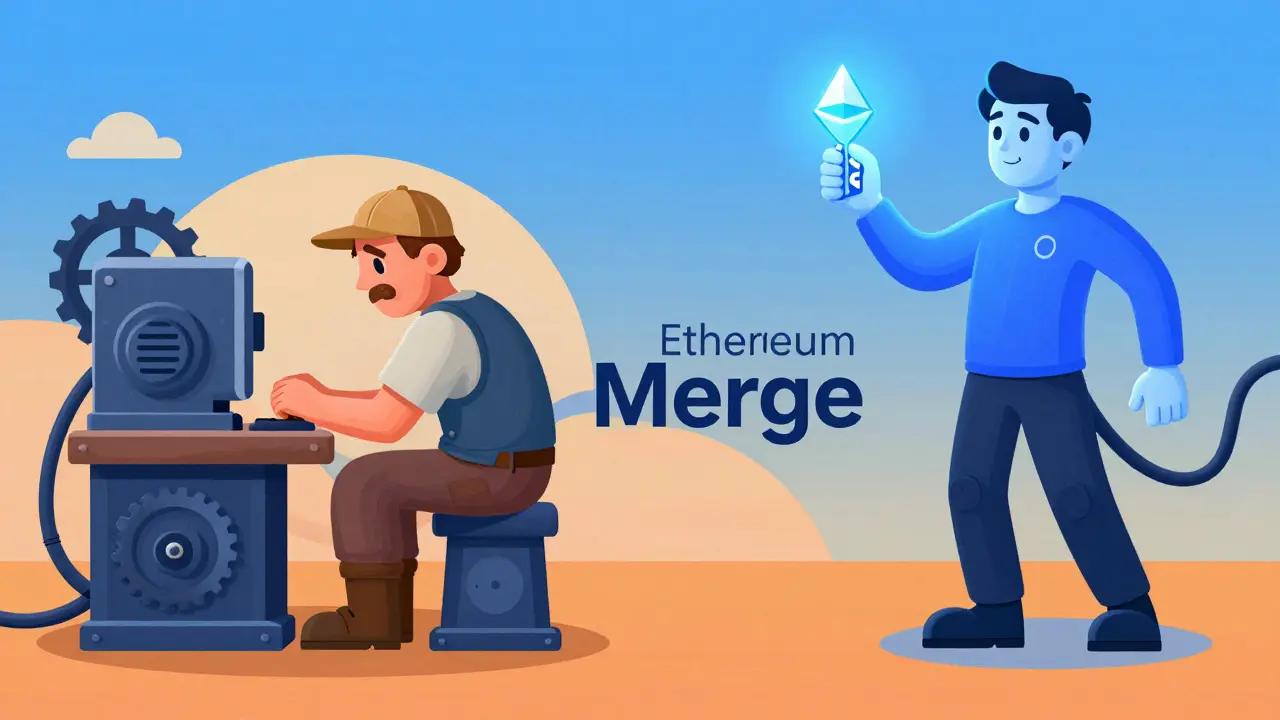
Ethereum, the leading smart contract platform that transitioned from proof-of-work to proof-of-stake in 2022 took a different path. Until September 2022, Ethereum used the same proof-of-work model as Bitcoin, with miners earning 2 ETH plus fees per block. Then came "The Merge," shifting the network to proof-of-stake, a consensus mechanism where validators lock up cryptocurrency as collateral to propose and validate blocks.
In proof-of-stake, you don't need energy-hungry computers. Instead, you lock up 32 ETH to become a validator. Your "reward" comes from two sources: newly issued ETH (inflation) and transaction fees. However, Ethereum introduced a twist with EIP-1559. Now, the base fee of every transaction is burned (destroyed), while validators only keep the priority fee (tip). This means that during periods of high network activity, more ETH is burned than is created. This can make Ethereum deflationary, reducing the total supply over time rather than increasing it. For validators, this changes the math significantly. They earn less from new issuance but gain from the efficiency of the network.
Comparison of Major Blockchain Reward Models
| Cryptocurrency | Consensus Model | Current Reward Structure | Supply Cap | Key Feature |
|---|---|---|---|---|
| Bitcoin | Proof-of-Work | 3.125 BTC + Fees | 21 Million | Halving every 4 years |
| Ethereum | Proof-of-Stake | Variable Issuance + Tips | No Hard Cap | Base fees are burned (deflationary potential) |
| Litecoin | Proof-of-Work | Halved Subsidy + Fees | 84 Million | Faster blocks, similar halving logic to Bitcoin |
| Monero | Proof-of-Work | Tail Emission (0.6 XMR/min) | Infinite (low inflation) | Perpetual miner incentives after initial supply |
Why Do Block Rewards Matter for Security?
You might think block rewards are just about making money for miners. But their real job is buying security. In a decentralized network, anyone can try to cheat. They could try to spend the same coin twice (a double-spend attack) or rewrite history. To prevent this, the network requires a massive amount of computational power (in Bitcoin) or locked-up value (in Ethereum).
The block reward pays for this effort. If the reward drops too low, miners might turn off their machines. If enough miners leave, the network becomes vulnerable to attacks. This is why the upcoming shift to fee-only security in Bitcoin is a major topic of debate among economists and developers. Dr. David Easley from Cornell University noted that Bitcoin's halving creates a predictable monetary policy, but critics warn that if transaction fees don't rise sufficiently, the security budget could shrink drastically.
For example, in 2023, Bitcoin's total security budget (miner revenue) was around $6.3 billion. Most of that came from the block subsidy. If that subsidy disappears, users must collectively pay that $6.3 billion annually in fees to maintain the same level of security. That would mean average transaction fees rising from pennies to perhaps $15-$25 per transaction. Whether users will accept that cost is an open question.

Challenges for Miners and Validators
Earning block rewards isn't passive income. It involves significant technical and financial hurdles.
For Bitcoin miners, the barrier to entry is sky-high. Solo mining is nearly impossible today because the chance of finding a block alone is like winning the lottery. Most miners join pools like F2Pool or Antpool to share rewards. You need industrial-grade hardware, such as the Bitmain Antminer S21, which costs around $12,500 and consumes vast amounts of electricity. With difficulty adjustments happening regularly, older machines quickly become unprofitable.
Ethereum validators face different risks. You need to lock up 32 ETH (worth over $100,000 at current prices) to start. If your computer goes offline or crashes, you get "slashed," meaning you lose a portion of your stake. According to a Consensys survey, hardware failure is the top concern for validators, costing them thousands in lost rewards and penalties. Plus, you need to run complex software clients like Lighthouse or Prysm, requiring constant maintenance and updates.
The Future of Block Rewards
As we move through 2026, the landscape continues to evolve. Bitcoin's next halving is projected for August 2028, dropping the reward to 1.5625 BTC. Ethereum is working on upgrades like Prague to improve how validators handle Maximal Extractable Value (MEV), potentially boosting their earnings. Meanwhile, newer chains are experimenting with different models. Chia Network uses proof-of-space-and-time, rewarding farmers based on storage capacity rather than computing power. Filecoin ties rewards to data storage proofs.
The trend is clear: block rewards are moving from simple inflation-based payouts to more complex economic systems that blend issuance, fees, and utility. For investors and users, understanding these mechanics helps explain price volatility, network congestion, and long-term viability. The block reward is not just a payout; it is the fundamental economic engine that keeps the entire cryptocurrency ecosystem running.
What happens to block rewards when Bitcoin reaches its 21 million cap?
When Bitcoin reaches its maximum supply of 21 million coins around the year 2140, the block subsidy (newly minted coins) will drop to zero. Miners will then rely exclusively on transaction fees to earn income. This transition requires users to pay higher fees to ensure the network remains secure and profitable for miners.
Is the block reward the same for all cryptocurrencies?
No, block rewards vary significantly. Bitcoin has a fixed, decreasing schedule via halvings. Ethereum has dynamic issuance based on staking participation and burns base fees. Other coins like Monero use tail emissions to provide perpetual low-level rewards, while some privacy coins or niche tokens may have entirely different distribution mechanisms.
How do transaction fees affect block rewards?
Transaction fees are added to the block subsidy to form the total block reward. As the block subsidy decreases over time (especially in Bitcoin), transaction fees become a larger percentage of the total reward. During times of high network congestion, fees can spike, temporarily boosting miner or validator income significantly.
Can I earn block rewards without owning expensive mining hardware?
Yes, if you participate in proof-of-stake networks like Ethereum. Instead of buying ASIC miners, you need to lock up a certain amount of cryptocurrency (e.g., 32 ETH for a solo validator) or use a staking pool service that allows smaller amounts. This earns you rewards based on the network's issuance and fees, though it carries different risks like slashing penalties.
Why does Bitcoin halve its block reward every four years?
The halving is designed to control inflation and create scarcity. By cutting the supply of new bitcoins in half regularly, the protocol ensures that the total supply never exceeds 21 million. This mimics the extraction difficulty of precious metals like gold, aiming to preserve value over the long term compared to fiat currencies that can be printed indefinitely.

6 Comments
Sus Sawyer
Look, i get that this is a "simple guide" but lets not pretend the economics here are simple for anyone who isnt holding bags. The whole halving thing is just scheduled scarcity to keep the price pump alive while the whales dump on retail. You talk about security budgets like its some noble mission, but really its just a race to the bottom for energy efficiency until the grid collapses or we all move to nuclear powered mining farms in basements. I run a small pool and let me tell ya, the margins are razor thin after you factor in the ASIC depreciation and the electricity spikes during summer heatwaves. People think they can just buy an S21 and set it and forget it, but if your hash rate drops even slightly due to heat, you are bleeding money every single hour. It is brutal out there.
amy miranda
The article completely glosses over the moral bankruptcy of Proof-of-Work. We are burning enough electricity to power small nations just to shuffle digital numbers around in a ledger that could easily be maintained by a few servers. It is obscene. Ethereum did the right thing with The Merge, even if their deflationary mechanics are still a bit murky. To suggest that Bitcoin's environmental footprint is justified by "security" is a convenient narrative pushed by those who profit from the chaos. We need sustainable finance, not industrial-scale energy waste disguised as innovation.
Pernelia Wahkan
Actually, the comparison between PoW and PoS isn't as black and white as some make it out to be. While PoW does consume significant energy, much of it is stranded energy or renewable sources that would otherwise go unused. Plus, the decentralization aspect of PoW is hard to beat; anyone with hardware can participate, whereas PoS tends to centralize wealth among those who already hold large amounts of ETH. The slashing conditions mentioned are real risks, but so is the risk of validator clients being buggy or centralized providers going down. It is a trade-off between energy consumption and capital concentration.
Subhash Kashyap Dm
centralization is inevitable regardless of consensus mechanism. look at the exchange dominance in staking rewards. cloudflare aws azure they control the infrastructure. bitcoin miners are moving to places with cheap hydro because the government wants them gone anyway. the halving is a psyop to create artificial demand. when fees take over the network will be unusable for normal people only corporations will afford tx fees. prepare for the collapse of the fee market model.
Billy Cunningham
True. 📉 The math doesn't lie. Most people don't realize how fragile the fee-only model is. One bad quarter and miners capitulate. 😬
Ed Wallace
There is something poetic about the idea of digital scarcity, isn't there? In a world where fiat currency can be printed endlessly, the rigid schedule of Bitcoin's halving feels like a anchor to reality. But perhaps we are projecting too much meaning onto code. The block reward is merely an incentive structure, a carrot on a stick. As the carrot shrinks, do we value the stick more? Or do we simply walk away? The transition to fee-based security will likely reveal whether the network has genuine utility or if it was always just a speculative vehicle. Time will tell, but the philosophical implications of decentralized trust are fascinating.