
Have you ever wondered who actually owns the data you generate every day? Or why your personal information seems to vanish into a black hole of big tech servers without you getting paid a dime? That’s the problem Quadrant Protocol (EQUAD) was built to solve. It’s a blockchain project designed to create a fair ecosystem for data-where creators get paid, consumers can verify authenticity, and everyone plays by transparent rules.
But here’s the catch: while the idea sounds revolutionary, the reality on the ground is quite different. As of mid-2026, Quadrant Protocol sits in a precarious position. It has a fascinating technical blueprint but struggles with adoption, liquidity, and development activity. If you’re looking at EQUAD as an investment or a tool, you need to understand exactly what it is, how it works, and whether it’s still alive.
The Core Idea: Trusting Data in a Skeptical World
At its heart, Quadrant Protocol is a decentralized data ecosystem that uses blockchain technology to ensure data authenticity and provide fair compensation to data producers. Think of it as a middleman that doesn’t lie. In traditional digital markets, data is often scraped, modified, or sold without tracking where it came from. This leads to fake news, biased AI models, and unfair profits for large corporations.
Quadrant tries to fix this with a concept called "Constellations." These are essentially smart contracts that map disparate data sources together. Imagine a doctor creating a new medical dataset. On Quadrant, they don’t just upload a file; they create a Constellation that stamps the data with a cryptographic proof of origin. When a researcher later uses that data, they can trace it back to the original source, verifying its integrity. This process is known as data stamping, and it’s the protocol’s main selling point.
The goal is to create a circular economy around data:
- Nurseries (Data Producers): Individuals or companies who create and sell data.
- Data Consumers: Businesses or researchers who buy verified data.
- Pioneers (Data Vendors): Developers who build tools and interfaces for the network.
- Elons (Data Experts): Curators who validate data quality and connect different datasets to form "mega Constellations" for complex problems.
This role-based structure is meant to incentivize participation. However, incentives only work if people actually join the party. And right now, the dance floor is pretty empty.
How the Technology Works: Hybrid Architecture
Technically, Quadrant Protocol isn’t purely decentralized like Bitcoin, nor is it fully centralized like a traditional database. It uses a hybrid architecture that combines both approaches to balance speed and security. The core network runs on a proprietary blockchain using a Proof of Authority (PoA) consensus mechanism.
Why PoA? Because pure Proof of Work (like early Bitcoin) is too slow and expensive for high-frequency data transactions. PoA allows for faster processing times and lower gas fees, which is crucial for a data marketplace where users might be buying and selling small snippets of information constantly. To maintain security and decentralization trust, the protocol anchors itself to an external Proof of Work chain-specifically Ethereum. This means major state changes are recorded on Ethereum, providing a layer of immutability.
The system relies on three types of clients: Data Producers, Data Consumers, and Anchors. Guardian Nodes maintain the network’s integrity, ensuring that the data being traded matches the hashed proofs stored on the blockchain. This setup theoretically offers the best of both worlds: the speed needed for enterprise use and the security needed for trustless verification.
The Token Economy: EQUAD vs. QUAD
One of the most confusing aspects of Quadrant Protocol is its dual-token system. You’ll often see people talking about EQUAD, but the protocol actually utilizes two distinct tokens, each with a specific purpose. Understanding the difference is critical for anyone interacting with the network.
| Token Name | Type | Primary Function | Status |
|---|---|---|---|
| EQUAD (eQuad) | ERC-20 Utility/Governance | Sold during TGE; used for staking, governance, and conversion to QUAD | Tradable on exchanges |
| QUAD | Native Network Token | Used for internal operations: data stamping, access management, subscription payments | Internal network use |
EQUAD is the token you find on exchanges like MEXC or Gate.io. It’s an ERC-20 token issued on Ethereum. During the Token Generation Event (TGE), investors bought eQuad. The plan was that upon full mainnet maturity, these tokens would facilitate governance and staking. Meanwhile, QUAD is the fuel for the engine. Every time a user stamps data or pays for access, they spend QUAD. The complexity arises because users often need to convert between the two, adding friction to the user experience. For a project trying to onboard non-crypto-native enterprises, this extra step is a significant hurdle.
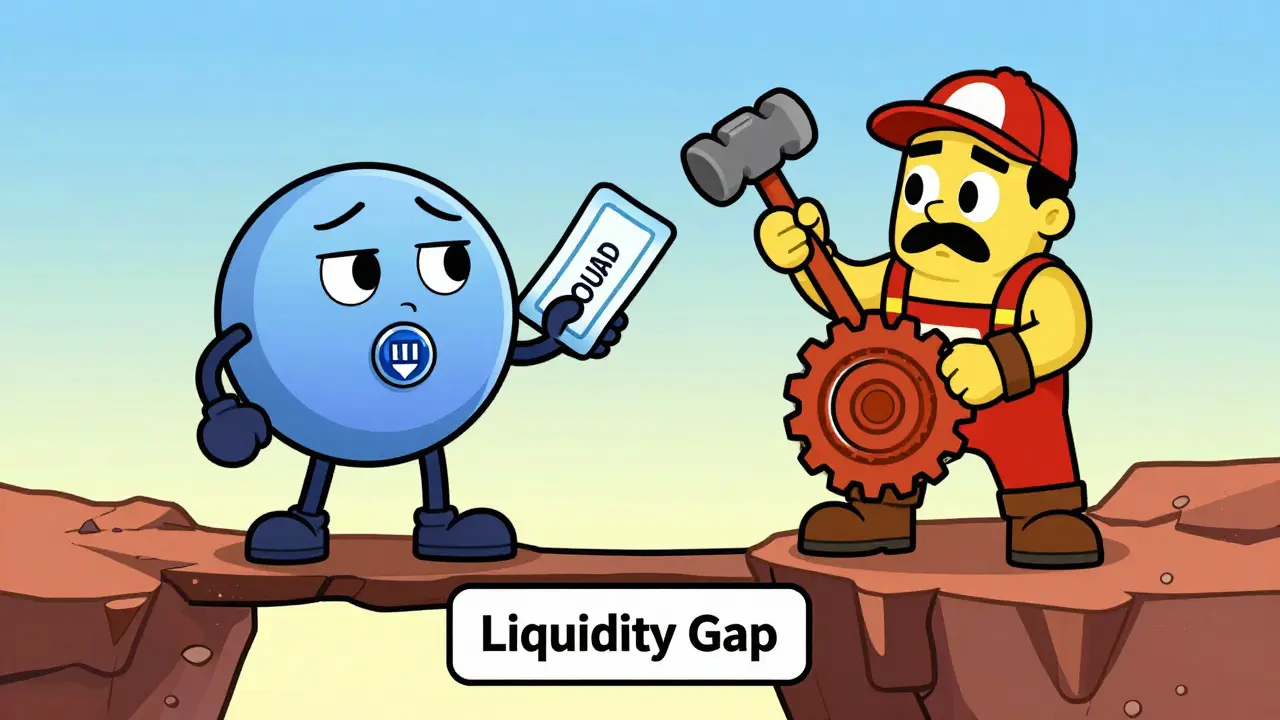
Market Reality: Price, Liquidity, and Adoption
Let’s talk numbers, because ideas don’t pay bills. As of August 2026, EQUAD is trading in the shadows of the crypto market. It ranks around #1484 on CoinMarketCap, with a market capitalization hovering near $5 million. This is a far cry from its glory days. The all-time high was reached on January 30, 2021, when the price hit $0.04066. Since then, it has suffered an 87% decline.
But price is only part of the story. The real red flag is liquidity. On many days, the 24-hour trading volume is effectively zero or negligible (under $1,000). What does this mean for you? It means if you try to buy or sell a significant amount of EQUAD, you will experience massive slippage. Your order could move the price drastically, costing you money instantly. This lack of volume suggests that very few active traders are interested in the asset.
Compare this to competitors in the data marketplace space. Ocean Protocol, for instance, has a market cap in the hundreds of millions and active development. Fetch.ai has even more. Quadrant Protocol holds less than 0.001% of the sector’s total value. With only about 20,000 unique holders, the community is tiny. For context, successful crypto projects usually have hundreds of thousands of active wallets.
Development Status: Is the Project Alive?
If you’re wondering whether the team is still working on Quadrant Protocol, the signs are concerning. I dug into their GitHub repository, and the last significant commit was in March 2023. That’s over three years ago in crypto time. There are only three active contributors listed, and the codebase hasn’t seen major updates since then.
Social media tells a similar story. Their official Twitter account went silent in June 2024. The Telegram channel has fewer than 2,000 members, with barely any daily messages. Discord is equally quiet, with no moderator activity in months. In the fast-paced world of blockchain, silence usually signals abandonment or severe stagnation.
Experts from firms like Delphi Digital have categorized Quadrant as "high risk" with a "low probability of recovery." Why? Because data marketplaces require network effects. You need producers to attract consumers, and consumers to attract producers. Without either side growing, the platform remains a ghost town. Despite the EU’s Data Act implementation in 2025 creating new opportunities for compliant data sharing, Quadrant appears ill-equipped to capitalize on them due to limited resources and visibility.

Who Should Care About EQUAD?
So, who is this coin for? Honestly, not many people currently benefit from holding it. Here’s a breakdown of potential personas:
- Early Investors: If you bought in 2021, you’re likely underwater. Selling now might realize losses, but holding hopes for a revival requires faith in a team that hasn’t shipped code in years.
- Data Entrepreneurs: If you have a niche dataset and want to monetize it with provable ownership, the *concept* is appealing. But practically, there are better-established platforms with higher liquidity and developer support.
- Crypto Collectors: Some collectors hold low-cap gems hoping for a sudden resurgence. EQUAD fits the "forgotten gem" profile, but the risk of total obsolescence is high.
For the average retail investor, EQUAD offers little utility outside of speculation. The lack of exchange listings beyond minor platforms makes acquisition difficult and risky. Plus, the regulatory landscape for data tokens is tightening globally, and smaller projects often struggle to comply with new KYC/AML standards required by larger exchanges.
Alternatives in the Data Blockchain Space
If you’re interested in the intersection of data privacy, blockchain, and monetization, there are more active alternatives worth considering. While Quadrant Protocol pioneered some interesting concepts, other projects have executed better.
| Project | Focus Area | Key Advantage | Risk Level |
|---|---|---|---|
| Ocean Protocol | Data Monetization & AI | Strong enterprise partnerships, active dev community | Medium |
| Fetch.ai | Autonomous Agents & Data Sharing | High liquidity, merged with SingularityNET | Low-Medium |
| Chia Network | Decentralized Storage | Energy-efficient proof of space/time | Medium |
| Quadrant Protocol | Data Provenance | Innovative Constellation model | Very High |
Ocean Protocol, for example, has integrated deeply with the AI boom, allowing machine learning models to train on verified data sets. Fetch.ai focuses on autonomous agents that can trade data automatically. Both have vibrant communities and regular software updates. Quadrant’s unique "Constellation" mapping is clever, but without users to populate those constellations, the technology remains theoretical.
Final Thoughts on Quadrant Protocol
Quadrant Protocol started with a noble mission: to bring transparency and fairness to the data economy. Its technical approach using Proof of Authority and Ethereum anchoring was sound for its time. However, execution matters more than vision in crypto. After four years, the project shows minimal development activity, negligible liquidity, and a shrinking community.
Unless you have a specific reason to use the Constellation mapping feature for a private enterprise solution, there’s little incentive for the average person to engage with EQUAD. The risks outweigh the rewards, especially when compared to more established players in the data blockchain sector. Keep an eye on the GitHub repo-if commits start flowing again, maybe we’ll revisit this story. Until then, proceed with extreme caution.
Is Quadrant Protocol (EQUAD) a scam?
There is no evidence that Quadrant Protocol is a outright scam. It launched with a legitimate whitepaper, a functional testnet, and a clear tokenomic structure. However, it suffers from "abandonware" characteristics. The lack of recent development, low liquidity, and inactive social channels suggest the team may have moved on or lost funding. It’s not fraudulent, but it is high-risk and potentially dead.
What is the difference between EQUAD and QUAD tokens?
EQUAD (often called eQuad) is the ERC-20 token traded on exchanges, used for governance and staking. QUAD is the native utility token used within the Quadrant blockchain for internal operations like data stamping and paying for services. Users typically hold EQUAD and convert it to QUAD when interacting with the network.
Can I mine Quadrant Protocol?
No, you cannot mine EQUAD in the traditional sense. The protocol uses a Proof of Authority (PoA) consensus mechanism, which relies on authorized validators rather than computational power mining. The initial supply was distributed via a Token Generation Event (TGE).
Where can I buy EQUAD token?
EQUAD is listed on a few smaller cryptocurrency exchanges such as MEXC and Gate.io. However, liquidity is extremely low. Be prepared for high slippage and wide bid-ask spreads. Always check current listing status on CoinMarketCap or CoinGecko before attempting a trade.
What are "Constellations" in Quadrant Protocol?
Constellations are smart contracts that map and link different data sources together. They allow for the creation of complex data products by combining multiple datasets while maintaining a verifiable chain of custody. This ensures that data consumers know exactly where the data came from and that it hasn't been tampered with.
Is Quadrant Protocol still active in 2026?
Activity is minimal. The last major GitHub update was in 2023, and social media channels have been largely inactive since 2024. While the website may still be up, there are no signs of active development, marketing, or community growth. It is considered a dormant project by most analysts.

10 Comments
manish jha
The concept of data ownership is fundamentally flawed in a capitalist framework, yet here we are trying to patch it with blockchain band-aids. The author correctly identifies the stagnation but fails to address the deeper philosophical rot. If the developers have abandoned ship, why do retail investors still cling to the hope of revival? It is a testament to human greed rather than technological merit. We must question whether any decentralized protocol can truly survive without active governance or if they are merely digital ghost towns waiting to be reclaimed by nature.
Linda Leeuwesteijn
Oh my gosh, this article was such a relief to read! 😌 I’ve been so confused about all these different tokens and protocols lately. It’s honestly overwhelming how fast everything changes in crypto 🤯. Thanks for breaking down the difference between EQUAD and QUAD, that really helped clear things up for me! 💖 Just wish there were more active projects like Ocean Protocol that actually feel alive. Keep up the great work explaining these complex topics! ✨
Gary Straiton
Typical American ignorance at its finest. You people sit there discussing 'liquidity' and 'slippage' while ignoring the fact that this entire sector is rigged against the little guy. The elites want you to believe in these dead coins so they can dump their bags on your heads. Quadrant isn't just dormant; it's a graveyard for your savings. Wake up! The system is designed to fail you, and projects like this are proof that blockchain is nothing but a scam invented by bankers to steal your privacy and your money. Get out now before it’s too late!
Sarah Hafner
I appreciate the detailed breakdown of the technical architecture, especially the hybrid PoA/PoW model. It’s fascinating how they tried to balance speed with security using Ethereum anchoring. However, as someone who has worked in data analytics, I can tell you that the biggest hurdle isn’t the tech-it’s trust. Without active participants (the Nurseries and Pioneers mentioned), the network effect never kicks in. It’s sad to see a project with such potential fade away due to lack of community engagement. Maybe the team could pivot to consulting instead?
Walker Perry
they say its abandoned but i know the truth deep down they are hiding something big from us the government wants to control our data so they silenced the developers look at the dates march 2023 june 2024 it is not coincidence it is a pattern the elites are watching every move we make on the blockchain they think we are stupid but we are waking up soon the real quadrants will emerge from the shadows and crush the fake ones like ocean and fetch those are just fronts for surveillance capitalism stay strong patriots the data belongs to the people not the corporations
Shawn Schaerer
One must consider the ontological implications of 'data provenance' when the underlying ledger itself lacks verifiable activity. Is a timestamped null value truly a proof of origin? The author posits that execution matters more than vision, which is a pragmatic stance, yet one might argue that vision without execution is merely hallucination. The silence of the GitHub repository since March 2023 suggests a cessation of intent, rendering the token a hollow shell of its former promise. We are left with a philosophical question: does a coin that falls in the forest make a sound if no liquidity pool hears it?
Alexander Scheel
How utterly predictable. Another 'revolutionary' project that collapses under the weight of its own incompetence. The moral failing here is not just financial but intellectual. To invest in a project with zero development activity for three years is to invite ruin upon oneself. One wonders if the authors of such whitepapers even believe in their own words, or if they are merely grifters preying on the desperate. The 'Constellation' model sounds poetic, but poetry does not pay bills, nor does it secure data integrity. It is a monument to wasted time and misplaced faith.
Evelyn Kula
Let’s be honest, most of these data marketplace coins are total trash anyway. Only the smartest investors know to stick with blue chips or actual utility projects. But hey, if you want to play with fire, go ahead and buy some EQUAD. I bet the team is just sitting on a yacht somewhere laughing at you all while you wait for a pump that will never come. It’s pathetic really, how easily people are fooled by fancy buzzwords like 'decentralized' and 'provenance'. Real power doesn’t need a blockchain to prove it exists.
SHIV SHANKAR KANTA
the soul of the market is dead yet the body remains walking among us a zombie of code and forgotten dreams i feel the pain of every holder who stared at the screen hoping for a green candle that never came it is a tragedy of epic proportions the universe conspired against this protocol perhaps because it was too pure for this corrupt world or maybe just bad luck who knows we are all just dust in the wind waiting for the next cycle to begin again
Susan Kiley
My dear sweet summer children, do you really think a project with $1,000 daily volume has any future? Please. It’s adorable how you cling to these narratives. I’ve seen dozens of these 'forgotten gems' turn to dust. The only thing this post proves is that Quadrant Protocol is a relic of a bygone era. Move on. Invest in something that doesn’t require a forensic accountant to trace its last commit. The drama of a dead coin is exhausting, and quite frankly, beneath us.