
Most people think of cryptocurrency as money for buying things or investing. But what if crypto could be used to protect your art, music, or even AI training data? That’s exactly what Story Protocol (IP) is trying to do. Unlike Bitcoin or Ethereum, which focus on payments or smart contracts, Story Protocol is the first blockchain built just for intellectual property. Its native token, $IP, isn’t just a currency-it’s the key to registering, licensing, and getting paid for creative work online.
What Exactly Is Story Protocol?
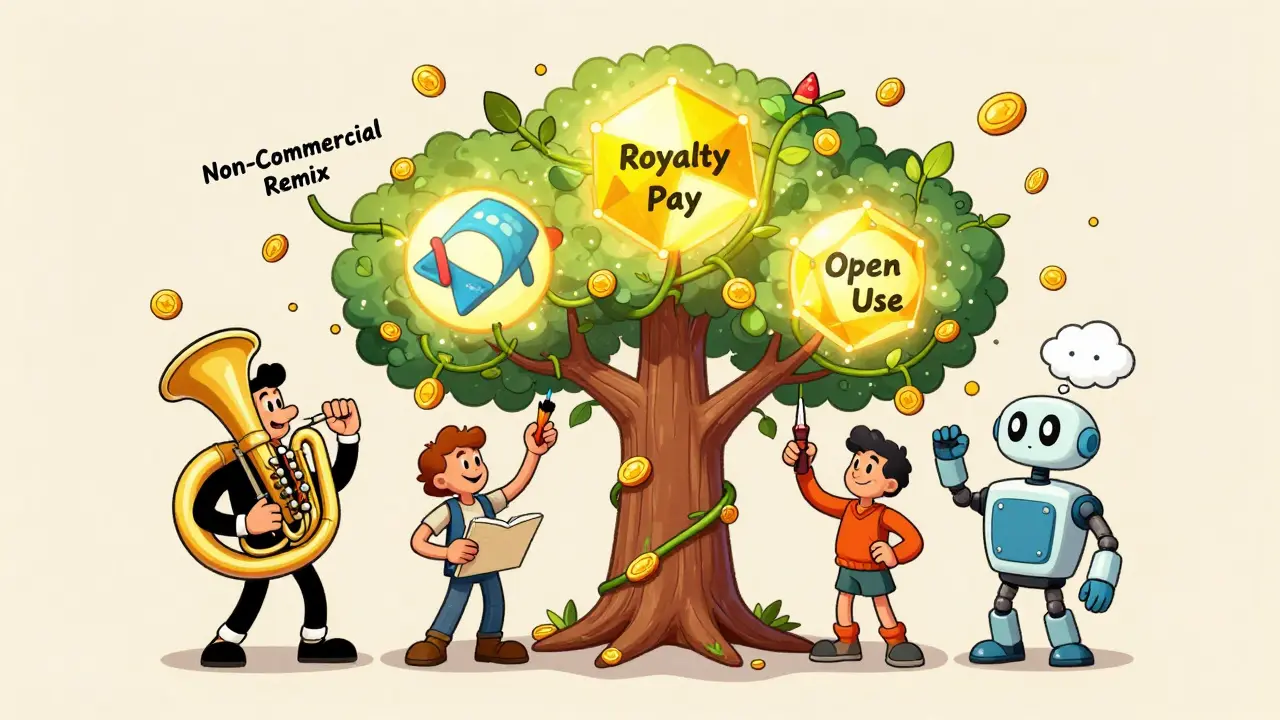
Story Protocol is a Layer 1 blockchain designed to handle intellectual property (IP) like a digital copyright office that never sleeps. It lets creators-whether they’re musicians, illustrators, writers, or AI data providers-register their work on-chain and set automatic rules for how others can use it. Want someone to remix your song but only for non-commercial use? You can lock that rule into a smart contract. If they use it, royalties get paid automatically. No middlemen. No paperwork. No chasing down payments.
The project was founded by Seung Yoon Lee, Jason Levy, Jason Zhao, and Ben Sternberg. Their goal? To unlock the $80 trillion global intellectual property market by making IP programmable. That means turning legal rights-like who can use your work, how much they pay, and when-into code that runs on a blockchain.
How Does the $IP Token Work?
The $IP token is the fuel of the Story Protocol ecosystem. It’s not a meme coin or a speculative asset-it’s a utility token with real jobs inside the system:
- Paying transaction fees (gas) to register or license IP assets
- Registering your original work or derivative creations
- Licensing your IP to others with programmable terms
- Voting on protocol upgrades and governance decisions
- Staking to help secure the network and earn rewards
There are exactly 1 billion $IP tokens total, and none will ever be created after launch. At its Token Generation Event (TGE) in February 2025, around 250 million tokens (25%) will be in circulation. The rest are locked for future ecosystem growth, team incentives, and community rewards.
How Is It Different From NFTs on Ethereum or Solana?
Many people confuse Story Protocol with NFT marketplaces like OpenSea or Magic Eden. But there’s a big difference. NFTs prove you own a digital file. Story Protocol doesn’t just prove ownership-it controls how that file can be used.
Story uses ERC-721 and ERC-6551 standards (same as many NFTs), but adds something new: the Programmable IP License (PIL). This lets creators embed licensing rules directly into the token. For example:
- Open Use: Anyone can use it, no payment needed
- Non-Commercial Remix: You can tweak it, but not sell it
- Commercial Use: Pay a flat fee to use it in ads or products
- Commercial Remix: Pay royalties every time your work is remixed and sold
Traditional NFTs can’t do this. If someone buys your NFT, they might think they own the rights to use it however they want. With Story, the rules are built in. If someone violates them, the smart contract can block usage or trigger a payment automatically.
Technical Backbone: A Blockchain Built for IP Relationships
Most blockchains are linear-they store one thing after another. But intellectual property isn’t linear. A song might be sampled from another song, which was inspired by a poem, which was adapted from a film. Story Protocol’s blockchain is built to handle these complex relationships using graph data structures. It can track chains of creation, derivatives, and contributions across multiple creators.
The network runs on a modified Proof-of-Stake consensus using CometBFT, allowing transactions to finalize in 1-2 seconds. On the testnet, fees are around $0.002 per transaction, and it handles about 45 transactions per second. That’s fast enough for real-world use by creators and small studios.
Developers need to learn Story’s SDK and API, which includes 127 endpoints and 28 sample templates. Onboarding takes 3-4 weeks for experienced blockchain devs. The testnet is already live, with over 14,000 IP assets registered as of December 2024-mostly from digital artists and AI data providers.
Who’s Using It? Real-World Examples
Early adopters are already seeing results:
- An independent music platform automated royalty splits for 17 contributors across three countries. Administrative costs dropped by 83%.
- A digital illustrator registered her entire portfolio with custom remix rules. Every time someone used her art in a TikTok video, she got paid automatically.
- An AI training company used Story to license 50,000 images with clear usage terms, avoiding legal gray areas around data sourcing.
But it’s not perfect. One gaming studio tried to integrate Story into their character IP system but abandoned it because their existing licensing agreements didn’t map cleanly to the protocol’s templates. That’s a common hurdle-translating legal contracts into code isn’t easy.
Challenges and Risks
Story Protocol isn’t without risks. The biggest one? Legal recognition. Right now, no country officially accepts blockchain-based IP registration as legally binding. The U.S. Copyright Office hasn’t issued guidance. The EU’s AI Act (coming in 2026) might recognize it, but that’s still uncertain.
Traditional IP law experts, like Professor Jonathan Band from George Washington University, argue that blockchain can’t replace national copyright systems. They worry it could create confusion in cross-border disputes.
There’s also competition. Companies like IPwe and Bernstein are building blockchain tools for IP too. But they’re mostly focused on patents and trademarks-not creative content. Story is the only one built for artists, musicians, and digital creators.
And then there’s adoption. For this to work, millions of creators need to switch from traditional systems. That’s a tall order. But early user feedback is positive: 4.1/5 on Trustpilot, with 68% praising the easy API and clear documentation.
What’s Next for Story Protocol?
The roadmap is ambitious:
- Q1 2025: Integrate with major AI training platforms to license datasets
- Q2 2025: Launch IPFi-a DeFi marketplace where you can collateralize your IP as loan security
- Q3 2025: Enable cross-chain licensing so IP registered on Story can be used on Solana, Ethereum, or others
Analysts are split on its future. Messari predicts $IP could hit a $3.5 billion market cap by 2026. JPMorgan thinks regulatory delays will slow growth, projecting just $750 million. Blockchain Capital gives it a 78% chance of long-term success. Sequoia Capital is less optimistic, citing the difficulty of changing century-old IP laws.
Should You Care About $IP?
If you’re a creator-whether you make music, art, videos, or AI training data-Story Protocol could be a game-changer. It solves a real problem: getting paid fairly when your work gets used online. Right now, most platforms take 30-50% of your revenue. Story cuts out the middleman.
If you’re an investor, $IP is high-risk, high-reward. It’s not a currency. It’s infrastructure. Its value depends entirely on whether creators adopt it. If even 1% of the $80 trillion IP market moves on-chain, $IP could become essential.
But don’t buy it just because it’s new. Wait for the mainnet launch after February 2025. Watch how many creators actually register work. See if platforms start integrating it. The technology is solid. The question is: will the world trust it?
Is Story (IP) a real cryptocurrency or just a token on Ethereum?
Story Protocol is a standalone Layer 1 blockchain, not just an ERC-20 token on Ethereum. While some sources mistakenly describe it as an Ethereum-based token, official documentation from CoinMarketCap, Crypto.com, and KuCoin confirms it runs on its own network using CometBFT consensus. The $IP token is native to this chain, though it’s compatible with Ethereum standards like ERC-721 for asset registration.
Can I use Story Protocol to protect my music or artwork?
Yes. Story Protocol is designed specifically for creators. You can register your music, illustrations, videos, writing, or even AI-generated content as an IP asset. You then set licensing rules-like whether others can remix it, sell it, or use it commercially-and those rules are enforced automatically via smart contracts. Royalties are paid directly to you when your work is used.
How do I get $IP tokens?
$IP tokens will be distributed at the Token Generation Event (TGE) in February 2025. Before then, you can participate in testnet activities to earn early rewards. After launch, tokens will be available on major exchanges. Do not buy pre-launch tokens from unofficial sources-they’re likely scams. Only trust official channels like the Story Protocol website and verified partners.
Is Story Protocol legal?
The technology itself is legal, but its legal standing as a replacement for copyright offices is not yet recognized. No country currently accepts blockchain-based IP registration as official proof of ownership in court. However, the smart contracts can still serve as strong evidence of creation and licensing terms. Legal recognition may come with regulations like the EU’s AI Act in 2026, but for now, Story works best as a tool for voluntary, automated royalty distribution-not as a substitute for legal copyright.
What’s the difference between Story Protocol and IPwe or Bernstein?
IPwe and Bernstein focus on patents and trademarks, mostly for corporations and universities. Story Protocol is built for digital creators-musicians, artists, writers, YouTubers, and AI data providers. It handles creative works, derivatives, and remixes, which traditional IP systems don’t support well. Story also has programmable licensing built into the blockchain, while others use blockchain mostly for record-keeping.

5 Comments
Terrance Alan
Look i dont care about your blockchain or your smart contracts or your fancy PIL thing
Creators have been getting screwed for decades and you think putting it on a ledger fixes that
People dont care about royalties they care about vibes and reach
If your song gets used in a TikTok and you make 2 cents you think thats victory
Its not its just another way to monetize desperation
The real problem is platforms taking 70 percent not the lack of code
And now you want me to learn another API just to get paid less
Thanks but no thanks
Sally Valdez
Oh great another Silicon Valley fantasy where Americans think they can rewrite copyright law with a blockchain
Whats next a crypto version of the DMCA
You think some indie artist in Ohio is gonna register their bedroom pop song on this thing
Meanwhile in China Russia and India people are just sharing music and laughing at your overengineered nonsense
This isnt innovation its colonialism with gas fees
And dont even get me started on the tokenomics
1 billion tokens and 25 percent in circulation
Thats a pump and dump waiting to happen
Go back to your NFT ape clubs
Elvis Lam
There are real technical wins here that people are missing
Story Protocol isnt trying to replace copyright offices its giving creators tools to enforce their own terms without lawyers
The PIL system is actually brilliant
Using ERC-6551 to attach licensing metadata to NFTs means you can track derivatives across platforms
Thats something no one else has done at scale
And the testnet numbers speak for themselves
14k assets registered in under a year mostly by artists not devs
Yes legal recognition is years away but that doesnt mean its not useful now
Think of it like email in 1995
Not official but still better than snail mail
And the gas fees are dirt cheap compared to Ethereum
Its not perfect but its the only thing that actually solves the royalty fragmentation problem
Stop comparing it to NFTs its not even in the same category
George Cheetham
Im sitting here thinking about what this means for creativity itself
What if we stopped seeing art as something to own and started seeing it as something to flow through
Story Protocol doesnt just track usage it invites collaboration
Imagine a musician in Lagos sampling a poem from a poet in Jakarta and both getting paid automatically because the terms were coded in
Thats not just technology thats a new kind of cultural contract
Yes the legal system is slow
Yes there are scams and hype
But what if this is the quiet revolution weve been waiting for
Not a revolution of ownership but of respect
What if the next generation of artists dont fight for rights but build systems that honor them
Thats what this feels like to me
Not a token
Not a blockchain
But a promise
That your voice matters even if you dont have a label a lawyer or a million followers
Sue Bumgarner
This is just crypto bros trying to sell vaporware again.