Global Crypto Seizure Comparison Tool
Crypto Seizure Comparison Tool
Compare seizure values and approaches by country. Based on 2025 data from the article.
Crypto Seizure Statistics by Country
| Country | Seizure Value (USD) | Primary Asset | Approach | Notes |
|---|
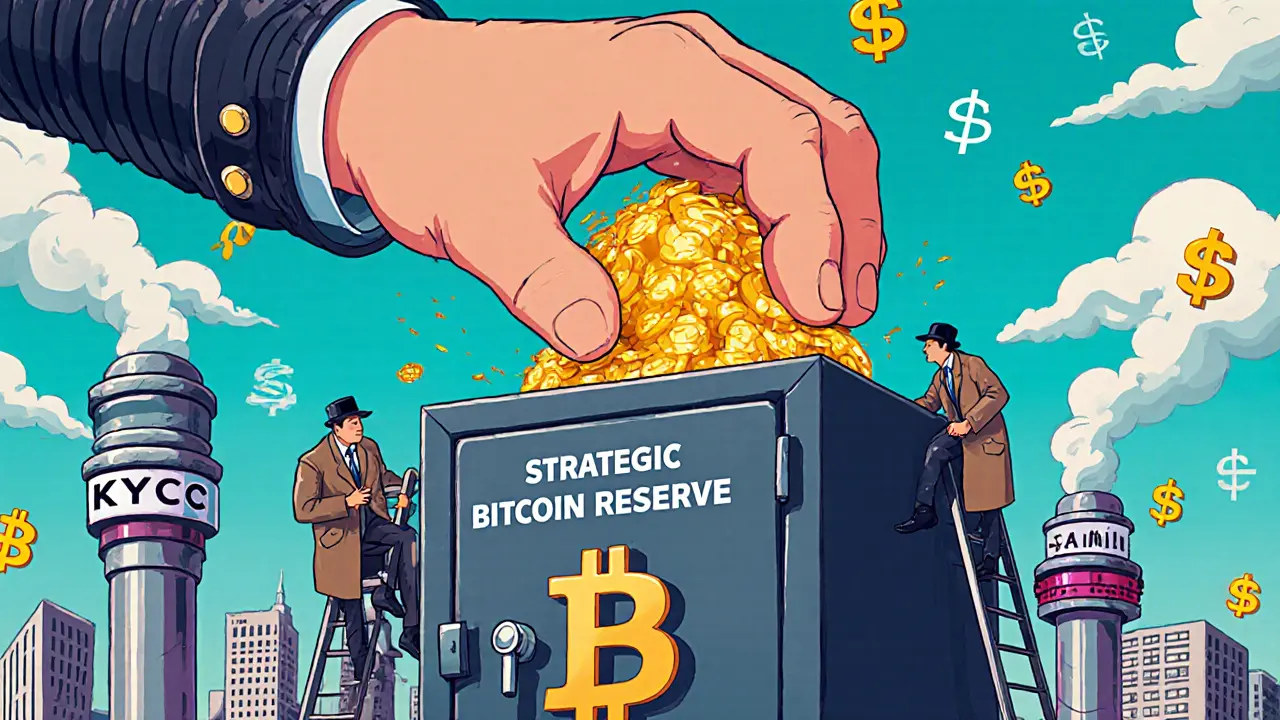
When the U.S. government quietly added 207,000 Bitcoin to its holdings in March 2025, it wasn’t buying on the open market. It was taking possession of stolen, laundered, and forfeited crypto - and storing it as a sovereign reserve. This wasn’t just a big haul. It was a policy revolution.
For years, seized cryptocurrency was sold off quickly to avoid market disruption. Now, the U.S. is holding onto it. Why? Because holding Bitcoin isn’t just about money anymore. It’s about national strategy. And other countries are watching - and copying.
How Crypto Seizures Work - And Why They’re So Hard
Crypto seizures aren’t like grabbing cash from a drug dealer. You can’t cuff a wallet. You can’t freeze a private key with a court order alone. To seize Bitcoin or Ethereum, law enforcement needs either:
- Access to the private key (often through a suspect’s device or a compromised exchange)
- Control over the wallet through a court-ordered freeze on a regulated exchange
- Proof that the asset was used in a crime - like money laundering, ransomware, or darknet market transactions
Once seized, the asset is moved to a government-controlled wallet. In the U.S., that’s now the Strategic Bitcoin Reserve. Other countries are still figuring out how to store these assets securely. Some use cold storage. Others outsource to third-party custodians with government oversight.
It’s not just Bitcoin. NFTs, DeFi tokens, and even stablecoins like USDC are now fair game. In 2025, the U.S. Department of Justice seized a collection of 1,200 NFTs linked to a ransomware gang. Courts ruled they were proceeds of crime - just like a stolen car or a fake Rolex.
The U.S. Leads - But Not How You Think
The U.S. leads the world in crypto seizures by value. In the first half of 2025 alone, American agencies recovered over $1.3 billion in digital assets. But here’s the twist: the U.S. isn’t just seizing more. It’s keeping more.
The Strategic Bitcoin Reserve, launched in March 2025, holds over 207,000 BTC. That’s about 1% of all Bitcoin ever mined. The reserve isn’t meant to be sold. It’s meant to be held - as a hedge against inflation, a funding source for future investigations, and a tool to stabilize markets. Selling all that Bitcoin at once would crash prices. Holding it lets the government benefit from price appreciation while still using small amounts to pay victims or fund operations.
The SEC and CFTC also changed their game. Instead of just fining exchanges, they now work with them. Coinbase and Circle are publicly traded. New rules force stablecoin issuers to hold 1:1 reserves. KYC and AML rules are tighter than ever. The goal? Make it harder for criminals to move crypto - and easier for law enforcement to track it.
Who Else Is Seizing Crypto - And How?
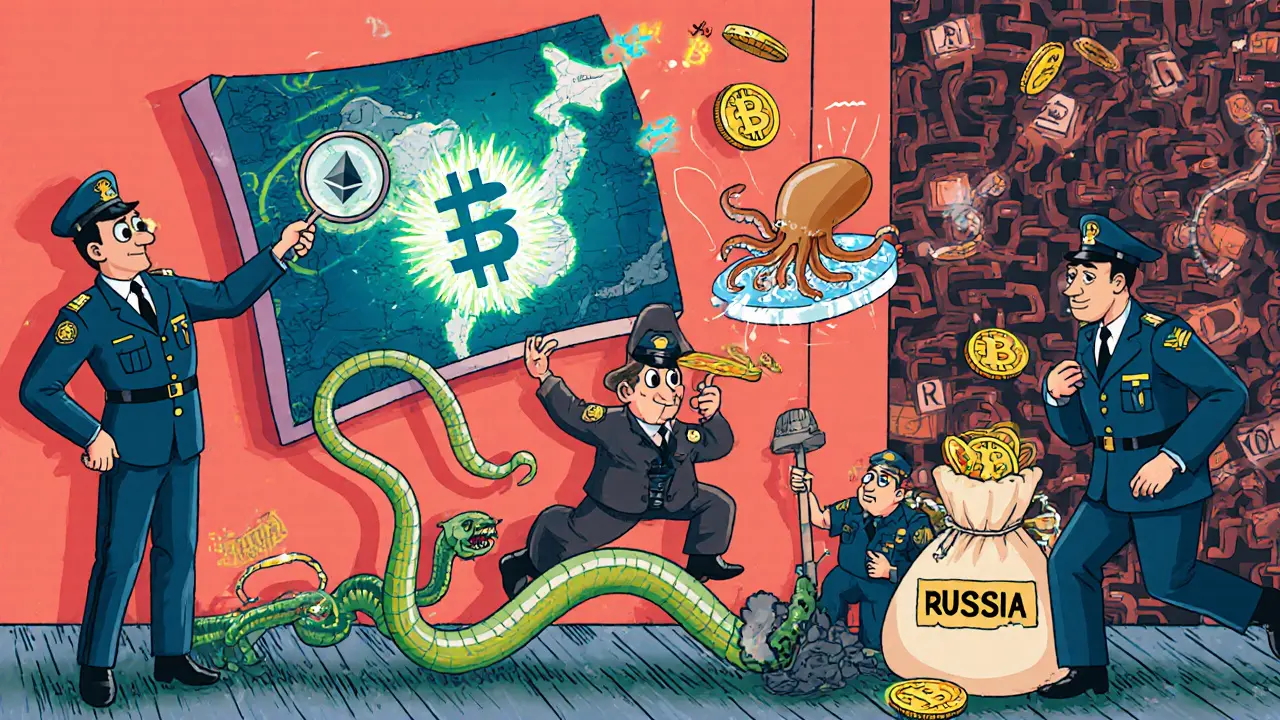
Germany seized over $380 million in crypto in 2025, mostly Ethereum and stablecoins. Their approach? Close collaboration with Europol and the U.S. Treasury. German police now have dedicated crypto forensics units trained to trace transactions on the blockchain.
Japan’s Financial Services Agency (FSA) seized over $290 million, mostly from unlicensed exchanges. Japan has some of the strictest licensing rules in the world. Any exchange operating without FSA approval is shut down - and its assets frozen.
Spain’s Guardia Civil made headlines in 2025 when they partnered with the FBI to track down a $150 million crypto laundering ring based in Eastern Europe. The operation used blockchain analytics tools to trace transactions from a darknet marketplace to wallets in Spain, then to a crypto mixer in Moldova. The mixers were shut down. The wallets were seized.
Russia? They don’t seize crypto for law enforcement. They seize it for the state. In 2025, Russian authorities confiscated over $220 million in Bitcoin from individuals who tried to move money out of the country. The government doesn’t return it. It just keeps it - no court order needed.
Canada, the UK, and Australia are following the U.S. model. They’re setting up digital asset reserves. They’re hiring blockchain analysts. They’re training judges to understand smart contracts.
Where Crypto Theft Is Worst - And Who’s Most Vulnerable
Seizures only happen because crimes happen. And in 2025, crypto theft hit record levels. Over $2.17 billion was stolen in the first six months - more than all of 2024.
The top victim countries by total theft: United States, Germany, Russia, Canada, Japan, Indonesia, and South Korea. But the real shock? The UAE, Chile, India, Lithuania, Iran, Israel, and Norway. These countries have the highest value stolen per victim. Why? Because their users hold large amounts of crypto - often in self-custody wallets with weak security.
North America leads in Bitcoin and altcoin theft. Europe leads in Ethereum and stablecoin theft. Why? Because Europeans use DeFi and stablecoins more. Attackers target liquidity pools, not just wallets.
Eastern Europe, the Middle East, and Central Asia saw the fastest growth in thefts from 2024 to 2025. That’s not because people there are careless. It’s because organized crime groups are moving in. Cybercriminals from Ukraine, Russia, and Belarus are targeting users in Moldova, Georgia, and Kazakhstan - places with weak enforcement and high crypto adoption.
Sub-Saharan Africa? Lowest theft value. Not because people don’t use crypto. Because most users have small balances. A $500 theft is huge there. But globally, it doesn’t move the needle.
Legal Chaos - Some Countries Ban It, Others Embrace It
There’s no global rulebook. What’s legal in one country is a felony in another.
In Mauritius, crypto is a regulated asset. You can trade, hold, and invest. But if you’re hacked? Tough luck. No government compensation.
In South Africa, Bitcoin isn’t legal tender. The central bank says it’s just “an intangible asset.” But the tax office taxes it like property. Seizures happen - but only if linked to tax fraud or money laundering.
Angola allows crypto. No laws ban it. But officials warn citizens not to use it. The government doesn’t enforce anything. So seizures? Almost none.
Namibia banned crypto exchanges in 2017. No trading. No payments. If you try to use Bitcoin there, your bank can freeze your account. Seizures aren’t needed - the system blocks it before it starts.
Ukraine leads the world in crypto adoption - not because it’s rich, but because it’s desperate. After the war started, crypto became a lifeline. The government doesn’t seize it. It encourages it. In 2025, Ukraine launched its own crypto donation platform to fund defense. Seizures? Only for war criminals.
What’s Next? The Global Race to Control Crypto
The big shift isn’t just about seizing crypto. It’s about owning it.
The U.S. Strategic Bitcoin Reserve isn’t a one-off. It’s a blueprint. Countries with strong rule of law - Canada, Germany, Japan - are building their own. Countries with weak institutions - like Venezuela and Zimbabwe - are using crypto seizures to fund state operations without transparency.
Expect more international operations. More blockchain forensics. More courts recognizing NFTs as property. More exchanges forced to freeze wallets on government request.
And don’t be surprised if, in the next two years, you see a country sell gold to buy more Bitcoin - not to invest, but to fill its reserve. The U.S. is already considering it.
One thing’s clear: Crypto isn’t just money anymore. It’s power. And the countries that learn how to control it - without crashing the market - will lead the next financial era.
Can governments really seize Bitcoin if it’s decentralized?
Yes - but only if they can access the wallet. Bitcoin itself can’t be blocked. But if your private key is on a device police can seize, or your funds are on an exchange they can compel to freeze, they can take control. Decentralization doesn’t mean unseizable.
What happens to seized crypto after it’s taken?
In the U.S., it goes into the Strategic Bitcoin Reserve. Some is sold to pay victims or fund investigations. The rest is held long-term. Other countries sell it quickly. Russia keeps it. Some nations auction it off to private buyers.
Are crypto seizures legal in all countries?
No. In countries like Namibia and China, crypto is restricted or banned, so seizures aren’t needed - the system blocks it. In others like Mauritius, seizures are legal but rare. In authoritarian states like Russia, seizures are used for political control, not just crime fighting.
Why is the U.S. holding onto Bitcoin instead of selling it?
Selling 207,000 BTC at once would crash the market. Holding it avoids that. It also lets the government benefit from price increases. Plus, it’s a strategic asset - like gold. The reserve can be used to fund future operations, pay victims, or even stabilize financial markets during a crisis.
Which countries are most active in crypto enforcement?
The U.S., Germany, Japan, Spain, and Canada lead in both volume and sophistication. They have dedicated crypto units, blockchain analysts, and international partnerships. Countries like Ukraine and Georgia are also active - not because they’re wealthy, but because they’ve been targeted so heavily, they had to adapt fast.

9 Comments
Joel Christian
bro the us just hoarding btc like its 2012 and they’re the only ones who know how to use a computer lmao. why do i feel like they’re gonna lose the keys and we’ll all find out in 5 years when the news says ‘oops forgot the cold wallet passphrrase’?? 😅
jeff aza
The Strategic Bitcoin Reserve (SBR) is a macroeconomic hedge vehicle predicated on the assumption of non-correlation with traditional fiat inflation metrics-however, this ignores the systemic risk introduced by centralized custody of a decentralized asset. The U.S. Treasury’s reliance on third-party custodians (e.g., Coinbase Custody) creates a single point of failure that contradicts the foundational tenets of Bitcoin’s trustless architecture. Moreover, the legal precedent of treating NFTs as ‘proceeds of crime’-akin to counterfeit Rolex watches-demonstrates a profound ontological confusion between digital scarcity and physical property rights.
Vijay Kumar
America thinks it owns Bitcoin now? Ha. The real power is in the nodes. Not the wallets. Not the laws. The code doesn't care who holds the keys. You can seize the coins, but you can't seize the truth.
Vance Ashby
so the us is just turning into a crypto bank now? lol. i mean, if they’re holding it long-term, why not just mint bonds against it? 🤔 also, anyone else think the ‘strategic reserve’ is just a fancy way to say ‘we’re scared to sell and crash the market’?
Brian Bernfeld
Let me break this down real simple: if you’re stealing crypto from ransomware gangs, you’re not just fighting crime-you’re taking money from monsters. And holding it? That’s smart. Selling it all at once would tank the market and hurt everyday people who didn’t do anything wrong. The U.S. isn’t hoarding-it’s being responsible. Germany’s doing it right. Japan’s doing it right. Ukraine’s using it to fund its defense. This isn’t control. It’s stewardship. And if you’re mad about it, you’re mad because you don’t understand how the world works anymore.
Ian Esche
The U.S. is the only country with the guts to actually do something. While Europe is busy debating crypto ethics, we’re building a digital fortress. Russia? They steal crypto from their own people. We steal it from criminals. Big difference. If you don’t like it, move to Namibia. They banned it. Maybe they’ll let you pay for your chai with seashells.
Felicia Sue Lynn
There is a profound moral tension here. On one hand, seizing assets from criminals serves justice. On the other, consolidating sovereign control over a decentralized medium fundamentally alters its nature. Is Bitcoin still Bitcoin when the state becomes its largest holder? We must ask not only whether we can, but whether we should. The answer may define the future of freedom in digital finance.
Christina Oneviane
Oh wow, the U.S. is ‘holding’ Bitcoin like it’s a collectible baseball card? 🙄 Next they’ll start putting it in museums with little plaques: ‘This 1 BTC was seized from a guy who tried to pay for a darknet drug deal. He’s probably in jail. We won.’
fanny adam
This entire narrative is a distraction. The Strategic Bitcoin Reserve is not a financial tool-it’s a surveillance mechanism. Every wallet moved into government custody is a data point. Every transaction traceable. Every private key recovered is a backdoor. The U.S. government doesn’t want to hold Bitcoin. It wants to own the ledger. And if you think NFTs being seized as ‘proceeds of crime’ is normal, you’re not paying attention to the slippery slope. This is the first step toward mandatory blockchain identity. The crypto revolution didn’t die. It was kidnapped.