
Imagine your solar panels don’t just power your home-they also let you sell extra electricity to your neighbor, automatically, without a middleman. No bills to negotiate. No utility company deciding your rates. Just a clean, direct exchange, recorded forever on a digital ledger. This isn’t science fiction. It’s happening right now, thanks to blockchain energy trading.
What Blockchain Energy Trading Actually Does
Traditional electricity flows one way: from big power plants, through wires, to your outlet. You pay a utility, and that’s it. But with rooftop solar, wind turbines, and home batteries becoming common, that model is breaking down. Now, homes and small businesses aren’t just consumers-they’re producers. They generate more energy than they use. So why can’t they sell it? That’s where blockchain comes in. Instead of relying on a single company to manage energy flow and billing, blockchain creates a decentralized network. Every time someone produces or buys energy, the transaction is recorded on a public, tamper-proof ledger. Smart contracts-self-executing code-handle the rest. If your neighbor’s solar panels produce 5 kWh at 2 p.m., and your EV needs charging at that exact time, the system matches them automatically. Payment happens in seconds. No paperwork. No delays. This isn’t theory. In Brooklyn, New York, the Transactive Grid project lets neighbors trade solar power using blockchain. In Australia, Power Ledger has enabled over 20,000 households to trade renewable energy. These aren’t pilot programs anymore-they’re working, real-world systems.Lower Costs for Everyone
Think about how much you pay for electricity. A big chunk of that bill doesn’t go to generating power-it goes to intermediaries. Transmission companies, billing departments, regulatory fees, profit margins for distributors. All of them add up. Blockchain cuts out most of that. When you trade energy directly with someone nearby, you skip the long-distance transmission lines, the complex billing systems, and the overhead of a monopoly utility. Studies from the National Renewable Energy Laboratory show that peer-to-peer energy trading can reduce consumer costs by 15% to 30% in areas with high solar adoption. And it’s not just about lowering bills. For small producers, it’s about getting paid fairly. In traditional markets, excess solar power often gets sold back to the grid at a low, fixed rate. With blockchain, you set your own price. If demand is high on a sunny afternoon, you can charge more. If it’s quiet, you lower it. The market decides-not a utility board.Smart Contracts Automate Everything
Remember when you had to manually transfer money to a friend? Now you just tap your phone. Blockchain energy trading does the same thing, but for electricity. Smart contracts are the engine behind this. They’re lines of code that run automatically when conditions are met. For example:- If your solar system produces more than 80% of your home’s usage, the contract sells the surplus to the highest bidder in your neighborhood.
- If your battery drops below 20%, the contract buys power from nearby producers at the lowest price.
- If a storm knocks out the grid, the system reroutes energy from local sources to critical homes-no human approval needed.
Transparency You Can Trust
How do you know the electricity you’re buying is actually from solar panels and not a coal plant? In traditional systems, you can’t. Utilities label their energy as “green” with little proof. Blockchain changes that. Every unit of energy traded comes with a digital passport. It shows exactly where it came from, when it was produced, and who sold it. You can verify that the 10 kWh you bought for your EV was generated by your neighbor’s rooftop panels at 11:32 a.m. on March 15, 2026. This transparency isn’t just nice-it’s necessary for trust. People are more willing to participate in energy markets when they know exactly what they’re buying. It also helps regulators verify compliance with clean energy mandates. No more guesswork.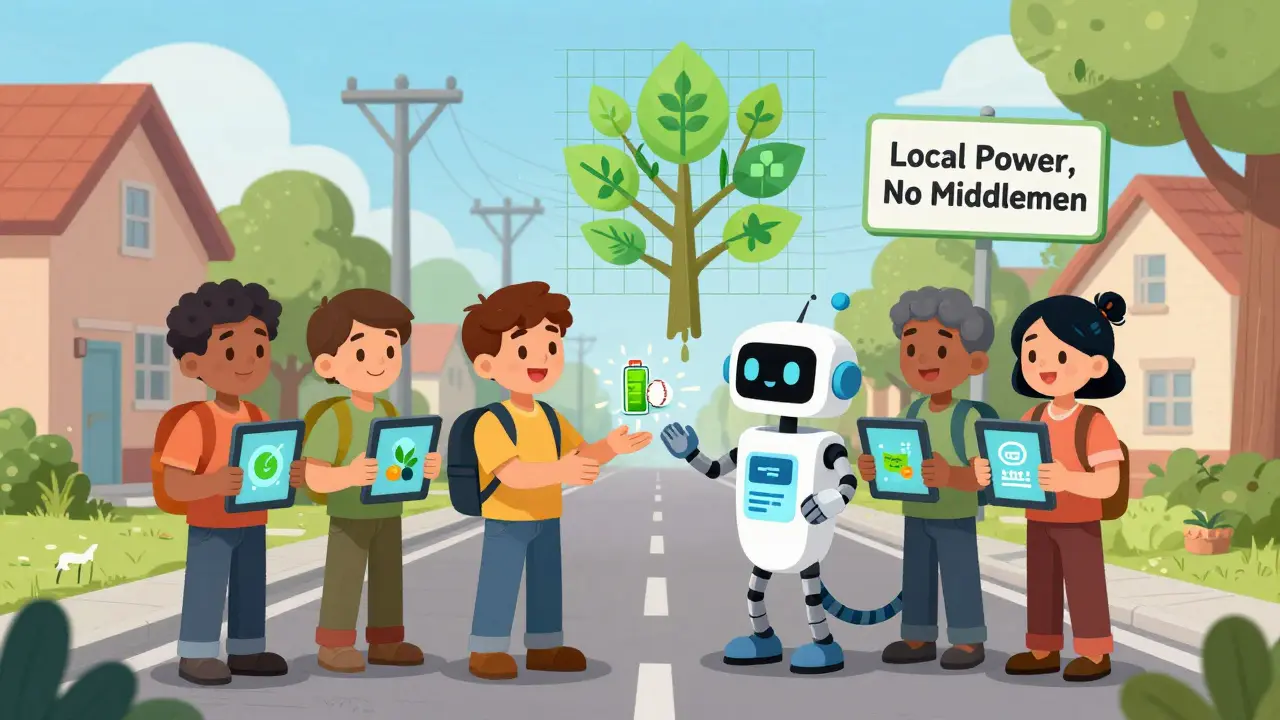
Grid Resilience in a Climate Crisis
When a storm knocks out a power plant, the whole grid can go down. Centralized systems are fragile. But blockchain energy networks? They’re designed to survive. Because energy is produced and used locally, there’s less dependence on long-distance transmission lines. If one part of the grid fails, others keep running. Homes with batteries can power their own circuits. Neighbors can share energy without relying on a central hub. During the 2021 Texas blackout, over 4 million people lost power. A blockchain-powered grid could have kept lights on in neighborhoods with solar and storage, even if the main grid collapsed. Local networks don’t need to wait for repairs-they just reroute. This isn’t just about convenience. It’s about safety. As extreme weather becomes more common, decentralized grids are becoming essential infrastructure.Democratizing Energy Access
Big energy companies have always controlled the market. They own the plants, the wires, and the rules. Small producers-like a family with a few solar panels or a community wind turbine-had no real way to compete. Blockchain changes that. You don’t need a corporate contract or a legal team to join. All you need is a meter, a smart inverter, and an app. Suddenly, a homeowner in rural Colorado or a small business in Ohio can sell energy on the same platform as a utility. This opens up markets that were locked out before. A 2025 report from the European Energy Exchange found that blockchain platforms increased participation from small producers by 210% in just two years. More competition means better prices and faster innovation.Environmental Impact You Can Measure
Renewable energy only helps the planet if it’s actually used. Right now, a lot of solar and wind power goes to waste because there’s nowhere to send it. Blockchain solves that. It connects surplus energy with real demand-right when and where it’s needed. No more curtailment. No more burning fossil fuels to fill gaps because clean energy wasn’t distributed efficiently. In Germany, a blockchain pilot in the town of Wildpoldsried reduced fossil fuel use by 38% in one year by better matching local wind and solar output with household consumption. That’s not a small win. That’s a shift. By making renewable energy trading easy and profitable, blockchain encourages more people to install solar panels, buy batteries, and invest in clean tech. It turns sustainability from a slogan into a financial incentive.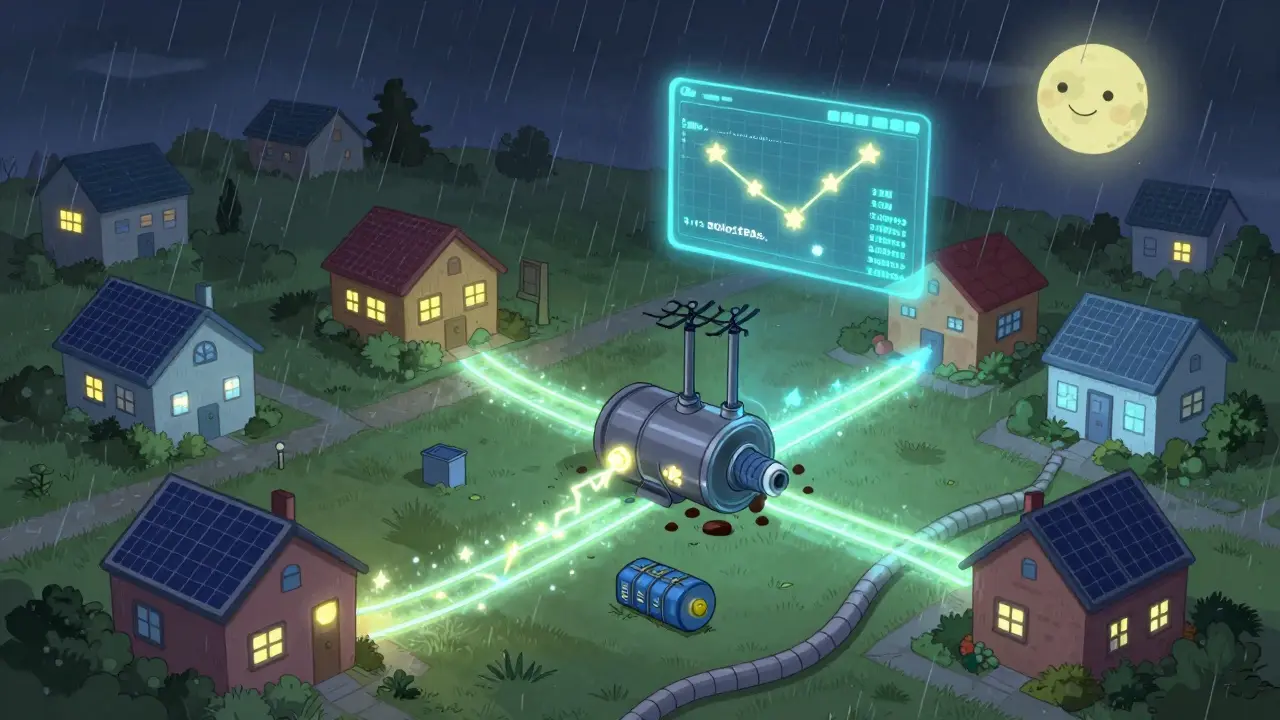
Privacy Without Sacrificing Control
Utilities track your energy use down to the minute. Some even use that data to adjust your rates. That’s invasive. Blockchain gives you control. You decide what data to share and with whom. Your energy usage history isn’t stored in one company’s database-it’s distributed across thousands of nodes. Hackers can’t easily steal it. Companies can’t manipulate it. Plus, you can choose anonymity. You don’t need to give your name or credit card to trade energy. Just a digital wallet. Your privacy stays intact while your power flows freely.Community Power, Not Corporate Power
Think about what happens when you pay your utility bill. Most of that money leaves your town. It goes to corporate offices, shareholders, and distant infrastructure projects. With blockchain energy trading, the money stays local. Your neighbor buys your solar power. Your community fund gets a cut. Local jobs are created to maintain the network. Money circulates within the neighborhood, not outside it. In Vermont, a community energy cooperative using blockchain reported that 82% of energy revenue stayed within the region, compared to just 18% under the old utility model. That’s not just economic-it’s cultural. People feel connected to their energy. They care more about it.Why This Isn’t Just a Trend
Blockchain energy trading isn’t about crypto hype. It’s about fixing a broken system. The grid is aging. Renewable energy is booming. Consumers want control. Utilities are slow to adapt. This technology answers all of those needs. It’s cheaper. It’s faster. It’s fairer. And it’s scalable. Countries across Europe, Asia, and North America are testing it. Cities are passing laws to allow it. Investors are pouring billions into startups building these platforms. This isn’t the future. It’s the present. And if you have solar panels, a battery, or even just a smart meter, you’re already part of it.Can I really sell my solar energy to my neighbor using blockchain?
Yes. In many areas, you can. Platforms like Power Ledger (Australia), Brooklyn Microgrid (USA), and WePower (Europe) let homeowners trade solar power directly with neighbors. All you need is a smart meter, a compatible inverter, and an app. The system automatically matches supply and demand, executes the trade via smart contract, and transfers payment in cryptocurrency or local digital currency. No utility approval is needed.
Do I need to understand cryptocurrency to use blockchain energy trading?
No. While some platforms use tokens or crypto for payments, most consumer-facing apps hide the complexity. You’ll see your energy balance in kilowatt-hours, and payments might appear as dollars or credits on your phone. Behind the scenes, blockchain handles the transaction-but you interact with it like a utility app. Think of it like using Venmo: you don’t need to know how banking networks work to send money.
Is blockchain energy trading legal in the U.S.?
Yes, in many states. California, New York, Vermont, and Colorado have passed laws allowing peer-to-peer energy trading. The Federal Energy Regulatory Commission (FERC) also approved Rule 2222 in 2020, which requires utilities to let distributed energy resources (like home solar) participate in wholesale markets. Local regulations vary, so check with your state’s public utility commission, but the legal framework is already in place.
How does blockchain prevent fraud in energy trading?
Each transaction is recorded on a distributed ledger that’s copied across hundreds of computers. Once a trade is confirmed, it can’t be changed. Smart contracts verify the source of energy using meter data and cryptographic signatures. If someone tries to fake production numbers, the system rejects the transaction. Unlike centralized systems where one company controls the data, blockchain makes manipulation nearly impossible without controlling the majority of the network-which is practically unfeasible.
What happens if the internet goes down?
Most blockchain energy systems are designed to work offline. Smart contracts execute based on local data from your meter and inverter. Payments may be delayed until internet is restored, but energy flow continues. Some systems even use mesh networks or satellite backups to maintain communication. The grid doesn’t rely on the internet to deliver power-it just uses it to record and settle trades.

9 Comments
Shayne Cokerdem
this shit is wild. my neighbor got solar last year and now he's rich? i'm broke and still paying 200 a month. why can't i just sell my damn fridge power? they gotta make it easier. not everyone's a tech wizard.
kavya barikar
This is a meaningful step toward energy equity. Decentralization empowers individuals and reduces systemic dependency. Simple, yet profound.
aravindsai pandla
The technical foundations here are solid. Smart contracts eliminate human error and ensure transparency. This model could serve as a blueprint for other public utilities.
Andrea Zaszczynski
I tried to join one of these platforms and they asked for my social security number, my credit score, and a video of me holding a sign that says 'I love blockchain.' That's not empowerment. That's surveillance with a greenwashing label.
Cordany Harper
I live in Texas and saw what happened during the blackout. If we had even a few neighborhoods on a local blockchain grid, people wouldn't have frozen. This isn't futuristic-it's survival. And yeah, you don't need to know crypto. My grandma uses the app. She just sees kWh and dollars. That's all she cares about.
DarShawn Owens
I love this. My cousin in Colorado started trading energy last year and now she's got a little fund going for her kid's college. It’s not about the money-it’s about feeling like you’re part of something real. Like you’re helping, not just consuming.
Andy Green
You people are falling for the crypto grift again. Blockchain is just a glorified Excel sheet run by tech bros who think they’re Elon. The grid doesn’t need to be decentralized-it needs to be rebuilt with real public investment. Not some blockchain startup funded by VC money. This is capitalism with a blockchain sticker on it.
Zion Banks
They’re using this to track us. Every time you trade energy, they log your location, your habits, your schedule. Next thing you know, the government’s using it to ration power during ‘emergencies.’ And don’t think they’re not already talking to the Chinese about this. I’ve seen the leaks. This isn’t freedom. It’s a digital leash.
Kevin Da silva
In the UK we’re still stuck with fixed tariffs and monopolies. This model could change everything. Simple, direct, fair. Why hasn’t this been rolled out here yet?