
Remember CryptoKitties? In late 2017, this simple game clogged the Ethereum network because people were paying real money for pixelated cats. It was a novelty then. But fast forward to November 2026, and that "gimmick" has evolved into a $128 billion industry projected by Statista. We are no longer just buying digital pets; we are building persistent virtual economies where your sword in one game can become your avatar’s skin in another. The Metaverse isn't just a buzzword anymore-it's the infrastructure layer connecting these fragmented worlds.
If you clicked this article expecting to hear that blockchain gaming is dead because NFTs cooled off, you missed the pivot. The hype cycle crashed, sure. Projects like Star Atlas saw their tokens drop 98% from highs. But while speculators fled, builders stayed. Today, blockchain gaming serves as the primary on-ramp to crypto for 78% of new users, according to Udonis Blog. Why? Because playing a game is easier than understanding DeFi yield farming. Let’s break down what actually works now, what’s failing, and where the money is going in the next five years.
The Shift from Speculation to Sustainable Play
Early blockchain games suffered from a fatal flaw: they relied on new players to pay old players. It was a Ponzi-like structure. If growth stopped, the economy collapsed. By 2025, the industry matured. Jason Rosenstein of Konvoy Ventures noted in early 2025 that retention metrics improved by 210% year-over-year. How? Developers stopped focusing solely on "Play-to-Earn" (P2E) and started prioritizing "Play-and-Earn." The difference is subtle but critical. P2E treats gaming as a job; Play-and-Earn treats it as entertainment with optional financial upside.
This shift fixed the user experience. You don’t need to understand gas fees or seed phrases to enjoy titles like Splinterlands. A player in the Philippines reported earning $350 monthly-exceeding local minimum wage-without treating the game as a full-time grind. The key metric here isn't token price; it's daily active users who stay because the game is fun, not just because they hope to get rich.
- True Ownership: Unlike Steam, where Valve bans blockchain items, Web3 games let you sell your loot on open marketplaces like OpenSea or Rarible.
- Interoperability: Protocols like Polygon’s zkEVM now allow assets to move between 12 major platforms, breaking down walled gardens.
- Incentivized Participation: Token rewards now supplement gameplay rather than replacing it, reducing inflationary pressure on native currencies.
Technical Reality: Can It Actually Scale?
Let’s be honest about the tech stack. Traditional gaming servers handle thousands of concurrent actions per second. Blockchain networks historically struggled with even ten. This lag killed immersion for years. However, Layer 2 solutions have changed the math. As of Q1 2025, Ethereum Layer 2s processed 15-30 transactions per second-a 500% improvement over 2022 levels. While still slower than centralized servers, this speed is sufficient for turn-based strategy games and social hubs.
Hardware barriers have also crumbled. Meta’s Quest 3 headset dropped to $499.99, making VR accessible to mainstream consumers. When you combine cheap hardware with faster blockchains, the friction disappears. DappRadar reports over 20 million daily gaming transactions across various chains. That’s not niche traffic; that’s volume. The bottleneck is no longer technical capacity; it’s user interface design. Only 38% of new users successfully complete their first transaction without external help, according to CoinMarketCap. Until wallets feel as easy as logging in with Google, mass adoption will remain stalled.
Metaverse Convergence: Work, Play, and Socialize
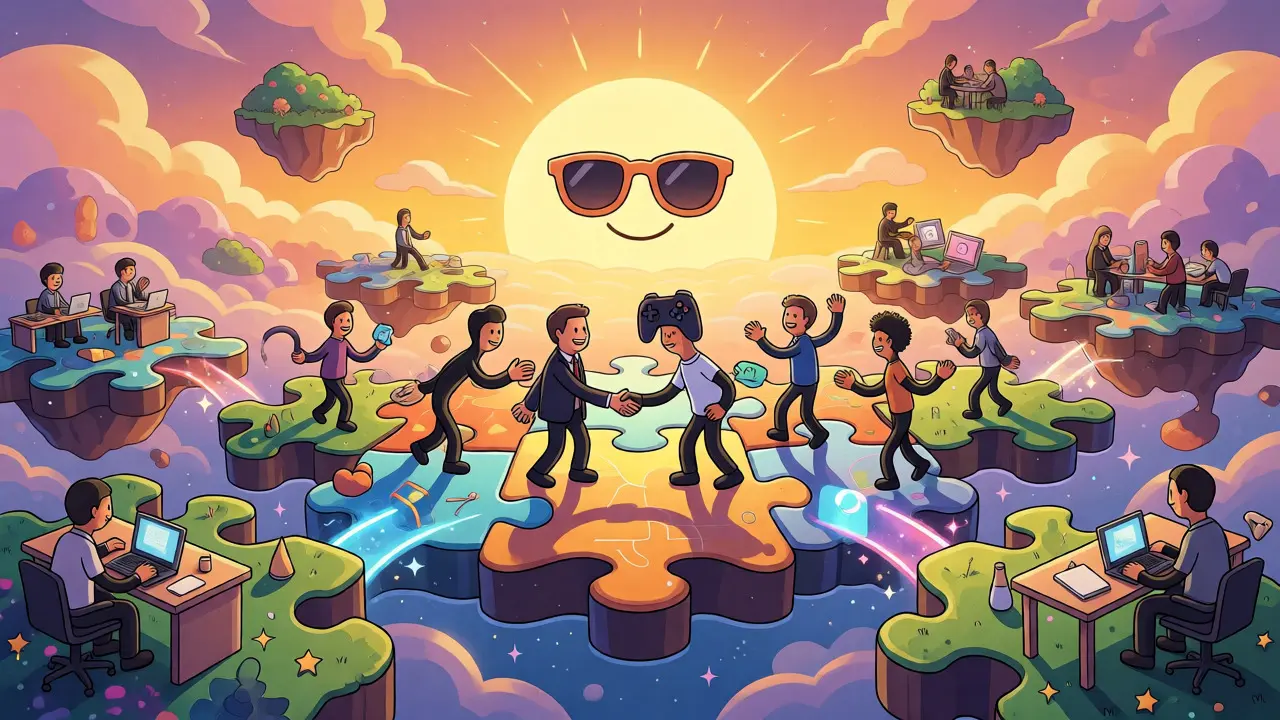
The term "Metaverse" often conjures images of clunky avatars in empty rooms. That’s outdated. Gartner’s Q1 2025 report highlights that 62% of metaverse platforms now include professional collaboration features. We are seeing a convergence of three distinct behaviors: gaming, social interaction, and remote work. Platforms like Roblox introduced limited blockchain integration for virtual land ownership in February 2025, signaling that even traditional giants see value in decentralized property rights.
Virtual real estate is becoming a tangible asset class. Decentraland’s LAND parcels averaged $2,850 each in March 2025. But unlike physical real estate, these plots generate revenue through advertising, events, and mini-games hosted on them. Microsoft’s Mesh platform and NVIDIA’s Omniverse are targeting enterprise use cases, proving that the metaverse isn't just for gamers. It’s for architects, trainers, and marketers. TSG Invest forecasts an addressable market of $8-13 trillion by 2030, serving potentially 5 billion users. Gaming remains the entry point, but the destination is a unified digital life.
| Feature | Traditional Gaming (e.g., Steam) | Blockchain Gaming (Web3) |
|---|---|---|
| Asset Ownership | Licensed access; server-dependent | Verifiable NFT ownership; portable |
| Economic Model | Free-to-play or upfront purchase | Play-to-Earn / Play-and-Earn hybrid |
| Transaction Speed | Instant (Centralized Server) | 15-30 TPS (Layer 2 Solutions) |
| User Barrier | Low (Standard Login) | Moderate (Wallet setup required) |
| Market Share (2024) | 96.8% | 3.2% |
The Economic Sustainability Problem
Not every project survives. Matthew Ball, a prominent industry analyst, warned in January 2025 that 63% of play-to-earn games launched between 2021 and 2022 ceased operations. Why? Unsustainable tokenomics. Many projects printed tokens endlessly to reward players, causing hyperinflation. When the supply outpaces demand, the value crashes. Goldmans Sachs’ analysis suggests only 22% of current projects have models sustainable beyond 2026.
The survivors are those with dual-loop economies. They balance in-game utility sinks (spending tokens on upgrades) with emission sources (earning tokens). DAO governance is also helping. 38% of major blockchain games now incorporate player governance via Decentralized Autonomous Organizations. Players vote on updates, fee structures, and treasury spending. This community-driven approach reduces the risk of rug pulls and aligns incentives between developers and users.
Regulatory Landscape and Global Adoption
Regulation is the final boss for global adoption. The EU’s MiCA regulations, effective June 2024, provided clarity for crypto assets, boosting institutional confidence. In contrast, the US maintains a fragmented approach, with 17 active state-level gaming regulations complicating compliance. For developers, this means geo-fencing certain features. Some countries ban gambling-like mechanics involving crypto; others embrace them.
Mobile gaming drives 67% of blockchain activity, largely due to lower hardware requirements and widespread smartphone penetration in emerging markets. Countries like the Philippines and Vietnam see blockchain gaming as a viable income source during economic downturns. Conversely, Western markets treat it as speculative investment or hobbyist collection. Understanding this geographic split is crucial for any investor or developer looking at the future of this sector.
What’s Next: 2027 and Beyond
The World Economic Forum projects that 10% of global GDP will be stored on blockchain technology by 2027. Gaming assets will represent a significant slice of that pie. Expect consolidation. Small, underfunded studios will merge or shut down. Large publishers like Epic Games are already launching blockchain-agnostic platforms to capture this market without betting everything on one chain.
We are moving toward an era where your digital identity persists across platforms. Imagine taking a rare weapon from a shooter game into a racing game as a cosmetic item. Interoperability protocols are getting closer to this reality. The metaverse won't be one single app; it will be a federation of interconnected worlds, bound together by shared standards for ownership and currency. Blockchain gaming is the glue holding that federation together.
Is blockchain gaming really profitable for average players?
It depends on your location and time commitment. In emerging markets like Southeast Asia, players can earn supplemental income exceeding local minimum wages. In developed nations, earnings are often modest unless you trade assets actively. Most successful players treat it as a hobby with side income, not a primary salary.
Do I need expensive VR headsets to participate in the metaverse?
No. While VR enhances immersion, 67% of blockchain gaming activity happens on mobile devices. High-end headsets like Meta Quest 3 cost around $500, but many top-tier Web3 games are fully playable on smartphones and PCs without any special hardware.
What happens if a blockchain game shuts down?
Unlike traditional games where items vanish when servers close, blockchain assets exist on the ledger independently. You retain ownership of your NFTs. However, their utility may decrease if no other game supports them, affecting their resale value. Interoperability efforts aim to mitigate this by allowing assets to migrate to new experiences.
Are smart contracts secure enough for high-value assets?
Generally, yes, but risks remain. Audits are standard for reputable projects, yet bugs happen. Phishing attacks accounted for 17% of compromised accounts in late 2024. Always verify contract addresses and use hardware wallets for significant holdings to minimize security risks.
How does regulation affect my ability to cash out?
Regulations vary by region. The EU’s MiCA framework offers clear guidelines, facilitating easier exchanges. In the US, state-specific laws can complicate things, especially regarding tax reporting for earned tokens. Always consult local tax authorities before converting large amounts of gaming tokens to fiat currency.
