
Bitcoin’s network just hit 690 exahashes per second-that’s 690 quintillion calculations every second. And yet, most miners are barely breaking even. Why? Because hash rate isn’t just about power. It’s about survival. If you’re thinking about mining crypto in 2026, you need to understand the real math behind profitability-not the hype.
What Hash Rate Actually Means
Hash rate is the speed at which mining hardware solves cryptographic puzzles to validate Bitcoin transactions. It’s measured in hashes per second. Back in 2009, Satoshi Nakamoto mined the first block using a regular CPU. Today, the entire Bitcoin network runs on specialized machines called ASICs, each doing billions of calculations per second.The higher the global hash rate, the harder it gets to mine new blocks. That’s by design. Every 2,016 blocks (roughly every two weeks), Bitcoin adjusts its difficulty to keep block times at 10 minutes. In January 2020, difficulty was at 1.73 trillion. By October 2024, it hit 83.15 trillion. That’s a 4,812% increase. More miners = harder to win. No exceptions.
Modern ASIC miners like the Bitmain AntMiner S21e XP Hyd hit 860 TH/s (terahashes per second) and consume 11,180 watts. That’s not a gaming rig. That’s industrial equipment. And it’s not even the top model anymore-Bitmain’s newer S21 Hydro series cuts power use by 30%, hitting just 8.2 joules per terahash. Efficiency matters more than raw speed now.
How Mining Profitability Works
Profitability isn’t about how much Bitcoin you mine. It’s about how much money you make after paying for electricity, hardware, cooling, and pool fees.Let’s say you buy an AntMiner S21e XP Hyd for $5,999. It earns about 0.00047 BTC per day-roughly $39 at $83,000/BTC. Sounds great. But if your electricity costs $0.12/kWh, you’re spending $15.30 a day just to run it. That leaves you with $23.70 profit. After factoring in hardware depreciation (you’ll need to replace it in 18-24 months), maintenance, and cooling, your real net profit might be under $10 a day.
Now imagine your power bill is $0.05/kWh-common in places like Texas or Iceland. Suddenly, you’re spending $6.40 a day on electricity. That’s $32.60 profit. That’s the difference between staying in business and shutting down.
The April 2024 Bitcoin halving cut block rewards from 6.25 BTC to 3.125 BTC. Overnight, miners lost half their income. The network hash rate dropped 19.3% as weaker machines shut off. Those who stayed in business were the ones with cheap power, newer hardware, or access to stranded energy-like flared gas in North Dakota or hydroelectric power in Canada.
ASICs vs. GPUs vs. CPUs: The Real Profit Gap
You might think you can mine Bitcoin with a gaming GPU. You can’t. Not profitably.Here’s the hard truth:
- AntMiner S21e XP Hyd (ASIC): 860 TH/s → $39.11/day
- NVIDIA RTX 4090 (GPU): 0.000006 BTC/day → $0.50/day
- AMD Threadripper 3990X (CPU): 0.000014 BTC/day → $1.16/day
Even if you bought 100 RTX 4090s for $50,000, you’d make less than one S21e XP Hyd. And you’d need a warehouse-sized room, industrial cooling, and 1.2 megawatts of power. The math doesn’t work. GPUs are dead for Bitcoin. They’re only viable for coins like Ethereum Classic or Ravencoin that use GPU-friendly algorithms like Ethash and KawPow.
For SHA-256 coins (Bitcoin, Bitcoin Cash), ASICs dominate 99.8% of the network. If you’re not using ASICs, you’re not competing-you’re donating electricity to someone else’s profit.
Electricity Costs Are the Real Gatekeeper
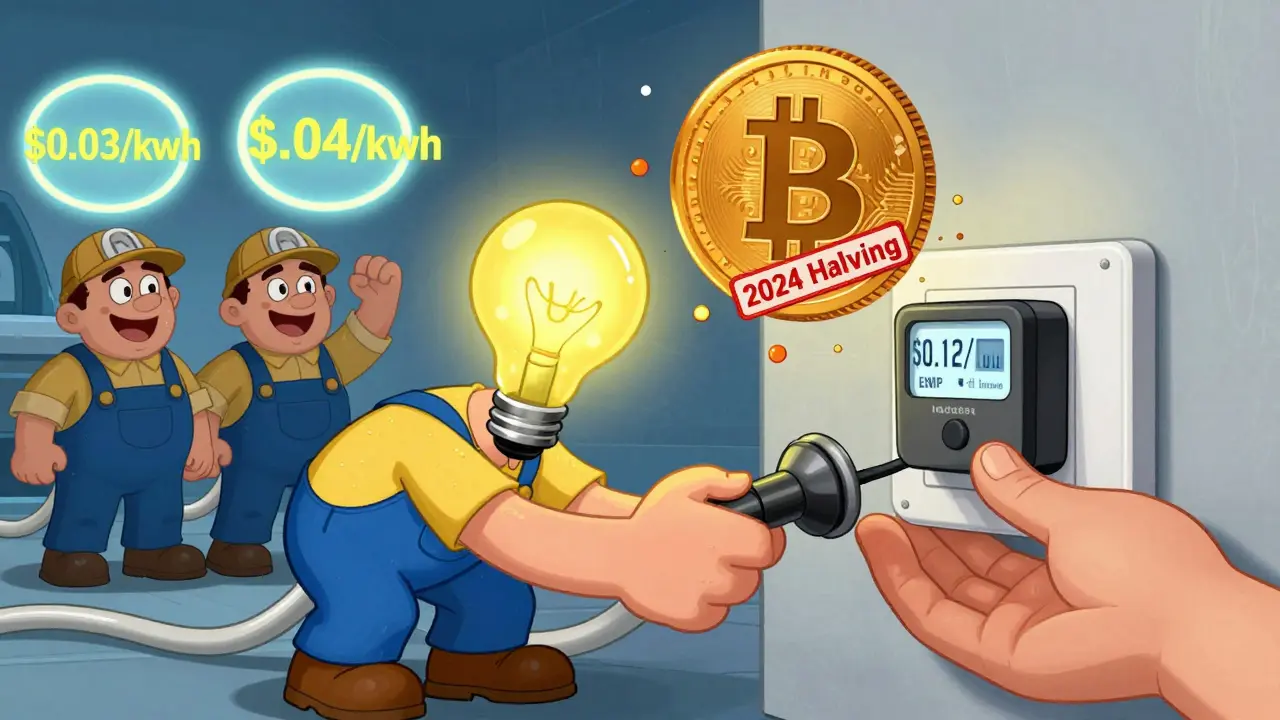
In the U.S., average commercial electricity is $0.1178/kWh. That’s too high for most miners. The break-even point for a new ASIC miner is around $0.06/kWh. Below that, you’re profitable. Above it, you’re losing money-even with the best hardware.That’s why 18.7% of Bitcoin’s hash rate now comes from stranded energy sources: flared gas, hydro dams, excess wind, or geothermal vents. These aren’t fancy data centers. They’re repurposed oil fields, abandoned mines, or remote power plants that would otherwise waste energy. Miners are turning waste into profit.
Miners in Iceland pay $0.03/kWh. In Texas, some industrial zones charge $0.04/kWh thanks to deregulated markets and cheap natural gas. That’s why Marathon Digital and Riot Platforms built massive facilities there. They’re not mining Bitcoin-they’re buying electricity at discount rates and flipping it into crypto.
But here’s the catch: regulatory risk is rising. The EU slapped a 20% energy tax on proof-of-work mining starting January 2025. New York banned new PoW mining for two years. China still bans it outright. If you’re mining in a gray zone, you’re gambling-not investing.
Hardware Costs and Supply Chain Reality
You can’t just walk into a store and buy an AntMiner S21 XP+. You have to order it. And wait.As of Q3 2024, average delivery time for ASIC miners was 14.3 weeks. Some miners waited over six months. If you’re planning to mine in 2026, you need to order your hardware now-or buy used. But used ASICs are risky. They’re often overclocked, poorly maintained, or near end-of-life. A miner that costs $3,000 new might be broken in six months if it was pushed too hard.
Repair costs are real. A single ASIC board replacement can cost $287. Cooling systems add another 2.5x the hardware cost. Noise is a problem too-AntMiners run at 75-85 decibels. That’s like standing next to a jackhammer. You can’t run them in your garage without neighbors calling the cops.
Warranties? Bitmain offers 180 days. But their support response time averages 72 hours. Most miners rely on Reddit, BitcoinTalk, or private forums for help. Community support resolves 85% of issues-better than official channels.
What’s Next for Mining in 2026?
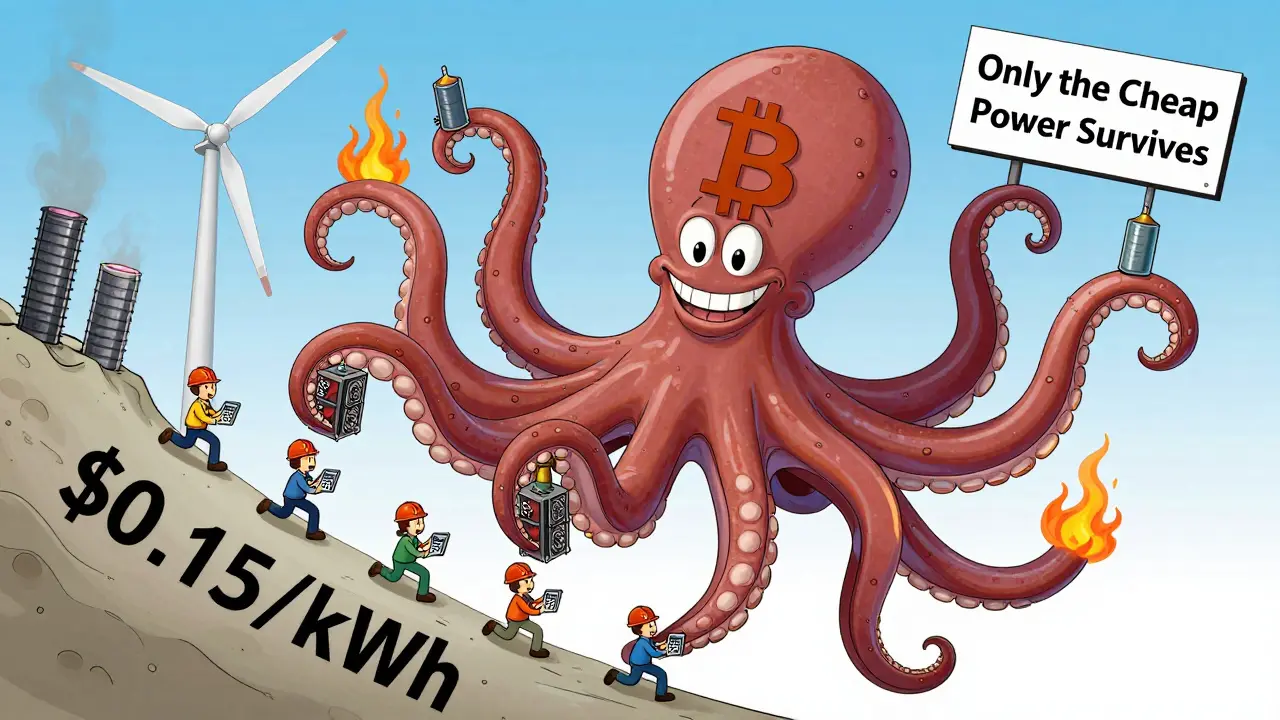
By 2026, mining will be even more concentrated. JPMorgan estimates 68% of current operations will be unprofitable without efficiency gains. Only the top 10%-those with sub-10 J/TH efficiency and power under $0.06/kWh-will survive.Hardware is getting smarter. Canaan’s Avalon 14 series, launching in Q2 2025, targets 150 J/TH efficiency. That’s a 20% improvement over today’s best. But it won’t help if you’re stuck with $0.15/kWh power.
Transaction fees are the long-term lifeline. Right now, block rewards are 3.125 BTC. In 2028, they’ll be 1.56 BTC. By 2032, just 0.78 BTC. But as Bitcoin adoption grows, so do transaction fees. In 2024, fees averaged $1.20 per transaction. In 2030, they could hit $5 or more. Miners who survive the next halving will be paid by users-not block rewards.
Some experts say mining will last until 2140. Others say it’s already a dying industry. The truth? Mining is no longer a hobby. It’s a capital-intensive, energy-hungry business. If you’re not a corporation, a utility, or a billionaire with access to cheap power-you’re probably better off buying Bitcoin outright.
Can You Still Profit in 2026?
Yes. But only if you have:- Access to electricity under $0.06/kWh
- Hardware with efficiency below 10 J/TH
- At least $10,000 to invest upfront
- A facility with industrial cooling and power redundancy
- A tolerance for regulatory risk
If you don’t have those, don’t buy a miner. Buy Bitcoin instead. Or invest in mining companies like Marathon Digital or Riot Platforms. They’ve already solved the power problem. You just need to buy their stock.
Hash rate isn’t a measure of success. It’s a measure of competition. The network keeps getting harder. The winners aren’t the ones with the most powerful machines. They’re the ones with the cheapest power.
Is Bitcoin mining still profitable in 2026?
Yes-but only for those with access to electricity below $0.06/kWh and modern ASIC miners with efficiency under 10 J/TH. Most home miners with standard power rates are losing money after hardware depreciation and cooling costs. The era of casual mining ended with the 2024 halving.
Can I mine Bitcoin with a GPU or CPU?
No, not profitably. A top-end NVIDIA RTX 4090 earns about $0.50 per day in Bitcoin. An AntMiner S21e XP Hyd earns $39.11. The GPU uses 90% of the power for 1/78th of the output. CPU mining is even worse. ASICs dominate Bitcoin mining for a reason: they’re 100x more efficient.
What’s the best ASIC miner for 2026?
As of late 2025, the Bitmain AntMiner S21 Hydro and MicroBT WhatsMiner M56S++ lead in efficiency, hitting 8.2-8.5 J/TH. But availability is low. Most new units are sold out until mid-2026. Used S21e XP Hyd units (860 TH/s, 12.9 J/TH) are still the most common choice for new miners with budget constraints.
How much electricity does Bitcoin mining use?
Bitcoin mining consumes roughly 110-120 terawatt-hours per year-about the same as Argentina or the Netherlands. That’s 0.5% of global electricity use. But efficiency is improving fast. In 2013, miners used 10,000 J/TH. Today’s best models use under 13 J/TH. Renewable sources now power nearly 40% of the network.
What happens if Bitcoin’s price crashes?
If Bitcoin drops below $40,000, most miners with power costs above $0.08/kWh shut down. The network difficulty drops within weeks as machines turn off. This resets the system and allows efficient miners to resume profitably. Price crashes are part of the cycle-they filter out weak operators and protect long-term network security.
Should I mine Bitcoin or just buy it?
For 95% of people, buying Bitcoin is the better choice. Mining requires technical knowledge, upfront capital, reliable power, and tolerance for risk. If you don’t have access to cheap electricity or industrial space, you’re better off buying BTC directly. The ROI is higher, and you avoid hardware failure, maintenance, and regulatory headaches.

7 Comments
Staci Armezzani
Just ran the numbers on my home setup-8 S21e XP Hyds, $0.11/kWh in Texas. Profit? $2.40 a day after cooling and maintenance. I’m not losing money, but I’m not getting rich either. Honestly, I do it for the tech thrill more than the cash. If you’re in it for ROI, buy BTC. If you’re in it to geek out, welcome to the club.
Also, the noise? My dog started barking at the rigs like they’re aliens. I put them in a soundproofed shed. Worth every penny.
sathish kumar
It is imperative to acknowledge that the computational architecture underpinning Bitcoin mining has undergone a paradigmatic evolution since its inception. The energy-to-hash efficiency ratio, now approaching sub-10 joules per terahash, represents a triumph of industrial engineering. However, the socioeconomic implications of centralized mining operations, particularly those leveraging subsidized energy sources, warrant critical scrutiny from both regulatory and ethical perspectives. The marginalization of individual participants is not merely a technical outcome-it is a structural exclusion.
Jordan Leon
There’s something poetic about mining being reduced to a utility play. You’re not a miner anymore-you’re an energy arbitrageur. The machines are just fancy transformers turning watts into Bitcoin.
I used to think the decentralization myth was about hardware. Now I see it’s about access. The ones who win aren’t the cleverest-they’re the ones with the cheapest grid connection. Kinda makes you wonder if Satoshi ever imagined this.
Brittany Slick
Okay but imagine if you could turn your garage into a mini power plant and make money while doing it? Like, you’re literally recycling waste energy into digital gold. It’s wild. I don’t have the cash to buy an ASIC, but I root for the weirdos doing it. You’re not just mining-you’re hacking the system. And honestly? That’s kind of beautiful.
Also, if you ever hear a jackhammer in your neighbor’s basement… now you know why.
Denise Paiva
Everyone’s acting like ASICs are the only way but what if the whole model is broken? Why are we still using proof-of-work in 2026? It’s like using a typewriter because ‘it’s always worked’
And who cares about $0.06/kWh? I’m not paying that. I’m paying $0.20. So I guess I’m just donating to Elon’s next rocket fund.
Also the whole ‘stranded energy’ thing is just greenwashing. You’re burning gas to make crypto. That’s not sustainability. That’s capitalism with a fancy label
Charlotte Parker
Oh wow. So mining is now a billionaire’s club where you need a power plant and a lawyer to stay legal? Congrats, Bitcoin. You turned into the thing you were supposed to destroy.
Let me get this straight-you’re telling me a guy with a $6k rig and a $1500 electric bill is a ‘miner’ while a hedge fund with a data center in Iceland is ‘decentralized’? The irony is thicker than the cooling fluid in those ASICs.
And don’t even get me started on ‘used ASICs.’ You’re buying a 12-month-old machine that’s been overclocked by a guy in a basement who thinks ‘thermal paste’ is a type of pasta. Good luck.
Buy BTC. Seriously. Stop pretending you’re a pioneer. You’re a cash cow for Bitmain.
Calen Adams
Let’s cut through the noise-this isn’t mining anymore, it’s industrial crypto arbitrage. The real winners? The ones who own the power, not the rigs.
ASICs are the only game in town. GPUs? Dead. CPUs? Fossil tech. If you’re still running a 4090 farm, you’re not a miner-you’re a data center janitor.
And yeah, the halving killed the hobbyists. But that’s the beauty of it. The network self-cleans. Weak players exit. Efficient ones survive. That’s how you build a resilient system.
Stop whining about electricity costs. Go find cheap power. Go partner with a wind farm. Go lease a decommissioned coal plant. That’s the innovation. Not buying BTC and calling it a day.
Also-warranties are garbage. You think Bitmain gives a shit? No. You’re on your own. That’s why Reddit is your new IT department. Embrace it.
Bottom line: if you don’t have sub-$0.06/kWh and a 10 J/TH rig, you’re not in the game. You’re just watching. So either step up… or get out.
And if you’re reading this and thinking ‘I’ll just buy stock’-you’re right. But you’re also missing the thrill. The noise. The heat. The grind. That’s the real crypto.