
Imagine stealing over $1.5 billion in a single night. Now imagine trying to spend it without anyone noticing where it came from. That is the daily reality for Lazarus Group, the elite cyber-warfare unit linked to North Korea's Reconnaissance General Bureau. For years, these hackers relied on simple mixing services to hide their tracks. But as regulators cracked down on those tools, Pyongyang adapted. They stopped hiding funds in one place and started moving them everywhere. Today, they exploit the very infrastructure designed to make crypto interoperable-cross-chain bridges-to wash billions of dollars through a digital labyrinth.
The Shift From Mixers to Bridges
If you followed crypto news between 2019 and 2021, you know about mixers like Tornado Cash or Sinbad. These services pooled users' coins together so no one could tell which input matched which output. It worked well until governments started freezing assets associated with these platforms. By 2023, the strategy had changed. The Lazarus Group shifted its focus to cross-chain bridge exploitation and rapid asset conversion. Instead of just obscuring who owns what, they began changing what the asset actually is.
This isn't just about moving money; it's about breaking the trail. When stolen Ethereum hits a bridge, it might emerge as Bitcoin on another chain. Then it swaps again into a stablecoin on a third network. Each hop resets the analytical clock for investigators. According to data from TRM Labs, this method has become the dominant tactic. Between 2023 and 2024, the volume of funds processed through these conversion services surged by over 100%. Why? Because while a mixer leaves a statistical footprint, a bridge swap looks like legitimate user activity-at least until you trace the entire journey across five different blockchains.
Anatomy of a Cross-Chain Heist
Let’s look at how this actually plays out, using the massive Bybit hack in February 2025 as a case study. This wasn't just a theft; it was a masterclass in obfuscation. The attackers didn't just drain the wallet and run. They initiated a "flood the zone" technique. This involves overwhelming compliance teams and blockchain analysts with a barrage of high-frequency transactions across multiple platforms simultaneously.
Here is the typical lifecycle of stolen DPRK funds:
- Extraction: Funds are drained from centralized exchanges (CEXs) or DeFi protocols on chains like Ethereum or Solana.
- Initial Conversion: Tokens are swapped via decentralized exchanges (DEXs) into native assets like ETH or TRX.
- Bridge Hopping: Assets move across bridges such as Ren Bridge or Avalanche Bridge. Bitdefender noted that over 9,500 BTC flowed through the Avalanche Bridge alone during recent campaigns.
- Layering: The assets are split into smaller chunks and sent to freshly created addresses on obscure blockchains where analytics coverage is thin.
- Final Destination: Eventually, much of this value converts back to Bitcoin, often sitting idle in wallets awaiting large-scale liquidation via Over-The-Counter (OTC) desks.
The goal isn't always immediate cash-out. Often, the funds sit dormant. This pause allows the heat to die down before the final sale, making it harder for law enforcement to link the initial theft to the eventual buyer.
| Tactic Era | Primary Method | Key Tools | Vulnerability |
|---|---|---|---|
| 2017-2021 | Mixing & Centralized Exchanges | Sinbad, Wasabi Wallet, LocalBitcoins | Sanctions on mixers; KYC on major CEXs |
| 2022-2024 | Cross-Chain Bridging | Avalanche Bridge, Ren Bridge, Polygon PoS | Improved cross-chain analytics (TRM Phoenix) |
| 2025-Present | Flood the Zone & Social Engineering | Obscure L2s, Custom Tokens, OTC Desks | Human error; lack of coverage on niche chains |

Why Bridges Are the Perfect Hideout
Cross-chain bridges were built to solve a problem: blockchains don't talk to each other natively. If you want to use your Ethereum-based token on Solana, you lock the ETH and mint a wrapped version on Solana. For legitimate users, this is convenient. For launderers, it's a blind spot.
Most blockchain analytics tools excel at tracking transactions within a single chain. Tracing an address on Ethereum is straightforward. But when that address sends funds to a bridge contract, the link becomes probabilistic rather than deterministic. You have to match timing, amount, and destination patterns across disparate ledgers. This process is slow and prone to errors.
North Korean operators exploit this friction. They use less popular chains-sometimes called "obscure blockchains"-where firms like Chainalysis or Elliptic have limited node coverage. If a hacker moves funds to a small Layer-2 solution or a new altcoin, the trail goes cold quickly. Furthermore, some groups create their own tokens on these networks, trading them against established assets to further muddy the waters. It’s not just about moving money; it’s about creating noise.
The Economic Engine Behind the Guns
You might wonder why a nation state cares so much about crypto theft. The answer lies in sanctions. North Korea faces severe economic restrictions that limit its ability to earn foreign currency through traditional trade. Cybercrime fills that gap. A senior U.S. official estimated in 2024 that roughly 50% of the DPRK's foreign-currency earnings now come from cyber operations.
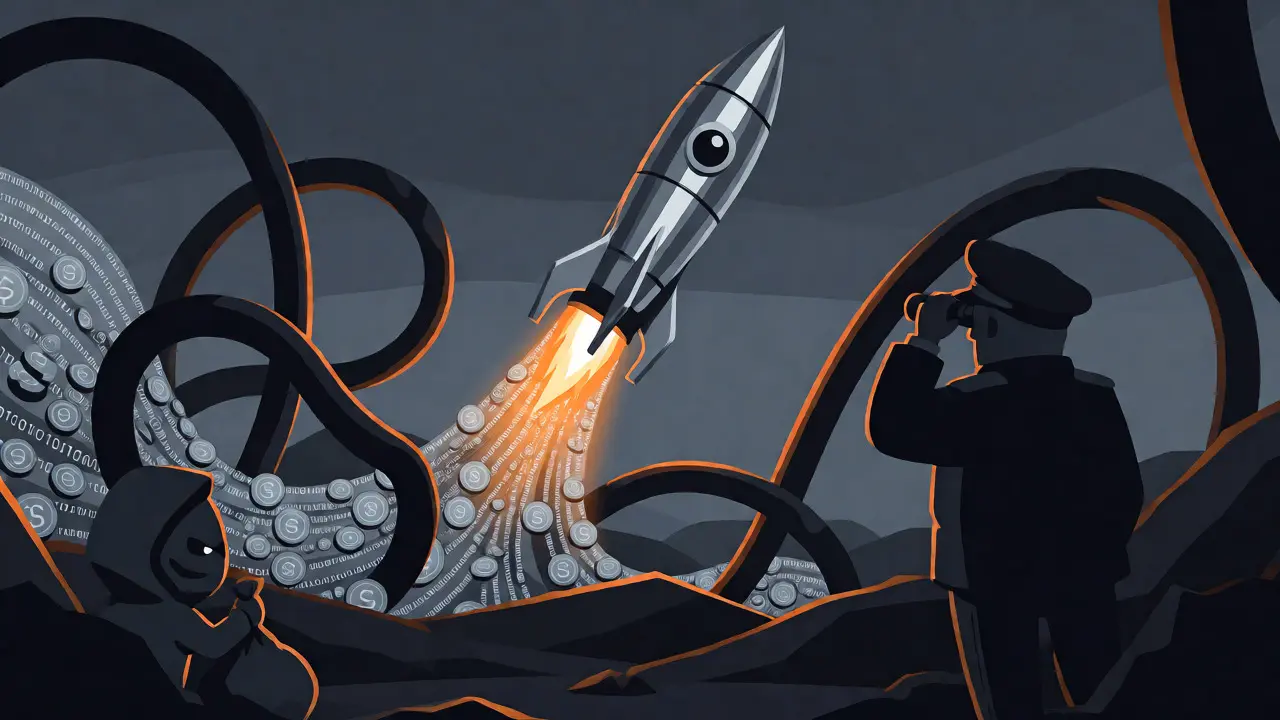
The scale is staggering. In 2023, North Korean hackers stole approximately $660 million. In 2024, that number jumped to $1.34 billion. By 2025, reports indicate thefts exceeding $2 billion annually. The Bybit heist alone accounted for more than all of 2023's combined losses. This revenue directly funds the regime's weapons programs. As noted in UN reports, there is a direct pipeline from stolen digital assets to missile tests and nuclear development. Every dollar laundered through a bridge is a dollar that potentially buys components for a rocket engine.
The Arms Race: Analytics vs. Automation
As DPRK tactics evolve, so do the countermeasures. Firms like TRM Labs and Elliptic have developed specialized tools to track cross-chain flows. TRM introduced "Phoenix," a system designed specifically to automatically trace funds moving through bridges. Before this, analysts had to manually stitch together transaction histories across different block explorers-a time-consuming process that allowed criminals to slip away.
However, the attackers are also automating. They use scripts to execute hundreds of swaps in minutes, racing against human analysts. The FBI even intervened in August 2023, urging exchanges to freeze known Lazarus-associated wallets. Yet, the sheer volume of new addresses created daily makes blacklisting difficult. It’s a game of whack-a-mole where the moles are sophisticated, well-funded, and operating from behind one of the world's most closed borders.
Moreover, the target profile is shifting. While early attacks focused on hacking exchange code, recent operations increasingly rely on social engineering. Phishing attacks targeting individual executives and high-net-worth holders have become common. As Elliptic pointed out, the weak point is no longer the technology-it’s the human. A compromised private key from a careless executive can yield millions faster than a complex smart contract exploit.
What This Means for Regular Investors
So, why should you care if you’re just holding Bitcoin or trading altcoins? First, security. If you interact with DeFi protocols or bridges, be aware that your funds might pass through environments heavily trafficked by illicit actors. Second, regulatory pressure. As governments tighten rules on cross-chain transactions, you might see increased KYC requirements or delays in withdrawals from certain platforms.
Third, market volatility. Large-scale dumps of laundered crypto can impact prices. When DPRK hackers finally decide to liquidate billions in stationary Bitcoin, it creates selling pressure. Understanding the flow of these illicit funds helps predict potential market shocks.
The story of DPRK crypto laundering is far from over. As long as blockchain interoperability grows, so will the methods used to abuse it. The hackers are adapting faster than regulations can keep up, turning the open nature of public ledgers into a shield rather than a sword. For now, the arms race continues, with every new bridge launch offering a fresh opportunity for the next big heist.
Who is the Lazarus Group?
The Lazarus Group is a cyber-threat organization attributed to North Korea's Reconnaissance General Bureau (RGB). It serves as the umbrella term for various intelligence units conducting cyber espionage and financial theft, including the subunit TraderTraitor, which the FBI linked to the 2025 Bybit hack.
Why did North Korean hackers stop using mixers?
Regulators intensified scrutiny on mixing services like Tornado Cash and Sinbad, leading to seizures and sanctions. To evade detection, hackers shifted to cross-chain bridges, which allow them to convert assets between different blockchains, effectively breaking the direct transactional link that mixers previously obscured.
What is the "flood the zone" technique?
This is a laundering strategy where attackers overwhelm compliance teams and blockchain analysts with a high volume of rapid transactions across multiple platforms. The sheer speed and complexity make it difficult for investigators to track the origin and destination of funds in real-time.
How much crypto has North Korea stolen recently?
Estimates vary, but significant reports suggest escalating totals: approximately $660 million in 2023, $1.34 billion in 2024, and over $2 billion in 2025. The single Bybit breach in February 2025 exceeded $1.5 billion, marking it as one of the largest crypto heists in history.
Do North Korean hackers only attack exchanges?
No. While centralized exchanges remain prime targets, there has been a strategic pivot toward attacking individuals, particularly high-net-worth crypto holders and company executives. These targets often use social engineering tactics like phishing and fake job offers, exploiting human error rather than just technical vulnerabilities.
