
India Crypto Tax Calculator
Calculate Your Potential Tax Liability
Estimate your tax obligations under India's new CARF reporting framework (effective April 1, 2027). This tool helps you understand potential liabilities for crypto transactions.
Calculation Results
Enter your transaction details to see estimated tax liability.
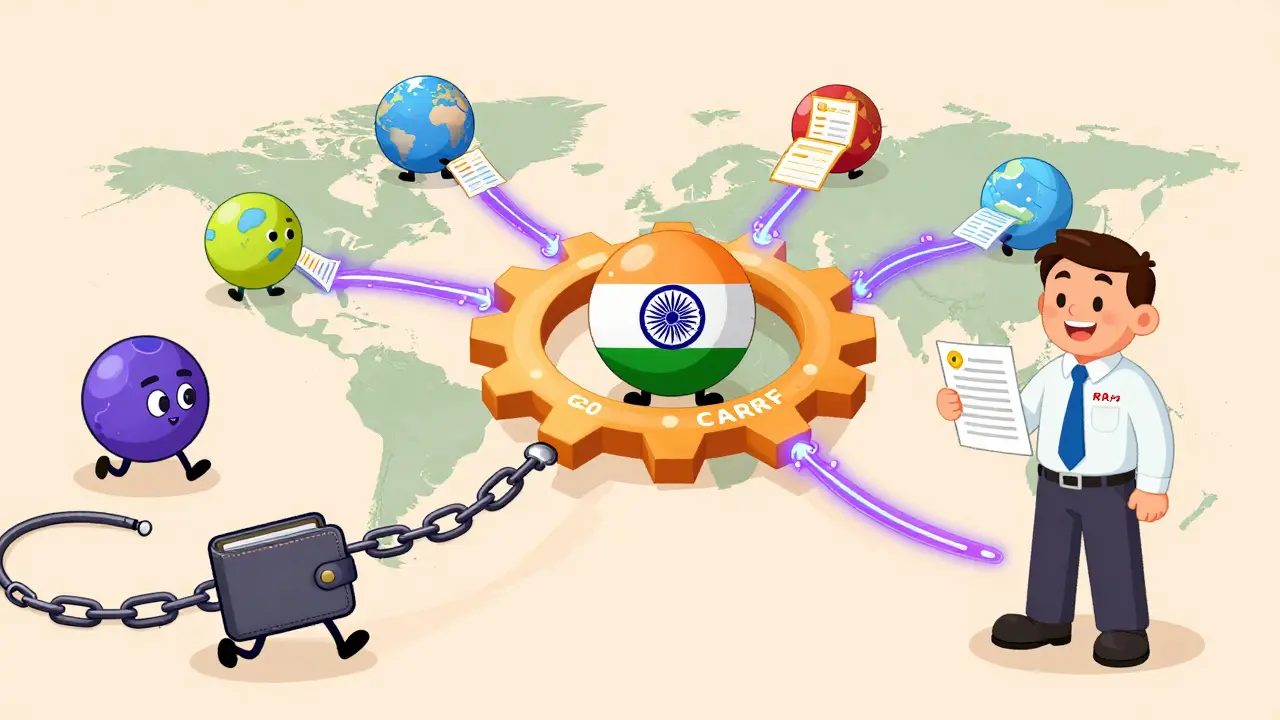
Starting April 1, 2027, Indian residents holding cryptocurrency overseas will no longer be able to hide those assets from tax authorities. India has officially committed to adopting the OECD Crypto-Asset Reporting Framework (CARF), a global system designed to automatically share crypto transaction data between countries. This isn’t just another regulation-it’s a fundamental shift in how India tracks digital asset ownership and enforces tax compliance.
What Is the OECD Crypto-Asset Reporting Framework?
The OECD’s CARF is a global standard that forces financial institutions and crypto service providers to collect and report detailed information about their users’ crypto transactions. Think of it like the Common Reporting Standard (CRS), which India has used since 2015 to share bank account data with other countries-but now it’s extended to Bitcoin, Ethereum, and all other crypto-assets. The framework doesn’t just track balances. It captures buy/sell dates, transaction values, wallet addresses, and even the identities of users who trade through exchanges or custodial platforms.
India is one of 67 countries that have pledged to implement CARF by 2027-2028. This isn’t optional. It’s a coordinated effort led by the G20, with all major economies on board. The goal? Close the loophole that allowed people to move crypto offshore to avoid taxes. Before CARF, if you bought Bitcoin on a foreign exchange and never reported it, Indian tax authorities had little way of knowing. Now, that exchange will report your activity directly to India’s tax department.
When Does It Start? The Timeline
The rollout has a clear, two-phase timeline:
- April 1, 2026: Section 285BAA of the Income Tax Act comes into force. This new law requires Indian crypto exchanges, wallet providers, and other designated reporting entities to start collecting user data. They must log every transaction: who bought what, when, and for how much. This is the groundwork phase.
- April 1, 2027: Full CARF implementation. India begins automatically exchanging this data with other participating countries. If you hold crypto on Binance, Kraken, or any foreign platform, and you’re an Indian resident, that platform will send your details to the Indian tax authorities-and vice versa.
That gives Indian firms about 12 months to upgrade their systems. The OECD published XML reporting standards in October 2024, and every reporting entity must comply with them. No more manual spreadsheets. No more guesswork. The data must be structured, machine-readable, and transmitted securely.
Who Has to Report?
The rules apply to anyone acting as a “reporting entity” under the law. That includes:
- Indian-based crypto exchanges (like WazirX, CoinSwitch Kuber)
- Foreign exchanges that serve Indian users (Binance, Coinbase, Kraken)
- Custodial wallet providers (platforms that hold your keys for you)
- Payment processors that facilitate crypto transactions
Individual users don’t report directly. But if you use any of these services, your data will be collected and shared. Non-custodial wallets (like MetaMask or Ledger where you control your own keys) are trickier. The framework doesn’t yet require reporting from self-hosted wallets, but that’s a gray area. If you move crypto from a regulated exchange to your own wallet and then trade on another platform, the system may still catch you through transaction tracing.

Why Now? India’s Strategic Move
India’s decision didn’t come out of nowhere. During its G20 presidency in 2023, India pushed for global consensus on crypto taxation. The New Delhi Leaders’ Declaration included a unanimous endorsement of CARF. That gave India political leverage-and moral authority-to lead the charge.
Before CARF, India’s crypto tax rules were limited. The 30% tax on crypto gains introduced in 2022 was a start, but enforcement was weak. Without knowing where assets were held, the tax department couldn’t verify claims. Millions of users reported zero income, even as crypto trading volumes in India soared past $100 billion annually. CARF changes that. It turns tax evasion from a guessing game into a data-driven audit.
Experts say this is about fiscal sovereignty. As digital assets grow, so does the risk of capital flight. CARF ensures India can track where its citizens’ wealth is going-and collect what’s owed. It’s not about punishing users. It’s about leveling the playing field so everyone pays their fair share.
What This Means for Crypto Users in India
If you’ve been holding crypto on foreign platforms without declaring it, you’re now at risk. The tax department will soon have a complete picture of your activity. Late disclosures will likely trigger penalties, interest, and possible scrutiny.
Here’s what you should do now:
- Review all your crypto holdings-both domestic and foreign.
- Check your past tax filings. Did you report gains from 2022 onward?
- If you haven’t, consider voluntary disclosure before CARF goes live. The government may offer a window to correct past errors without heavy penalties.
- Keep records of all transactions: dates, amounts, exchange names, and wallet addresses.
Privacy concerns are real. Some users worry this is surveillance. But CARF doesn’t track your every move-it only reports what exchanges already know. If you’re compliant, you have nothing to fear. If you’ve been hiding, the net is closing.
Impact on Crypto Exchanges and Businesses
For Indian exchanges, CARF is a double-edged sword. On one hand, it brings legitimacy. Regulated platforms gain trust. On the other, compliance is expensive.
Building systems that can track thousands of transactions per second, map wallet addresses to real identities, and format data in OECD XML standards isn’t cheap. Medium-sized exchanges may need to hire compliance teams or buy third-party software. Smaller players might struggle to survive. Some may exit the market entirely.
Foreign exchanges serving Indian users face the same pressure. If they don’t comply, they risk being blocked from operating in India. The government has the power to restrict access to Indian payment gateways or impose fines. That’s why Binance and Coinbase are already preparing.
One silver lining: clarity. For years, Indian crypto businesses operated in legal limbo. CARF gives them a roadmap. Even if it’s strict, at least they know what’s expected.
How It Compares to Other Countries
India isn’t alone. The U.S. is pushing broker reporting rules under the IRS. The EU has MiCA, its own crypto regulation. But India’s approach is unique because of its scale. With over 100 million crypto users, India represents one of the largest markets in the world. If CARF works here, it sets a precedent for other emerging economies.
Unlike the EU, which focuses on consumer protection and market structure, India’s CARF rollout is laser-focused on tax collection. That makes it more aggressive-and potentially more effective. The U.S. still struggles with fragmented state-level rules. India’s centralized system gives it an edge in enforcement.
What’s Next?
The Finance Ministry is expected to release detailed implementation guidelines in early 2025. These will define exactly what data must be collected, how often, and how it’s transmitted. The OECD will continue updating its XML standards, and India will need to align with them.
By mid-2026, all reporting entities should have systems ready. The real test comes in 2027, when the first data exchange happens. If the system works smoothly, expect more countries to join. If there are glitches, delays could push back deadlines.
For now, the message is clear: the era of unreported crypto is ending. India is no longer waiting for global standards-it’s helping to build them. And whether you’re a trader, investor, or exchange operator, you need to be ready.

9 Comments
Akash Kumar Yadav
This is long overdue. For years, Indians have been laughing at the tax department while stashing crypto on Binance like it's some kind of secret club. Now the net's closing and the feds are getting the full ledger. Good. If you're rich enough to buy Bitcoin but too cheap to pay taxes, you deserve to get audited into next decade.
samuel goodge
It's fascinating how CARF mirrors the evolution of financial transparency - from paper ledgers to blockchain immutability. The real question isn't whether India can enforce it, but whether the global infrastructure can handle the volume without collapsing under its own weight. The XML standards are elegant, but are the APIs robust enough? And what happens when a user holds crypto across 17 different wallets on 5 continents?
Vidyut Arcot
Hey, if you're holding crypto and not reporting - now's the time to clean it up. No panic, no drama. Just sit down, pull your transaction history, and file what you missed. The government’s not coming for your grandma’s savings - they’re coming for the people who think loopholes are a lifestyle. You’ve got a year. Use it wisely.
Heather Hartman
I’m so proud of India for taking this step! It’s not about control - it’s about fairness. Everyone deserves a level playing field, and now, even the quiet investors who never brag about their gains will finally be seen. This is how you build trust in the future of finance.
Reggie Herbert
Let’s be clear: CARF is not a tax policy. It’s a surveillance protocol disguised as compliance. The OECD doesn’t care about your fiscal sovereignty - they care about centralizing control. And this isn’t ‘fairness’ - it’s the death of financial privacy. If you’re okay with every wallet address being mapped to your Aadhaar, then congrats, you’ve already surrendered.
justin allen
Oh wow, another country joining the global nanny-state parade. Next they’ll require your toaster to report your butter consumption. This isn’t regulation - it’s psychological warfare. They want you scared enough to obey. And guess what? It’s working. Sad.
ashi chopra
I know people are scared, but I’ve been talking to my cousin who runs a small crypto shop in Pune - he’s actually relieved. For years, he had no idea if he was breaking the law. Now he knows exactly what to do. That’s peace of mind. Maybe this isn’t about punishment… maybe it’s about giving people a real chance to get right.
alex bolduin
History keeps repeating itself. Remember when banks went digital and everyone screamed about privacy? Then we got online banking and never looked back. Crypto’s the same. The tech doesn’t change - the fear does. CARF isn’t the end of freedom. It’s the beginning of maturity.
Alan Brandon Rivera León
As someone who’s lived in both the US and India, I see this as a quiet revolution. The US talks about innovation but moves slow. Europe over-regulates. India? They’re building the future while the others debate it. This isn’t about control - it’s about responsibility. And honestly? That’s something we all need more of.