North Korean Crypto Wallet Sanction Checker
Check Wallet Address
Enter a cryptocurrency wallet address to verify if it's associated with North Korean cybercrime operations.
North Korea isn’t just building missiles and nuclear warheads-it’s stealing billions in cryptocurrency to pay for them. Since 2017, the regime has turned cyber theft into a state-run industry, targeting exchanges, DeFi protocols, and individual wallets with surgical precision. By 2025, the total stolen exceeded $6 billion, with over $2.03 billion taken in just the first nine months of the year alone. That’s more than triple what was stolen in 2024. And it’s not random hacking. This is a coordinated, government-backed operation run by elite cyber units under the Reconnaissance General Bureau.
How North Korea Steals Crypto at Scale
North Korea doesn’t break into wallets by guessing passwords. They use sophisticated phishing campaigns, fake job offers for overseas IT workers, and zero-day exploits in blockchain bridges. The biggest single heist in 2025 was the $1.46 billion attack on Bybit, one of the world’s top five crypto exchanges. Hackers exploited a flaw in its cross-chain bridge, drained funds across multiple chains, and moved them through a maze of intermediate wallets before cashing out.
Other targets included LND.fi, WOO X, and Seedify-all platforms with weak security or poor monitoring. These weren’t random picks. Intelligence suggests North Korean operators spent months studying transaction patterns, identifying liquidity pools with low vigilance, and mapping out exit routes before striking.
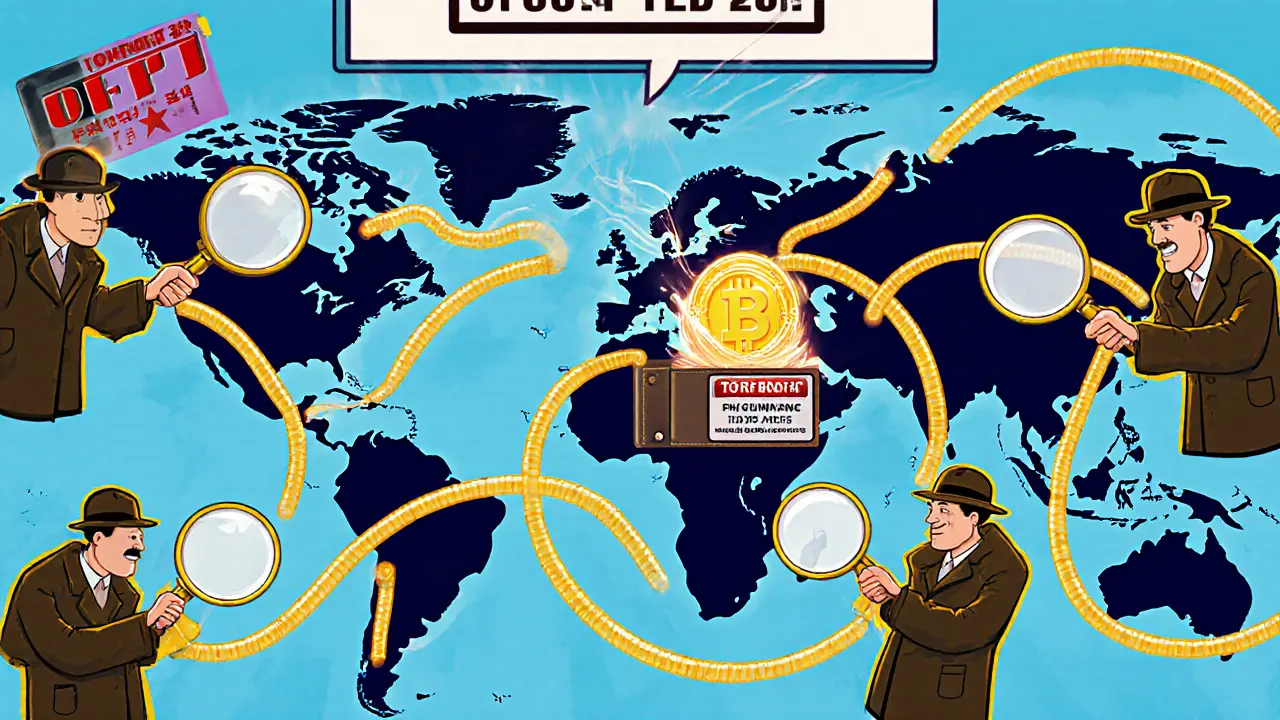
After the theft, the money doesn’t sit still. It flows through mixing services like Tornado Cash clones, gets swapped into privacy coins like Monero, then converted back to Bitcoin or Ethereum before moving to centralized exchanges. Some funds are laundered through fake businesses in China and Russia, disguised as payments for IT services. This isn’t just theft-it’s financial engineering on a national scale.
Who’s Behind the Attacks?
The U.S. Treasury’s Office of Foreign Assets Control (OFAC) has publicly named several entities tied to these operations. On July 24, 2025, OFAC sanctioned Vitaliy Sergeyevich Andreyev, Kim Ung Sun, Shenyang Geumpungri Network Technology Co., Ltd., and Korea Sinjin Trading Corporation. These aren’t random individuals. They’re nodes in a global network of front companies that hire North Korean coders under false identities to work remotely for foreign firms-while secretly stealing data, deploying ransomware, and laundering crypto.
The Multilateral Sanctions Monitoring Team (MSMT), a coalition of 11 nations including the U.S., Japan, and South Korea, confirmed in its October 2025 report that North Korea’s cyber operations now rival those of Russia and China. Their IT workers aren’t just freelancers-they’re soldiers in a digital war. Many operate from China, Vietnam, and Malaysia under fake passports, paid in crypto, and instructed to funnel profits back to Pyongyang.
These teams don’t just steal. They also sell stolen data on dark web markets, extort companies with ransomware, and even hack cryptocurrency projects to manipulate token prices. It’s a full-spectrum cyber economy funded by theft.
Sanctioned Wallet Addresses: What We Know (and What We Don’t)
Blockchain analytics firms like Elliptic have identified dozens of wallet clusters linked to North Korean actors. These aren’t single addresses-they’re networks of hundreds of wallets, each used for a specific stage of laundering. One cluster might receive stolen funds from an exchange breach. Another handles mixing. A third converts to fiat through offshore exchanges.
But here’s the catch: public reports rarely list exact wallet addresses. Why? Because publishing them gives North Korean hackers time to move the funds before sanctions can be enforced. Instead, regulators rely on pattern recognition-transaction timing, volume spikes, connections to known malicious addresses, and use of specific mixing services-to flag suspicious activity.
That said, some addresses have been indirectly revealed through enforcement actions. For example, after the Bybit breach, Elliptic traced over $800 million to a cluster of Ethereum and BNB Chain wallets that had previously been used in the 2022 Ronin Network heist. That same cluster showed up again in 2024 and 2025. It’s the same group. Same tools. Same playbook.
Financial institutions and exchanges now use real-time screening tools that check incoming and outgoing transactions against these known clusters. If a deposit comes from a wallet that’s ever interacted with a sanctioned address-even indirectly-it gets flagged. Some platforms freeze the funds and report them to authorities.
Why Sanctions Are Hard to Enforce
Sanctioning a wallet address sounds simple. But in practice, it’s like trying to stop a river by blocking one pebble.
North Korean hackers constantly generate new addresses. They use decentralized exchanges that don’t require KYC. They exploit cross-chain bridges that lack unified monitoring. They move funds through non-custodial wallets where no single entity controls access. Even when a wallet is sanctioned, the money is often already gone-converted to cash, invested in real estate, or used to buy weapons-grade materials.
Plus, many countries lack the technical capacity to monitor crypto flows. While the U.S., Japan, and South Korea have advanced blockchain analytics teams, others still rely on outdated AML systems built for banks, not blockchains. This creates gaps where funds slip through.
And then there’s the issue of attribution. Just because a wallet shows patterns similar to North Korean activity doesn’t mean it’s definitely theirs. Other threat actors mimic their techniques. Without intelligence from human sources or intercepted communications, regulators can’t act with full confidence. That’s why Elliptic says the real number of stolen funds is likely higher than reported.
How the World Is Fighting Back
The U.S. Department of State has offered up to $15 million for information leading to the disruption of North Korea’s crypto operations. That’s not just a reward-it’s a signal. They’re serious about shutting this down.
Exchanges like Binance, Coinbase, and Kraken now integrate blockchain intelligence tools from Chainalysis and Elliptic into their compliance systems. They automatically block transactions from known DPRK-linked clusters. Some even freeze accounts that interact with those wallets-even if the user didn’t know the address was tainted.
Japan and South Korea have created joint task forces to track crypto flows across borders. In 2025, they froze over $210 million in assets tied to North Korean front companies operating in Southeast Asia. The EU is also ramping up its crypto monitoring capabilities, though slower than the U.S.
But the real game-changer is the MSMT’s second report. For the first time, 11 nations are sharing intelligence, not just sanctions lists. They’re pooling data on wallet clusters, hacking tools, and laundering routes. That kind of cooperation is what finally starts to close the loopholes.
What’s Next? The Rise of DeFi Exploits
North Korea’s next target? Decentralized finance.
The $1.46 billion Bybit breach showed how vulnerable centralized exchanges can be. But DeFi protocols? They’re even more exposed. Many have poorly audited smart contracts, no central team to freeze funds, and no way to reverse transactions. In 2025, North Korean hackers began probing protocols like Pendle, Curve, and Yearn Finance. They’re testing ways to drain liquidity pools without triggering alerts.
Experts predict the next major heist will come from a flash loan attack on a new DeFi bridge. These attacks require no prior access-just a clever exploit and a few minutes of network time. And once the funds are gone, they’re gone for good.
That’s why blockchain developers are now building “sanction-aware” protocols. Some are embedding OFAC compliance checks directly into smart contracts. Others are creating on-chain blacklists that automatically reject transactions from known bad actors. It’s not perfect-but it’s a start.
What You Need to Know
If you’re a crypto user, you’re not directly at risk of being targeted by North Korea. But you could be caught in the crossfire.
- Always use reputable exchanges with strong compliance systems.
- Avoid sending crypto to unfamiliar wallets-even if they’re promoted as “safe” or “high-yield.”
- Use wallet analytics tools like Nansen or Arkham to check if a recipient address has ties to sanctioned entities.
- If your wallet gets flagged by your exchange, don’t panic. It’s likely a false positive. Contact support and provide transaction history.
The bottom line: North Korea’s crypto theft isn’t going away. But the world is getting better at stopping it. The $6 billion stolen so far is a wake-up call. The next billion might be the last one they get away with.
Are there public lists of North Korean crypto wallet addresses?
No official public list exists. Governments and blockchain analytics firms like Elliptic track clusters of wallets linked to North Korea, but they don’t publish exact addresses to avoid tipping off hackers. Instead, exchanges and financial institutions use real-time screening tools that detect suspicious patterns and known associations without revealing specific addresses.
Can I get in trouble if I accidentally transact with a sanctioned wallet?
Generally, no-if you didn’t know the address was linked to North Korea and didn’t intend to help launder funds. Most exchanges will freeze the transaction and report it, but individuals aren’t penalized unless there’s evidence of intent. However, repeated interactions with flagged addresses may trigger further scrutiny from your exchange or financial institution.
How do blockchain analytics firms trace North Korean crypto?
They use transaction clustering, pattern recognition, and intelligence sources. For example, if multiple wallets receive funds from a known breach, then send them to the same mixing service, then to a specific exchange-all in a short time window-that’s a signature of North Korean laundering. They also cross-reference data from seized devices, insider reports, and past heists to build attribution.
Why is North Korea stealing so much crypto now?
International sanctions have cut off traditional revenue streams like arms sales and coal exports. Crypto theft is now their primary way to earn hard currency without physical transactions. It’s fast, anonymous, and global. With over $2 billion stolen in 2025 alone, it’s become their most reliable funding source for nuclear and missile programs.
Is it possible to completely stop North Korea’s crypto theft?
Not entirely. As long as blockchain technology exists, there will be vulnerabilities to exploit. But the goal isn’t total prevention-it’s disruption. By making it harder, slower, and riskier to launder stolen funds, the international community is forcing North Korea to spend more resources for less return. That’s how you win a war of attrition.

8 Comments
Abby cant tell ya
so like... North Korea is basically the ultimate crypto grifter? 😒 i mean, they’re not even trying to be subtle anymore. stole $2 billion in 9 months? bro, that’s more than my entire 401k. and we’re just sitting here debating whether to buy shiba or not. absolute chaos.
Janice Jose
It’s wild how much tech has turned into a battlefield. I get scared thinking about how many normal people’s wallets got caught in the crossfire just because they used a sketchy DEX. We need way more education-not just sanctions.
Eddy Lust
fr tho, the fact that they’re using fake IT jobs to recruit coders is next level. like… imagine getting a ‘remote dev role’ from a company in Vietnam, only to realize you’re part of a state-sponsored heist squad. it’s not even a scam anymore-it’s a cult. 🤯 i’ve seen dudes on Reddit bragging about their ‘crypto side hustle’… now i wonder if they’re just laundering for Pyongyang.
Casey Meehan
LOL the idea that we can ‘stop’ this is delusional. 🤡 North Korea’s got more crypto cash than most small countries. They’re not stealing for fun-they’re building nukes with ETH. And you think a few sanctioned wallets are gonna stop them? bro, they’ve got 500 new addresses before you finish reading this comment. 💸💣 #CryptoIsWar
Tom MacDermott
Oh wow, another ‘woke blockchain analyst’ article pretending this is a ‘technical problem.’ Please. This isn’t about smart contracts-it’s about a totalitarian regime exploiting Western naivety. The real failure? The fact that we still treat crypto like a free market when it’s clearly a lawless playground for dictators. And yet, somehow, the same people who scream about ‘decentralization’ are now begging for OFAC to police their wallets. Pathetic.
Martin Doyle
You guys are missing the point. This isn’t about wallets or addresses-it’s about accountability. If exchanges are letting billions get stolen through bridges they didn’t audit, they’re complicit. Time to shut down the lazy platforms. No more ‘we’re just a marketplace’ excuses. If you don’t secure it, you don’t get to profit from it. #HoldExchangesAccountable
Susan Dugan
Okay but real talk-this is why I always tell my friends to use Nansen before sending anything. I’ve saved two people from accidentally sending funds to flagged clusters just by checking the address history. It’s not hard, it’s not scary, it’s just common sense. Also, if your exchange doesn’t use Chainalysis or Elliptic? Switch. Your money’s not safe. And yes, I’m that person who sends you a 10-slide deck on wallet hygiene. You’re welcome. 💪
Tony spart
North Korea? Pfft. They’re just a bunch of hacks with bad Wi-Fi. The real problem? The US letting these commie scumbags get away with it while we’re busy banning TikTok. If we had a real president, we’d nuke their servers and call it a day. Why are we even talking about wallets? Just bomb the damn data centers in China. #AmericaFirst #CryptoIsCommie