
Imagine paying $15 to send a simple transaction on Ethereum mainnet. Now imagine doing the same thing for less than a dime. That gap is exactly what Optimistic Rollups are built to close. These Layer 2 scaling solutions move heavy computation off the main blockchain while keeping security tied directly to Ethereum’s consensus layer. If you’ve ever wondered why your gas fees spike during network congestion or why withdrawing funds from an L2 chain takes days, this guide breaks down how optimistic rollups work, their real-world costs, and where they stand in the 2026 market.
The Core Problem: Ethereum Scalability Limits
Ethereum’s base layer has always struggled with throughput. During peak usage periods in early 2021, transaction fees routinely exceeded $15 per transfer, making everyday DeFi interactions prohibitively expensive for most users. This congestion created a critical bottleneck: the network could only process about 15 transactions per second (TPS), far below what modern decentralized applications require. Optimistic rollups emerged as a direct response to this limitation, aiming to boost throughput by handling execution off-chain while posting compressed data back to Ethereum for finality.
The solution isn’t just about speed; it’s about cost efficiency. By batching thousands of transactions together before submitting them to the main chain, these systems reduce on-chain data requirements by 80-90%. For example, Arbitrum One, launched in August 2021, aggregates approximately 4,000 to 6,000 transactions per batch. This compression allows average transaction fees to drop to $0.02-$0.15, compared to $1.50-$15 on Ethereum mainnet under similar conditions. As of Q4 2025, both major optimistic rollup networks process over 5 million transactions daily, proving that the model scales effectively in production environments.
How Optimistic Rollups Actually Work
At their core, optimistic rollups rely on a simple but powerful assumption: all transactions are valid unless proven otherwise. This “optimistic” stance eliminates the need for complex cryptographic proofs for every single batch, unlike ZK-Rollups which require mathematical verification each time. Instead, the system uses a challenge period-typically seven days-during which validators can submit fraud proofs if they detect invalid state transitions.
The architecture consists of three key components:
- L1 Contract System: Includes the Rollup contract (storing the Merkle root of the rollup’s state), Bond Manager (handling validator stakes), and Inbox/Outbox contracts (managing cross-layer messaging).
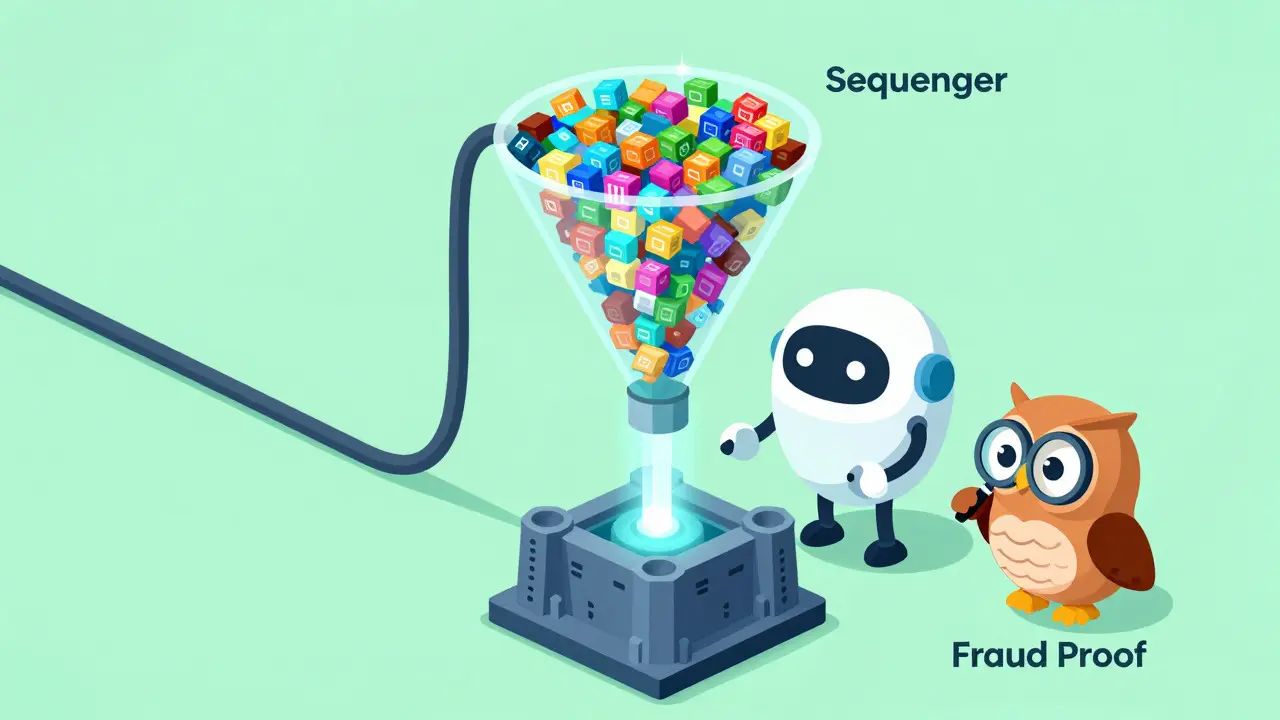
- Off-Chain Execution Environment: A sequencer orders and executes transactions before compressing data into batches. Currently, this sequencer is centralized in most implementations, though decentralization efforts are underway.
- Fraud Proof Mechanism: Uses interactive verification games where a challenger and defender narrow down disputed computations step-by-step. This process requires only O(log n) steps to verify an n-step computation, making it computationally efficient when fraud is rare.
This design trades immediate finality for lower computational overhead. While you wait seven days to withdraw funds from an optimistic rollup to Ethereum mainnet, you benefit from significantly lower fees and higher throughput. The trade-off is clear: speed in execution, patience in withdrawal.
Optimistic vs. ZK-Rollups: Key Differences
Choosing between optimistic and zero-knowledge rollups depends on your priorities. Here’s how they stack up based on 2025 benchmark data:
| Feature | Optimistic Rollups | ZK-Rollups |
|---|---|---|
| Withdrawal Time | 7 days (standard) | Near-instant |
| EVM Compatibility | 99.8% (Arbitrum) | ~85% (early implementations) |
| Peak Throughput | 4,200 TPS (Arbitrum) | 2,100 TPS (StarkNet) |
| Average Fee | $0.07 | $0.35 |
| Security Model | Fraud proofs after submission | Cryptographic proofs per batch |
| Engineering Complexity | Lower (~40% of ZK effort) | Higher |
Optimistic rollups win on EVM compatibility and cost. If you’re deploying existing Ethereum smart contracts without modification, Optimism or Arbitrum offer seamless integration. However, if instant withdrawals matter more than fee savings, ZK-Rollups provide a better user experience. The 7-day challenge window remains the biggest UX drawback, cited by 63% of negative reviews on Trustpilot as a primary complaint.
Market Position and Adoption in 2026
As of January 2026, optimistic rollups dominate the Ethereum L2 landscape. They command 62% of the total value locked (TVL) across all L2 solutions, with Arbitrum holding 34% and Optimism 28%, according to DefiLlama data. Total TVL reached $38.7 billion, reflecting strong institutional and retail adoption. Daily transaction volume stands at 12.3 million, accounting for 68% of all Ethereum L2 activity.
Enterprise adoption is particularly notable. 87% of the top 100 DeFi protocols have deployed on at least one optimistic rollup. Major names like Uniswap (v3 on Optimism), Aave (v3 on Arbitrum), and Curve (handling 35% of its volume on optimistic chains) demonstrate deep integration into the DeFi ecosystem. Regulatory clarity has also accelerated growth, with the SEC’s October 2025 framework classifying optimistic rollup tokens as utility assets rather than securities.
However, competition is intensifying. ZK-Rollups are growing faster, with quarterly growth rates of 45% compared to 28% for optimistic rollups. Analysts project that while optimistic rollups will maintain dominance in EVM-compatible applications through 2027, ZK-Rollups may surpass them in market share by 2028 due to improving prover technology. Galaxy Digital forecasts a 55-45 split in favor of ZK-Rollups by 2030, though hybrid models combining both approaches could extend optimistic rollup relevance beyond current projections.
User Experience: What It’s Like to Use Them
Real-world usage reveals both strengths and pain points. On Reddit’s r/ethereum, a trader reported saving $2,300 in gas fees over three months using Arbitrum for Uniswap arbitrage strategies. But the same user lost $420 when a withdrawal got stuck for eight days during a network congestion event. This duality captures the essence of optimistic rollups: massive savings on entry, potential friction on exit.
Trustpilot reviews for Optimism show an average rating of 3.8/5, with transaction speed scoring 4.5/5 but withdrawal delays dragging the score down to 2.1/5. Common praise includes near-mainnet EVM compatibility (mentioned in 78% of positive comments) and significantly lower gas fees (cited in 89% of positive reviews). Complaints focus on withdrawal delays, centralized sequencer control, and occasional bridge reliability issues.
For developers, the learning curve is moderate. Experienced Ethereum developers typically need 2-3 weeks to become proficient. Key implementation steps include deploying contracts to both L1 and L2, integrating with bridge contracts like the CrossDomainMessenger, and managing the challenge period for withdrawals. Documentation quality is solid, with Arbitrum scoring 4.5/5 and Optimism 4.2/5 in developer surveys.

Future Developments and Long-Term Viability
The technology isn’t standing still. Recent updates aim to address the biggest criticisms. Arbitrum Nova introduced “single-round fraud proofs” in September 2025, reducing challenge periods from 7 days to 60 minutes for certain transaction types. This change boosted user adoption by 37% in Q4 2025. Both major platforms are also working toward decentralized sequencers. Optimism’s “Bedrock” upgrade, targeted for Q2 2026, aims to replace the centralized sequencer with a permissionless system. Arbitrum’s “Stylus” upgrade, launching in Q1 2026, introduces parallel execution to boost throughput to 10,000 TPS.
Vitalik Buterin, Ethereum co-founder, described optimistic rollups as “bridge technology” that scaled Ethereum while ZK-prover tech matured. He noted that the 7-day challenge window represents a fundamental UX limitation that may make them transitional rather than permanent solutions. Yet, his January 2026 proposal for “hybrid rollups” combining optimistic assumptions with occasional ZK-proofs suggests a path forward that extends their relevance. Gartner’s 2026 Blockchain Hype Cycle places optimistic rollups at the “Plateau of Productivity,” indicating stable, production-ready technology with predictable evolution.
For now, optimistic rollups remain the go-to choice for EVM-native developers and users prioritizing low fees and high compatibility. As ZK technology matures and hybrid models emerge, the landscape will continue to shift, but the foundational principles of optimistic rollups-off-chain execution, on-chain security, and fraud-proof verification-will likely persist in some form for years to come.
Frequently Asked Questions
What is the main advantage of optimistic rollups over ZK-rollups?
The main advantages are higher EVM compatibility (99.8% vs ~85%) and lower transaction fees ($0.07 vs $0.35). Optimistic rollups also have lower engineering complexity, making them easier to deploy and integrate with existing Ethereum smart contracts.
Why do withdrawals take 7 days on optimistic rollups?
The 7-day period is a challenge window during which validators can submit fraud proofs if they believe a state transition was invalid. This ensures security without requiring cryptographic verification for every batch. Newer implementations like Arbitrum Nova are reducing this to 60 minutes for specific transaction types.
Are optimistic rollups secure?
Yes, they inherit Ethereum’s security model by posting data to the main chain. However, security relies on the fraud proof mechanism being correctly implemented and on sufficient validator participation during the challenge period. Centralized sequencers introduce minor trust assumptions, but decentralization upgrades are addressing this.
Which is better for DeFi: Arbitrum or Optimism?
Both are excellent choices. Arbitrum generally offers slightly higher throughput (4,200 TPS peak) and better documentation ratings (4.5/5). Optimism has strong community support and robust bridge integrations. Your choice should depend on which protocols you use most frequently, as many major DeFi apps are deployed on both.
Will optimistic rollups be replaced by ZK-rollups?
Not entirely, but their market share may decline. ZK-rollups are growing faster and offer instant withdrawals. However, optimistic rollups’ superior EVM compatibility and lower fees keep them dominant for EVM-native applications. Hybrid models combining both technologies may become the standard, extending the life of optimistic rollup architecture.

10 Comments
Carmene Jackson
Okay so I just read this and honestly the part about waiting seven days to get your money back out is giving me major anxiety?? Like who actually waits that long? I mean sure the fees are cheap but if you are locked in for a week it feels like a trap. It’s such a weird trade off where you save pennies but lose your freedom. Just thinking about my funds being stuck makes me want to cry a little bit. Why can’t we have both low fees AND fast access? It feels like the tech is holding us hostage for no reason. I guess I will just keep using mainnet until they fix this. The stress of not knowing if the withdrawal will go through is real. Please someone make this faster before I lose my mind.
Stephanie Millar
Hello! Just wanted to chime in from over here in the UK, because the cultural context of 'waiting' is quite different to what Americans might expect! In Britain, we are famously patient with queues; indeed, one might argue that the 7-day challenge period is merely an extension of our national character regarding queuing etiquette! However, when applied to digital assets, the analogy breaks down slightly, doesn't it? One expects immediacy in the digital realm, yet we are asked to exhibit Victorian-era patience for blockchain finality! It is a fascinating juxtaposition of modern cryptography and old-world stoicism. Perhaps the 'optimistic' nature of the rollup is less about technical assumption and more about societal expectation management! I find the comparison to ZK-rollups particularly intriguing, as it highlights a distinct philosophical divide between trust-based systems and proof-based systems. Do you think the British public would accept a 7-day wait for bank transfers if framed as a 'security feature'? Probably not, but then again, we do wait ages for the postman! So perhaps there is hope after all!
Nikki keller
I think it's important to look at this not just as a financial tool, but as a social contract. When we adopt optimistic rollups, we are essentially agreeing to a shared vulnerability window. It's a bit like trusting a friend with your car keys for a week; you assume they won't steal it, but you're technically exposed. This perspective shifts the narrative from 'technical limitation' to 'community trust'. If the community believes in the security model, the 7-day wait becomes less of a burden and more of a ritual of verification. It’s a beautiful way to decentralize risk without decentralizing speed immediately. We should celebrate the progress made in reducing fees, even if the UX isn't perfect yet. The path to full decentralization is rarely linear, and these compromises are necessary steps. Let’s be patient with the technology, as it is learning alongside us. The future of finance is collaborative, not competitive. Embracing the delay might actually make us better stewards of our own assets. It forces mindfulness in our transactions. A slow transaction is a thoughtful transaction. Let’s reframe the narrative around intentionality rather than friction. The tech is doing its best to balance security and speed. We just need to give it time to mature. This is a journey, not a destination. Keep an open mind about where hybrid models might lead us. The potential for innovation here is truly limitless if we stay united in our support. Let’s build a bridge, not a wall, between L1 and L2 users.
Ami Elizabeth
honestly the 7 day thing is wild but i guess its better than paying $15 per tx right? i dont really care about instant withdrawals as long as my gas bill stays low. also the part about arbitrum having 99.8% evm compat sounds cool cause i dont wanna learn new coding stuff just to use defi. im pretty chill about the centralized sequencer too, as long as it works most of the time. maybe one day they will fix the withdrawal times but for now its good enough for me. just happy i can swap tokens without going broke on fees. the future looks bright i think, or at least cheaper. lets hope they get the decentralization part sorted out soon though. its kinda risky having one company run the show. but hey, its better than nothing. i am just a regular user trying to save money on crypto trades. the tech is complex but the results are simple: lower prices. that is all i really care about in the end. keep it up devs, you are doing a great job i think.
Ashley Snyder
I totally agree with the point about EVM compatibility being the killer feature here. For anyone coming from Ethereum mainnet, the fact that you don't have to rewrite your smart contracts is huge. It lowers the barrier to entry for developers significantly. I've seen too many projects fail because they had to port their code to a completely different environment. Optimistic rollups solve that problem elegantly. It allows for a smoother migration path for existing DeFi protocols. This continuity is crucial for maintaining liquidity and user confidence. The transition period is much less painful when the underlying architecture remains familiar. It's a pragmatic approach to scaling that respects the status quo while pushing boundaries. I think this is why adoption has been so rapid among established projects. They didn't have to take a massive leap of faith into unknown territory. They just moved sideways, keeping all their tools intact. That stability is reassuring for investors and users alike. It reduces the cognitive load required to participate in the ecosystem. You can focus on the value proposition rather than the technical implementation details. This is a win-win situation for everyone involved in the space. It bridges the gap between innovation and usability perfectly. Here's to more seamless integrations in the future!
Kate Staab
Oh, how delightful. Another article pretending that 'trust assumptions' are acceptable in a decentralized system. As if we haven't learned anything from the last decade of hacks and rug pulls. The so-called 'optimistic' model is just a fancy word for 'please believe us.' And don't get me started on the centralized sequencer; it's practically a monopoly wearing a tuxedo. The 7-day wait isn't a feature, it's a punishment for believing in the hype. I suppose we should be grateful for the $0.07 fee while we sit in our digital limbo. Truly, the pinnacle of engineering excellence. Bravo. Let's pretend the fraud proofs are robust and not just theoretical exercises in computer science. Because clearly, nobody wants to deal with the reality of actual execution risks. What a charming illusion. I shall wait for the ZK revolution to save us from this charade. Until then, I'll be watching my wallet drain slowly, patiently, and with great disdain.
Leah Humphrey
The throughput metrics cited (4,200 TPS peak) are somewhat misleading without context on the computational overhead of the fraud proof verification layer. While the off-chain execution is efficient, the on-chain data availability costs remain a significant variable in the total cost of ownership for validators. Furthermore, the claim of 99.8% EVM compatibility ignores the subtle discrepancies in precompile behavior that can still break certain edge-case contracts during state transitions. The security model relies heavily on the economic incentive for challengers to monitor every batch, which may not hold under conditions of extreme market volatility or low validator participation. We must also consider the latency introduced by the interactive nature of the fraud proof games, which scales logarithmically but still adds non-trivial delay to dispute resolution. The centralized sequencer bottleneck is not merely a trust issue but a single point of failure for liveness, potentially leading to transaction ordering disputes that could fragment the state root. Regulatory classification as 'utility assets' does not eliminate the risk of retroactive liability for protocol upgrades that alter consensus rules. The projected growth rates for ZK-rollups likely underestimate the acceleration in prover hardware optimization, which could compress the timeline for market share reversal significantly. Ultimately, the viability of optimistic rollups hinges on the development of fully decentralized, permissionless sequencer networks that can match the efficiency of the current centralized implementations.
Jay Johhnston
Great breakdown. I appreciate the clarity on the cost differences. It helps to see the numbers side-by-side. The enterprise adoption stats are interesting too. It shows that big players are betting on this tech. I think the hybrid model idea is promising. Combining the strengths of both approaches seems logical. We should keep an eye on those upcoming upgrades. The Bedrock and Stylus releases could change things. Thanks for sharing this info. It's always good to understand the mechanics behind the scenes. The future of scaling is definitely multi-layered. Collaboration between teams will be key. Looking forward to seeing how this evolves next year. Solid read overall. Nice work putting this together. It demystifies a lot of the jargon. Helpful for anyone getting into DeFi. Keep up the good work. The industry needs more of these clear explanations. It builds trust in the technology. I'm glad to see such detailed analysis available. It makes the decision-making process easier. Thanks again for the insight.
Niall O'Rourke
sure whatever. another article telling us the sky is falling if we dont use zk. but let me tell you something. the people who think optimistic rollups are dead are probably still using cash. because at least cash is honest about being slow. these guys are just selling you a dream of speed while keeping the controls in their hands. its all a game. and you are losing. i say stick with mainnet. yes its expensive. but you know exactly what you are paying for. no hidden tricks. no fake promises of decentralization. just pure unadulterated pain. which is what we deserve for wanting free money. anyway. nice try. but the real winners are the ones who never bought in. they are sitting on their bags laughing at us. enjoy your 7 day wait. it will teach you humility. or at least make you angry. which is basically the same thing in crypto. anyway. bye.
Jillian Groskreutz
You clearly missed the nuance in the third paragraph, darling! The distinction between 'fraud proofs' and 'validity proofs' is not merely semantic; it is foundational to the entire security paradigm! Did you even read the section on O(log n) complexity? Or were you too busy staring at the screen? It’s embarrassing, really. The 7-day window is a *feature*, not a bug, as any competent cryptographer would tell you! You’re conflating UX convenience with security integrity, which is a classic amateur mistake. Look at the data! 62% TVL dominance! Can you count? Apparently not, given your lack of engagement with the source material. The SEC framework was mentioned specifically to address regulatory uncertainty, yet you ignored it entirely! How did you miss that? It’s boldfaced, for crying out loud! Your opinion on ZK-rollups is premature; the prover technology is still maturing, as stated in the text! Don’t project your impatience onto the broader market dynamics. The hybrid model proposal by Vitalik is a sophisticated solution, not a compromise! Read it again. Maybe twice. Then come back and offer a critique that isn’t based on surface-level annoyance. Until then, please keep your comments to yourself. We have standards here.