
Prisma mkUSD (MKUSD) isn’t another stablecoin trying to mimic the dollar. It’s something more specific - a stablecoin built on top of liquid staking tokens like stETH and rETH. That means if you own staked Ethereum, you can use it to mint mkUSD without giving up your staking rewards. It’s a clever hack for DeFi users who want liquidity and yield at the same time.
How mkUSD Works: Collateralize Your Staked ETH
Most stablecoins are backed by cash (like USDC) or over-collateralized crypto (like DAI). mkUSD is different. To mint it, you lock up liquid staking tokens - tokens that represent your staked ETH on protocols like Lido or Rocket Pool. For every $1 of mkUSD you want to create, you need to deposit more than $1 worth of stETH or rETH. This over-collateralization keeps mkUSD stable even if the price of ETH drops.Here’s why this matters: If you stake ETH directly on Ethereum, your funds are locked. You can’t trade them or use them in DeFi. But if you convert them to stETH, you get a token that trades like ETH and still earns staking rewards. Prisma lets you take that stETH and turn it into mkUSD - a dollar-pegged coin you can spend, lend, or trade - while still earning ETH staking yields. You’re not sacrificing anything. You’re just making your capital work harder.
Who Built mkUSD and How Is It Governed?
Prisma Finance launched mkUSD on Ethereum in August 2023. It’s a non-custodial, open-source protocol. That means no company holds your funds. Smart contracts handle everything: collateral deposits, minting, liquidations, and rewards. The protocol is governed by the PRISMA token. If you lock PRISMA tokens, you gain voting power. The longer you lock them, the more influence you have. This is called a veToken model - used by Curve and other advanced DeFi projects.The total supply of PRISMA is 300 million tokens. About 62% (186 million) goes to emissions - meaning it’s distributed over time to users who provide liquidity or participate in the protocol. Another 20% (60 million) was allocated to core team members, unlocking gradually over a year. This structure encourages long-term participation instead of quick flips.
Why mkUSD Is Different From DAI, USDC, or Frax
Let’s compare mkUSD to other stablecoins:- USDC: Backed by cash and short-term U.S. Treasuries. Centralized. No yield. You just hold a dollar.
- DAI: Over-collateralized with ETH, WBTC, and other assets. You can mint it, but you don’t earn extra rewards beyond the stability fee.
- Frax: Partially collateralized. Uses a mix of ETH and algorithmic mechanisms. Less secure in extreme crashes.
- mkUSD: Only accepts liquid staking tokens. You get staking rewards + yield from the stability pool + trading rewards from Curve and Convex. It’s a triple-layered incentive.
That last part is key. When you deposit mkUSD into the protocol’s stability pool, you earn a share of fees from liquidated positions. You also get CRV (Curve) and CVX (Convex) tokens just for holding mkUSD in liquidity pools. And you still earn ETH staking rewards on your original stETH. No other stablecoin does all three at once.
Current Market Reality: Small But Specialized
As of February 2026, mkUSD has a market cap of around $245,000. That’s tiny compared to USDC ($34.5 billion) or even DAI ($4.2 billion). CoinMarketCap ranks it #2566. CoinGecko puts it at #5170. These numbers don’t lie - mkUSD isn’t mainstream.But it’s not trying to be. It targets a narrow group: experienced DeFi users who already hold stETH or rETH and want to unlock value without selling. Around 1,200 unique addresses interact with the protocol monthly. That’s not a lot, but it’s a dedicated group. Most users are yield farmers looking to maximize returns on their staked ETH. They know the risks. They’re not here for convenience - they’re here for efficiency.
How to Use mkUSD: The Steps
If you want to try mkUSD, here’s what you need to do:- Get stETH or rETH: You can’t mint mkUSD with ETH. You need a liquid staking token. Use Lido or Rocket Pool to stake ETH and receive stETH or rETH.
- Connect your wallet: Go to the Prisma Finance app (prisma.finance) and connect MetaMask or another Web3 wallet.
- Deposit your stETH/rETH: Approve the smart contract and deposit your tokens as collateral.
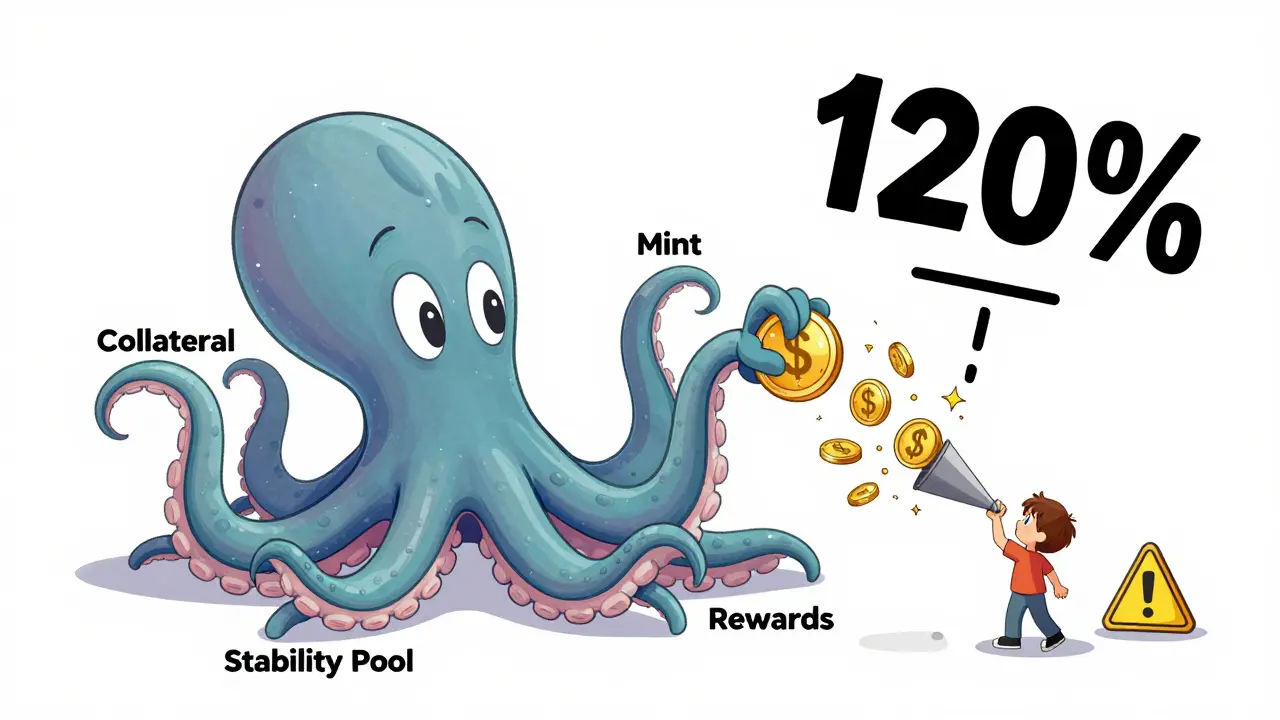
- Mint mkUSD: Enter how much mkUSD you want to borrow. The system will show your collateralization ratio - aim for at least 120% to avoid liquidation.
- Use or stake your mkUSD: You can trade it on Curve, add liquidity, or deposit it into the stability pool to earn extra rewards.
It’s not beginner-friendly. The interface assumes you know what stETH is. There’s no “click here to buy” button. If you’ve never used DeFi before, this will feel overwhelming. But for those who have, it’s one of the most efficient ways to leverage staked ETH.

Risks and Challenges
mkUSD isn’t risk-free. Here are the real concerns:- Collateral volatility: If ETH crashes 40%, your stETH drops. If your collateralization ratio falls below 110%, your position gets liquidated.
- Smart contract risk: Even with audits, new protocols can have hidden bugs. mkUSD is only two years old - it hasn’t been tested in a full bear market.
- Liquidity crunch: If everyone tries to withdraw mkUSD at once, the stability pool might not have enough reserves. It’s never happened, but it’s possible.
- Low adoption: Few exchanges list mkUSD. You can’t buy it with a credit card. You need to go through DeFi to get it.
Gas fees on Ethereum can also be a problem. Minting or redeeming mkUSD during network congestion can cost $10-$20 in fees. Some users use Layer 2s like Arbitrum to reduce costs, but Prisma doesn’t officially support them yet.
What’s Next for mkUSD?
Prisma Finance has a clear roadmap:- Expand collateral: They’re adding new liquid staking tokens like rsETH and cbETH.
- Layer 2 integration: Plans to launch on Arbitrum and Base to cut gas fees.
- More DeFi integrations: Working with Aave, Compound, and other lending protocols to let mkUSD be used as collateral elsewhere.
- DAO treasury growth: The Prisma DAO is slowly accumulating funds to fund development and marketing.
Analysts from Delphi Digital predict mkUSD could hit $5-10 million in market cap by 2027 - still small, but meaningful growth for a niche product. Its success depends on two things: whether more people start staking ETH, and whether DeFi users keep seeking yield on top of yield.
Should You Use mkUSD?
If you’re new to crypto - skip it. If you’re a casual holder of ETH - don’t bother. But if you’re already staking ETH, using Curve, or farming yield on DeFi, mkUSD is worth exploring. It’s not a magic bullet. But for a specific group of users, it’s one of the most powerful tools in DeFi.The real value isn’t in the stablecoin itself. It’s in the system: a way to turn locked-up staking rewards into usable capital - without giving up a single percentage point of yield. That’s innovation. And it’s why mkUSD exists.
Is mkUSD backed by real money like USDC?
No, mkUSD is not backed by cash or U.S. dollars. It’s fully backed by liquid staking tokens like stETH and rETH, which represent staked Ethereum. Its value comes from over-collateralization and smart contract rules, not fiat reserves.
Can I buy mkUSD on Coinbase or Binance?
Not directly. mkUSD isn’t listed on major centralized exchanges like Coinbase or Binance. You can only get it by minting it through the Prisma Finance app using stETH or rETH as collateral. Some decentralized exchanges like Curve may have trading pairs, but you’ll need a Web3 wallet to access them.
How much yield can I earn with mkUSD?
Yield depends on how you use it. If you deposit mkUSD into the stability pool, you can earn 8-12% APY from liquidation fees. If you add it to Curve liquidity pools, you get CRV and CVX rewards on top. And you still earn ETH staking rewards on your original stETH. Combined, users have reported total yields of 15-20% APY in favorable conditions.
Is mkUSD safe from hacks or exploits?
Prisma Finance has had its smart contracts audited by reputable firms like CertiK and SlowMist. No major exploit has occurred since launch. However, like all DeFi protocols, it carries smart contract risk. It’s relatively new (launched in 2023), so it hasn’t been tested in a full market crash. Use only what you can afford to lose.
What happens if ETH crashes and my collateral drops?
If your collateral value falls below the minimum ratio (currently 110%), your position is automatically liquidated. A portion of your stETH is sold to repay your mkUSD debt, and the rest goes to the stability pool as a reward. To avoid this, keep your collateralization ratio above 120% and monitor your position during market swings.
Do I need PRISMA tokens to use mkUSD?
No. You don’t need PRISMA tokens to mint or use mkUSD. PRISMA is only required if you want to vote in the Prisma DAO or earn additional emissions from governance rewards. The core function of minting mkUSD is open to anyone with stETH or rETH.
Can I redeem mkUSD for ETH?
Not directly. You can’t swap mkUSD for ETH in one step. But you can repay your mkUSD debt to unlock your stETH collateral. Then, you can sell your stETH on a DEX like Curve to get ETH. The process is two-step, but it’s fully non-custodial and trustless.

9 Comments
Danica Cheney
mkUSD? sounds like a fancy way to get taxed twice. i just hold eth and chill. why overcomplicate what works?
Kyle Pearce-O'Brien
This is the true evolution of capital efficiency - not merely collateralization, but meta-collateralization. By layering liquid staking tokens into a yield-bearing stablecoin architecture, we’re witnessing the emergence of a decentralized yield stack - a quantum leap beyond the primitive fiat-pegged stablecoins of the 2020s. 🚀💎
Matthew Ryan
I've been using mkUSD for a few months now. It's not perfect, but it's the most efficient way to unlock value from stETH without selling. The triple yield is real - staking rewards + stability pool + CRV/CVX. Just keep an eye on your collateral ratio.
Nathaniel Okubule
If you're already staking ETH and using DeFi, mkUSD makes sense. But if you're new, stick to USDC. This isn't for everyone. Know your risk tolerance.
Robin Ødis
You people act like this is some revolutionary breakthrough when it's just another over-collateralized, gas-guzzling, rug-pull waiting to happen. I've seen this movie before - DeFi 2.0, then 3.0, then 4.0 - all the same: high yields until the next bear market hits and everyone's position gets liquidated while the devs cash out their PRISMA tokens. And don't even get me started on the 'triple yield' nonsense - you're not earning yield, you're just compounding risk. And the fact that you need to use Lido or Rocket Pool? That's centralized staking with extra steps. Wake up.
laura mundy
This is why crypto is doomed. People are so desperate for yield they'll mortgage their future for 18% APY on a coin backed by tokens that are themselves backed by staked ETH which is backed by… nothing. You're not a farmer. You're a gambler with a spreadsheet.
Jacque Istok
LMAO the 'triple yield' is just a marketing gimmick. Let me break it down for the folks who think they're genius: 1) staking rewards (already yours) 2) stability pool fees (which you get only if someone gets liquidated - so you profit from someone else's loss) 3) CRV/CVX (which are volatile and subject to governance decay). So you're basically a vulture waiting for someone to undercollateralize. Congrats, you're the reason DeFi is a horror show.
Mendy H
The fact that this protocol is still under $300k market cap says everything. It’s not a revolution - it’s a footnote. The only people using it are yield farmers who don’t know what risk looks like. I’ve seen 10x more promising ideas die on the vine. This isn’t innovation. It’s inertia with a whitepaper.
Molly Andrejko
It’s okay if mkUSD isn’t for everyone. But for those of us who’ve been staking ETH and want to use it more wisely - this is actually thoughtful. It’s not flashy, but it’s functional. If you’re careful, monitor your ratios, and don’t over-leverage, it can be a quiet win. Don’t let the noise drown out the utility. 💛