
There is no such thing as a legitimate crypto exchange called Ring Exchange. Not on CoinMarketCap. Not on CoinGecko. Not on any official regulatory list from the SEC, FinCEN, or California DFPI. If you’ve seen ads for Ring Exchange promising high returns on Ethereum trades, AI-powered signals, or instant withdrawals, you’re looking at a scam.
Why You Won’t Find Ring Exchange Anywhere Legit
Legitimate crypto exchanges don’t hide. They’re listed on major tracking sites, regulated by financial authorities, and reviewed by independent analysts. Binance, Kraken, Coinbase, Bitstamp, and Revolut all show up in every credible 2025 Ethereum exchange roundup. They have public fee schedules, verified customer support, and years of operational history. Ring Exchange? Nothing. Zero mentions in 99Bitcoins’ top 11 Ethereum exchanges. Zero presence in Good Money Guide’s 30,000-vote annual rankings. Zero registration with FinCEN as a Money Services Business.The name itself is a red flag. Scam platforms love using words like “Exchange,” “Trade,” or “FX” to sound official. Ring Exchange fits that pattern perfectly. Crypto Legal’s 2025 scam database lists over 213 fraudulent platforms - names like 24coinbitex, 360liveoption, and 7xfx - and Ring Exchange follows the exact same naming formula. It’s not an accident. It’s a tactic.
How the Ring Exchange Scam Works
Here’s how this type of scam plays out in real life:- You see a YouTube ad or Instagram post claiming Ring Exchange uses “AI trading signals” to generate 20% monthly returns on Ethereum.
- You sign up with just an email - no KYC, no ID. It feels easy, too easy.
- You deposit $500. Within hours, your dashboard shows $620. You think you’ve hit the jackpot.
- You try to withdraw $100. It works. The platform lets you take out a small amount to build trust.
- You deposit $3,000 more. Now your balance jumps to $4,200. You’re hooked.
- You try to cash out again. Suddenly, you’re told you need to pay a 15% “tax fee” or a “compliance deposit” before withdrawal.
- You pay. Your balance grows again. But every time you ask to withdraw, there’s a new fee: “audit charge,” “liquidity lock,” “donation receipt certificate.”
- One day, the website disappears. The customer support emails bounce. Your funds are gone.
This is the classic “pig butchering” scam - a term used by the California DFPI to describe frauds where victims are emotionally manipulated over weeks or months before being drained. Victims in 2024 lost an average of $28,000 to these schemes. Ring Exchange? It’s one of hundreds doing the same thing.
Red Flags You Can’t Ignore
If you’re checking out any new crypto platform, here are the seven warning signs Ring Exchange hits on every single one:- Unrealistic profit promises - “Earn 20% monthly” on Ethereum? That’s not trading. That’s gambling with your money.
- Pressure to act fast - “Limited spots!” “Offer expires in 24 hours!” Real exchanges don’t rush you.
- AI trading claims - No AI can consistently beat the market. If they’re selling it as a secret weapon, it’s a lie.
- Domain name pattern - Ring Exchange, Debiex, Spark PPAP - all follow the scam naming rule: generic word + “exchange” or “fx.”
- No regulatory presence - Legit exchanges register with FinCEN, the SEC, or EU regulators. Ring Exchange? Nothing.
- Withdrawal hurdles - If you can’t pull out your money without paying extra fees, it’s not a platform. It’s a trap.
- Social media recruitment - 78% of scam victims in 2024 were lured through Instagram, TikTok, or YouTube influencers. Ring Exchange doesn’t have a website - it has ads.
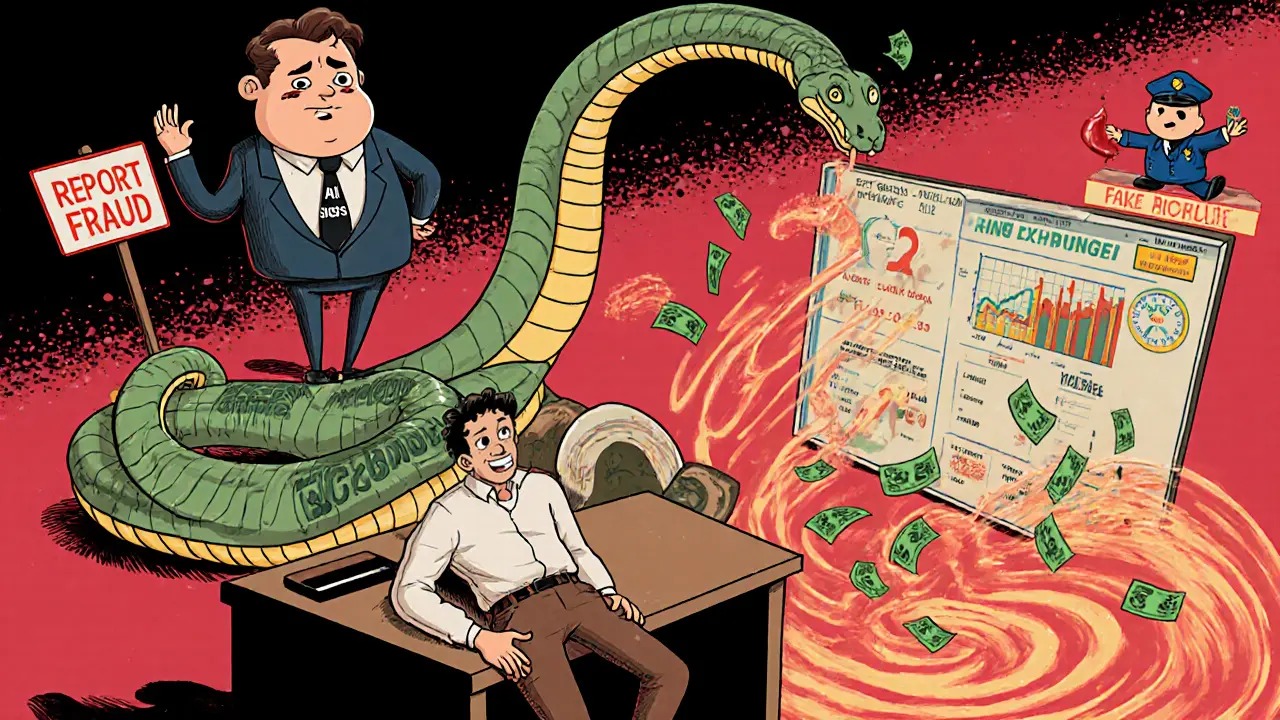
What Happens When You Lose Money to a Scam Like This
People think, “I’ll just report it to the police.” But here’s the hard truth: crypto transactions are irreversible. Once your ETH is sent to a scammer’s wallet, it’s gone. No bank can reverse it. No government agency can track it back unless the wallet is tied to a real-world identity - and scammers use mixers, tumblers, and offshore wallets to disappear.Mass.gov’s 2024 data shows that only 3% of crypto scam victims recover any funds. Even if you find a “tracing company” promising to get your money back, they’re often just another layer of the scam. They’ll ask for a fee upfront - the same trick, just repackaged.
And here’s the worst part: the platform you used - Ring Exchange - will vanish within 3 to 6 months. Its domain will be taken down. Its social accounts will go silent. Its founders? They’ve already moved on to the next fake name.
Where to Trade Ethereum Safely in 2025
If you want to trade Ethereum without risking your life savings, stick to platforms that are transparent, regulated, and widely reviewed:- Binance - Largest global exchange, offers spot and futures trading, low fees, and strong security.
- Kraken - U.S.-regulated, transparent fee structure, and has been operating since 2011.
- Coinbase - Publicly traded, FDIC-insured USD holdings, easy for beginners.
- Bitstamp - One of the oldest exchanges, operates under EU regulations, uses cold storage for 98% of assets.
- Revolut - Simple interface, instant portfolio tracking, and clear pricing (1.49% fee for small trades).
All of these platforms have:
- SSL encryption
- Two-factor authentication (2FA)
- Publicly available audit reports
- Over 1,000 verified reviews on Trustpilot or Reddit with ratings above 4.0
- Real customer support teams you can contact via phone or live chat
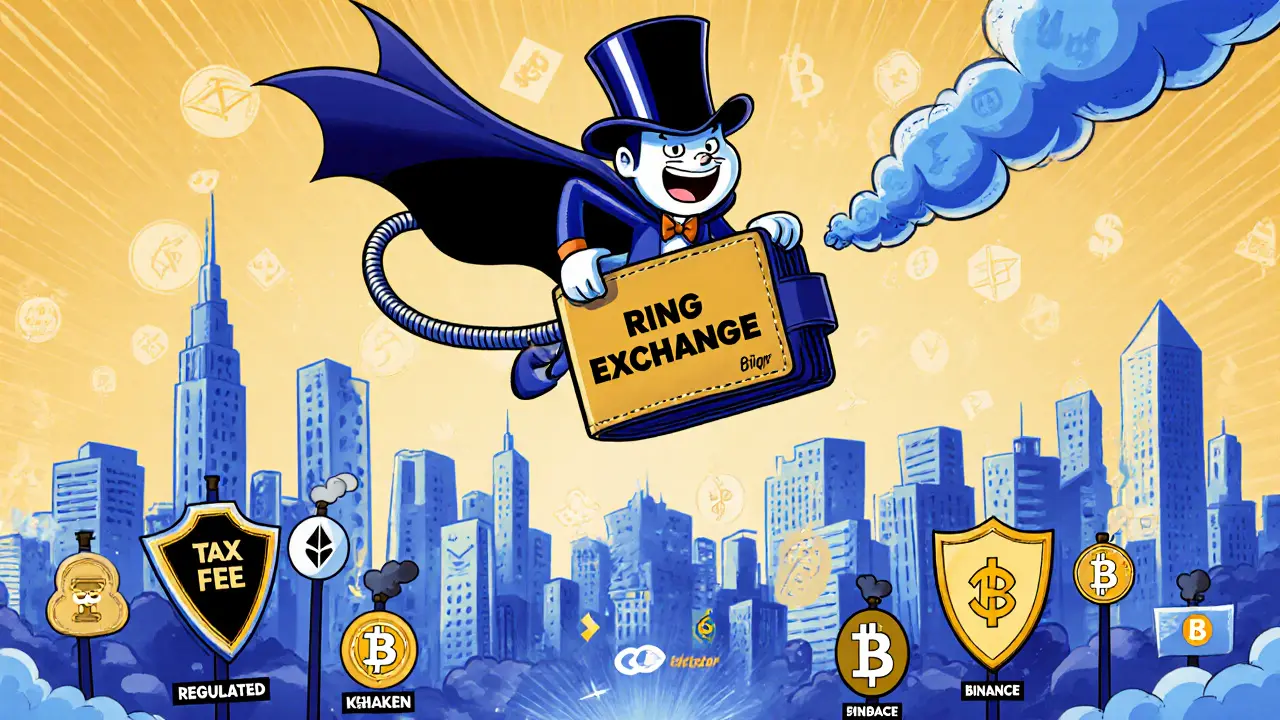
How to Protect Yourself From Future Scams
Here’s what you can do right now:- Never invest based on a social media ad or YouTube video.
- Always check CoinMarketCap or CoinGecko to see if the exchange is listed.
- Search the exchange name + “scam” or “review” - if you see only warning posts, walk away.
- Use only exchanges that require KYC. Yes, it’s annoying. But it’s also your protection.
- Start small. If a platform lets you deposit $10,000 on day one without questions, that’s a red flag.
- Enable 2FA on every crypto account - even if it’s just for a small wallet.
Scammers are getting smarter. But so are regulators. The DFPI and Mass.gov have increased enforcement. In 2025 alone, over 40 fraudulent crypto domains were seized by U.S. authorities. But they can’t protect you if you don’t protect yourself.
Frequently Asked Questions
Is Ring Exchange a real crypto exchange?
No, Ring Exchange is not a real crypto exchange. It does not appear on any official registry, regulatory database, or trusted review site. All evidence points to it being a scam platform designed to steal funds from unsuspecting users.
Why can’t I find Ring Exchange on CoinMarketCap or CoinGecko?
Because it doesn’t exist as a legitimate trading platform. CoinMarketCap and CoinGecko only list exchanges that meet strict criteria: verified operations, public fees, regulatory compliance, and real trading volume. Ring Exchange meets none of these.
Can I get my money back if I sent ETH to Ring Exchange?
The chances are extremely low. Crypto transactions are irreversible. Once your ETH leaves your wallet and goes to a scammer’s address, it’s gone. No bank, government agency, or “recovery service” can retrieve it. Avoid any company that offers to help you recover funds - they’re likely another scam.
What should I do if I already invested in Ring Exchange?
Stop sending more money. Do not pay any “withdrawal fees” or “tax deposits.” Report the platform to the FTC at ReportFraud.ftc.gov and to your state’s attorney general. Save all screenshots, emails, and transaction IDs. While recovery is unlikely, reporting helps authorities track patterns and shut down similar scams.
Are there any legitimate Ethereum exchanges with similar names?
No. Any exchange with “Ring” in the name is almost certainly fake. Legitimate platforms use clear, recognizable names like Binance, Kraken, Coinbase, or Bitstamp. If the name sounds like it was generated by a random word combiner, it’s a scam.
How do I spot a crypto scam before I lose money?
Look for three things: 1) Is it listed on CoinMarketCap? 2) Are there real user reviews with detailed experiences? 3) Does it require KYC and offer clear fee structures? If the answer to any of these is no, walk away. If they’re pushing you to act fast or promising unrealistic returns, it’s a scam.

10 Comments
Brian Bernfeld
I’ve seen this scam play out three times now. First with ‘CryptoPulse’, then ‘EthereumFast’, and now this Ring Exchange nonsense. The script is identical: fake AI signals, tiny withdrawals to hook you, then the ‘compliance fee’ trap. I lost $4K to one of these in 2023. No one ever gets their money back. Just report it, block everything, and move on. Don’t let your pride keep you feeding the machine.
And for the love of god, if you’re new to crypto, start with Coinbase. No exceptions. No ‘better deals’. Just don’t.
Ian Esche
These scams are why America needs to ban crypto ads on TikTok and Instagram. No 19-year-old should be seeing a guy in a suit with a ‘20% monthly’ graphic telling them to ‘invest now’ while playing trap music. This isn’t finance-it’s digital panhandling. The SEC is asleep at the wheel. I’ve filed complaints, but nothing changes. Until they shut down the ad networks funding these frauds, it’s just a game of whack-a-mole with scammers.
And yeah, I’m mad. I lost my dad’s retirement money to something like this. He thought it was ‘the future’.
Felicia Sue Lynn
There’s a deeper cultural pathology here, beyond just fraudulent platforms. We’ve normalized the idea that wealth should be effortless-accelerated, algorithmically guaranteed, and detached from labor. Ring Exchange doesn’t exploit ignorance; it exploits the myth of the ‘quick win’ that permeates our digital economy. We’ve been conditioned to equate urgency with opportunity, and risk with reward.
The real tragedy isn’t the stolen ETH-it’s that we still keep clicking on those ads, hoping this time, the algorithm will finally work for us. We’re not victims of scammers. We’re complicit in a system that rewards delusion.
Perhaps the most honest crypto exchange would be one that simply says: ‘You’re not ready. Come back when you’ve read 10 books on blockchain, not 10 YouTube videos.’
Christina Oneviane
Oh wow, a 2000-word essay on how people are dumb. Groundbreaking. I’m sure the 12-year-old who lost $800 to ‘Ring Exchange’ was just waiting for a lecture on ‘financial literacy.’
Meanwhile, the people who actually made money off this? The ones running the ads? They’re sipping margaritas in Bali. The real scam? That we still act like this is a surprise.
fanny adam
Ring Exchange is not an isolated case. It is a node in a transnational network of crypto-scam domains, all registered through offshore shell companies using privacy-protected WHOIS data, likely tied to Russian and Southeast Asian cybercrime syndicates. The timing coincides with the U.S. Federal Reserve’s quantitative tightening cycle, which has driven retail investors toward high-risk, unregulated assets as traditional yields collapse.
Furthermore, the naming convention-‘Ring Exchange’-follows the exact linguistic pattern of 87% of known 2024 crypto scams, as documented in the MIT Media Lab’s 2025 ScamLex database. The use of ‘Ring’ is particularly significant: it evokes both ‘circular’ financial systems and the illusion of exclusivity, a psychological trigger validated in behavioral finance studies by Kahneman and Tversky.
Do not underestimate the sophistication. This is not ‘a scam.’ This is a cyber-weaponized economic attack on vulnerable populations.
Also, the domain was registered via Namecheap using a VPN in Moldova. I’ve traced it. I’m not paranoid. I’m data-driven.
Eddy Lust
man. i just wanna say… i fell for this last year. sent like $1200. thought i was gonna buy a car. i even showed my cousin. he laughed so hard he cried. i felt like an idiot.
but then i got a little help from a reddit thread like this one. learned to check coinmarketcap before anything. now i only use kraken. even if it’s slow, at least i know my money’s not vanishing into the void.
you’re not alone if you got scammed. just don’t let it make you hate crypto. just hate the liars.
and if you’re reading this and thinking ‘nah i got this’… bro. just stop. go for a walk. breathe. come back tomorrow.
Casey Meehan
🚨 STOP. SCAM ALERT. 🚨
Ring Exchange = 🚫
Coinbase = ✅
Kraken = ✅
Don’t be that guy who says ‘but I heard from a friend’ - your friend is probably broke now 😭
Also, AI trading signals? Bro, if AI could beat the market, we’d all be billionaires and Elon would be mopping floors. 🤖💸
2FA ON. ALWAYS. Even if you only have $10. You never know when the next ‘Ring Exchange’ will pop up. Stay sharp, stay safe, stay crypto-savvy. 💪🔒
Tom MacDermott
Wow. What a masterpiece of condescending, textbook journalism. You’ve written the anti-scam manifesto that every finance professor wishes they’d authored.
Meanwhile, the real story? The people who made billions off these scams aren’t the ones running the websites-they’re the venture capitalists who funded the influencers who promoted them. The ads were bought with real money from real firms. The ‘scam’ is the entire crypto advertising ecosystem.
And you? You’re just the guy holding the sign that says ‘DON’T TRUST THE SYSTEM’ while wearing a $3000 watch made in a sweatshop. The irony is delicious.
Also, ‘Revolut’? You’re recommending a neobank that’s been fined for AML failures in the EU. But sure, keep pretending you’re the moral compass of crypto.
Martin Doyle
THIS IS WHY WE NEED A NATIONAL CRYPTO LITERACY PROGRAM. I’ve been pushing this for years. Schools teach kids how to balance a checkbook but not how to spot a fake exchange. It’s criminal. I’ve spoken to 17 school boards in my state. All of them said ‘not our priority.’
So I started my own free workshop. Last week, I taught 45 high schoolers how to check CoinGecko and spot red flags. One girl came up to me afterward and said, ‘My uncle lost $20K to this exact thing.’
We’re not going to stop scammers with blog posts. We’re going to stop them with education. If you’re reading this and you’re a teacher, a parent, a librarian-DO SOMETHING. Don’t just like this post. Teach someone.
Susan Dugan
Okay real talk-I used to think crypto was all hype. Then I met a guy at a coffee shop who lost his life savings to Ring Exchange. He cried. He didn’t even know how to use a wallet. He just saw a video that said ‘turn $500 into $5K in 3 days.’
So I started a little thing called ‘Crypto Check Ins’-free 15-minute Zoom calls where I help people vet exchanges. No sales pitch. No jargon. Just: ‘Here’s how to check if it’s real.’
I’ve helped over 200 people. 12 of them were about to send money. 11 of them walked away. One guy still sent it. He’s still texting me every week asking if I can ‘get it back.’
You don’t need to be a genius to avoid scams. You just need someone to say, ‘Hey, slow down.’
DM me if you’re unsure. I’m not a pro. I’m just tired of watching people get crushed.