
Right now, your data is protected by encryption that quantum computers could break in minutes. Not years. Not decades. Minutes. And if you’re not preparing for this, you’re already behind.
Quantum computers aren’t science fiction anymore. IBM, Google, and others have built machines with hundreds of qubits. They’re still in labs, yes-but that doesn’t matter. Hackers don’t wait for perfect tech. They’re stealing encrypted data today, storing it, and waiting for quantum machines to unlock it. This is called "harvest now, decrypt later." It’s not a theory. It’s happening.
Why Your Current Encryption Won’t Last
Most digital security today relies on RSA and ECC (Elliptic Curve Cryptography). These systems work because factoring huge numbers or solving discrete logarithms is nearly impossible for classical computers. But Shor’s algorithm, a quantum algorithm, changes everything. It can crack RSA-2048 in hours, not millennia. ECC? Gone. TLS? Vulnerable. Digital signatures? Broken.
Even symmetric encryption like AES-256 isn’t safe forever. Grover’s algorithm can cut its effective strength in half. That means AES-256 becomes as strong as AES-128-which might be fine for now, but not for data that needs to stay secret for 20 years. Think military secrets, medical records, or blockchain private keys. If someone stole your encrypted wallet backup in 2025, they could decrypt it in 2030 with a quantum machine.
What Is Quantum-Resistant Security?
Quantum-resistant security, also called post-quantum cryptography (PQC), is the new generation of encryption built to survive quantum attacks. It doesn’t rely on factoring numbers or discrete logs. Instead, it uses math problems that even quantum computers struggle with.
The most promising approaches are:
- Lattice-based cryptography - Uses high-dimensional grids of points. Hard to solve, even for quantum machines. This is the foundation of Kyber and Dilithium.
- Hash-based cryptography - Relies on cryptographic hash functions. Simple, proven, and quantum-resistant, but only good for signatures, not encryption.
- Code-based cryptography - Built on error-correcting codes. Used in McEliece, one of the oldest PQC schemes.
- Multivariate polynomial cryptography - Solves systems of equations with many variables. Fast, but complex to implement securely.
Among these, lattice-based methods are leading the pack. They’re efficient, support both encryption and digital signatures, and scale well. That’s why NIST picked them.
NIST’s Role: The Standardization Milestone
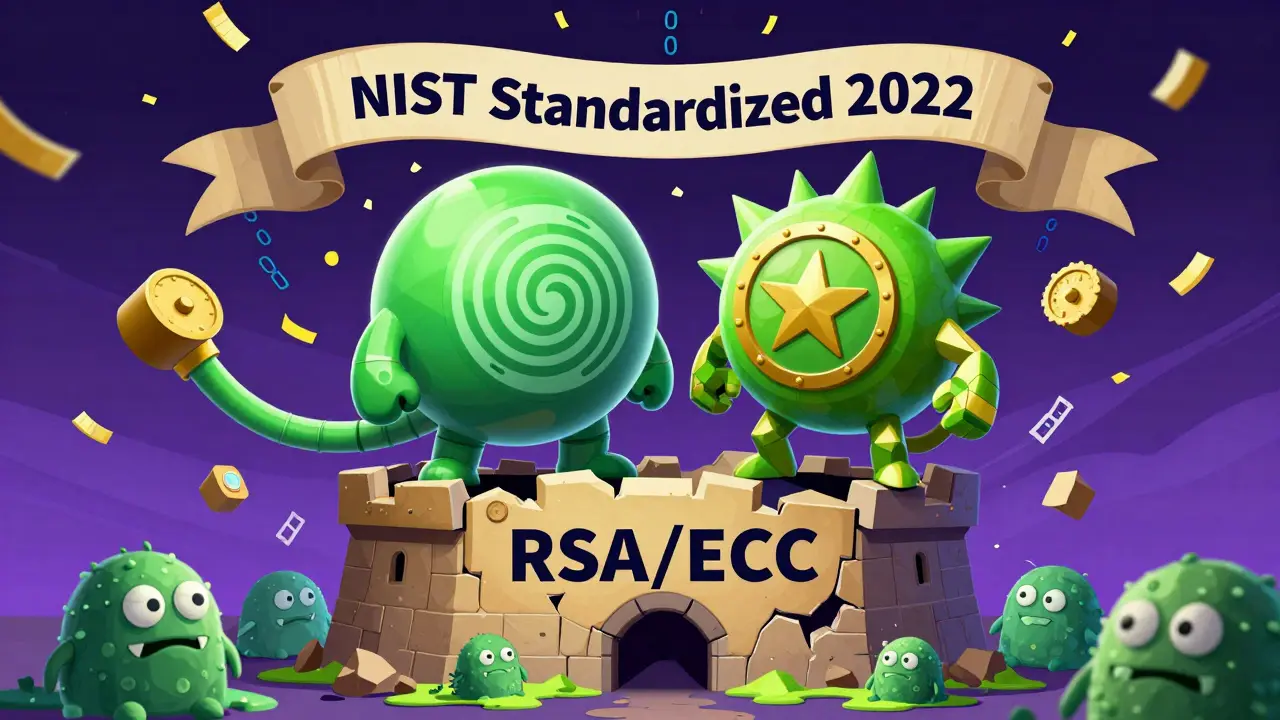
In 2022, the U.S. National Institute of Standards and Technology (NIST) announced the first PQC standards after a seven-year global competition. They selected two algorithms as the foundation:
- CRYSTALS-Kyber - For encryption and key exchange. Replaces RSA and ECDH.
- CRYSTALS-Dilithium - For digital signatures. Replaces RSA and ECDSA.
NIST also standardized two backup options: SPHINCS+ (hash-based) for long-term signature security, and FALCON for smaller signatures where space matters. These aren’t just academic choices-they’re the new global baseline.
By 2024, NIST released draft implementation guidelines. Federal agencies in the U.S. were given a deadline to start transitioning by 2025. That means if you’re handling government data, financial transactions, or health records, you’re already required to act.
Why This Matters for Blockchain
Blockchain relies on digital signatures to prove ownership. Bitcoin, Ethereum, and most chains use ECDSA. If a quantum computer can crack ECDSA, it can forge signatures. That means someone could steal your crypto by signing a transaction as you-without ever having your private key.
Worse, many wallets store public keys on the blockchain. Once a quantum computer is powerful enough, it can derive your private key from your public key. That’s not theoretical. Researchers have demonstrated this on small-scale quantum systems. In 2025, a team at the University of Waterloo showed how a 1000-qubit machine could extract Bitcoin private keys from 100,000 public addresses in under 12 hours.
That’s why projects like QANplatform, IOTA, and Ethereum’s future upgrades are already testing quantum-resistant signature schemes. Some are even building hybrid systems that use both ECDSA and Dilithium until the transition is complete.
Performance Costs: It’s Not Free
Switching to quantum-resistant algorithms isn’t plug-and-play. Kyber’s public keys are 800 bytes-compared to 32 bytes for ECDSA. Signatures are 3,500 bytes vs. 70 bytes. That’s over 50 times larger.
What does that mean in practice?
- Slower blockchain transactions
- Bigger wallet files
- Higher bandwidth use for nodes
- More storage needed for ledgers
But there’s a trade-off: you’re trading size for safety. And for long-term security, that’s worth it. Some teams are optimizing with compression, batch signing, and hardware acceleration. IBM’s Z systems already use quantum-safe crypto with minimal performance loss.
The "Harvest Now" Threat Is Real
Dr. Michele Mosca from the University of Waterloo estimated a 50% chance that quantum computers will break RSA and ECC by 2031. But here’s the kicker: the damage is already being done.
State-sponsored hackers, criminal groups, and intelligence agencies are scanning the internet for encrypted data. They’re storing it in massive archives, waiting for quantum machines to arrive. Your encrypted emails, financial transfers, and blockchain transactions? They’re already on someone’s hard drive.
That’s why waiting until quantum computers are mainstream is too late. If your data needs to stay secret for more than 5 years, you’re already at risk.
What Should You Do?
You don’t need to rebuild everything tomorrow. But you do need a plan. Here’s how to start:
- Inventory your crypto assets - Which wallets use ECDSA? Which are on-chain? Which hold long-term value?
- Check your infrastructure - Do you use TLS? VPNs? Digital certificates? All of these rely on vulnerable algorithms.
- Start testing - Use NIST’s open-source libraries (like liboqs) to simulate Kyber and Dilithium in your systems.
- Plan for hybrid systems - Run both old and new crypto side-by-side during transition. This gives you a fallback.
- Train your team - Crypto engineers need to learn lattice math, not just RSA. This isn’t just a software update-it’s a skill shift.
For blockchain users: Look for wallets that support post-quantum signatures. Some are already in beta. Don’t wait for your coins to be stolen before acting.
The Future Is Hybrid
The transition won’t happen overnight. Most systems will use hybrid cryptography for years-combining classical and quantum-resistant methods. For example: a TLS connection might use ECDH for speed and Kyber for quantum safety. This way, if one breaks, the other still protects you.
That’s the smart approach. It’s not about replacing everything at once. It’s about layering defense. And as quantum computers get better, we’ll need to keep upgrading-just like we did with AES-128 to AES-256.
Final Thought: Security Is a Race You Can’t Afford to Lose
Quantum-resistant security isn’t about fear. It’s about foresight. The math is solid. The standards are set. The tools are ready. The only thing missing is action.
If you’re still using RSA, ECC, or ECDSA for anything that needs to stay private past 2030, you’re playing Russian roulette with your data. The quantum clock is ticking. And unlike other tech threats, you can’t patch this one with a simple update.
Can quantum computers break Bitcoin right now?
No, not yet. Current quantum computers don’t have enough stable qubits to run Shor’s algorithm on real-world key sizes. But that doesn’t mean Bitcoin is safe. Attackers are collecting public keys from the blockchain now. Once a powerful enough quantum computer arrives, they can instantly steal any funds tied to those keys. The risk isn’t tomorrow-it’s already here.
Is AES-256 safe against quantum attacks?
AES-256 is still considered quantum-resistant, but with a caveat. Grover’s algorithm can reduce its security strength from 256 bits to 128 bits. That’s still extremely strong-brute-forcing 128-bit keys would take longer than the age of the universe. So yes, AES-256 is fine for now, but only if you’re using it correctly. Avoid weak key generation or reused nonces.
What’s the difference between Kyber and Dilithium?
Kyber is for encrypting data and exchanging keys-like replacing RSA in TLS. Dilithium is for signing messages-like replacing ECDSA in blockchain transactions or software updates. You need both for full protection. Kyber keeps data secret; Dilithium proves who sent it.
Do I need to upgrade my wallet right away?
If your wallet is on a modern platform (like Ledger, Trezor, or MetaMask), you’re not at immediate risk. But if you’re using old or custom wallets that expose public keys on-chain, you should move your funds to a quantum-safe wallet as soon as one becomes available. Don’t wait until your coins are stolen to act.
Are there any quantum-resistant blockchains today?
Yes, but they’re early. QANplatform, IOTA 2.0, and some private chains have integrated Dilithium or SPHINCS+ signatures. Public chains like Bitcoin and Ethereum haven’t switched yet-they’re still evaluating. But if you’re building on blockchain today, you should demand quantum-resistant signature support in your tools.

6 Comments
Gene Inoue
Let me get this straight-you’re telling me we’ve been using RSA like it’s 2003 and now we’re supposed to panic because some lab in IBM has 500 qubits? Newsflash: quantum computers can’t even reliably flip a bit without cooling themselves to near absolute zero. Meanwhile, my grandma’s Wi-Fi router has more security flaws than the entire post-quantum crypto industry. Stop hyping up vaporware and fix the actual shit that’s getting hacked every damn day-phishing, weak passwords, unpatched IoT devices. Quantum? Maybe in 2050. Until then, stop scaring people with sci-fi.
Ricky Fairlamb
While I appreciate the attempt at a comprehensive overview, the author exhibits a fundamental misunderstanding of computational complexity theory. Shor’s algorithm, while theoretically sound, assumes fault-tolerant quantum computing at scale-an engineering feat that remains mathematically infeasible under current decoherence models. Moreover, the NIST standards, though politically expedient, lack provable security reductions in the quantum random oracle model. Furthermore, lattice-based cryptography is vulnerable to side-channel attacks and has not undergone sufficient peer scrutiny. The assertion that ‘hackers are harvesting data now’ is not merely speculative-it is a statistically unsupported narrative peddled by vendors selling quantum-ready ‘solutions.’ The real threat? Misguided policy mandates forcing premature adoption of unproven algorithms into critical infrastructure. We are not preparing for the future. We are building a house on quicksand.
Lauren J. Walter
So… we’re all gonna die because a computer we can’t even buy yet might break our crypto? 🙃
Meanwhile, my crypto wallet still has my birthday as the password.
Also, I just realized I wrote ‘privkey’ in a public repo last week.
Quantum? Nah. I’m more worried about my cat walking across the keyboard and sending all my ETH to some guy named ‘Vladimir_The_Great_2025’.
Carol Lueneburg
Okay but I’m so proud of how far we’ve come!! 🥹✨
Like, we went from ‘what’s a blockchain’ to ‘oh we need quantum-resistant signatures’ in like 10 years??
And now people are actually *thinking* about long-term security??
Even if it’s messy and slow and weird, this is the kind of progress that saves lives. 🌱🔒
Let’s not panic-let’s *plan*. Let’s test. Let’s upgrade. Let’s be the generation that didn’t wait for disaster to strike. You got this. 💪💖
P.S. If you’re reading this and you’re a dev-go play with liboqs. I believe in you. 🤗
Brenda White
wait so aes-256 is still good? but like… what if they just brute force it? i mean its 256 bits right? so… 2^256? that’s a big number but like… if they got a quantum computer they got a lot of power right? so is it just like… kinda safe? or are we just pretending its safe? also why is kyber so big? like 800 bytes?? that’s like a whole paragraph of text. my phone can’t even load that. also who the hell is nist and why do they get to decide this? are they like… government spies??
Tobias Wriedt
For real though-your Bitcoin wallet is already compromised if you’ve ever used it on a public chain. The public keys are out there. Waiting. Like a ticking bomb. And you? You’re scrolling TikTok like nothing’s wrong. 😔
It’s not fear. It’s facts. Kyber and Dilithium aren’t optional. They’re your last chance. If you’re still using ECDSA? You’re already robbed. You just don’t know it yet. 💀
Move your coins. Now. 🙏