
You've probably heard the hype about AI taking over the world. But have you heard of an AI that promises to be free from corporate bias and censorship? That's the core pitch behind enqAI (ENQAI). It's a cryptocurrency project trying to build a decentralized network where artificial intelligence isn't controlled by big tech giants like Google or OpenAI. Instead, it relies on a global mesh of GPU nodes.
If you're digging through crypto charts looking for the next big AI play, you might have stumbled upon this tiny market cap token. But what exactly is it? Is it a hidden gem or a risky gamble? Let's break down how enqAI works, what its tokens do, and whether it stands out in the crowded field of AI cryptocurrencies.
The Core Concept: Decentralized, Bias-Free AI
Most modern AI models are centralized. You send a query to a server farm owned by a corporation, and they process it. The problem? These corporations set the rules. They decide what answers are "safe," what topics are off-limits, and often inject subtle biases into their outputs. enqAI aims to flip this model on its head. The platform was founded in late 2023 with a specific mission: create a censorship-free, bias-free AI ecosystem built on the Ethereum blockchain.
Think of it as Airbnb for computing power. Instead of one company owning all the servers, thousands of individuals contribute their Graphics Processing Units (GPUs). In exchange, these providers earn ENQAI tokens. Users spend those same tokens to access AI services. This peer-to-peer structure removes the single point of failure-and the single point of control-that plagues traditional AI.
The platform operates via two main proprietary products:
- Eridu: A large language model (LLM) marketed as having no hidden built-in biases.
- noiseGPT: A voice cloning and text-to-speech engine designed for lifelike audio generation.
By decentralizing the infrastructure, enqAI argues that no single entity can shut down a conversation or alter an answer based on political pressure. It’s an ambitious claim, but it addresses a growing frustration among users who feel mainstream AI tools are becoming too sanitized.
How the ENQAI Token Works
At the heart of this ecosystem is the ENQAI token. It’s an ERC-20 standard token living on the Ethereum blockchain. If you’re familiar with other Ethereum-based projects, you know the drill: it has 18 decimal places and uses smart contracts to manage transfers and approvals.
The token serves two distinct purposes, creating a circular economy within the network:
- Access Currency: Developers and users pay ENQAI to run queries against the Eridu LLM or generate speech with noiseGPT.
- Reward Mechanism: Individuals who connect their high-performance GPUs to the network earn ENQAI for processing these requests.
This dual utility is crucial. Without demand from users, GPU providers wouldn’t earn anything. Without enough GPU providers, users would face slow response times or higher costs. The balance between supply and demand here determines the health of the network.
| Attribute | Value |
|---|---|
| Token Standard | ERC-20 |
| Blockchain | Ethereum |
| Total Supply | 1,100,000,000 |
| Circulating Supply | ~987,638,312 |
| Primary Use Case | Decentralized AI Computation |
Technical Architecture and Products
Let’s look under the hood. The technical backbone of enqAI is its decentralized GPU network. When you send a request to Eridu, it doesn’t go to a central data center. Instead, the task is split and distributed across various nodes in the network. These nodes perform the heavy lifting-matrix multiplications and neural network inference-and return the results.
Eridu, the flagship LLM, is positioned as a direct competitor to restricted models like GPT-4. While GPT-4 might refuse to answer certain controversial questions or steer conversations toward politically neutral ground, Eridu claims to provide raw, unfiltered responses. For researchers, journalists, or creatives who need unbiased data, this distinction matters.
Then there’s noiseGPT. Voice technology is exploding right now, from audiobooks to virtual assistants. noiseGPT offers text-to-speech capabilities that sound surprisingly human. More importantly, because it runs on a decentralized network, it avoids the potential privacy pitfalls of sending your voice data to a centralized cloud provider. Your data stays fragmented across nodes rather than sitting in one company’s database.
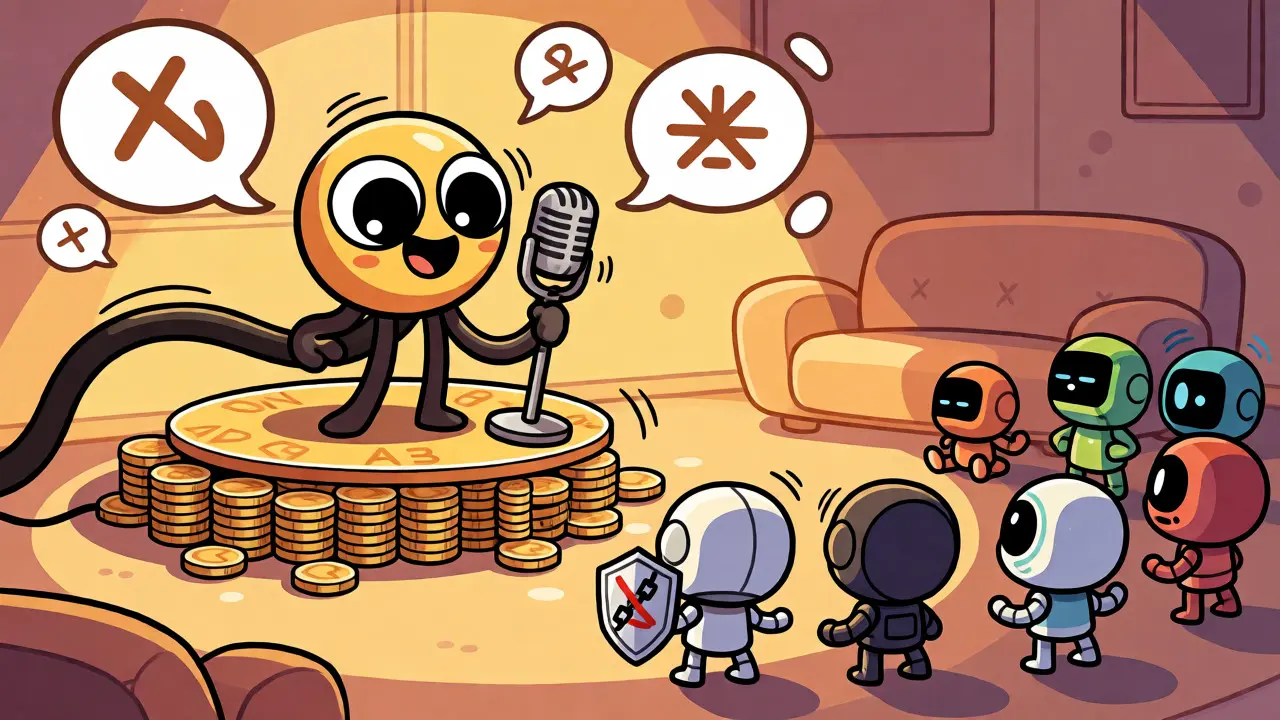
However, building this kind of infrastructure is hard. Running AI models requires significant computational power. Not every home computer has a GPU capable of handling complex LLM inference efficiently. This creates a barrier to entry for node operators, limiting the speed at which the network can scale compared to centralized competitors who just buy more server racks.
Market Performance and Risks
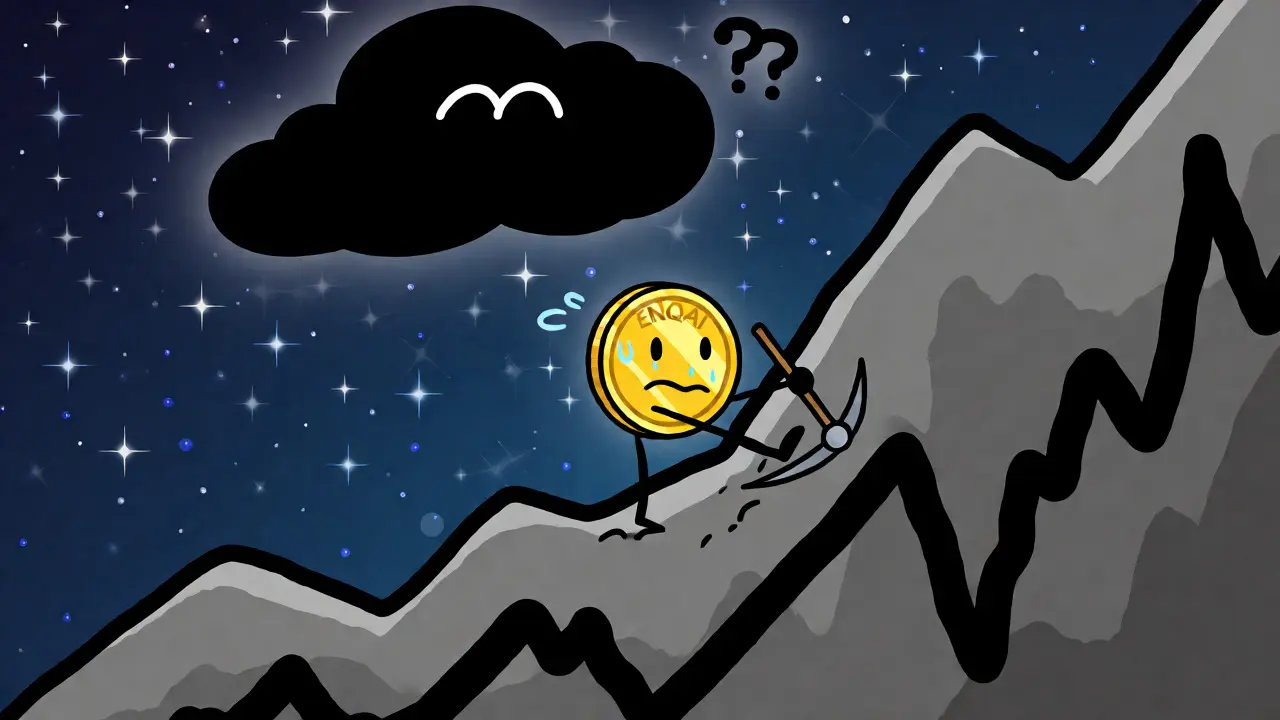
Here’s the reality check. While the concept is compelling, the market performance of ENQAI has been rough. As of late 2026, the token trades at fractions of a cent. Its market capitalization sits around $628,500, ranking it near #1981 globally. To put that in perspective, established AI tokens like Render Network (RNDR) or Fetch.ai (FET) boast market caps in the billions.
The price action tells a story of extreme volatility. Since its launch, ENQAI has dropped nearly 99% from its all-time high. Why such a steep decline? Several factors come into play:
- Liquidity Issues: With a 24-hour trading volume hovering around $72,000, liquidity is thin. Large sell orders can crash the price quickly.
- Competition: The AI crypto sector is crowded. Projects like SingularityNET and Render have larger communities, more active development teams, and stronger partnerships.
- Adoption Gap: There’s limited public evidence of widespread adoption of Eridu or noiseGPT. Without real-world usage driving token demand, price speculation tends to fade.
Technical analysts view the trend bearishly. The token trades below both its 50-day and 200-day moving averages, signaling strong downward momentum. Fear & Greed Index scores remain neutral, suggesting the market hasn’t capitulated entirely but lacks conviction to push prices up.
Comparing enqAI to Other AI Tokens
To understand where enqAI fits, we need to compare it to its peers. Most AI cryptos focus on different aspects of the industry. Some handle data storage, others handle compute resources, and some offer specific machine learning agents.
| Project | Primary Focus | Market Position | Unique Selling Point |
|---|---|---|---|
| enqAI | Uncensored LLM & Voice | Niche / Micro-cap | Bias-free, agenda-free AI output |
| Render Network | GPU Rendering Power | Large Cap | Distributed rendering for graphics |
| Fetch.ai | Autonomous Agents | Mid-Large Cap | Self-driving economic agents |
| SingularityNET | AI Marketplace | Mid Cap | Open marketplace for AI algorithms |
Notice the difference? Render focuses on visual rendering (think movie effects), while Fetch.ai builds autonomous bots for business tasks. enqAI doubles down specifically on the *nature* of the AI output-its freedom from censorship. This makes it a smaller, more specialized player. It appeals to a specific demographic: people who distrust centralized AI governance. But niche markets are harder to monetize at scale.
How to Buy and Use ENQAI
If you’re intrigued by the idea of supporting decentralized, uncensored AI, buying ENQAI is relatively straightforward, though it requires some DeFi knowledge. Since it’s not listed on major centralized exchanges like Coinbase or Binance, you’ll need to use a decentralized exchange (DEX).
Here’s the typical workflow:
- Set Up a Wallet: Install MetaMask or another compatible Ethereum wallet.
- Fund with ETH: Buy Ethereum on a centralized exchange and transfer it to your wallet. You’ll need ETH for gas fees.
- Connect to a DEX: Go to Uniswap V3 or Camelot. Connect your wallet.
- Swap: Search for the ENQAI contract address (0x710287d1d39dcf62094a83ebb3e736e79400068a) to ensure you’re buying the correct token. Swap your ETH for ENQAI.
Using the actual AI services takes a bit more effort. You’ll likely need to visit the enqAI website, connect your wallet, and deposit tokens to start generating text or speech. The user interface is functional but basic compared to polished SaaS platforms like ChatGPT. Expect a steeper learning curve if you’re new to Web3 interfaces.
The Future Outlook: Can It Survive?
Is enqAI worth holding long-term? That depends on your risk tolerance. The bull case rests on the growing backlash against AI censorship. If regulations tighten further, or if public trust in Big Tech AI continues to erode, enqAI could find a loyal community willing to pay for "free" speech.
The bear case is stronger in the short term. Development activity appears sluggish, with minimal code commits on GitHub recently. Without aggressive marketing or major partnerships, breaking out of the micro-cap tier will be tough. Regulatory risks also loom large; the EU AI Act and similar laws worldwide might challenge the very definition of "uncensored" AI.
For now, enqAI remains a speculative bet on a specific ideological stance in the AI revolution. It’s not a blue-chip investment like Bitcoin, nor is it a proven utility play like Chainlink. It’s a high-risk, high-reward experiment in decentralized intelligence.
What is the primary use case of the ENQAI token?
The ENQAI token acts as the economic fuel for the enqAI ecosystem. Users spend it to access AI services like the Eridu LLM and noiseGPT voice engine. Meanwhile, GPU providers earn ENQAI by contributing their hardware’s computational power to process these AI requests.
Is enqAI truly uncensored?
The platform markets itself as "bias-free, agenda-free, and censorship-free." By running models on a decentralized network rather than centralized corporate servers, it aims to prevent any single entity from filtering or altering AI outputs based on political or social agendas.
Where can I buy ENQAI tokens?
ENQAI is primarily traded on decentralized exchanges (DEXs) such as Uniswap V3 and Camelot. It is generally not available on major centralized exchanges like Coinbase or Binance due to its lower market capitalization and liquidity levels.
What are the main risks of investing in enqAI?
Key risks include extremely low liquidity, high volatility (having fallen over 99% from its all-time high), intense competition from larger AI crypto projects like Render and Fetch.ai, and uncertain regulatory environments regarding uncensored AI content.
How does Eridu differ from ChatGPT?
While both are Large Language Models, Eridu is hosted on a decentralized network and emphasizes a lack of built-in biases or censorship filters. ChatGPT is centralized, controlled by OpenAI, and applies strict safety guidelines that may restrict certain types of responses or creative outputs.
