
Have you ever looked at a list of cryptocurrencies and seen a coin called Verified USD, only to notice its price isn't exactly $1? It’s confusing. If it’s supposed to be a digital dollar, why does the market data show it trading for pennies on the dollar? You aren’t imagining things. The gap between what Verified USD (USDV) claims to be-a fully backed, transparent stablecoin-and how it behaves in the wild is one of the most interesting case studies in modern crypto.
In this guide, we’re going to strip away the marketing fluff and look at the actual mechanics of USDV. We’ll explore who runs it, what backs it up, and why you need to understand the difference between 'intrinsic value' and 'market price' before you even think about touching this token.
Quick Takeaways: What You Need to Know About USDV
- Verified USD (USDV) is an RWA-backed stablecoin pegged 1:1 to the US Dollar, launched by the non-profit Verified USD Foundation.
- Unlike Tether or USDC, which often use bank deposits, USDV is backed entirely by tokenized US Treasury bills via Matrixport’s STBT tokens.
- It operates as an ERC-20 token but aims to be "omnichain," meaning it can move across different blockchains like Ethereum, Solana, or others.
- Market data shows significant volatility and de-pegging issues, with prices sometimes trading far below $1 due to low liquidity.
- The project promises that yield from the underlying Treasuries will be shared with the community, rather than kept by a central company.
What Exactly Is Verified USD (USDV)?
To understand USDV, you first have to understand the category it sits in. It is a stablecoin. In simple terms, a stablecoin is a cryptocurrency designed to keep a steady value, usually tied to a fiat currency like the US Dollar. Most people know Bitcoin for its wild swings; they know stablecoins for their calmness. You buy them when you want to park your money without watching it crash overnight.
But not all stablecoins are built the same way. There are three main types:
- Fiat-Collateralized: Backed by cash in a bank account (e.g., USDC, USDT).
- Crypto-Collateralized: Backed by other cryptocurrencies like ETH (e.g., DAI).
- RWA-Backed (Real World Assets): Backed by tangible assets like gold or government debt.
USDV falls into that third bucket. It was launched on November 14, 2023, by the Verified USD Foundation. This foundation is crucial because it’s not a for-profit corporation trying to maximize shareholder returns. It’s a non-profit entity. Their stated goal is to create a "progressive stablecoin ecosystem" where the benefits-specifically the interest earned on the backing assets-are shared fairly among users.
The Engine Room: How USDV Gets Its Value
This is the part that separates USDV from the giants like Tether. When you hold a standard stablecoin, the issuer holds a pile of cash in commercial banks. That’s safe enough, but it relies on trusting those banks and the opaque audit reports they publish.
USDV takes a different route. Every single USDV token in circulation is supposed to be backed 1:1 by Matrixport Short-term Treasury Bill Tokens (STBT). Let’s break that down, because it sounds complicated.
- US Treasury Bills: These are short-term loans you give to the US government. They are considered one of the safest investments in the world because the risk of the US defaulting is near zero.
- Tokenization: Normally, buying Treasuries involves paperwork, brokers, and delays. Matrixport has taken these real-world bills and turned them into digital tokens (STBT) that live on the blockchain.
- The Link: The Verified USD Foundation uses these STBT tokens as collateral. So, when you mint 1 USDV, the system locks up $1 worth of STBT.
Why does this matter? Because US Treasuries pay interest. If USDV is backed by assets earning 5% interest, who gets that money? In traditional finance, the bank keeps it. The Verified USD Foundation argues that in their model, that yield should flow back to the ecosystem-potentially reducing fees for users or rewarding holders. It’s an ambitious idea that tries to bridge the gap between boring, safe government bonds and exciting, fast-moving decentralized finance (DeFi).
How Does the Peg Work? (And Why It Sometimes Breaks)
A stablecoin’s job is to stay at $1.00. If you go to an exchange and try to buy USDV for $1.05, arbitrageurs (traders looking for free money) should step in, sell USDV until the price drops back to $1. If the price hits $0.95, they should buy it up, pushing the price back up. This mechanism relies on two things: liquidity (enough people trading) and redemption access (the ability to swap your token for actual dollars easily).
Here is where the rubber meets the road. According to recent market data snapshots from major exchanges like Coinbase, USDV has struggled with this. At various points, USDV has traded significantly below its $1 peg-sometimes dipping as low as $0.26 per token.
Does this mean the coin is worthless? Not necessarily. It means there is a disconnect between the asset value and the market price. Think of it like a gift card. If a store closes down temporarily, you might find someone selling a $100 gift card for $20 because they don’t trust they can use it soon. The card still represents $100 of goods, but the market panic drives the price down.
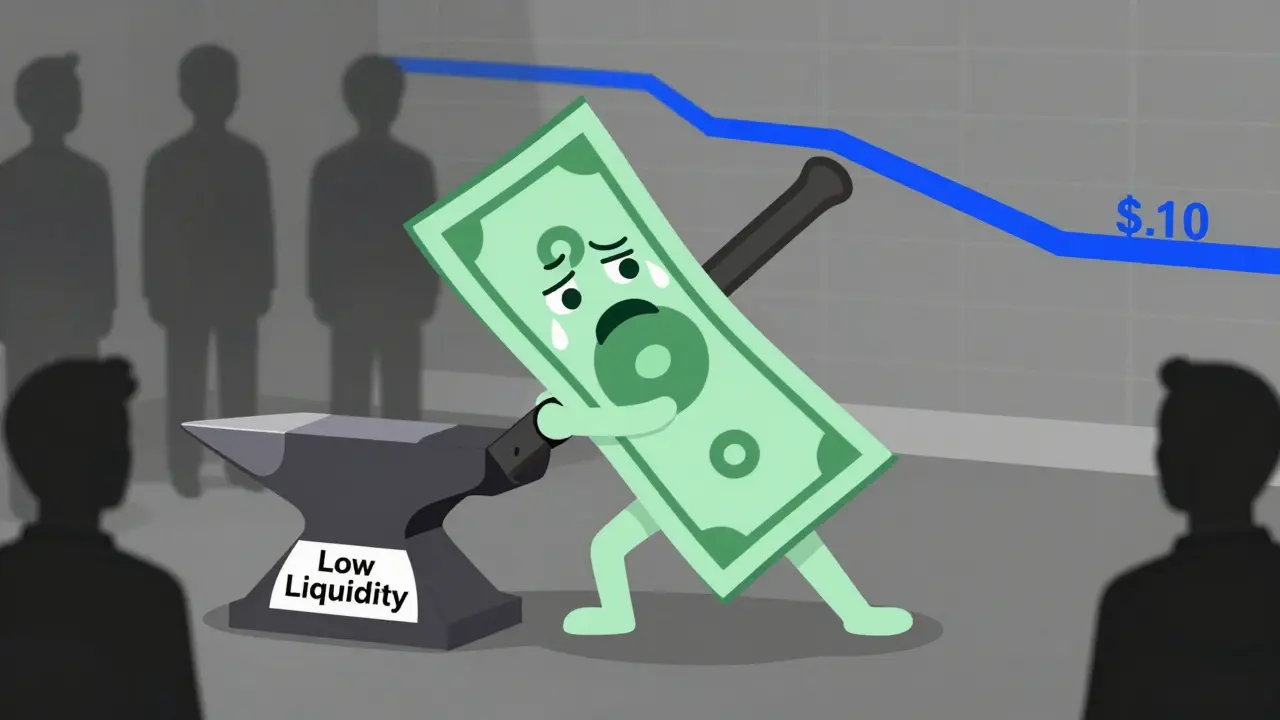
For USDV, the low price reflects low trading volume and limited liquidity pools. If there aren’t enough buyers and sellers actively trading the token, the price can drift wildly. Furthermore, if the process to redeem USDV for actual US Dollars is complex or restricted to large institutional players, retail investors are left stuck in a thin secondary market.
Technical Specs: Where Can You Use It?
If you are a developer or a trader, you care about compatibility. USDV was designed to be flexible. It launches primarily as an ERC-20 token. This is the standard format used by thousands of apps on the Ethereum network. If a wallet or DeFi protocol supports ERC-20, it can technically support USDV with minimal coding changes.
However, the foundation markets USDV as "native omnichain." This is buzzword-heavy speak for a very practical feature: cross-chain interoperability. They want USDV to move seamlessly between Ethereum, Solana, Polygon, and other networks without needing clunky bridges that often get hacked. The vision is a borderless payment rail that works 24/7, unlike traditional banking hours.
While the technical architecture is sound, adoption is the hurdle. For a stablecoin to succeed, it needs to be integrated into lending protocols, exchanges, and payment processors. As of mid-2026, USDV’s integration footprint remains relatively small compared to industry leaders, which limits its utility outside of speculative trading.
Comparing USDV to the Giants
To see where USDV stands, we have to compare it to the incumbents. Here is how it stacks up against the most common stablecoins you likely already know.
| Feature | Verified USD (USDV) | USDC (Circle) | Tether (USDT) |
|---|---|---|---|
| Backing Asset | Tokenized US Treasuries (STBT) | Cash & Cash Equivalents / Treasuries | Commercial Paper & Cash Equivalents |
| Issuer Type | Non-Profit Foundation | Public Corporation (Circle) | Private Company (Tether Ltd) |
| Yield Sharing | Yes (Proposed to community) | No (Retained by issuer) | No (Retained by issuer) |
| Liquidity | Low / Thin Markets | Very High | Highest |
| Transparency | On-chain reserves visible | Monthly attestations | Quarterly attestations |
Notice the trade-off. USDV offers a theoretically superior backing structure (direct treasury exposure) and a better governance model (non-profit). However, it loses heavily on liquidity. In crypto, liquidity is king. If you can’t sell your asset quickly without crashing the price, it doesn’t matter how good the backing is.

Is USDV Safe? Understanding the Risks
No investment is risk-free, and stablecoins carry unique dangers. Here are the specific risks associated with USDV:
- Smart Contract Risk: Like any crypto token, USDV lives on code. If there is a bug in the smart contract managing the STBT collateral or the USDV issuance, funds could be lost. Always check if the contracts have been audited by reputable firms.
- Counterparty Risk (Matrixport): USDV relies on Matrixport to correctly tokenize the Treasuries. If Matrixport fails, goes bankrupt, or acts maliciously, the link between USDV and the real-world dollars breaks.
- Regulatory Risk: Tokenized securities are under heavy scrutiny by regulators like the SEC. If the US government decides that tokenized Treasuries are unregistered securities, it could impact the legality of holding STBT, and by extension, USDV.
- De-pegging Risk: As mentioned, the market price has deviated significantly from $1. If confidence drops further, the token could become illiquid, trapping your capital at a steep discount.
Who Is USDV Actually For?
Based on its current state, USDV isn't really for the average person looking to buy coffee or send money to family. The friction is too high, and the price instability makes it unreliable for payments.
Its ideal user right now is likely a sophisticated DeFi participant who:
- Believes in the long-term thesis of yield-sharing stablecoins.
- Understands how to navigate cross-chain bridges.
- Is willing to accept higher risk for the potential upside of early adoption in the Real World Asset (RWA) sector.
For everyone else, sticking to highly liquid options like USDC or USDT is generally safer for daily operations. USDV serves more as an experiment in financial engineering than a ready-to-use currency at this stage.
Final Thoughts on Verified USD
Verified USD represents a fascinating attempt to fix the flaws of the current stablecoin market. By moving away from opaque bank deposits and toward transparent, on-chain US Treasuries, it addresses legitimate concerns about counterparty risk. The non-profit structure is also a refreshing change from the profit-driven models of its competitors.
However, ideas don’t make markets-liquidity does. Until USDV builds deep trading pools and widespread exchange support, it will remain a niche asset with volatile pricing. Keep an eye on its total value locked (TVL) and social sentiment. If those numbers start climbing steadily, it might signal that the market is finally catching up to the technology. Until then, treat it with caution, do your own due diligence, and never invest more than you can afford to lose.
Can I redeem USDV for real US Dollars?
Technically, yes. Since each USDV is backed by assets worth $1, the redemption mechanism exists. However, for retail users, direct redemption may be difficult or require minimum thresholds. Most users end up selling USDV on secondary exchanges, where they face the risk of getting less than $1 due to low liquidity.
Why is the price of USDV so low compared to $1?
The low price (often seen around $0.26-$0.80 depending on the venue) is a market phenomenon, not necessarily a reflection of its backing. It indicates low demand and poor liquidity on certain exchanges. Without active market makers keeping the price steady, supply and demand imbalances cause the price to drop below its intrinsic value.
What is Matrixport STBT?
STBT stands for Matrixport Short-term Treasury Bill Token. It is a digital token that represents ownership in short-term US government debt. USDV uses STBT as its primary collateral, meaning every USDV issued is matched by an equivalent value of these treasury-backed tokens.
Is USDV regulated by the US Government?
The regulatory status of tokenized assets is still evolving. While the underlying US Treasuries are regulated, the tokenization layer (STBT) and the stablecoin wrapper (USDV) operate in a gray area. The Verified USD Foundation is a non-profit, but it does not currently appear to have the same level of explicit federal oversight as larger issuers like Circle (USDC).
How does USDV share yield with users?
The Verified USD Foundation intends to distribute the interest earned from the underlying US Treasuries back to the ecosystem. This could happen through reduced transaction fees, direct rewards to holders, or funding development grants. Specific mechanisms for individual user payouts are still being defined and implemented within their governance framework.

6 Comments
mark valmart
man this whole stablecoin thing is giving me a headache just reading about it
i get that they want to be transparent but seeing the price drop like that makes me nervous
Hadleigh Edwards
I honestly think we should give these projects a chance to breathe and find their footing because innovation in the financial sector often comes with growing pains that are completely normal for any new technology trying to disrupt established systems, and if we look at the broader picture of where decentralized finance is heading, having a non-profit entity managing treasury-backed assets sounds incredibly promising for the future of equitable wealth distribution, so instead of focusing on the temporary volatility which is largely due to lack of liquidity rather than fundamental failure, we ought to celebrate the attempt to bring real-world yield back to the community level rather than letting banks hoard all the interest, and who knows maybe in a few years USDV will be as reliable as USDC was when it first launched, so let's keep our optimism high and support the builders who are trying to make crypto more accessible and profitable for everyone involved in this exciting journey.
Crystal Davis
you are all missing the point entirely because liquidity is not just a 'growing pain' it is the absolute bedrock of any functional currency and without deep order books your token is nothing more than a digital collectible with no utility whatsoever
the fact that USDV trades at $0.26 while claiming to be backed by risk-free treasuries proves that the redemption mechanism is either broken or intentionally restricted to institutional players leaving retail holders holding the bag
this is classic rug-pull dynamics disguised as 'innovation' and anyone buying into this narrative is ignoring basic market microstructure principles
Miss Masquer
I have been following the development of Real World Assets in Canada and Europe closely and it seems like there is a significant cultural disconnect between how traditional finance views stability versus how the crypto community interprets transparency, and while I understand the skepticism regarding the current trading price of USDV, it is important to consider that cross-chain interoperability is still in its infancy globally, meaning that the infrastructure required to seamlessly move value between Ethereum and Solana without slippage is not yet fully matured for mass adoption, so perhaps the low volume is less a reflection of the asset's intrinsic worth and more a symptom of the technical hurdles that developers are currently working through to create a truly borderless financial system that respects both regulatory compliance and user sovereignty across different jurisdictions.
trisya hazriyana
yield sharing is just marketing fluff until the smart contracts are audited by top tier firms and even then its probably a trap
why would a foundation give away free money unless they want you to hold the bag while they exit liquidity
smart contract risk is real and matrixport could vanish tomorrow leaving you with worthless stbt tokens
stop dreaming about passive income and start looking at the code
Debbie Lewis
just sticking usdc for now thanks