
You send a small payment, but the fee eats up half your balance. It happens to everyone at least once. You click "send," see a $15 charge for a $50 transfer, and wonder where that money went. It didn’t vanish into thin air. Someone got paid. But who, and why did it cost so much?
Cryptocurrency transaction fees are not random numbers pulled from a hat. They are the result of a complex auction system driven by supply, demand, and technical limits. In 2026, with stablecoin volumes exceeding $4 trillion annually, understanding these costs is no longer optional-it’s essential for anyone holding digital assets.
The Core Driver: Network Congestion
Imagine a highway with only one lane. When five cars want to pass through at once, they wait. When fifty cars show up, chaos ensues. Drivers start offering money to jump ahead. That is exactly how blockchain networks work.
Network congestion is the single biggest factor affecting crypto fees. Every blockchain has a limit on how many transactions it can process per block. Bitcoin, for example, handles about 7 transactions per second. Ethereum processes more, but still hits bottlenecks during high activity.
When too many people try to transact simultaneously, unconfirmed transactions pile up in the mempool. This waiting area forces users to bid against each other. If you need your transaction confirmed quickly, you must pay more than the person behind you. During market rallies or major news events, this bidding war drives fees sky-high. In March 2025, Bitcoin fees spiked as traders rushed to move funds, leaving casual users priced out of their own wallets.
How Blockchains Calculate Your Fee
Not all chains charge the same way. The method depends on the technology underneath.
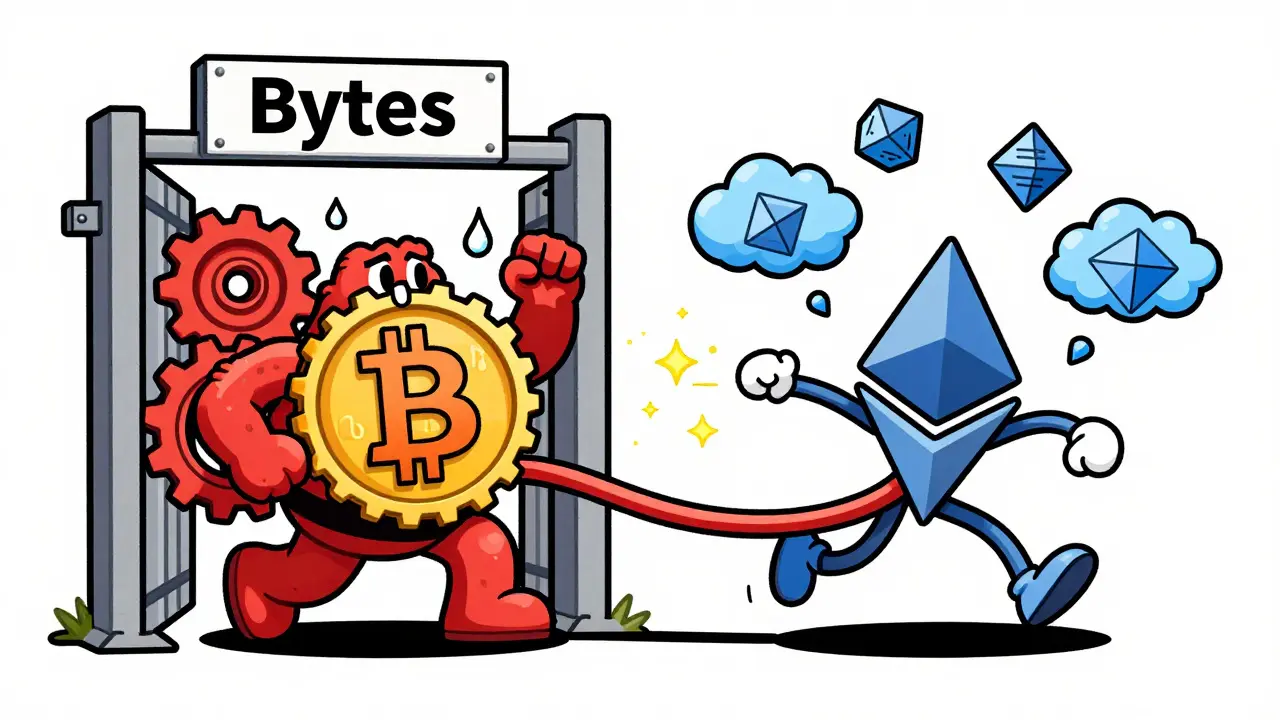
Bitcoin uses a byte-based model. Your fee equals the size of your transaction data multiplied by the current rate (satoshis per byte). The more inputs and outputs you have, the larger the data. Sending money from ten different small balances to one address creates a bulky transaction. Consolidating those first saves space-and money.
Ethereum uses gas. Gas measures computational effort. Simple transfers use little gas. Interacting with a complex decentralized finance (DeFi) contract uses a lot. The total fee is the gas used times the gas price you set. During DeFi surges, gas prices explode because validators prioritize complex, high-value contracts over simple transfers.
| Blockchain | Fee Mechanism | Avg. Cost (Low Congestion) | Best For |
|---|---|---|---|
| Bitcoin | Satoshis per Byte | $1 - $5 | Store of value, large transfers |
| Ethereum | Gas (Gwei) | $2 - $10 | Smart contracts, DeFi, NFTs |
| Tron | Bandwidth/Energy | $0.01 - $0.02 | Stablecoins, gaming, media |
| IOTA | Fee-less (Tangle) | $0 | IoT devices, microtransactions |
Transaction Complexity Matters
Your wallet isn’t just sending coins; it’s signing data. The complexity of that data changes the cost.
In Bitcoin, every input (source of funds) adds bytes to the transaction. If you’ve received many small payments over time, your wallet might use ten inputs to make one payment. That’s ten signatures, ten verification steps, and a larger file size. Validators charge for the space you occupy. Keeping fewer, larger UTXOs (Unspent Transaction Outputs) reduces future fees.
On Ethereum, complexity comes from code execution. Buying an NFT involves checking ownership, updating records, and potentially triggering royalties. Each step consumes gas. A simple ETH transfer is cheap because it does almost nothing except change the balance sheet. Always check if a dApp requires excessive computation before confirming.
Consensus Mechanisms and Speed
How a network agrees on the truth affects its cost structure. Proof of Work (PoW), used by Bitcoin, relies on miners solving puzzles. This is secure but slow and energy-intensive, leading to higher fees during peaks.
Proof of Stake (PoS), now standard for Ethereum, is faster and cheaper to run. However, demand still outstrips supply during busy periods. Newer models like Delegated Proof of Stake (DPoS), used by Tron, allow very high throughput with minimal fees. Tron validators produce blocks rapidly, keeping costs under a cent for most transfers.
IOTA takes a different path entirely. Its Tangle architecture has no blocks and no miners. Users validate each other’s transactions. This eliminates fees completely, making it ideal for machine-to-machine payments where fractions of a penny matter.
Timing and Market Sentiment
When you send matters as much as how you send. Crypto markets operate 24/7, but human behavior follows patterns.
Weekends often see lower activity as institutional traders sleep. Tuesday through Thursday mornings (UTC) typically offer the lowest congestion. Conversely, Friday afternoons and Monday mornings spike as global markets open. News events-like regulatory announcements or exchange hacks-trigger panic moves that clog networks instantly.
During bull markets, fees rise predictably. More people enter, more transactions occur, and the mempool fills up. In April 2025, 28% of Bitcoin transactions took over two hours to confirm because users refused to pay premium rates. Patience pays off. Setting a low fee and waiting can save you 60-80% compared to paying for instant confirmation.

Exchange Withdrawal Fees vs. Network Fees
Here’s a trap many fall into: exchange withdrawal fees are not always network fees. Platforms like Coinbase or Binance often charge fixed rates for withdrawals. These cover their operational costs and profit margins.
If the network fee is $2, but the exchange charges $10, you’re paying an $8 markup. Some exchanges update these daily; others keep them static for months. Always compare the exchange’s stated fee with real-time data from explorers like Etherscan or Blockstream.info. For large amounts, using a non-custodial wallet and paying the direct network fee is usually cheaper.
Strategies to Reduce Your Costs
You don’t have to accept high fees. Here’s how to take control:
- Use Layer 2 Solutions: Networks like Lightning Network (Bitcoin) or Arbitrum/Optimism (Ethereum) handle transactions off-chain and settle later. Fees drop from dollars to fractions of a cent.
- Choose the Right Chain: Moving USDT on Tron costs pennies. Doing it on Ethereum can cost dollars. Match the asset to the chain designed for speed.
- Monitor Mempools: Tools like Mempool.space show real-time congestion. Wait for the green zone before sending non-urgent funds.
- Enable RBF: Replace-By-Fee allows you to bump a stuck transaction later without losing the original amount. Most modern wallets support this.
- Batch Transactions: Send multiple payments in one go instead of separately. One signature is cheaper than ten.
The Future of Fee Structures
As blockchains mature, fee dynamics will shift. Layer 2 adoption is accelerating, pushing base-layer fees down for average users while reserving mainnet space for high-value settlements. Stablecoins dominate volume, driving demand for low-cost rails like Tron and Solana.
Regulatory pressure may also influence fees. As governments scrutinize illicit flows, compliance checks could add hidden costs. However, competition remains fierce. Networks that fail to optimize fees risk losing users to faster, cheaper alternatives. The trend is clear: efficiency wins.
Understanding these factors turns frustration into strategy. You’re not just paying a fee; you’re participating in a global auction for bandwidth. Play smart, and you keep more of what’s yours.
Why do crypto fees change so frequently?
Fees fluctuate based on network congestion. When many users send transactions at once, the limited block space becomes scarce. Users bid up the price to get their transactions processed faster, creating a dynamic market similar to Uber surge pricing.
Is it better to send crypto during the day or night?
Generally, sending during off-peak hours like Tuesday-Thursday mornings (UTC) results in lower fees. Weekends and market opening hours (Monday/Friday) tend to have higher congestion and thus higher fees.
What is the difference between gas fees and transaction fees?
Gas fees are specific to Ethereum and similar networks, measuring computational effort. Transaction fees is a broader term encompassing all costs, including Bitcoin's satoshi-per-byte fees. Both serve the same purpose: compensating validators for processing your request.
Can I avoid paying crypto transaction fees entirely?
Yes, on certain networks like IOTA which uses a fee-less architecture. Additionally, some applications implement fee abstraction, covering the cost for users. However, on major chains like Bitcoin and Ethereum, fees are mandatory to prevent spam and secure the network.
Why are exchange withdrawal fees higher than network fees?
Exchanges charge fixed withdrawal fees to cover their operational overhead and generate profit. These fees often exceed the actual network cost. Using a self-custody wallet allows you to pay only the true network fee, which is usually lower.

9 Comments
sreeja boora
It is truly disheartening to see how Western financial structures continue to exploit users with these arbitrary fees while claiming innovation. The global south suffers most from this inefficiency, yet the discourse remains centered on US-centric platforms like Coinbase. We need sovereign digital infrastructure that respects our economic sovereignty rather than relying on congested networks controlled by foreign entities.
Annemarie Fitzgerald
the fees arent just numbers theyre a reflection of our collective anxiety in the digital void
i feel it in my bones when the mempool clogs up its like the universe holding its breath waiting for someone to blink first
why do we trust machines with our worth anyway
Kenneth Riley
you people are all missing the point entirely its not about congestion its about manipulation by the validators who rig the auction system to bleed retail investors dry every single time you try to move your funds they know exactly what you will pay and they extract maximum value because you are desperate and stupid enough to believe speed matters more than capital preservation
Abby Sivertsen
Hey, I get why everyone is frustrated with the costs, but let's keep it real. The tech is still evolving, and complaining doesn't lower the gas price. I've been using Layer 2s like Arbitrum for months now, and honestly, it's changed the game for me. No more sweating over $20 transfers. Just switch chains if you want cheap moves.
Benjamin Eisen
I think the section on batching transactions is super helpful thanks for sharing that tip i never realized how much i was wasting by sending small amounts separately
does anyone else use tools like Mempool.space regularly or do you just guess when to send
Grace Newman
They want you to believe it is supply and demand but it is a coordinated effort by central banks to make crypto unusable for everyday transactions so you remain dependent on their failing fiat systems. The spikes are artificial signals designed to drive you back into traditional banking where they can monitor every cent you spend. Do not fall for the narrative that this is 'just technology'. It is control.
ravi mahla
Haha, nice article but seriously, who is still paying Ethereum mainnet fees in 2026? You guys are living in the past. Move to Solana or Tron if you want to actually use your money instead of storing it as a digital paperweight. It's funny watching people complain about fees while ignoring the obvious solutions right in front of them.
Mark Brunschwiler
i feel so drained when i see those fees
it takes the joy out of owning crypto
why does it have to be so hard to just send money to a friend
i just want to feel connected not taxed
Sonya O'Brien
This is such a comprehensive breakdown of the current landscape, and I really appreciate how it breaks down the difference between exchange withdrawal fees and actual network costs, which is something so many people overlook until they are hit with an unexpected charge at the worst possible moment. I have found that consolidating UTXOs in Bitcoin wallets before making large transfers has saved me a significant amount of money over the last year alone, and I highly recommend that strategy to anyone who holds long-term positions. Furthermore, the mention of RBF (Replace-By-Fee) is crucial because it provides a safety net for those times when market conditions shift rapidly after you have already submitted your transaction, allowing you to adjust without losing the original input. It is also interesting to note how the rise of stablecoin volumes is pushing networks like Tron and Solana to optimize for low-cost microtransactions, which might eventually force Ethereum and Bitcoin to adapt their fee structures even further to remain competitive for everyday usage scenarios. Overall, understanding these mechanics empowers us to make better decisions rather than feeling like victims of a broken system, and I hope more educational content like this becomes available to help new users navigate these complexities without getting discouraged by the initial learning curve associated with self-custody and fee management strategies.