
El Salvador didn’t just try Bitcoin-it made it legal tender. And for a while, the Chivo wallet was the heart of that experiment. Launched on September 7, 2021, it was supposed to be the tool that finally brought banking to the 70% of Salvadorans who had never used a bank. The idea was simple: let people send and receive money in Bitcoin for free, skip the middlemen, and cut remittance fees that were eating up a fifth of the country’s GDP. The government even gave everyone $30 just to download the app. But here’s the truth: it didn’t work the way anyone hoped.
How Chivo Was Supposed to Change Everything
Before Chivo, sending money from the U.S. to family in El Salvador meant paying $10-$20 per transfer through Western Union or MoneyGram. For people living paycheck to paycheck, that added up fast. Chivo promised zero fees, instant transfers, and Bitcoin as real money-just like dollars. The app was built by AlphaPoint, a company with years of crypto infrastructure experience, and backed by the state. It handled both Bitcoin and U.S. dollars, so users didn’t have to convert unless they wanted to. The government claimed it was secure, scalable, and designed for millions.
At launch, 46% of the population downloaded the app. That’s not just adoption-it’s a cultural moment. People lined up outside government offices to get help. Schools ran workshops. Radio ads explained how to scan QR codes. For a few weeks, it felt like the future had arrived.
Why It Started Falling Apart
But the system cracked fast. The app crashed daily. Users reported money vanishing after transfers. Some got locked out of their accounts after identity verification failed. Others found their phones hacked, with funds drained through phishing scams. The government hadn’t trained enough support staff, and customer service was overwhelmed. By November 2021, Chivo was down for 18 hours straight. People couldn’t pay for groceries. Kids couldn’t get school supplies.
And then there was Bitcoin itself. In September 2021, Bitcoin was at $50,000. By January 2022, it dropped to $30,000. By mid-2022, it hit $16,000. People who received $30 in Bitcoin now had $9.90. A farmer who saved up to buy a new tractor saw his savings cut in half overnight. The government never warned users that Bitcoin’s price could swing like a pendulum. It wasn’t just a payment tool-it was a gamble.
The $30 Incentive That Didn’t Stick
The $30 bonus worked. People downloaded Chivo. But they didn’t use it. A 2024 survey found that 8 out of 10 Salvadorans rarely or never used Bitcoin for daily purchases. Why? Because they didn’t trust it. They didn’t understand it. And most importantly, they didn’t need it. Many still preferred cash. Others used mobile money apps like MovilPay or even WhatsApp for informal transfers. Chivo was a government project, not a user-driven solution.
Even those who used it for remittances often converted Bitcoin back to dollars immediately. The wallet’s real value wasn’t in holding Bitcoin-it was in avoiding wire transfer fees. But if you’re not holding Bitcoin, why use Chivo over a simple app like PayPal or Wise? The answer: you don’t.

The IMF and the End of Legal Tender
In January 2025, Bitcoin lost its status as legal tender in El Salvador. Not because the government changed its mind-but because the International Monetary Fund (IMF) made it a condition for a $1.4 billion loan. The IMF’s report said Bitcoin’s volatility posed a “systemic risk” to the economy. It warned that if Bitcoin crashed, the government could be forced to bail out citizens who lost savings. That wasn’t a theoretical concern-it had already happened. People were going into debt to cover losses.
By July 2025, the government stopped managing public-sector Bitcoin wallets. The Chivo wallet still exists, but it’s no longer government-run. It’s now a private app, like any other crypto wallet. The $30 bonus is gone. The zero-fee promise? Still technically true-but no one’s pushing it anymore.
What’s Left of the Experiment
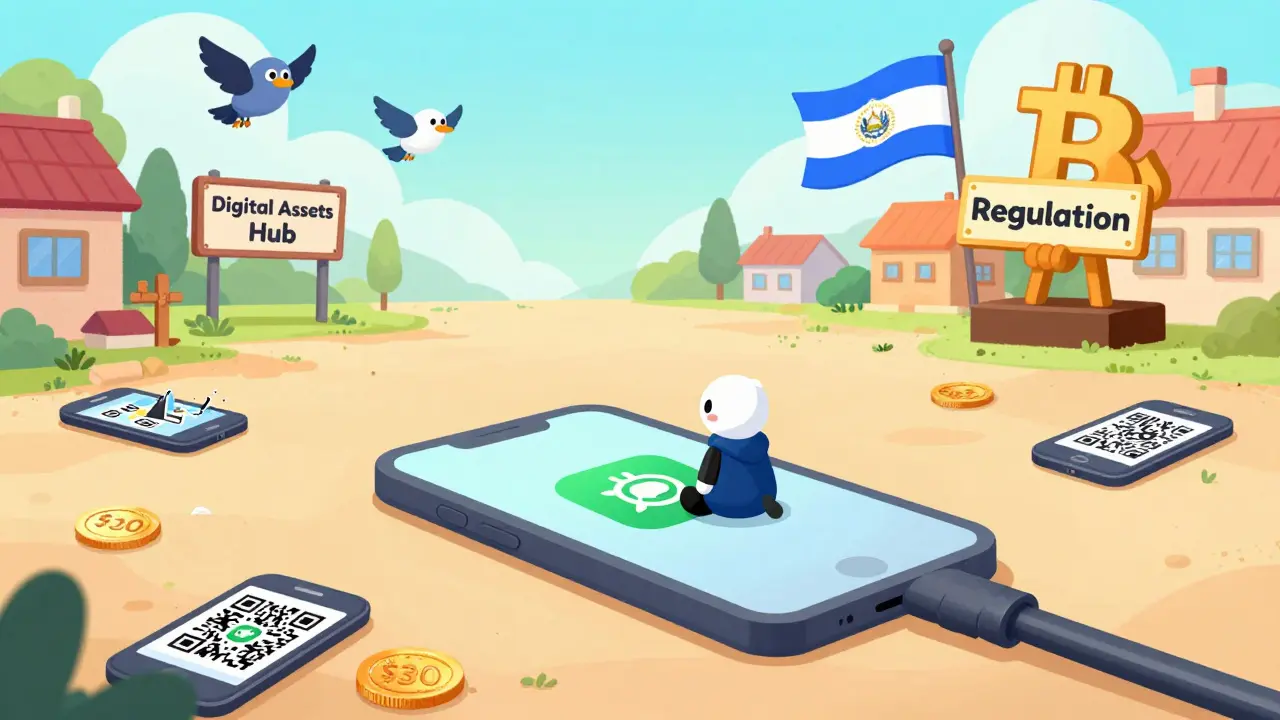
El Salvador didn’t give up on crypto. In fact, it doubled down-in the right direction. The Digital Assets Issuance Act (a 2023 law that created the National Commission of Digital Assets to regulate private crypto businesses) is still active. The government still holds 6,102 Bitcoin-worth around $500 million-as a strategic reserve. And in January 2025, El Salvador hosted PLANB Forum 2025, Central America’s biggest crypto conference. The country is now a hub for private crypto firms, not forced adoption.
Chivo’s legacy isn’t in how many people used it. It’s in what it taught the world: you can’t force people to adopt a volatile asset. You can’t build a financial revolution on a smartphone app without reliable internet, digital literacy, or price stability. And you can’t ignore the human cost of a policy that turns people’s savings into casino chips.
What You Can Learn from Chivo
If you’re thinking about crypto adoption in your own community, here’s what Chivo got wrong-and what you should avoid:
- Don’t mandate adoption. People need to want it, not be forced into it.
- Don’t mix legal tender with volatile assets. Bitcoin isn’t stable money. It’s a speculative asset.
- Don’t skip infrastructure. No app works if 30% of the population can’t get internet or doesn’t know how to use a smartphone.
- Don’t assume incentives last. $30 gets downloads. Trust gets usage.
- Don’t ignore regulation. Without clear rules, crypto becomes a free-for-all-and people get hurt.
Chivo didn’t fail because Bitcoin failed. It failed because the plan ignored reality. Real financial inclusion doesn’t come from a government app. It comes from access, education, and stability. El Salvador learned that the hard way.
Is the Chivo wallet still active in 2026?
Yes, the Chivo wallet app is still available for download on Android and iOS, but it no longer has government backing or integration with public services. It now functions like any other Bitcoin wallet-users can send, receive, and hold Bitcoin and USD, but the $30 incentive is gone, and the app no longer has priority support from the state.
Why did Bitcoin lose its legal tender status in El Salvador?
Bitcoin lost its legal tender status in January 2025 after the International Monetary Fund (IMF) made it a condition for a $1.4 billion financial assistance package. The IMF cited Bitcoin’s extreme price volatility as a threat to financial stability, warning that government-backed exposure to Bitcoin could lead to massive public losses if prices crashed. El Salvador agreed to remove its legal tender status to secure the loan.
Did Chivo wallet help reduce remittance costs?
For the small percentage of users who actively used Chivo for remittances, yes-it cut costs. Transfers from the U.S. to El Salvador dropped from $10-$20 to near zero. But most users converted Bitcoin back to USD immediately, meaning the real benefit was avoiding wire transfer fees, not using Bitcoin. Overall, remittance patterns didn’t change significantly because most people still used traditional services.
What happened to the $30 given to users?
The $30 was a one-time incentive paid in Bitcoin when the app launched in 2021. Its value fluctuated with Bitcoin’s price. Many users cashed out immediately. Others lost money when Bitcoin dropped below $16,000. The government never replaced the funds, and the incentive program ended within months of launch. Today, the $30 is gone for everyone.
Can you still use Chivo wallet to pay for goods in El Salvador?
Technically, yes-but very few businesses accept Bitcoin through Chivo anymore. Most merchants still price goods in U.S. dollars and convert Bitcoin payments instantly to USD. The government no longer requires businesses to accept Bitcoin, and most have gone back to cash or card payments. Chivo is now mostly used for peer-to-peer Bitcoin transfers, not everyday spending.
Is El Salvador still a Bitcoin hub?
Yes, but not because of Chivo. The country has become a magnet for private crypto companies thanks to its clear regulatory framework under the Digital Assets Issuance Act. The National Commission of Digital Assets now oversees private crypto firms, and El Salvador hosts major crypto events like PLANB Forum. It’s no longer about forcing Bitcoin on citizens-it’s about attracting business.
What Comes Next?
El Salvador’s story isn’t over. It’s just changed direction. The country still holds billions in Bitcoin. It still has the world’s only national digital asset regulator. And it still has a population that knows what it’s like to be on the front lines of a financial experiment gone sideways. The lesson isn’t that crypto doesn’t work. It’s that top-down mandates don’t work. Real change comes from trust-not laws.

10 Comments
Dana Sikand
Man I remember when Chivo dropped. I thought it was genius. Free money just for downloading an app? Sign me up. But then I saw my cousin in San Miguel trying to pay for tortillas and the app crashed three times. She cried. Not because she lost $30, but because she couldn’t feed her kid that day. That’s not innovation. That’s a gamble on people’s hunger.
And don’t get me started on the Bitcoin rollercoaster. One week she’s got $30, next week it’s $9. Who the hell thought this was okay? No one warned them. No one trained them. Just slap an app on their phone and call it financial inclusion. Bullshit.
Elizabeth Smith
This whole thing was a moral failure disguised as progress. You don’t solve poverty by turning people’s life savings into crypto roulette. The government didn’t care about the people. They cared about headlines. About being the ‘first’. About looking cool on CNBC.
And now they’re pretending they’re still a ‘crypto hub’? Please. You don’t fix a broken system by inviting hedge funds to your backyard. You fix it by feeding your people. By giving them stable money. By respecting their dignity. Not by forcing them to become speculators.
Samantha Stultz
Let’s dissect the structural flaws here. The Chivo rollout violated three core tenets of fintech adoption: cognitive load, trust architecture, and liquidity alignment. The UX was designed for a tech-savvy urban cohort, not a rural population with intermittent connectivity and low digital literacy.
Moreover, conflating legal tender with a volatile asset class created an asymmetric risk exposure for the state. The IMF wasn’t being punitive-they were applying Basel III logic to a non-compliant system. The $30 incentive was a behavioral nudge that collapsed under utility decay. No one used Bitcoin for transactions because it lacked stable value proposition. It was a currency without a medium-of-exchange function. Just a speculative instrument wrapped in a welfare program.
precious Ncube
El Salvador didn’t fail. They were just too naive. You can’t force people to use something they don’t understand. That’s not leadership. That’s authoritarianism with a blockchain logo. And now they’re patting themselves on the back for ‘private crypto hubs’? Spare me. You let people lose their savings and now you want a trophy? Pathetic.
Jan Czuchaj
There’s a deeper layer here that most people miss. Chivo wasn’t about Bitcoin. It was about sovereignty. El Salvador was trying to break free from the dollar’s shadow, from remittance monopolies, from the economic imperialism of Western financial systems. The tools were wrong, the timing was off, the education was nonexistent-but the intention? That was noble.
People say ‘you can’t force adoption.’ But isn’t that what every financial revolution has done? The ATM didn’t get adopted because people loved it. It got adopted because banks forced it. Credit cards? Same. The difference is, Chivo didn’t have the infrastructure to back up its promise. Not because the tech failed-but because the human infrastructure was ignored.
Maybe the real lesson isn’t that crypto doesn’t work. Maybe it’s that we still don’t know how to build financial systems that serve the poor-not just dazzle them.
George Suggs
Still works. Still out there. Just quiet now. Like a ghost town after the boom.
People moved on. Cash is still king. And honestly? That’s fine.
Patrick Streeb
While the Chivo initiative may have exhibited significant operational shortcomings, it is nonetheless noteworthy that El Salvador demonstrated an unprecedented willingness to experiment with non-traditional monetary frameworks. The subsequent regulatory evolution under the Digital Assets Issuance Act represents a mature pivot toward institutionalizing innovation within a controlled, private-sector-oriented paradigm. This evolution, while divergent from the original intent, reflects a commendable capacity for adaptive governance in the face of empirical feedback.
Phillip Marson
They turned a country into a crypto lab rat and called it progress. People lost their shit-literally. A grandma’s pension turned into $9. A kid’s lunch money vaporized. And the government? They just shrugged and said ‘market forces.’
Now they’re throwing a party for crypto bros and calling it ‘leadership.’ You don’t get to call yourself a pioneer when your ‘revolution’ left people broke and confused. This wasn’t a bold move. It was a crime wrapped in a whitepaper.
Tracy Whetsel
I just want to say-I’m so proud of the Salvadorans who stuck with it even when everything fell apart. They tried. They learned. They didn’t give up.
And honestly? That’s more than most countries do. You don’t need a government app to be resilient. You just need people who care. The real heroes weren’t the devs or the politicians. They were the moms who taught their kids how to scan QR codes. The tío who sent money even when the app crashed. The teachers who stayed late to explain Bitcoin.
We’re not done here. We’re just getting started. 💛
And if you’re reading this and thinking ‘this is too hard’-you’re wrong. It’s not hard. It’s just new. And new things take time.
Alyssa Herndon
I think about how much love went into this. The way people lined up just to get help. The radio ads. The school workshops. It wasn’t just policy-it was hope. And hope doesn’t die just because the app crashes.
Maybe the lesson isn’t that crypto failed. Maybe it’s that we forgot to listen. We built something for people instead of with them. And that’s the real mistake.
Still, I believe in El Salvador. I believe in their quiet strength. And I believe the next version will be better. Not because of laws. But because of hearts.