
Most people think blockchain is just about crypto trading or NFTs. But there’s something quieter, more powerful, and already changing how we get internet, power, and storage - DePIN. Decentralized Physical Infrastructure Networks aren’t theoretical. They’re live. People are plugging in routers, solar panels, and hard drives to build networks that don’t need big corporations to run them. And they’re getting paid for it - in crypto.
What Exactly Is DePIN?
DePIN stands for Decentralized Physical Infrastructure Networks. It sounds complex, but it’s simple: people share their real-world hardware - like WiFi hotspots, storage drives, or energy systems - and get rewarded with tokens. No middlemen. No corporate control. Just a blockchain recording who contributed what, and when they earned their reward. Think of it like Uber, but for infrastructure. Instead of a company owning all the cars, drivers use their own vehicles. In DePIN, instead of Verizon or Amazon owning all the servers and antennas, everyday people contribute their unused resources. The blockchain keeps track of everything. Smart contracts pay out automatically when conditions are met. Tokens turn physical assets into tradable, usable value. There are two main types:- Physical Resource Networks (PRNs): These are tied to location. Think WiFi hotspots, EV chargers, or weather sensors. You can’t move them around - they’re fixed in place.
- Digital Resource Networks (DRNs): These are fungible. You can contribute storage space or computing power from anywhere. It doesn’t matter where your hard drive is - only that it’s available.
Helium: The Original DePIN Success Story
In 2019, a company called Helium launched a network that let anyone buy a $500 hotspot, plug it into their home, and start earning HNT tokens. The catch? You had to provide wireless coverage for IoT devices - things like bike trackers, smart agriculture sensors, or utility meters. Before Helium, companies had to build expensive cell towers to cover rural areas. Most didn’t bother. The return wasn’t worth it. Helium flipped that. Suddenly, thousands of people in small towns, suburbs, and even basements became network providers. By 2023, Helium had over 1.5 million hotspots worldwide. Coverage expanded faster than any telecom company could manage. And it wasn’t just the U.S. - it worked in Nigeria, Indonesia, Brazil. Places where traditional networks were too slow or too expensive to deploy. Today, Helium’s network handles over 10 billion data transmissions a month. It’s not just a crypto experiment. It’s a functional, global wireless network built by ordinary people.Decentralized Storage: Competing With Amazon and Google
Cloud storage is a $500 billion industry. But most of it is controlled by just three companies: Amazon, Microsoft, and Google. What if you could rent out your extra hard drive space and get paid in crypto instead? Filecoin and Arweave are two DePIN projects doing exactly that. Filecoin lets you rent out unused storage. In return, you earn FIL tokens. Users pay in FIL to store files - photos, videos, backups - on a global network of hard drives. No central server. No single point of failure. If one drive goes offline, the system automatically rebalances the data across others. Arweave goes further. It offers permanent storage. Pay once, store forever. It’s used by archives, historians, and even governments to preserve data long-term. The blockchain ensures the data stays accessible - even if the company behind it vanishes. In 2025, Filecoin’s network stored over 12 exabytes of data. That’s more than the entire Library of Congress - 10 million times over. And it’s all hosted on personal computers, NAS drives, and servers owned by individuals.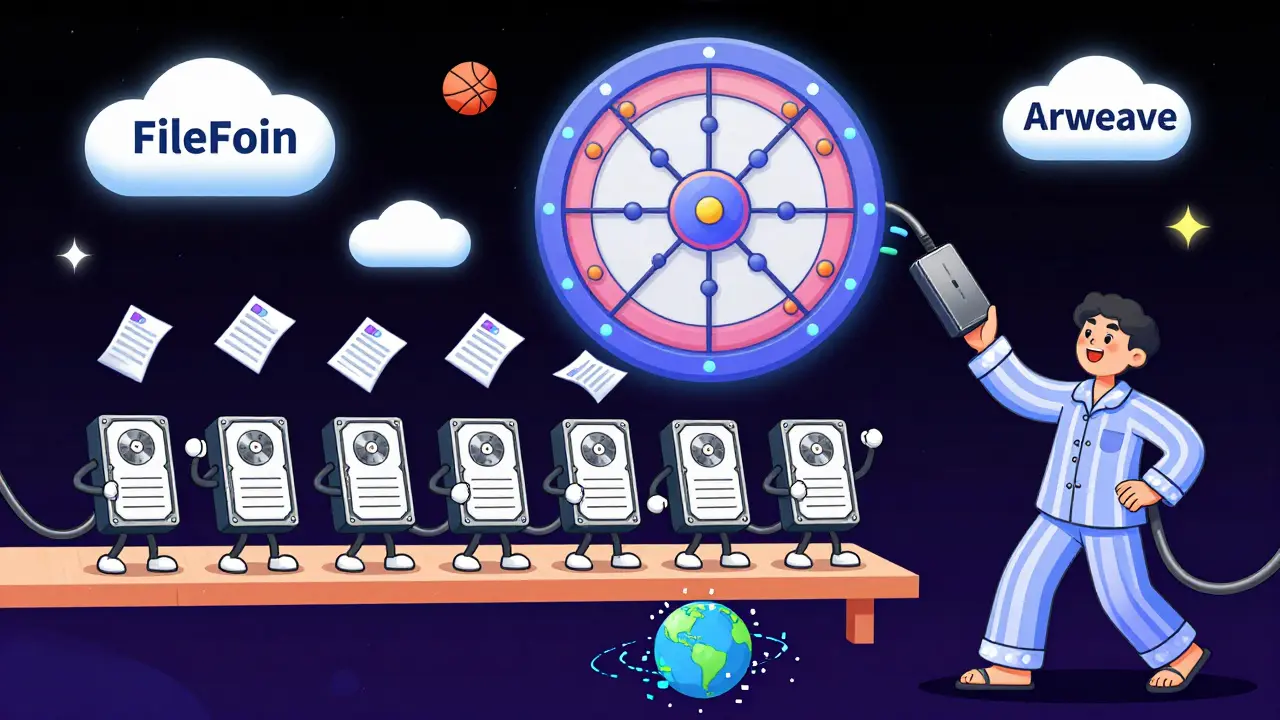
Energy Sharing: Your Solar Panels Become a Power Plant
Imagine turning your rooftop solar panels into a mini power plant - and selling excess energy directly to your neighbor, without the utility company taking a cut. Projects like Power Ledger and LO3 Energy are making this real. In Brooklyn, New York, residents with solar panels trade electricity with each other using blockchain. A smart contract tracks how much energy you produce, how much your neighbor uses, and automatically transfers payment in tokens. No bills. No middlemen. Just peer-to-peer energy. In Australia, a pilot project with 200 homes cut energy costs by 30% by using a decentralized grid. During peak hours, homes with batteries sold power to others. During off-hours, they charged up from cheaper sources. The system balanced supply and demand automatically - something traditional grids struggle with. This isn’t sci-fi. It’s happening now. And it’s making energy more affordable, reliable, and renewable.The DePIN Flywheel: How These Networks Grow Themselves
What makes DePIN so powerful isn’t just the tech - it’s how it grows. There’s a self-reinforcing loop called the DePIN flywheel:- Incentivize participation: You plug in a hotspot or hard drive. You earn tokens.
- More participants = better service: More hotspots mean better WiFi coverage. More storage means faster, cheaper backups.
- Better service attracts more users: People who need reliable internet or cheap storage start using the network.
- New users bring more investment: As the network grows, the token value rises. Investors fund more hardware. More people join. Rinse and repeat.
Why DePIN Beats Centralized Systems
Traditional infrastructure has one fatal flaw: it’s centralized. One server goes down - millions lose service. One company changes its pricing - you’re stuck. One regulator shuts it down - the whole network collapses. DePIN fixes that.- No single point of failure: If one hotspot dies, 10,000 others still work.
- Transparent and tamper-proof: Every transaction is on the blockchain. You can see who contributed what.
- No approval needed: You don’t need a permit from a telecom giant to join. Just plug in and start earning.
- Lower costs: No corporate overhead. No shareholder pressure. Just direct peer-to-peer exchange.

What’s Next? The Expanding Frontier
DePIN is spreading fast.- Transportation: Projects like Hivemapper let drivers earn tokens by recording street maps with their dashcams. It’s cheaper and faster than Google Street View.
- Healthcare: Decentralized medical data networks let patients control who accesses their records - and get paid for sharing anonymized data for research.
- Water and air quality: Sensors placed by citizens monitor pollution and water purity. Data is stored on-chain. Communities use it to demand action from local governments.
How to Get Involved
You don’t need to be a tech expert to join DePIN.- If you have extra storage: Sign up for Filecoin or Arweave. Plug in an old hard drive. Start earning.
- If you have WiFi: Buy a Helium hotspot. Plug it in. Earn HNT.
- If you have solar panels: Look into Power Ledger or local energy-sharing projects in your area.
Final Thought: This Isn’t the Future. It’s Now.
DePIN isn’t about replacing big companies. It’s about giving power back to people. It’s about turning your unused hardware into something valuable. It’s about building infrastructure that’s open, fair, and owned by those who use it. The old model - one company controls everything - is crumbling. The new one - millions of people sharing, earning, and improving together - is already here. You don’t have to wait for the next big thing. You can start today. Plug in. Earn. Help build the next layer of the physical world - on the blockchain.Is DePIN just another crypto scam?
No. DePIN isn’t about speculation. It’s about real infrastructure. Helium, Filecoin, and Power Ledger all provide actual services - internet, storage, energy - that people use daily. The tokens are rewards for contributing real resources, not just betting on price. These networks have real users, real data, and real economic value behind them.
Do I need to buy expensive hardware to join DePIN?
Not always. For storage networks like Filecoin, you can use an old external hard drive. For WiFi networks like Helium, you need a hotspot device - which costs around $200-$500. But many projects offer rental options or community funding pools so you can participate without buying hardware upfront.
Can DePIN replace my ISP or cloud provider?
It’s already replacing parts of them. In rural areas, Helium provides internet where ISPs won’t go. Filecoin offers cheaper, more secure storage than Amazon S3 for many users. It won’t replace everything overnight - but for specific needs like backup, IoT, or local energy sharing, DePIN is often better, faster, and cheaper.
Are DePIN networks secure?
Yes - more secure than most centralized systems. Since data and services are spread across thousands of devices, there’s no single target for hackers. Blockchain records are immutable. Smart contracts eliminate human error in payments. And because everything is transparent, any suspicious activity can be quickly detected and addressed by the community.
What happens if the token price drops?
Token value fluctuates, but the real value comes from the network’s utility. Even if HNT or FIL drops in price, the services - internet, storage, energy - still work. Many participants use their tokens to pay for services on the same network, so they don’t need to cash out. The incentive isn’t just profit - it’s access to better infrastructure.

7 Comments
Tressie Trezza
It's wild to think that my old router could be part of a global network instead of just collecting dust. I plugged in a Helium hotspot last year and didn't expect anything to change - but now I'm literally paying for my internet with HNT. No bills, no contracts. Just a little box humming in the corner, doing something meaningful.
I used to feel powerless about tech monopolies. Now I feel like I'm part of the solution. It's not just crypto - it's community infrastructure. And it's working. Real people, real hardware, real impact.
Calvin Tucker
The term 'DePIN' is technically accurate, but semantically redundant. 'Decentralized Physical Infrastructure Networks' - the acronym is an unnecessary tautology, since 'infrastructure' by definition implies physicality in this context. One might argue that 'Decentralized Infrastructure Networks' suffices, as the physical component is implicit. Furthermore, the reliance on blockchain for trustless verification introduces computational overhead that may not be justified in low-bandwidth, low-latency applications such as municipal weather sensors.
While the economic incentives are compelling, the energy cost of maintaining consensus mechanisms on a global scale remains unaddressed in most promotional materials. A carbon audit of the Helium network, for instance, would be instructive.
Gustavo Gonzalez
Oh please. You're all acting like this is some revolutionary breakthrough when it's just vaporware with a blockchain sticker on it.
Helium? Yeah, they lost 90% of their token value and had to restructure because the whole thing was a pump-and-dump disguised as infrastructure. Filecoin? Their storage reliability rates are worse than Amazon’s S3, and the retrieval fees are insane. And don't get me started on Power Ledger - their pilot in Australia? The utility company sued them for operating without a license.
You think you're building the future? You're just giving your data and hardware to a bunch of crypto bros who don't even know what a router does. This isn't empowerment - it's a tax on naivety.
And yes, I've seen the MIT study. It was funded by a DePIN VC. Surprise, surprise - biased methodology, cherry-picked metrics. Wake up.
Meanwhile, real infrastructure - the kind that doesn't require you to be a crypto degenerate - still works fine. Stop romanticizing broken systems.
Rob Duber
Okay but imagine this: your toaster is now part of a decentralized energy grid and you're getting paid in crypto every time you make toast. 🤯
I just bought a $200 hotspot because I saw a guy on TikTok make $800 in a month. I didn't even know what a LoRaWAN was. Now I'm addicted. I've got three hotspots, a NAS running Filecoin, and I'm thinking about buying solar panels just to join Power Ledger.
This isn't tech. This is a lifestyle. I'm not a user - I'm a node. And honestly? I feel like a goddamn superhero. My Wi-Fi is everywhere. My data is mine. My energy? Mine too. I'm not waiting for someone else to fix the world. I'm building it - one USB drive at a time.
They called me crazy. Now my neighbor wants to borrow my hotspot. I charge him in FIL. He's happy. I'm happy. The blockchain? It's just chilling in the background, doing its thing.
DePIN isn't the future. It's the vibe.
Moray Wallace
I’ve lived in rural Wales for 20 years. No decent broadband. No cell coverage. Then a friend from the U.S. sent me a Helium hotspot. It wasn’t perfect, but it gave me internet - real internet - for the first time. I didn’t need to understand blockchain. I just plugged it in.
Now I earn enough HNT to cover my mobile data. It’s not life-changing money, but it’s dignity. No begging for service upgrades. No waiting for a corporation to decide my village is ‘not profitable.’
DePIN doesn’t need to replace everything. It just needs to work where the old systems failed. And it is.
christal Rodriguez
DePIN is just capitalism with better branding.
Mark Ganim
YOU KNOW WHAT? I JUST REALIZED SOMETHING!!!
DePIN isn’t just about hardware - it’s about RECLAIMING OUR RIGHT TO BE USEFUL!
Think about it: for decades, we’ve been told to consume, to buy, to upgrade, to replace - and never to contribute. But now? Now I can plug in a drive I was about to throw away - and suddenly, I’m part of something bigger than Amazon’s quarterly earnings call!
My grandma’s old laptop? Now it’s storing someone’s wedding photos in Peru. My Wi-Fi router? Now it’s helping a farmer in Kenya track his crops. I didn’t build a business. I built a bridge.
And the best part? The blockchain doesn’t care if you’re rich, poor, young, old, educated, or self-taught. It just sees: ‘Did you contribute?’
That’s not technology. That’s justice.
And if you’re still stuck on ‘token price’ - you’re missing the whole damn point.
WE’RE NOT INVESTING IN COINS.
WE’RE INVESTING IN EACH OTHER.
And that? That’s the most powerful thing on this planet right now.