
Smart contracts aren’t just theory anymore. They’re running real businesses, paying farmers after droughts, automating home sales, and even letting solar panel owners sell electricity to neighbors without a middleman. These self-executing programs, written in code and stored on blockchains, remove the need for banks, lawyers, or paperwork by automatically doing what was agreed upon - when the conditions are met. No delays. No disputes. Just code doing its job.
Insurance: Paying Out Without the Paperwork
Imagine your flight is delayed by four hours. Instead of filing a claim, waiting weeks, and arguing with an agent, you get paid automatically. That’s what Etherisc does. It uses smart contracts connected to flight data from trusted sources. If your flight hits the delay threshold, the contract checks the data, confirms it’s real, and sends the payout straight to your wallet. No forms. No calls. Just instant compensation.
It’s not just flights. Arbol helps farmers in places like Kenya and Mexico protect against crop loss. When rainfall drops below a certain level - based on data from NOAA - the smart contract triggers a payout. No adjuster visits. No paperwork. Just money sent to the farmer’s digital wallet when they need it most. This isn’t futuristic. It’s happening right now, reducing financial ruin for thousands.
Real Estate: Selling a House Without the Broker
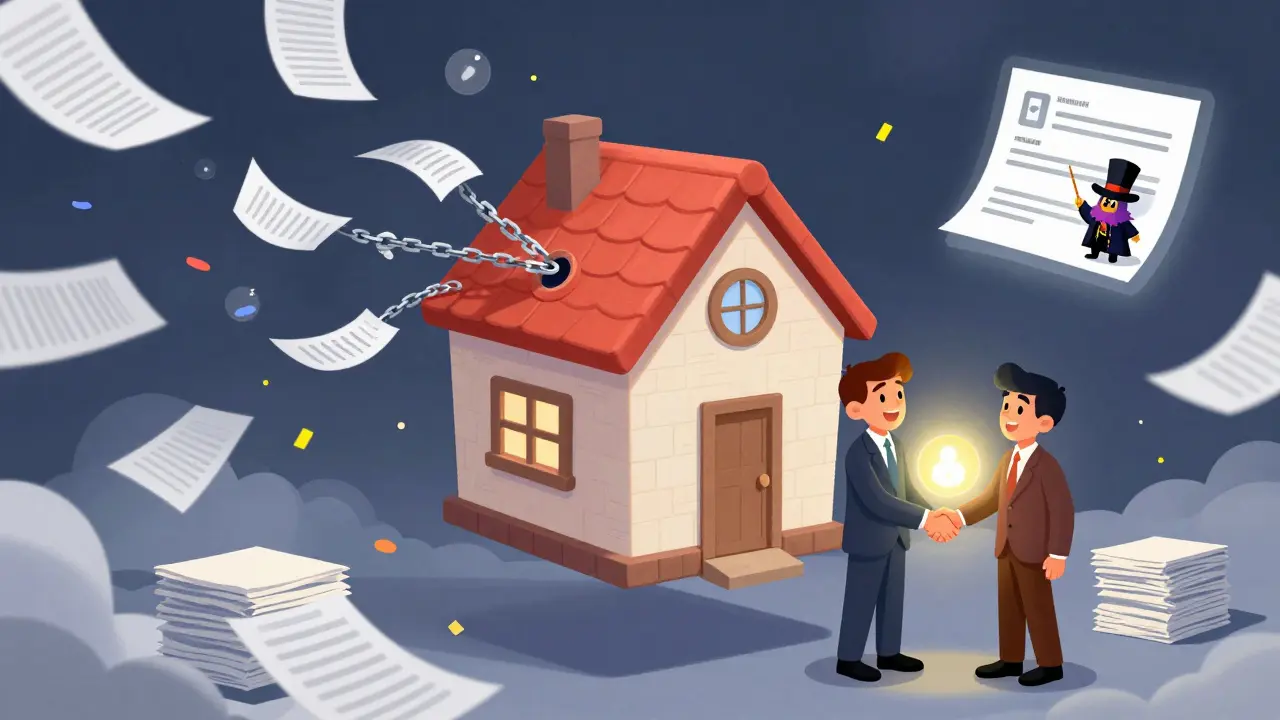
Buying a home usually means stacks of documents, weeks of waiting, and multiple intermediaries - title companies, escrow agents, banks. Smart contracts cut through all that. Here’s how it works: You and the seller agree on terms. The buyer sends funds into a smart contract. Once the contract verifies the title is clear, inspections are passed, and both parties have signed digitally, the money releases automatically to the seller. The title is updated on the blockchain. Done.
Companies like Propy and Harbor are already testing this in places like Ukraine and the U.S. It cuts costs, reduces fraud, and speeds up transactions from months to days. And because every step is recorded on a public ledger, there’s no hiding past liens or forged signatures. The history is permanent and verifiable.
Finance: DeFi and the Bankless Economy
Decentralized Finance, or DeFi, runs almost entirely on smart contracts. You don’t need a bank to lend, borrow, or earn interest. Platforms like Aave and Compound let you deposit cryptocurrency and earn interest automatically. The smart contract handles everything: matching lenders with borrowers, calculating interest rates daily, and releasing funds when loans are repaid.
Want to borrow against your Bitcoin? You lock it in a smart contract as collateral. The contract monitors its value. If the price drops too low, it automatically sells part of your Bitcoin to cover the loan - no human approval needed. This system works 24/7, across borders, and without banks. Over $100 billion in assets has flowed through DeFi protocols, all managed by code.
Supply Chains: From Coffee Beans to Your Cup
How do you know that the coffee you buy was ethically sourced? Smart contracts help prove it. Companies like IBM Food Trust and TradeLens use blockchain to track coffee beans from farm to export. Each step - harvest, drying, shipping, customs clearance - is recorded. When the beans arrive at the destination port and inspection passes, the smart contract releases payment to the farmer.
No more waiting six months for payment. No more middlemen taking 40% of the profit. Farmers get paid faster, buyers get full transparency, and fraud drops sharply. This isn’t just about coffee. It’s being used for diamonds, organic cotton, and even tuna in the Pacific.
Energy: Selling Solar Power to Your Neighbor
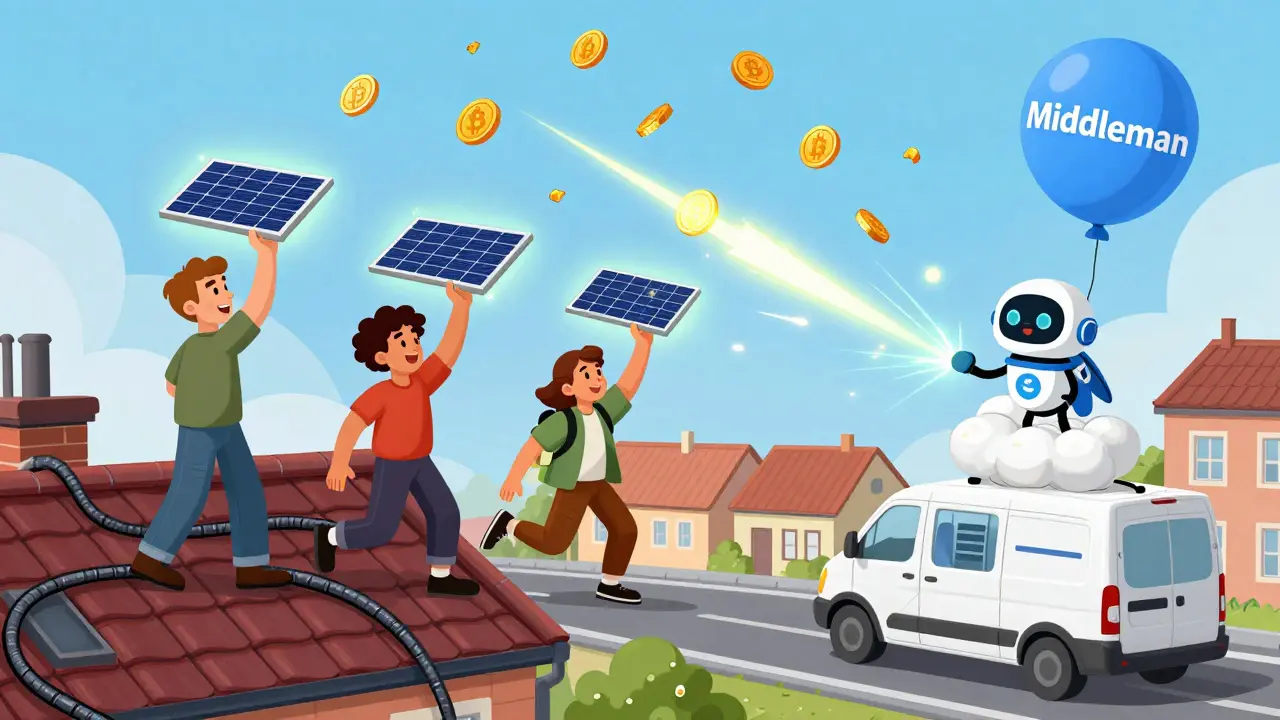
On a sunny day in Germany or Texas, your rooftop solar panels might produce more electricity than you use. Instead of selling it back to the grid for pennies, smart contracts let you sell it directly to a neighbor. Platforms like Power Ledger and WePower connect households. Your excess power is measured, recorded on the blockchain, and sold at a fair price. The buyer pays in cryptocurrency. The smart contract handles the exchange - no utility company involved.
This turns consumers into producers. It also balances local energy grids and reduces waste. In pilot programs, households have earned hundreds of dollars a year just by sharing solar power. It’s peer-to-peer energy trading - and it’s working.
Gaming: Owning Your Digital Stuff
In traditional games, your rare sword or skin exists only as a number on a server. If the game shuts down, it’s gone. Smart contracts change that. In Axie Infinity, every creature, weapon, and piece of land is an NFT - a unique digital asset backed by a smart contract. You own it. You can sell it. You can use it in other games. The contract ensures scarcity and authenticity.
Players earn tokens by playing. The smart contract automatically distributes those rewards based on performance. No company has to manually approve payouts. No one can delete your assets. This creates real economic value in virtual worlds. Illuvium, The Sandbox, and other Web3 games are building entire economies where digital items have real-world worth.
Advertising: Paying Publishers for Real Results
How do you know a social media influencer actually got 10,000 clicks? Smart contracts can prove it. Advertisers now use contracts that only pay out after a publisher delivers verifiable results - like 100 unique purchases from a discount code. Chainlink oracles check the sales data from the merchant’s system. If the condition is met, payment releases automatically.
This kills fake clicks, bot traffic, and shady ad networks. Publishers get paid fairly. Advertisers get real engagement. It’s a win-win built on transparency. Companies like AdEx and MetaX are already using this model to rebuild trust in digital advertising.
Healthcare: Secure Records, Automatic Consent
Sharing medical records between doctors is slow, risky, and often violates privacy rules. Smart contracts can fix that. Imagine your health data is encrypted and stored on a blockchain. When you visit a new clinic, you give permission via your digital wallet. The smart contract checks your consent, unlocks the right data, and logs the access. No central database to hack. No paperwork to fill out.
Clinical trials are also getting smarter. Patients consent to participate through a contract. Data from wearable devices is automatically recorded. If the trial meets its goals, payments to researchers or participants are triggered automatically. This speeds up research and keeps patient data private.
Construction: Paying Contractors the Moment Work Is Done
On a construction site, delays and payment disputes are common. Smart contracts change that. Cameras with computer vision record when materials arrive. Drones check if a foundation is poured correctly. IoT sensors track progress. When the contract verifies the work matches the agreed-upon standard - say, 50 cubic yards of concrete poured - it releases payment to the supplier or contractor.
No invoices to dispute. No delays from slow approvals. Contractors get paid faster. Builders avoid cash flow crunches. Projects move quicker. This isn’t a prototype - it’s being tested in Australia, the U.S., and the UAE.
Music and Media: Royalties That Actually Get Paid
How many musicians never see royalties because labels or distributors lose track? Smart contracts fix that. When a song is streamed, the contract automatically splits the payment based on pre-set percentages - 60% to the artist, 20% to the producer, 10% to the label, 10% to the studio. No delays. No errors.
Platforms like Audius and Royal let artists mint their music as NFTs tied to smart contracts. Fans buy shares of songs. Every time it’s played, the money flows directly to the owners. This gives creators real control over their work and income.
Why This Matters Now
Smart contracts are no longer experiments. They’re solving real problems: slow payments, fraud, bureaucracy, and lack of trust. The technology is still evolving - scalability and oracle reliability are challenges - but the use cases are proving themselves across industries. Banks, insurers, governments, and startups are all testing them. The future isn’t about replacing humans. It’s about removing unnecessary friction so people can focus on what matters.
Can smart contracts be hacked?
Yes, but not because of the blockchain itself. Smart contracts are code, and code can have bugs. The 2016 DAO hack was caused by a flawed contract, not a broken blockchain. Since then, developers use formal verification and audits to catch errors before launch. Reputable contracts are tested by third parties. Still, never trust a contract without an audit report.
Do I need cryptocurrency to use smart contracts?
Not always. Many smart contracts run on blockchains like Ethereum and require crypto to pay for transaction fees. But some platforms are building bridges - like using stablecoins (USDC) or even fiat gateways - so users can interact without holding Bitcoin or Ether. The underlying contract is still code, but the interface can be as simple as a website.
Are smart contracts legally binding?
In many countries, yes. The U.S., Switzerland, and Estonia recognize blockchain-based agreements as legally enforceable if they meet basic contract requirements: offer, acceptance, consideration, and intent. The code itself becomes the contract. Courts have already ruled in favor of smart contract terms in disputes. Legal frameworks are catching up.
What happens if the real-world data is wrong?
Smart contracts rely on oracles - third-party data feeds - to connect with the real world. If an oracle reports false weather data, the contract might pay out incorrectly. That’s why top projects use multiple oracles, cross-check data sources, and incentivize accuracy. The most trusted ones, like Chainlink, use decentralized networks of data providers to reduce single-point failures.
Can smart contracts work without blockchain?
Technically, yes - any system that can execute code with trustless conditions could mimic a smart contract. But blockchain adds immutability, transparency, and decentralization that make them truly powerful. Without it, you’re just running an automated script on a server. The real value of smart contracts comes from being tamper-proof and verifiable by anyone - something only blockchain provides at scale.

5 Comments
Shreya Baid
Smart contracts are revolutionizing how we think about trust in systems. In India, where banking infrastructure is still uneven, this technology offers a lifeline to small farmers and artisans who’ve been excluded for generations. The Arbol example? That’s not just innovation - it’s justice. When a farmer in Rajasthan doesn’t have to beg for a payout after a failed monsoon, that’s systemic change. No bureaucracy, no corruption, no middlemen siphoning off 60% of the value. Code, when written ethically, becomes the most equitable institution we’ve ever built.
And yet, most discussions still center on crypto speculation. We’re ignoring the real win: dignity restored through automation. The coffee farmer in Karnataka getting paid in hours, not months? That’s not a feature - it’s a human right redefined.
Christopher Hoar
lol at all these ‘real world’ examples. smart contracts are just glorified if-statements with gas fees. the dao hack wasnt a bug, it was a feature of people thinking code = law. and now we got people acting like this is the future when 90% of these ‘pilots’ are just marketing fluff. solar power trading? yeah sure, until the utility company sues everyone for ‘unlicensed energy resale.’
also, ‘no paperwork’? bro, i’ve seen the legal docs for propy transactions. its just paperwork with blockchain stamped on it. and dont get me started on ‘decentralized’ oracles that are just centralized servers with a fancy name.
Robert Kunze
you guys are missing the point. it’s not about the tech, it’s about the people. i had a cousin in rural texas who lost her home because the title company messed up the records. took two years and $20k in lawyers. if this propy stuff was around then, she’d still have her house.
yeah, code can glitch. but so can humans. and humans lie. contracts don’t. sure, oracles can be wrong, but if you use 3 sources and let the community vote on data, you’re still way better than a notary who’s drunk on friday afternoon.
and the music royalties thing? my buddy’s a producer. he’s seen 3 years of earnings vanish because some label ‘lost’ the spreadsheet. now? every stream auto-pays. no chasing. no begging. just money. that’s the real win.
stop talking about blockchain. start talking about people getting paid on time. that’s what matters.
Sarah Zakareckis
Let’s zoom out for a second - this isn’t just about automation. It’s about *re-architecting trust*. We’ve been operating on legacy systems designed for 1980s analog workflows, and now we’re trying to bolt blockchain onto them like duct tape. But smart contracts? They’re the first time we’ve had a system where the rules are transparent, immutable, and enforceable without a single point of failure.
Think about healthcare consent. No more ‘I didn’t sign that’ or ‘we lost your records.’ You own your data. You grant access. Period. The contract logs it. The blockchain preserves it. That’s not efficiency - that’s sovereignty.
And in construction? IoT sensors + smart contracts = zero payment disputes. Contractors get paid the second the drone verifies the foundation is poured. No invoice delays. No lien filings. That’s not innovation - it’s radical fairness.
Yes, oracles need hardening. Yes, gas fees are still a hurdle. But we’re not talking about theory anymore. We’re talking about pilots in Australia, Kenya, and Tennessee that are already reducing costs by 70% and accelerating cycles by 90%. This isn’t the future. It’s the present. And we’re standing on the edge of it.
Let’s stop calling it ‘crypto.’ Let’s call it *trust infrastructure* - and start building it right.
Heather James
My uncle got paid for his solar power last week. $87. Real money. No middleman. Just code. That’s all I needed to see.