
You stare at your screen. A Bitcoin chart looks like a jagged mountain range, while a whitepaper for a new DeFi protocol sits open in another tab. One tells you the price is moving up; the other tells you the project has zero revenue. Which one do you trust? This is the eternal clash between technical analysis and fundamental analysis.
In the world of blockchain and cryptocurrency, this isn't just academic theory. It’s the difference between catching a 10% pump in an hour and holding a coin that goes to zero because the team vanished. Most beginners pick one side and stick to it. The pros usually mix them. Let’s break down exactly how each method works, where they fail, and how you can use both to stop guessing and start trading with a plan.
The Core Difference: Price vs. Value
At its heart, this debate is about what you believe drives price. Do prices move because of supply and demand psychology, or because of underlying utility?
Fundamental analysis is the process of evaluating an asset's intrinsic value by examining related economic, financial, and qualitative factors. In traditional stocks, this means looking at earnings reports, management teams, and industry health. In crypto, it shifts slightly. You’re not looking at quarterly profits (most projects don’t have them). Instead, you look at tokenomics, active wallet addresses, developer activity on GitHub, and total value locked (TVL) in protocols. You are trying to answer: "Is this project actually useful?"
Technical analysis is the study of historical price action and volume to predict future market movements. It ignores whether the project is "good" or "bad." If Elon Musk tweets about Dogecoin, technical analysts care only about the resulting spike in volume and price, not the meme itself. They believe all known information is already priced into the chart. Their question is: "Where is the money flowing right now?"
Fundamental Analysis in Blockchain: Digging Deeper
If you choose fundamentals, you are playing the long game. You are looking for undervalued assets. Here is what that actually looks like in 2026.
- Tokenomics: How many tokens exist? Are they being inflated daily by venture capital unlocks? A project might have great tech, but if 40% of the supply is released next month, the price will likely drop regardless of quality. Check the vesting schedules.
- On-Chain Metrics: Unlike stock markets, blockchains are transparent. Use tools to check active addresses. Is the number of unique users growing? If the price is rising but user activity is flat, it’s a red flag. Real adoption drives long-term value.
- Protocol Revenue: For DeFi platforms, does the protocol generate fees? Does it burn tokens based on usage? Projects that capture real economic value tend to survive bear markets better than those relying solely on hype.
- Team and Community: Who is building this? Are they anonymous? Do they have a track record? In crypto, trust is scarce. A strong, active community often acts as a moat against competitors.
The downside? Fundamentals are slow. A great project can sit sideways for six months while the market ignores it. You need patience and a high tolerance for volatility.
Technical Analysis: Reading the Crowd
Technical analysis is about timing. It assumes that history repeats itself because human psychology-fear and greed-doesn’t change. Whether you are trading Ethereum or Solana, the charts look similar because traders react similarly.
Here are the three pillars every trader needs to know:
- Trend Lines: Is the price making higher highs and higher lows? That’s an uptrend. Don’t fight the trend. Buying during a clear uptrend is statistically safer than trying to catch a falling knife.
- Support and Resistance: These are price levels where the asset has historically struggled to break through (resistance) or fallen no further (support). Think of resistance as a ceiling and support as a floor. Traders buy at support and sell at resistance.
- Volume: Price movement without volume is suspicious. If Bitcoin breaks a key resistance level but volume is low, it’s likely a "fakeout." High volume confirms that big players are behind the move.
Common indicators include Moving Averages (to smooth out noise), RSI (Relative Strength Index, to spot overbought or oversold conditions), and MACD (Moving Average Convergence Divergence, to spot momentum shifts).
The risk here is false signals. In crypto, "wicks"-sharp, temporary price spikes followed by immediate reversals-are common. A purely technical trader might get stopped out repeatedly if they don’t understand the broader context.
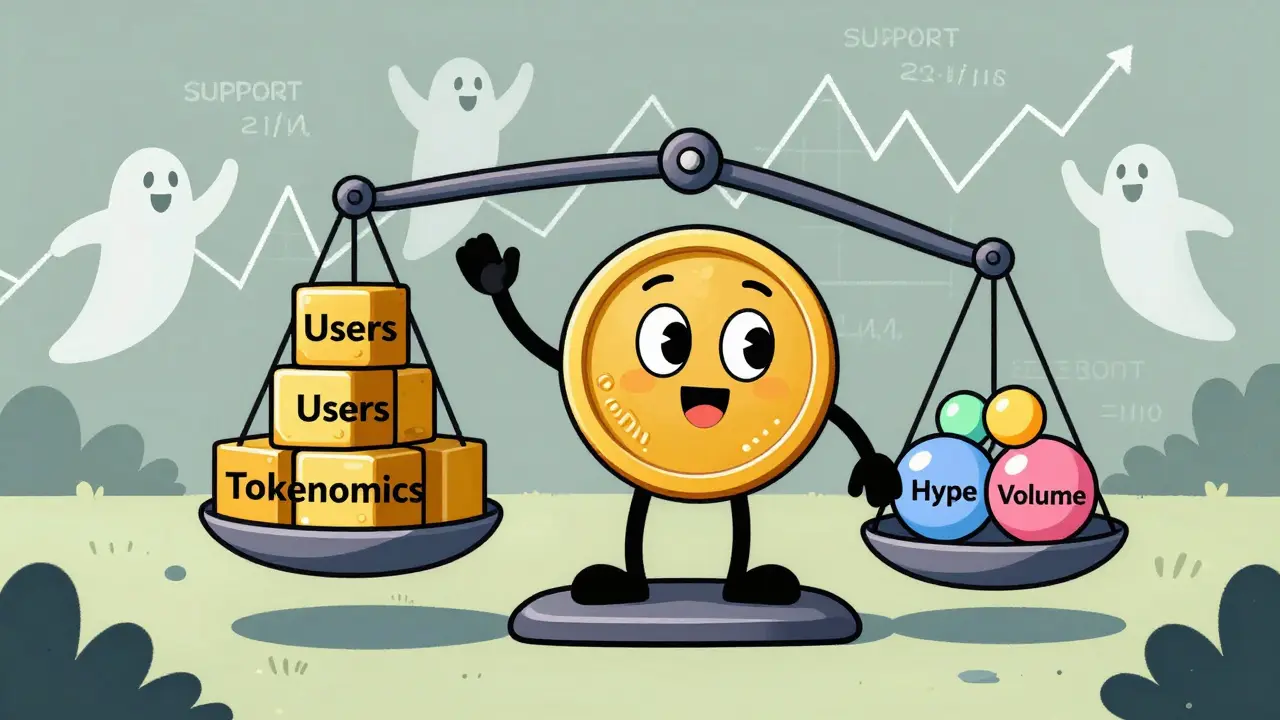
Head-to-Head Comparison
| Feature | Fundamental Analysis | Technical Analysis |
|---|---|---|
| Primary Goal | Determine intrinsic value | Predict price direction |
| Data Source | Financials, on-chain data, news | Price charts, volume, indicators |
| Time Horizon | Long-term (months to years) | Short-term (minutes to weeks) |
| Best For | Investors, HODLers | Traders, Swing Traders |
| Weakness | Slow results, ignores sentiment | False signals, ignores project quality |
The Hybrid Approach: Best of Both Worlds
Why choose one when you can use both? The most successful crypto investors I’ve seen don’t treat these methods as enemies. They use fundamentals to decide what to buy, and technicals to decide when to buy.
Here is a practical workflow:
First, use fundamental analysis to build a watchlist. Look for projects with strong tokenomics, growing user bases, and solid development teams. Let’s say you identify a Layer-2 scaling solution that is gaining traction. You believe it’s undervalued.
Second, switch to technical analysis. Don’t just buy it immediately. Wait for a pullback to a key support level. Check the RSI-is it oversold? Is volume drying up, suggesting sellers are exhausted? When the price bounces off support with increasing volume, that’s your entry signal.
This method protects you from buying "good" projects at their peak prices. It also keeps you from buying "cheap" projects that are fundamentally broken. You get the safety of value investing with the precision of trend trading.

Common Pitfalls to Avoid
Even with a plan, mistakes happen. Here are the most frequent traps:
- Confirmation Bias: You love a project because you did deep research. So you ignore the technical chart showing a massive downtrend. Hope is not a strategy. Respect the price action.
- Over-Trading: Technical analysis can be addictive. Constantly checking 5-minute charts leads to burnout and excessive fees. Stick to your timeframe.
- Ignoring Macro Trends: Crypto doesn’t exist in a vacuum. Interest rates, regulatory news, and global economic events affect all assets. Even the best technical setup can fail if the Federal Reserve raises rates unexpectedly.
- Chasing Hype: Buying a coin just because it’s trending on social media is neither fundamental nor technical analysis. It’s gambling. Always have a thesis.
Which One Should You Start With?
If you are new to blockchain, start with fundamentals. It teaches you to understand the technology and the ecosystem. It builds a foundation of knowledge that protects you from scams and rug pulls. Learn to read a whitepaper. Understand what staking is. Know why a token has value.
Once you understand the assets, layer on technical analysis. Start simple. Learn to identify trends and support levels. Use stop-loss orders to manage risk. As you gain experience, you’ll develop an intuition for market sentiment that complements your fundamental research.
Remember, the market is always changing. What worked in 2021 might not work in 2026. Stay curious, keep learning, and never invest more than you can afford to lose.
Can you make money using only technical analysis in crypto?
Yes, many professional day traders rely exclusively on technical analysis. However, it requires strict discipline, excellent risk management, and significant time commitment. Without understanding fundamentals, you risk holding assets that lose value permanently due to project failure.
Is fundamental analysis useless for short-term trading?
Not entirely. While short-term moves are driven by sentiment, major news events (like upgrades or partnerships) are fundamental catalysts. Ignoring them can lead to unexpected volatility. However, for trades lasting less than a week, technicals usually dominate.
What are the best tools for crypto fundamental analysis?
Tools like Glassnode and Nansen provide on-chain data. CoinGecko and CoinMarketCap offer basic metrics. For deeper dives, read project documentation, audit reports, and follow developer updates on GitHub and Discord.
How do I combine both methods effectively?
Use fundamentals to select high-quality assets for your portfolio. Then, use technical analysis to time your entries and exits. Buy when the price dips to support levels during a broader uptrend, ensuring you get a good price on a good asset.
Does technical analysis work in bear markets?
Yes, but the strategies change. In bear markets, focus on identifying resistance levels to short or avoid buying. Look for "dead cat bounces"-temporary rallies that fail to sustain. Volume confirmation becomes even more critical to distinguish real reversals from fakeouts.
