
Imagine a single transaction on your phone costing as much energy as driving a gas-powered car for over 1,600 kilometers. That is the reality for many cryptocurrency transactions, particularly those involving digital assets like Bitcoin that rely on energy-intensive validation methods. As we move through 2026, the debate around whether blockchain technology is a financial revolution or an environmental disaster has moved from academic papers to courtrooms and community town halls. You might be holding crypto in your portfolio, considering buying in, or just trying to understand why your local grid feels strained. The truth is, the environmental impact of cryptocurrency is complex, rapidly evolving, and far more nuanced than "it’s bad" or "it’s clean."
The Scale of the Problem: How Much Power Does Crypto Actually Use?
To understand the footprint, you have to look at the numbers, not just the headlines. Bitcoin is the largest cryptocurrency by market cap, accounting for roughly half of the total digital asset value. Its network alone consumes an estimated 150 terawatt-hours (TWh) of electricity annually. To put that in perspective, that is comparable to the total annual energy consumption of countries like Mexico or Italy combined. This isn’t a small niche hobby anymore; it is a global industrial operation.
The source of this power matters just as much as the volume. A 2025 report from the Cambridge Centre for Alternative Finance (CCAF), which surveyed nearly half of all Bitcoin miners, revealed a mixed bag. About 43% of the energy powering Bitcoin mining comes from renewables. However, 38% comes from natural gas, 10% from nuclear, and 9% from coal. While the renewable share is growing, the reliance on fossil fuels remains significant. In the United States, researchers from Harvard T.H. Chan School of Public Health found that between August 2022 and July 2023, the 34 largest U.S. Bitcoin mines consumed 32.3 TWh of electricity-33% more than the entire city of Los Angeles uses in a year. Worse yet, 85% of that increased demand was met by fossil fuel plants.
This isn’t just about abstract carbon metrics. It’s about air quality. Those same studies linked the surge in mining activity to increased levels of fine particulate matter (PM2.5) in the air. We are talking about pollutants linked to cancer, heart disease, and dementia. Millions of Americans living near these mining hubs are breathing in the consequences of decentralized finance.
Why Is Bitcoin So Energy-Intensive? Understanding Proof-of-Work
You might wonder why validating a digital ledger requires so much power. It comes down to the consensus mechanism. Bitcoin uses something called Proof-of-Work (PoW), which is a cryptographic method where computers compete to solve complex mathematical puzzles to validate transactions and secure the network. Think of it like a global lottery where everyone buys tickets (computing power) hoping to win the right to add the next block to the chain. The harder the puzzle, the more energy is burned.
This design was intentional. Satoshi Nakamoto, Bitcoin’s creator, wanted a system that was incredibly difficult to attack. To hack Bitcoin, you would need to control more than 50% of the world’s mining power, which costs billions in hardware and electricity. But that security comes at a steep environmental price. Each Bitcoin transaction emits approximately 672 kg of CO₂. By comparison, a Visa transaction emits less than 0.01 kg of CO₂.
Contrast this with Ethereum, which is the second-largest cryptocurrency platform, known for smart contracts and decentralized applications. Ethereum used to run on Proof-of-Work, but in September 2022, it underwent "The Merge," switching to Proof-of-Stake (PoS), which is a consensus mechanism where validators stake their own coins to secure the network rather than burning energy to solve puzzles. This change reduced Ethereum’s energy consumption by 99.95%. It proved that high-value digital assets don’t have to be energy hogs. Yet, Bitcoin remains stubbornly attached to its original PoW model, creating a fundamental divide in the industry’s environmental ethics.
| Feature | Proof-of-Work (Bitcoin) | Proof-of-Stake (Ethereum) |
|---|---|---|
| Energy Consumption | Very High (~150 TWh/year for BTC) | Very Low (Reduced by 99.95%) |
| Primary Resource Used | Electricity & Hardware | Staked Capital (Coins) |
| CO₂ per Transaction | ~672 kg | ~0.01 kg |
| Security Model | Economic cost of attack via hardware | Economic cost of attack via staked funds |
| Environmental Trend | Growing due to hash rate increases | Stable/Low |
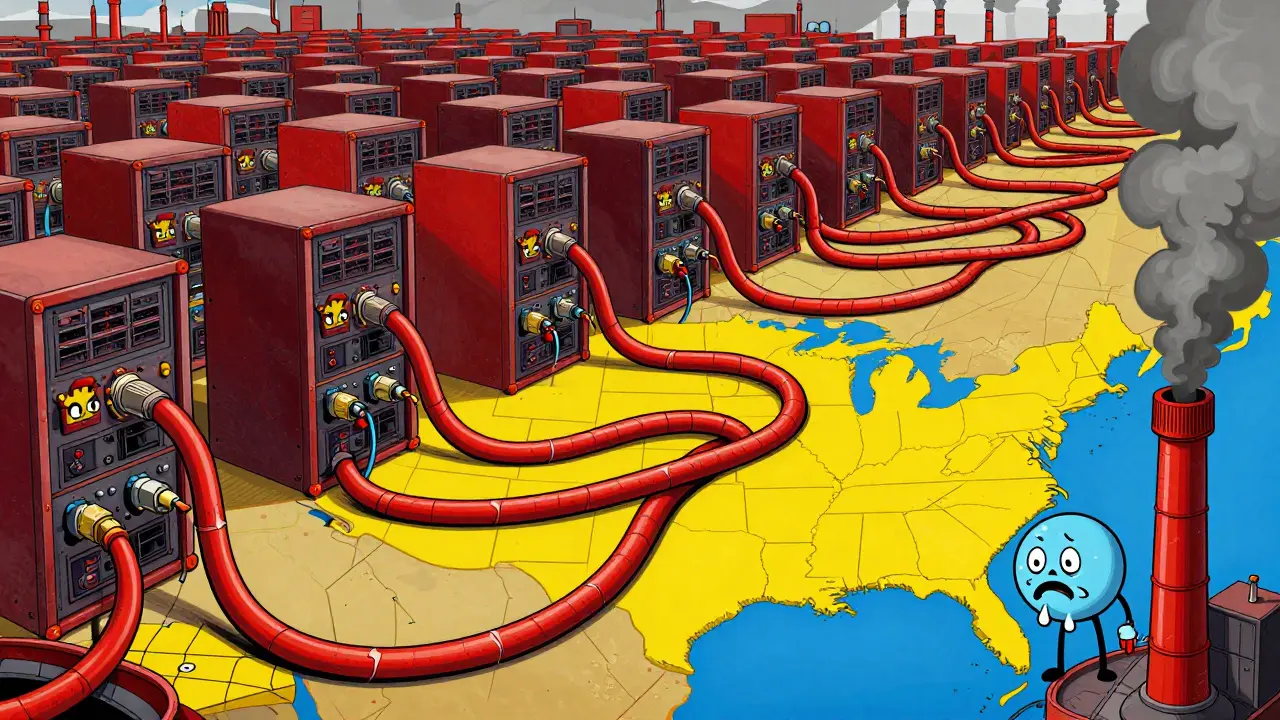
Beyond Carbon: Water, Noise, and Land Use
We often focus on CO₂, but the environmental damage extends further. A study by the United Nations University Institute for Water, Environment and Health (UNU-INWEH) highlighted Bitcoin’s water and land footprints. Mining rigs generate immense heat. To keep them from melting, they need cooling. In dry regions, this means pumping vast amounts of water for evaporative cooling systems. In wetter regions, it means using hydroelectric dams, which can disrupt local ecosystems and displace communities.
Then there is noise pollution. If you live in Texas or parts of Canada where mining farms are located, you know the sound. It’s a constant, deafening hum from thousands of industrial fans running 24/7. Reports from 2025 describe decibel levels of 70-80 dB, similar to a vacuum cleaner or garbage disposal, never stopping. This has led to local ordinances threatening operations because residents simply cannot sleep or talk outside their homes. It’s a localized environmental injustice that doesn’t show up in global carbon reports but devastates local quality of life.
The Geographic Divide: Where You Mine Matters
Not all kilowatt-hours are created equal. The environmental impact of Bitcoin depends heavily on where the mining happens. In countries like Canada, Iceland, and Scandinavia, abundant hydroelectric and geothermal power allow miners to operate with a relatively low carbon footprint. They tap into surplus energy that might otherwise go to waste.
In contrast, in the United States, the picture is murkier. WattTime’s research showed that U.S. miners historically relied on fossil fuels for over 50% of their power. While some companies claim to use "flare gas"-capturing methane that oil companies would otherwise burn off-it’s not a perfect solution. Capturing flare gas still involves extracting fossil fuels and adds complexity to the supply chain. Moreover, critics argue that diverting cheap, clean hydropower to crypto mining limits access for regular households and small businesses, forcing them to rely on dirtier alternatives. As Mandy DeRoche from Earthjustice noted, if humans can’t use the clean energy because crypto took it, the net benefit is questionable.

Regulatory Pressure and Industry Response
The era of wild west crypto mining is ending. Governments are waking up to the strain on their grids. Kuwait banned mining operations in 2025 due to excessive strain on its power infrastructure. In the European Union, the Markets in Crypto-Assets (MiCA) regulation, effective June 2024, includes strict environmental impact reporting requirements. Deloitte’s 2025 survey found that 78% of EU-based exchanges struggled to comply, highlighting how unprepared the industry was for transparency.
In the U.S., the landscape is fragmented. Some states welcome miners for tax revenue, while others face lawsuits. Following the Harvard study linking mining to air pollution, 17 class-action lawsuits were filed in federal courts by mid-2026. Meanwhile, major corporations are taking sides. Tesla resumed Bitcoin payments only after verifying renewable usage, while PayPal discontinued crypto services citing unresolved environmental concerns.
The industry is fighting back with "green mining" initiatives. Companies like Marathon Digital and CleanSpark are investing hundreds of millions in connecting directly to solar farms and wind turbines. Immersion cooling technology, which submerges servers in non-conductive fluid to reduce fan noise and energy use, is becoming more common, though it costs around $15,000 per rack-a barrier for smaller players. The Bitcoin Mining Council reports that nearly 60% of its members have committed to net-zero operations by 2030, but voluntary pledges aren’t the same as enforced standards.
What Should You Do? Navigating Crypto in a Climate-Conscious World
If you’re an investor, consumer, or just a concerned citizen, here is how to make sense of this:
- Check the Coin’s Mechanism: Prefer cryptocurrencies that use Proof-of-Stake (like Ethereum, Cardano, or Solana) if environmental impact is a priority. They offer similar utility with a fraction of the energy cost.
- Research the Miner: If you hold Bitcoin, look into who is securing the network. Support exchanges and funds that partner with miners using verified renewable energy sources.
- Advocate for Transparency: Push for regulations that require clear disclosure of energy sources. Voluntary reporting is insufficient when public health and grid stability are at risk.
- Consider the Local Impact: Be aware of where mining farms are being built. Community opposition to noisy, polluting facilities is a valid form of environmental activism.
The technology itself isn’t evil, but its current implementation has serious flaws. As Dr. Katharine Hayhoe warned, without fundamental changes to consensus mechanisms or massive shifts to renewable integration, cryptocurrency’s environmental costs will become unsustainable in a climate-constrained world. The question isn’t just whether crypto will survive, but whether it can evolve fast enough to coexist with a livable planet.
Is Bitcoin really worse for the environment than traditional banking?
Yes, in terms of energy per transaction. Traditional banking systems like Visa process millions of transactions per day using a fraction of the energy Bitcoin uses for a few thousand. However, Bitcoin provides censorship-resistant, borderless transfers that banks do not, which some argue justifies the higher cost. The trade-off is between decentralization/security and energy efficiency.
Can Bitcoin ever be truly "green"?
It can become significantly greener, but likely never zero-impact under Proof-of-Work. Miners are increasingly moving to areas with excess renewable energy (hydro, wind, solar). Some also capture stranded energy like flare gas. However, as long as the protocol rewards energy expenditure, there will always be an incentive to consume more power as the difficulty rises.
Why didn't Bitcoin switch to Proof-of-Stake like Ethereum?
Bitcoin’s community and developers prioritize decentralization and security above all else. Many believe Proof-of-Stake introduces centralization risks, where those with the most coins have the most power. Switching would require a hard fork, potentially splitting the network and undermining trust in Bitcoin as "digital gold."
Does crypto mining help support renewable energy development?
Proponents argue yes. Miners can provide a reliable buyer for intermittent renewable energy (like wind at night or solar during the day), helping stabilize grids and making renewable projects financially viable. Critics counter that this diverts clean energy from human needs and can lock in fossil fuel infrastructure if renewables aren't available.
What are the health effects of living near a crypto mine?
Residents report severe noise pollution (70-80 dB constant hum), which leads to sleep deprivation and stress. Additionally, if the mine relies on local fossil fuel plants, there is increased exposure to PM2.5 air pollution, linked to respiratory issues, heart disease, and cognitive decline, as documented in recent Harvard studies.

5 Comments
Fede Faith
Look, I’ve been in the mining sector for years and this article hits on a lot of real pain points we’re dealing with right now. The noise pollution issue is actually getting worse because local zoning laws are so loose in places like Texas and upstate New York. We see these massive warehouses popping up near residential zones, and the fans are deafening. It’s not just about carbon anymore; it’s about quality of life for the people living next door to these operations.
The shift to immersion cooling is happening, but it’s expensive. Small operators can’t afford the $15k per rack setup, so they keep running old air-cooled rigs that sound like jet engines. Big players like Marathon are moving fast, but the mid-tier miners are stuck in the middle. They want to be green, but the capital expenditure is too high without subsidies.
I think the regulatory pressure from the EU MiCA regulation is going to force some change globally, even if US states are fragmented. If you can’t prove your energy source, you can’t list on major European exchanges. That creates a market incentive to clean up or die. It’s harsh, but necessary.
Danna Charris
This entire narrative is designed to make you feel guilty for holding an asset class that offers actual financial sovereignty. Typical mainstream media fear-mongering. You ignore the fact that Bitcoin miners often act as grid stabilizers, buying excess energy that would otherwise go to waste. Without them, many renewable projects wouldn’t be financially viable.
The comparison to Visa is intellectually dishonest because it ignores the value proposition of decentralization. You don’t pay for security by burning energy; you pay for trustless verification. If you want cheap transactions, use a centralized ledger. If you want censorship resistance, you accept the cost. It’s a trade-off, not a disaster. Stop letting activists dictate technological standards based on emotional reactions rather than economic reality.
Mark Brunschwiler
It makes me so angry that we are destroying the planet for digital coins that have no real value. People are sick, kids are coughing up dust, and rich guys are sitting in their mansions counting their crypto while the air turns black. It is selfish. It is cruel. Why do we need this? Why can’t we just use money like normal people? The noise keeps me awake at night and my dog won’t stop barking. I hate this technology. I hate the greed behind it. It feels like the world is ending and nobody cares except the ones making billions. We deserve better than this toxic mess. Fix it or shut it down. I am tired of breathing poison for your profit. This is not progress. This is madness.
Josh Dodson
i totally agree with the point about noise pollusion its super annoying i live near a small farm and u can hear it 24/7 its crazy tho i think the green mining stuff is gonna save it in the end. ppl r smart and will figure out how to use solar and wind better. its just a phase we r going thru. dont worry too much about it the tech evolves fast. maybe in 5 years it will be all clean energy. hopefullly anyway. lets stay positive!
Suman Patil
Hey everyone, let's look at the bigger picture here. The hash rate increase is actually a good sign for network security, even if the energy usage goes up. In India, we are seeing a lot of innovation in using stranded gas and hydro power for mining. It’s not perfect, but it’s better than flaring gas into the atmosphere.
The key is synergy between blockchain and renewable infrastructure. Miners provide baseload demand for intermittent renewables. When the sun isn’t shining or wind isn’t blowing, miners can ramp up or down quickly to balance the grid. This flexibility is valuable. We need more dialogue between policymakers and miners to optimize this. Let’s not demonize the tech, but instead push for smarter integration. The future is decentralized and sustainable, but we have to build it together. Keep the conversation open and constructive!