
Imagine you have $10,000 to lend out. You could put it in a savings account where it sits idle most of the time, or you could hand it directly to people who need it right now. In the world of decentralized finance (DeFi), Automated Market Makers (AMMs) act as that lending pool, but they use algorithms instead of humans to facilitate trades. The biggest player in this space is Uniswap, a protocol that has evolved significantly since its inception. For years, Uniswap v2 was the gold standard for simplicity. But in 2021, Uniswap v3 arrived with a radical new feature: concentrated liquidity. This change didn't just tweak the system; it completely reshaped how capital efficiency works in crypto markets.
If you are looking to provide liquidity or understand why these two versions coexist in 2026, you need to look past the marketing hype and understand the mechanics. One version rewards passive investors with ease of use, while the other demands active management for potentially massive returns. Here is how the designs differ, what they mean for your wallet, and which one fits your strategy.
The Core Difference: Uniform vs. Concentrated Liquidity
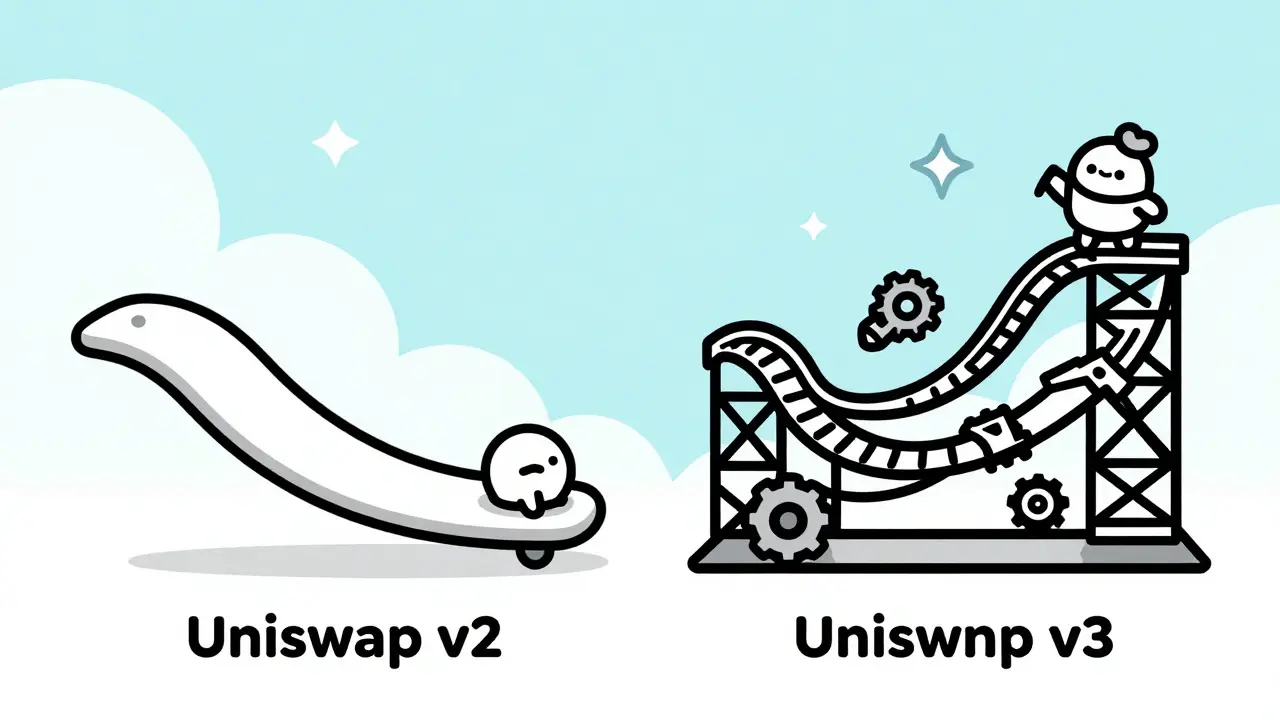
To understand the shift from v2 to v3, you first need to grasp how liquidity is distributed. In Uniswap v2, liquidity is spread evenly across every possible price range-from zero to infinity. Think of it like a library that keeps copies of every book ever written on every shelf, even if no one reads them. This ensures that trades can always happen, regardless of how volatile the asset becomes, but it means a lot of your capital is sitting unused at extreme prices.
Uniswap v3 changes this by allowing liquidity providers (LPs) to choose specific price ranges. This is called concentrated liquidity. Instead of funding the entire curve, you only fund the part of the market you think is relevant right now. If you believe ETH will stay between $3,000 and $3,500, you can allocate your funds strictly within that band. This design achieves up to 20,000x greater capital efficiency compared to v2 in optimal scenarios. Your money works harder because it is only exposed when trades actually occur within your selected range.
This fundamental architectural shift creates a trade-off. V2 offers broad, passive exposure. V3 offers targeted, high-efficiency exposure but requires you to predict where the price will go. If the price moves outside your range, your position stops earning fees until you rebalance it.
Technical Architecture: ERC-20 Tokens vs. NFT Positions
The way these protocols handle ownership reflects their different philosophies. Uniswap v2 uses fungible ERC-20 tokens to represent liquidity positions. When you deposit assets, you receive LP tokens that are identical to those held by anyone else in the same pool. This makes it easy to transfer, swap, or use your liquidity position in other DeFi protocols without much thought.
In contrast, Uniswap v3 represents each liquidity position as a unique ERC-721 NFT. Since every user might have chosen a different price range, fee tier, or amount, each position is distinct. This non-fungible nature adds complexity. You cannot simply "swap" one v3 position for another easily; you have to manage individual NFTs. However, this structure allows for granular control. You can hold multiple positions in the same pair with different ranges, effectively creating a custom liquidity curve tailored to your risk tolerance.
For developers, this also changes integration. V2’s simple token model meant external contracts could easily interact with liquidity. V3’s NFT model requires more sophisticated handling, though it enables advanced strategies like automated rebalancing bots and fractionalized liquidity shares through third-party services.

Fees, Oracles, and Performance Metrics
Let’s talk about the numbers that matter: fees and data accuracy. Uniswap v2 charges a flat 0.30% fee on all trades. It’s simple, predictable, and works well for most volatile pairs. However, it lacks flexibility. Stablecoin traders often find 0.30% too high, while exotic pairs might need higher fees to compensate for risk.
Uniswap v3 introduces four fee tiers: 0.01%, 0.05%, 0.30%, and 1.00%. This allows users to match the fee structure to the volatility of the asset pair. Stablecoins like USDC/USDT typically sit in the 0.01% tier, attracting high-volume arbitrageurs. Highly volatile pairs might use the 1.00% tier to protect LPs from impermanent loss. This flexibility drives volume; as of late 2025, v3 accounts for roughly 72% of Uniswap’s total trading volume.
Beyond fees, there is a critical technical improvement in how prices are tracked. V2 uses an arithmetic mean Time-Weighted Average Price (TWAP) oracle. While functional, it can be manipulated during periods of extreme volatility. V3 implements a geometric mean TWAP oracle. This mathematical adjustment makes the price feed more robust against flash loans and sudden market swings, providing better security for derivatives and lending protocols that rely on Uniswap’s price data.
| Feature | Uniswap v2 | Uniswap v3 |
|---|---|---|
| Liquidity Distribution | Uniform (0 to ∞) | Concentrated (Custom Ranges) |
| Token Standard | ERC-20 (Fungible) | ERC-721 (Non-Fungible NFT) |
| Fee Structure | Fixed 0.30% | Tiered (0.01%, 0.05%, 0.30%, 1.00%) |
| Capital Efficiency | Low | High (Up to 20,000x in stable pairs) |
| Management Style | Passive | Active (Requires Rebalancing) |
| Oracle Type | Arithmetic Mean TWAP | Geometric Mean TWAP |
User Experience: Simplicity vs. Complexity
If you value simplicity, Uniswap v2 remains the champion. You deposit equal values of two tokens, click "Approve," and you are done. Your position earns fees automatically, regardless of where the price goes. It is ideal for beginners or those who want to set it and forget it. Data shows that approximately 82% of new DeFi users attempt liquidity provision on v2, compared to only 38% on v3, largely due to this lower barrier to entry.
Uniswap v3 demands attention. You must define a minimum and maximum price. If the market moves beyond this range, your position becomes fully imbalanced-either holding only the appreciated asset or only the depreciated one-and stops earning fees. To keep earning, you must actively monitor and rebalance your position. Professional LPs report spending 3-5 hours per week optimizing their v3 positions. This complexity excludes many retail participants but unlocks significantly higher yields for those willing to put in the work. For example, a user managing $250k in liquidity reported 37% higher annual yields on stablecoin pairs in v3 compared to v2, thanks to tight range concentration.
However, complexity isn’t just a hurdle; it’s a filter. It prevents casual users from accidentally exposing themselves to excessive impermanent loss in volatile markets without understanding the risks. Tools like Gamma Strategies have emerged to automate this process, managing 12% of v3 liquidity as of Q3 2025, bridging the gap for users who want v3 efficiency without the manual labor.
When to Use Which Version?
Choosing between v2 and v3 depends entirely on your asset type and your willingness to manage risk. There is no single "better" version; there is only the version that fits your specific goal.
Use Uniswap v2 if:
- You are trading highly volatile assets where predicting price ranges is nearly impossible (e.g., meme coins or early-stage altcoins).
- You prefer a passive investment strategy and do not want to monitor charts daily.
- You are new to DeFi and want to minimize the risk of making costly configuration errors.
- You need fungible LP tokens for integration with other protocols that don’t support NFT-based liquidity.
Use Uniswap v3 if:
- You are providing liquidity for stablecoin pairs (e.g., USDC/USDT) where prices rarely deviate, allowing for extremely tight ranges and massive capital efficiency.
- You have the time and knowledge to actively manage and rebalance your positions.
- You want to maximize returns on capital by concentrating liquidity around current market prices.
- You are an institutional trader or professional market maker seeking precise control over fee tiers and exposure.
Market data supports this split. As of November 2025, 87% of professional market makers use v3 for stablecoin pairs but maintain v2 positions for volatile assets. Meanwhile, retail sentiment analysis shows higher satisfaction with v2 among users with under $10k in liquidity, citing ease of use as the primary factor.
The Future: Coexistence and Evolution
Despite the arrival of Uniswap v4 in January 2025, both v2 and v3 remain vital parts of the ecosystem. V4 introduces hooks and custom logic, addressing some of v3’s rigidity, but it does not replace the foundational utility of its predecessors. Governance proposals in late 2025 showed strong community support (92.7% approval) for continuing to support v2 infrastructure, recognizing its role in serving retail users and volatile markets.
Analysts predict that v3 will continue to dominate volume, potentially handling 85% of Uniswap’s traffic by 2027, driven by institutional adoption and professional liquidity providers. However, v2 will persist as the go-to solution for simplicity and broad exposure. The dual-protocol strategy creates a comprehensive ecosystem that serves diverse user needs, from passive savers to active traders.
Is Uniswap v3 safer than v2?
Safety depends on your definition. Technically, v3 has a more robust oracle system (geometric mean TWAP) which reduces the risk of price manipulation attacks. However, for liquidity providers, v3 is operationally riskier because incorrect price range selection can lead to significant impermanent loss or idle capital. V2 is safer for users who want to avoid active management mistakes.
Can I move my liquidity from v2 to v3?
Yes, but it is not a direct conversion. You must withdraw your assets from the v2 pool, receiving the underlying tokens back into your wallet. Then, you can deposit those tokens into a v3 pool, selecting your desired price range and fee tier. This process incurs two sets of gas fees and transaction costs.
Why do stablecoin pairs perform better in v3?
Stablecoins like USDC and USDT maintain a peg close to $1.00, meaning their price rarely fluctuates widely. In v3, you can concentrate liquidity in a very narrow range (e.g., $0.99 to $1.01). This concentrates all trading volume into a small slice of capital, resulting in exponentially higher fee earnings compared to v2, where liquidity is spread across an infinite range.
What happens if the price exits my v3 range?
If the price moves above your upper bound, your position converts entirely into the quote asset (e.g., ETH). If it drops below your lower bound, it converts entirely into the base asset (e.g., USDC). In either case, you stop earning trading fees. To resume earning, you must rebalance your position by adding the missing asset or adjusting your range limits.
Do I need to pay taxes differently for v3?
Yes, v3 creates more complex tax implications. Because positions cross price range boundaries and involve frequent rebalancing, each adjustment may be considered a taxable event depending on your jurisdiction. Professional tax advisors recommend using specialized software to track these events, whereas v2’s passive nature results in fewer taxable interactions.

10 Comments
Jimmy vasquez
hey guys just wanted to drop a quick note that the v3 interface is way less intuitive than people say it needs to be you just gotta spend like ten minutes looking at the charts before depositing and then boom its smooth sailing
Janis Naglis
Oh my goodness, this is such a crucial distinction! The capital efficiency metrics are absolutely staggering when you consider the geometric mean TWAP oracle implementation. I have found that utilizing concentrated liquidity within tight bands for stablecoin pairs yields significantly higher APYs, provided one remains vigilant regarding impermanent loss vectors. It is truly fascinating how the ERC-721 NFT structure allows for such granular risk management strategies, don't you think?!
Tracy McBurney
You are clearly ignoring the operational overhead required to maintain these positions effectively. Most retail users who attempt concentrated liquidity without automated rebalancing tools end up with fully imbalanced portfolios within days, rendering their capital completely idle while they pretend to understand market microstructure. The article glosses over the fact that 'active management' is not a feature but a liability for anyone lacking institutional-grade infrastructure.
Ryan Nakielny
sure tracy keep pretending you're the only one who knows how to code a bot while the rest of us just want to earn some fees without staring at charts all day lol
Tracy McBurney
Your sarcasm does not change the mathematical reality of liquidity distribution. If you cannot handle the complexity, stick to v2 where your ignorance is protected by uniform spread. There is no shame in being passive, only in pretending active participation is something you can manage without professional tools.
Andrew Todd
this whole defi thing is getting too complicated for regular folks we should just go back to simple savings accounts instead of letting nerds play with smart contracts and nfts it is a waste of time and money for anyone who wants real security
Brendan Thraxton
look i get that v3 seems scary at first but honestly if you take the time to learn the basics it opens up so many opportunities for everyone not just the big players i really think we should help each other out here because knowledge sharing makes the whole community stronger and more inclusive for newcomers who might feel overwhelmed by the technical jargon
Sri Astuti
The narrative surrounding Uniswap v3's superiority is fundamentally flawed when examined through the lens of actual user retention rates and psychological burden associated with constant position monitoring, which leads to burnout and suboptimal decision-making during high volatility periods, thereby negating the theoretical capital efficiency gains for the average participant who lacks the bandwidth to engage in continuous algorithmic rebalancing strategies that are essentially reserved for institutional entities with dedicated engineering teams and sophisticated risk management frameworks that retail investors simply cannot replicate or afford to implement effectively in their daily lives :/
Elle Kharitou
I find it deeply philosophical how technology forces us to choose between ease and efficiency, much like life itself 🌿 In Australia, we often embrace a balanced approach, perhaps using v2 for our volatile assets and v3 for stables, allowing us to participate in the evolution of finance without losing our peace of mind or our weekends to screen-staring 😊 It is about harmony with the market, not domination over it ✨
Nitin Gupta
i think both versions have their place and it is nice to see the community discussing this openly i personally use gamma strategies to automate the v3 parts so i do not have to worry about the ranges too much but i still keep some in v2 for the meme coins since predicting those prices is impossible anyway thanks for sharing this detailed breakdown it helps clarify things for me