
You might have seen the ticker FWOG popping up in your feed or on a DEX dashboard and wondered what it actually is. Is it the next big thing, or just another frog-themed meme coin riding the wave of PEPE and BOME? The short answer is that FWOG (ETH) is a community-driven ERC-20 token launched on the Ethereum network in July 2024. It’s not a utility project with complex DeFi mechanics; it’s a speculative asset built around internet culture and community hype.
If you’re looking for deep technical whitepapers or staking rewards, you won’t find them here. Instead, you’ll find a token that lives and dies by its social sentiment. Understanding FWOG (ETH) requires looking past the cute logo and examining the hard data: supply caps, liquidity pools, and the confusing landscape of multiple contracts sharing the same name.
The Basics: What Makes FWOG (ETH) Different?
FWOG (ETH) is an Ethereum-based ERC-20 meme token with a maximum supply of 420,690,000,000,000 units. It was first listed on major trackers like CoinMarketCap and CoinLore shortly after its launch date of July 29, 2024. Unlike coins that require mining hardware or staking capital to secure the network, FWOG is non-mineable. This means new tokens aren’t created through consensus mechanisms; they are pre-mined and distributed according to the project's initial allocation strategy.
The "Frog" branding places it squarely in the niche of animal-themed meme coins. These assets often gain traction because they are easy to understand, visually distinct, and highly shareable on social media platforms like X (formerly Twitter) and Telegram. For FWOG (ETH), the value proposition is purely communal. There is no explicit utility function described in major aggregator listings beyond being "for community." This lack of technical utility is a red flag for fundamental investors but a green light for traders who believe in momentum and narrative.
Tokenomics: The Numbers Behind the Name
When analyzing any crypto asset, the tokenomics tell you how scarce or abundant the supply is. For FWOG (ETH), the numbers are deliberately chosen for meme appeal rather than mathematical precision. The total and maximum supply is fixed at 420.69 trillion tokens. This figure is a nod to popular internet slang, combining two numbers associated with cannabis culture. While this makes the number look huge, remember that the price per token is incredibly small, often measured in fractions of a cent or even less.
Here is where things get tricky. Data aggregators sometimes report conflicting information about the circulating supply. Some sources, like Coinbase’s snapshot from early 2025, listed a circulating supply of zero, which likely indicates a data error or a period where the token wasn't actively trading on their specific interface. Other sources, such as CoinCodex, assume the full 420.69 trillion tokens are in circulation. This discrepancy matters because market cap is calculated by multiplying the current price by the circulating supply. If the circulating supply is unknown or disputed, the reported market cap can be misleading.
| Attribute | Value | Context |
|---|---|---|
| Network | Ethereum (ERC-20) | Inherits security from Ethereum L1 |
| Max Supply | 420,690,000,000,000 | Fixed cap, no inflation |
| Mineable | No | Pre-mined distribution model |
| Launch Date | July 29, 2024 | Early-stage asset |
| All-Time High | ~0.000000000642 USD | Sharp drawdown since peak |
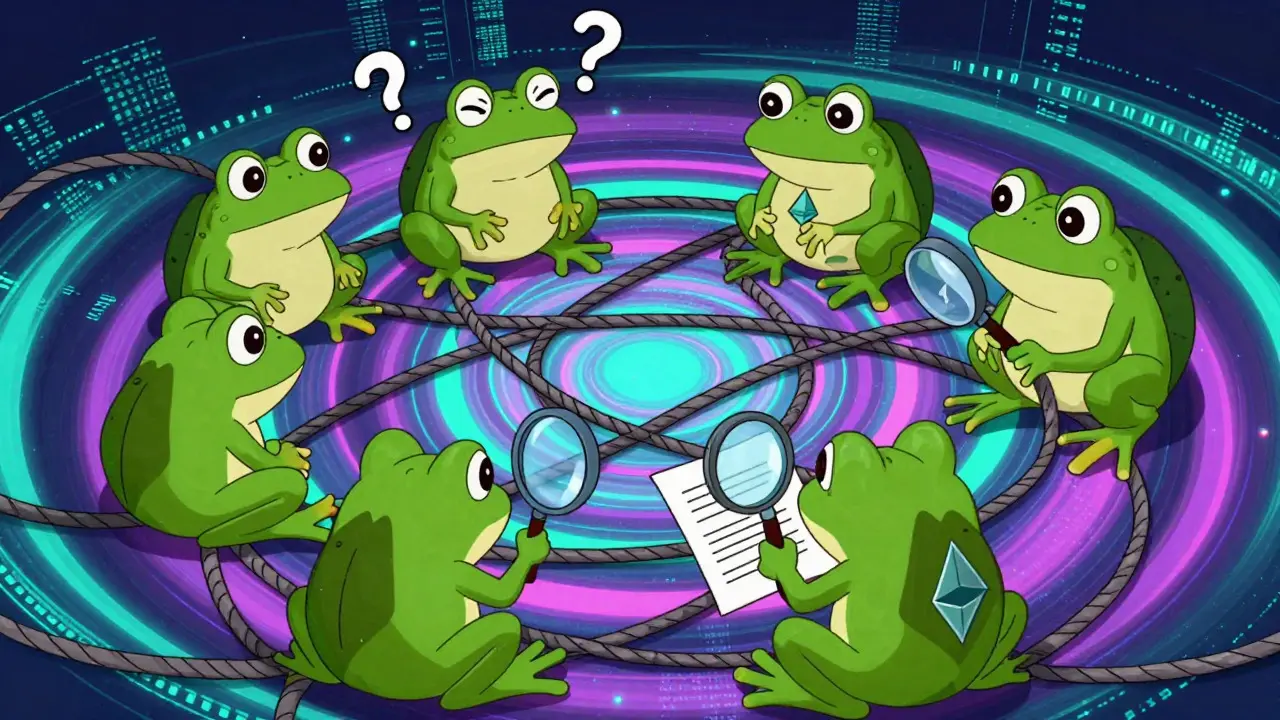
The Confusion Factor: Multiple Contracts and Chains
This is the most critical part for any potential buyer. The name "FWOG" is not unique to the Ethereum version. There is a separate, much larger FWOG token on the Solana blockchain. This Solana-based FWOG emerged from a rebranding of a token called Flog (FLOG) and has seen massive speculative rallies, reaching market caps in the hundreds of millions of dollars. Because both tokens use the same ticker and similar frog imagery, data aggregators sometimes mix them up, and users frequently buy the wrong one by mistake.
On Ethereum alone, there isn't just one contract address either. Different tracking sites list different addresses for "FWOG (ETH)." For example, Coinbase lists one official address, while LiveCoinWatch and Opensea point to another. DexScreener shows yet other pairs with wildly different prices. This fragmentation creates significant risk. If you buy from the wrong pool, you might end up holding an illiquid variant that has no real community support or liquidity depth. Always verify the contract address against the official community channels before swapping.
Liquidity and Trading Conditions
FWOG (ETH) is a micro-cap asset. This means its daily trading volume is low compared to mainstream cryptocurrencies. At various points in 2025, the 24-hour trading volume was reported as close to zero on some centralized exchanges, while decentralized exchanges (DEXs) showed activity in the range of a few hundred to a few thousand dollars. Specifically, Uniswap v2 pools have shown liquidity around $7,950, while Uniswap v3 pools have been thinner, sometimes under $200.
Low liquidity implies high slippage. If you try to buy or sell a large amount of FWOG, you will significantly move the price against yourself. For retail investors, this means keeping position sizes small. Large institutional players rarely touch these assets because entering or exiting a position would be too costly due to the thin order books. The primary venues for trading FWOG (ETH) are Uniswap (v2 and v3) and smaller centralized exchanges like Bilaxy. You won’t find it on major tier-1 exchanges like Binance or Coinbase’s main spot market, which limits its accessibility for casual users.

Risk Profile and Historical Performance
Like most meme coins, FWOG (ETH) is highly volatile. Since its launch, the token has experienced sharp drawdowns. CoinLore notes that the price fell by over 83% from its all-time high. Other metrics show declines of nearly 90% over one-year periods. This volatility is inherent to assets driven by speculation rather than cash flow or utility. When the hype cycle cools, the price tends to correct aggressively.
The absence of formal reviews or user ratings on major platforms also signals that FWOG (ETH) hasn't reached a scale where mainstream sentiment analysis applies. It relies entirely on organic community growth. If the community loses interest, the token can become effectively dead, with negligible trading activity. Conversely, if a viral trend picks it up, the price can spike rapidly, as seen with its Solana counterpart. Investors need to decide if they are comfortable with this binary outcome: massive gains or near-total loss.
How to Buy FWOG (ETH) Safely
If you decide to participate, the process involves using a Web3 wallet compatible with Ethereum, such as MetaMask. Here is the general workflow:
- Verify the correct contract address from the official project announcement or trusted community source.
- Add the token to your wallet using the verified address.
- Connect your wallet to a DEX like Uniswap.
- Swap ETH for FWOG, keeping in mind the gas fees on the Ethereum network.
- Monitor the pool liquidity to ensure you can exit your position later.
Be cautious of scams. Fake tokens are common in the meme coin space. Always double-check the checksum format of the address. Also, keep an eye on the difference between FWOG (ETH) and FWOG (Solana). Using the wrong chain will result in buying a completely different asset with different risks and rewards.
Is FWOG (ETH) a good investment?
It is a high-risk, speculative bet. With no underlying utility and low liquidity, it depends entirely on community hype. Only invest what you are willing to lose entirely.
What is the difference between FWOG (ETH) and FWOG (Solana)?
They are distinct tokens on different blockchains. FWOG (ETH) has a max supply of 420.69 trillion and is an ERC-20 token. FWOG (Solana) has a supply of ~975 million and is a SPL token. They do not trade directly against each other without bridging or selling one to buy the other.
Where can I buy FWOG (ETH)?
Primarily on decentralized exchanges like Uniswap v2 and v3. Some smaller centralized exchanges like Bilaxy may list it, but DEXs offer more direct access to the liquidity pools.
Does FWOG (ETH) have staking or governance features?
No. It is a standard ERC-20 token without native staking, yield farming, or on-chain governance mechanisms. Its value is derived from speculation and community engagement.
Why are there so many different contract addresses for FWOG?
This is due to cloning, migrations, or data errors across different tracking platforms. Always verify the address with the official project team to avoid buying an illiquid fake or outdated version.

7 Comments
Jennifer Ulmer
It is interesting how these tokens rely so much on community feeling rather than actual use. The supply number is definitely a joke which makes sense for the vibe they are going for. I think people should just look at the liquidity before they put money in. It feels like a lot of these projects disappear after a few months anyway.
Jade Brown
Let's be real, this is basically a degenerate casino with extra steps and zero fundamental backing. You're looking at a token that has no utility, no staking, and a supply cap that is literally just two numbers smashed together for meme appeal. The fact that Coinbase listed it as zero circulating supply for a while tells you everything about the data integrity here. It's a pure sentiment play, folks, driven by Twitter clout and Telegram hype bots. If you aren't ready to watch your portfolio evaporate because some influencer stopped talking about frogs, don't even touch it. The slippage on Uniswap v3 pools being under $200? That's not trading, that's gambling with high fees. This asset lives or dies on narrative momentum, and right now the narrative is fading fast. Don't confuse a cute logo with value; it's just another speculative vehicle for the brave or the foolish.
Claudio Perrone
wait so there is more then one contract?? i always thought the eth one was the main one but looks like solana is doing better numbers. its crazy how confusing this stuff is sometimes. i almost bought the wrong one last month. also why is the price so low like what does that even mean. feels like a trap to me honestly
Hicham Mounir
You really need to be careful with those addresses, it happens to the best of us. The difference between the chains is huge and easy to miss if you are rushing. Just take a breath and check the official links twice. We have all made mistakes in this space, do not let it stress you out too much. It is just part of learning the ropes in crypto.
Ami Elizabeth
honestly just keep position sizes small tho. gas fees on eth make it painful for small trades. i mostly just watch from the sidelines for stuff like this.
michelle aguilar
One must understand, truly, that this is not an investment; it is, quite frankly, a social experiment in collective delusion. The notion that a frog image can sustain market capitalization without underlying cash flow is, well, amusingly naive. I suppose for the uninitiated, the 'community' aspect serves as a sufficient proxy for value, but to the discerning eye, it is merely noise. Do not mistake volatility for opportunity; it is simply chaos wearing a mask. Enjoy your ride down, perhaps it will be entertaining for the rest of us watching from the safety of blue-chip holdings.
Lance Konig
The risk profile here is undeniable, but dismissing it entirely ignores the momentum factor. While utility is absent, narrative power is a real economic force in this sector. The fragmentation of contracts is a significant barrier to entry, which actually protects the core holders from casual FOMO buying. If you verify the address and manage your exit strategy, the asymmetry of reward versus risk remains intact for the patient trader.