
You’ve probably seen the ticker DAPP pop up in a low-cap list or heard whispers about Pencils Protocol, formerly known as PenPad. But what exactly is it? Is it a hidden gem waiting to explode, or is it a cautionary tale of early-stage DeFi volatility? The short answer: it’s a niche protocol built on the Scroll Layer 2 network, focusing on asset auctions and yield aggregation. However, the data tells a much more complex-and risky-story.
If you are looking for the next big thing, you need to look past the marketing promises. You need to understand the mechanics, the massive price drop from its all-time high, and why trading volume is currently near zero. This guide breaks down what Pencils Protocol actually does, how the DAPP token works, and whether there is any real value left in this ecosystem.
The Core Concept: Auctions and Yield on Scroll
At its heart, Pencils Protocol is a decentralized platform designed to handle two main functions: auctioning blockchain-native assets and Real-World Assets (RWAs), and aggregating yields. It positions itself as a gateway for liquid staking and restaking within the Scroll ecosystem. Scroll is a Zero-Knowledge (ZK) rollup solution that aims to bring Ethereum scalability to DeFi without sacrificing security.
Think of it like this: instead of just holding your assets idle, the protocol attempts to route them through various strategies to maximize returns. It also offers an auction house for specific digital and physical-backed assets. The goal was to become the primary Total Value Locked (TVL) hub for Scroll. However, execution has been difficult. The rebrand from PenPad to Pencils Protocol suggests a strategic pivot, likely trying to shed previous baggage or clarify its identity, but it hasn’t yet resulted in a surge of user adoption.
Tokenomics: Supply, Allocation, and Value
To understand if DAPP is worth your attention, you have to look at the numbers. The total supply of DAPP tokens is capped at 100 million. Currently, about 56.41 million tokens are in circulation. That means nearly 60% of the supply is already available to traders, while the remaining 43.59 million are locked or reserved for future releases.
Here is where it gets tricky. The team allocation includes 5 million DAPP tokens, which is 5% of the total supply. While this seems modest compared to some other projects, the initial Fully Diluted Valuation (FDV) was set at $150 million. For context, raising $2.1 million across multiple funding rounds with a $150 million FDV implies a very high expectation of growth that the market has not delivered. If the project fails to grow its TVL significantly, those unlocked tokens could create selling pressure, diluting the value for current holders.
| Metric | Value | Note |
|---|---|---|
| Total Supply | 100 Million DAPP | Fixed cap |
| Circulating Supply | ~56.41 Million DAPP | Available for trade |
| Team Allocation | 5 Million DAPP (5%) | Vested over time |
| All-Time High (ATH) | $0.4384 | Peak valuation |
| Current Price Range | ~$0.0042 | Subject to high volatility |
| Network | Scroll (Ethereum L2) | ZK-Rollup technology |
The Price Reality: A 99% Decline
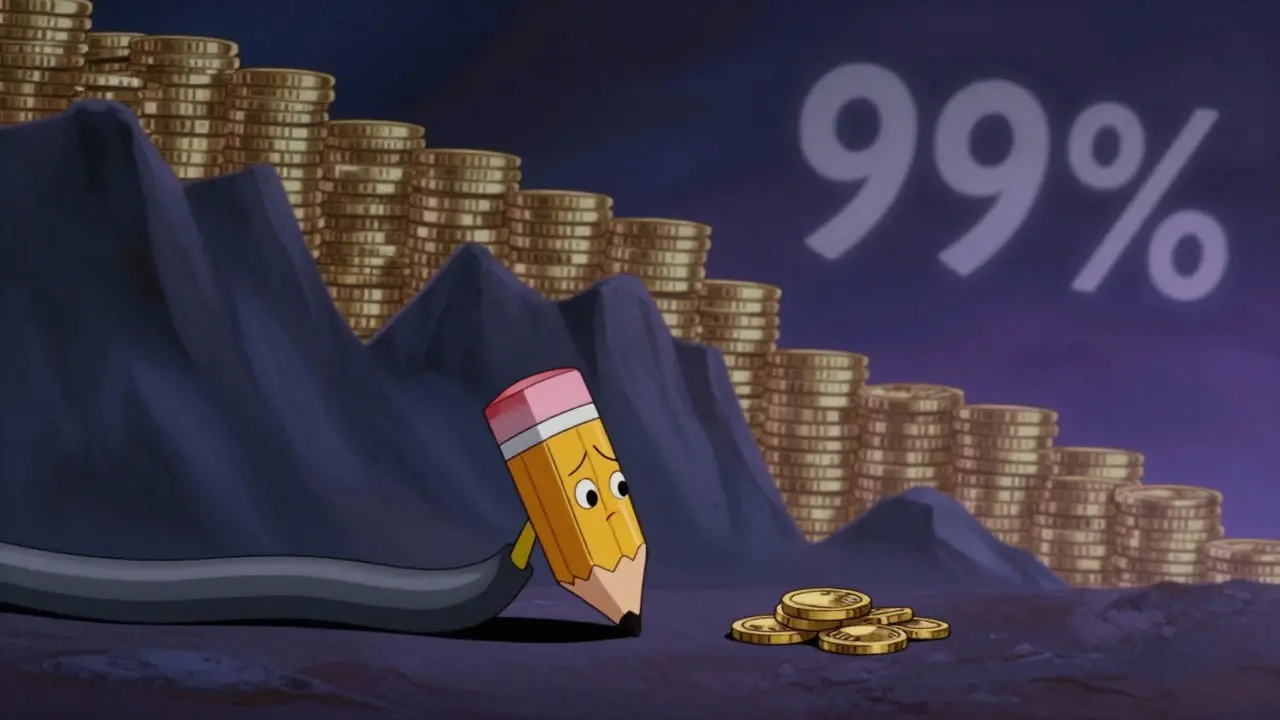
Let’s talk about the elephant in the room. Pencils Protocol reached an all-time high of roughly $0.4384. Today, it trades around $0.0042. That is a decline of approximately 99%. In crypto terms, this is catastrophic. It suggests that either the project failed to deliver on its promises, the market sentiment shifted drastically against Scroll-based projects, or there were fundamental issues with liquidity and adoption.
When a coin drops this hard, it usually means one of three things:
- Liquidity Crunch: There isn't enough money in the order books to support higher prices. The 24-hour trading volume is often reported around $94,000, which is incredibly low for a DeFi protocol. Low volume means you might struggle to sell larger positions without slippage.
- Loss of Confidence: Investors who bought early may have exited, leaving only long-term believers or bots. The lack of community buzz on Reddit or Twitter reinforces this. Without active users, yield aggregation services don't generate fees, and auctions don't happen.
- Competitive Pressure: The DeFi space is crowded. Established players on Arbitrum, Optimism, and Base dominate the yield aggregation narrative. Scroll is still growing, but being first doesn't mean being best.
How Does the Protocol Actually Work?
If you decide to interact with Pencils Protocol, here is what you are doing. First, you need to bridge your assets to the Scroll network. Since Scroll is an Ethereum Layer 2, you can use standard bridges to move ETH or stablecoins over. Once on Scroll, you can deposit assets into the protocol's vaults.
The protocol then routes these assets to various yield-generating strategies. This might involve lending, providing liquidity to pools, or restaking via protocols like EigenLayer (if integrated). The DAPP token serves several utilities:
- Governance: Holders can vote on protocol parameters, such as fee structures or new asset listings.
- Fees: Paying transaction fees in DAPP might offer discounts.
- Rewards: The "Pencils" points system rewards active users with token allocations and merchandise, attempting to build community engagement.
However, the complexity here is a barrier. You need to understand gas fees on Scroll, the risks of smart contracts, and the underlying assets being auctioned. It is not a "set and forget" investment for beginners.
Risks You Cannot Ignore
Before you buy even a single DAPP token, consider these risks. They are not hypothetical; they are based on current market data.
- Smart Contract Risk: Like all DeFi protocols, Pencils relies on code. If there is a bug in the auction mechanism or the yield aggregator, funds could be lost. Audits are critical, but even audited contracts can fail.
- Liquidity Risk: With a market cap potentially under $250,000 and low volume, exiting your position quickly is difficult. You might get stuck holding bags during a downturn.
- Regulatory Uncertainty: The focus on Real-World Assets (RWAs) puts the protocol in a gray area. Regulators are increasingly scrutinizing platforms that tokenize physical assets. If laws change, the auction service could be restricted.
- Dependency on Scroll: The protocol’s success is tied to the Scroll ecosystem. If Scroll loses market share to other L2s, Pencils Protocol suffers by proxy.
Is There Any Hope for Recovery?
Recovery is possible, but it requires catalysts. What would drive DAPP back up?
- Major Partnerships: Integrations with large DeFi protocols on Scroll could bring in TVL.
- Unique RWA Listings: If the auction house starts listing high-value, unique assets that cannot be found elsewhere, it will attract buyers.
- Community Revival: The points system needs to convert users into vocal advocates. Social media activity must increase.
Without these, the token remains a speculative asset with high downside risk. The gap between the ATH and current price is so wide that it would take exponential growth to close it. Most investors treat this as a "dead cat bounce" scenario unless significant development updates are released.
Final Thoughts: Proceed with Caution
Pencils Protocol is an ambitious project aiming to solve real problems in DeFi: efficient yield aggregation and asset liquidity. However, the execution has struggled. The 99% price drop is a stark warning sign. If you are curious, allocate only what you can afford to lose entirely. Treat it as a research opportunity rather than an investment. Monitor the Scroll ecosystem’s growth, watch for changes in trading volume, and pay attention to any new audits or partnerships. In crypto, survival is the first step to success, and Pencils Protocol is still fighting for its life.
What happened to PenPad?
PenPad rebranded to Pencils Protocol. This change was likely intended to refresh the brand image and better reflect the platform's focus on auction services and yield aggregation on the Scroll network. The underlying technology and token (DAPP) remained largely the same, but the name changed to distance itself from previous perceptions.
Is DAPP a good investment right now?
Based on current metrics, DAPP is extremely high-risk. It has dropped ~99% from its all-time high, has low trading volume, and minimal community engagement. It should only be considered by experienced traders who understand deep-value speculation and are willing to lose their entire investment. It is not suitable for conservative investors.
What is the purpose of the DAPP token?
The DAPP token is used for governance voting, paying protocol fees (often with discounts), and accessing premium features. Additionally, the protocol uses a "Pencils" points system where active users earn rewards, including potential token allocations and exclusive merchandise.
Why is Pencils Protocol built on Scroll?
Scroll is a Zero-Knowledge (ZK) Layer 2 solution for Ethereum. By building on Scroll, Pencils Protocol aims to leverage lower gas fees and faster transaction speeds compared to Ethereum mainnet, while maintaining high security. It also positions itself as a native gateway for the Scroll ecosystem, hoping to benefit from Scroll's growth.
Where can I buy DAPP tokens?
DAPP tokens are typically traded on decentralized exchanges (DEXs) supported by the Scroll network or Ethereum-compatible wallets. Some centralized exchanges like KuCoin may list it, but availability varies. Always verify the contract address (0x5fc429110a64bc51b57ca86dce1714fd0fbec303) to avoid scams.
What are Real-World Assets (RWAs) in this context?
RWAs refer to physical assets like real estate, commodities, or invoices that are tokenized on the blockchain. Pencils Protocol allows users to auction these tokenized assets, bridging traditional finance with DeFi. This adds complexity and regulatory considerations compared to pure crypto assets.

9 Comments
Caique Muniz
another rug waiting to happen lol
robert Whitehead
You people really need to stop buying these garbage coins. The math doesn't lie, the volume is non-existent and the team has clearly abandoned ship. It's pathetic that you're even considering putting money into a protocol that has dropped 99%. Do some actual research instead of listening to influencers who get paid to shill trash. This isn't investing, it's gambling on a losing ticket.
Mike S
I've been watching this space for years and let me tell you, Scroll projects are mostly vaporware right now. Pencils Protocol? More like pencils of doom. The rebrand from PenPad was just a desperate attempt to hide the fact that they had no users. You can't fix bad execution with a new logo. The smart contract risks alone should scare anyone away, but add in the liquidity crunch and regulatory gray areas for RWAs? It's a minefield. I wouldn't touch it with a ten-foot pole.
H F
Actually, I think there might be some merit to looking at the underlying tech if Scroll takes off. It’s risky sure, but early adopters always face volatility. If they manage to secure a major partnership or list some unique RWAs, we could see a bounce. Just don’t bet the farm on it!
Bradley Geldenhuys
look i know its down bad but sometimes the best opps come from the bottom. u gotta have faith in the builders man. they r trying to solve real problems with yield aggregation. dont let the haters get u down. keep learning and stay positive. maybe scroll will surprise us all soon.
Michael Berggren
Great breakdown! 📊 It’s interesting how the FDV was set so high initially. That $150M valuation for a project with such low TVL is a classic red flag. I’ve seen this pattern before where the tokenomics are designed to benefit insiders while retail gets diluted. The points system is cute though, trying to build community engagement through merchandise is a novel approach. Let’s see if they can execute on the RWA front. 🚀💎
Kiran CS
One must consider the sheer pretension of building an auction house for 'Real-World Assets' on a Layer 2 that barely has any traction. It is quite amusing to watch these developers believe they are revolutionizing finance when they are merely creating another layer of complexity for absolutely no reason. The regulatory uncertainty is not just a risk; it is a certainty of failure for such unregulated entities. Do educate yourselves before engaging in such trivial speculation.
Bijan Das
why do u guys care about this trash? its dead. end of story. stop wasting time reading articles about coins that go nowhere. just buy btc or eth and forget about these memecoins pretending to be protocols. ur energy is better spent elsewhere.
Ashley Rodriguez
i mean i read the whole thing and its pretty detailed but honestly i dont see why anyone would risk their money here especially with the low volume and all that slippage talk sounds scary and i dont want to lose my savings so im probably just gonna stick to safer things like index funds or something similar because crypto seems too stressful for me right now anyway thanks for sharing the info tho