
Imagine walking into a coffee shop in Istanbul with your wallet full of Bitcoin or USDT. You want to pay for your espresso. The barista smiles, shakes their head, and points to the card terminal. Why? Because since April 2021, using cryptocurrency as a direct payment method for goods and services has been illegal in Turkey. But here is the twist: you can still buy, sell, hold, and trade those same coins on licensed exchanges. This creates a confusing "trade-but-don't-spend" paradox that defines the Turkish crypto landscape today.
If you are navigating this market, understanding the difference between what is banned (payments) and what is regulated (trading) is crucial. The rules have tightened significantly since that initial 2021 ban, especially with new licensing requirements introduced in 2024 and 2025. Let’s break down exactly how these regulations work, who enforces them, and what they mean for users and businesses right now.
The 2021 Ban: What Actually Changed?
To understand where we are, we need to look back at the foundational moment. On April 16, 2021, the Central Bank of the Republic of Turkey (CBRT) issued a regulation that took effect on April 30, 2021. This wasn’t a total ban on cryptocurrency like China implemented later that year. Instead, it was a targeted restriction on utility.
The CBRT explicitly stated that cryptoassets would not be used for payments, directly or indirectly. This meant that payment institutions and electronic money issuers were prohibited from processing cryptocurrency transactions. If you tried to use a crypto debit card linked to an exchange to buy groceries, the transaction would fail. However, the regulation simultaneously clarified that crypto assets were not considered "prohibited goods." You could still purchase, sell, offer, transfer, or hold custody of them via licensed platforms.
Why did the Central Bank take this step? They cited five specific risks:
- Lack of regulatory supervision: No central authority oversees the value or issuance of most cryptos.
- Excessive volatility: Prices swing wildly, making them unreliable for pricing goods.
- Anonymity facilitating crime: The structure can hide illegal activities.
- Security vulnerabilities: Wallets can be stolen without authorization.
- Irrevocability: Once sent, transactions cannot be reversed, leaving consumers with no recourse if scammed.
This distinction is vital. The government didn’t want to kill the market; they wanted to ring-fence it. They allowed speculation and investment but blocked its use as a currency substitute to protect the Turkish Lira and consumer safety.
From Wild West to Licensed Operators: The 2024-2025 Shift
For three years after the 2021 ban, the trading side operated with relatively loose oversight. That changed dramatically with the implementation of the Law on Amendments to the Capital Markets Law, which came into force in July 2024. This law transformed the landscape by requiring all Crypto Asset Service Providers (CASPs) to obtain operating licenses from the Turkish Capital Markets Board (CMB).
CASPs include crypto exchanges, custodians, and wallet service providers. You can no longer just run a server overseas and serve Turkish users without permission. The barriers to entry are high. According to regulatory updates, exchanges must meet a minimum capital threshold of TRY 150 million (approximately $4.1 million), while custodians need TRY 500 million (around $13.7 million). These figures ensure that only serious, financially stable entities operate within the country.
| Requirement Type | Detail | Enforcing Body |
|---|---|---|
| Operating License | Mandatory for all CASPs serving Turkish users | Capital Markets Board (CMB) |
| Minimum Capital (Exchanges) | TRY 150 million (~$4.1 million) | CMB |
| Minimum Capital (Custodians) | TRY 500 million (~$13.7 million) | CMB |
| AML/KYC Threshold | ID verification required for transactions >15,000 TRY (~$425) | Financial Crimes Investigation Board (MASAK) |
| Technical Compliance | Standards for security and data protection | TÜBİTAK |
This shift moved Turkey from a permissive trading environment to a strictly regulated one. It aligns more closely with frameworks in Kazakhstan and Russia, which restrict usage but allow regulated trading, rather than El Salvador’s model of adopting Bitcoin as legal tender.
The New AML Rules: Identity Verification for Everyone
If you thought getting a license was the end of the story, think again. In December 2024, Turkey published additional Anti-Money Laundering (AML) regulations in the Official Gazette. These rules, which took effect on February 25, 2025, have immediate implications for everyday users.
The key change involves identity verification. Previously, smaller transactions might have flown under the radar. Now, any transaction exceeding 15,000 Turkish lira (approximately $425) requires strict identity verification. But it goes deeper than that. The regulations mandate verification for transactions involving unregistered wallet addresses. If you try to send funds to a wallet that hasn’t been properly vetted or linked to a known identity, the system may flag the transfer as "risky" and suspend it.
This effectively kills the anonymity that many crypto enthusiasts cherish. For businesses, this means implementing robust Know Your Customer (KYC) systems. Exchanges reported a 30-40% increase in compliance staffing needs according to Deloitte Turkey’s January 2025 industry report. They must record comprehensive transaction data, including canceled trades, and maintain dedicated risk management teams to monitor for suspicious activity.
Market Reality: High Adoption, Low Utility
So, how does this affect the average person in Turkey? The numbers tell a story of resilience and adaptation. Despite the payment ban, the cryptocurrency sector in Turkey is massive, valued at approximately $170 billion as of late 2024. Surveys from 2023 indicate that 19.3% of Turkey’s population actively uses cryptocurrencies. That’s nearly one in five people.
However, there is a clear divide between trading and spending. Enterprise adoption remains low. Only 2% of Turkish businesses accept cryptocurrency, compared to 14% in neighboring Georgia, which has more permissive regulations. Users have adapted to the "Turkish crypto paradox": they trade freely but cannot spend easily.
On forums like r/CryptoTurkey, users frequently express frustration. One user noted in early 2025: "I can trade freely but can't use my USDT to pay for dinner-that's the Turkish crypto paradox." Trustpilot reviews for major exchanges reflect this sentiment too. While users praise the efficiency of trading platforms, common complaints highlight the uselessness of crypto for daily payments due to regulatory blocks.

Legal Challenges and Future Outlook
Is the current framework permanent? Not necessarily. There is active legal pushback against the payment ban. Sima Baktaş, founding partner of the Turkish law firm GlobalB, filed a landmark case challenging the ban. Scheduled for hearing in May 2025 in Ankara, the case argues that lifting the ban would foster financial sector development, make payments more effective, and increase Turkey’s attractiveness for blockchain businesses.
Baktaş cites data showing an 11-fold increase in crypto users during 2021 alone. The argument is that regulation should enable innovation, not stifle it. If successful, this lawsuit could lead to secondary laws that allow limited payment usage under strict controls, creating new licensing opportunities for fintech companies.
However, the regulator’s recent actions suggest caution. In March 2025, the CMB blocked 46 crypto platforms, including decentralized finance (DeFi) giants like PancakeSwap. This enforcement action demonstrates that the authorities are willing to crack down on unregulated access. The CMB also prohibits derivative transactions involving crypto, though Initial Coin Offerings (ICOs) are permitted if exchanges review smart contracts and ensure compliance.
What This Means for You
If you are a trader in Turkey, you need to ensure you are using a CMB-licensed exchange. Unlicensed platforms are being actively blocked. Keep your KYC documents ready, as you will likely face stricter identity checks for any transaction over $425. Do not expect to use your crypto wallet to pay for rent, utilities, or coffee anytime soon-the ban remains firmly in place.
For businesses, the message is clear: do not attempt to process crypto payments through traditional banking channels. It is illegal. However, if you are looking to enter the market as a service provider, the path is open-but expensive. You must secure significant capital and build robust compliance infrastructure to get your CASP license.
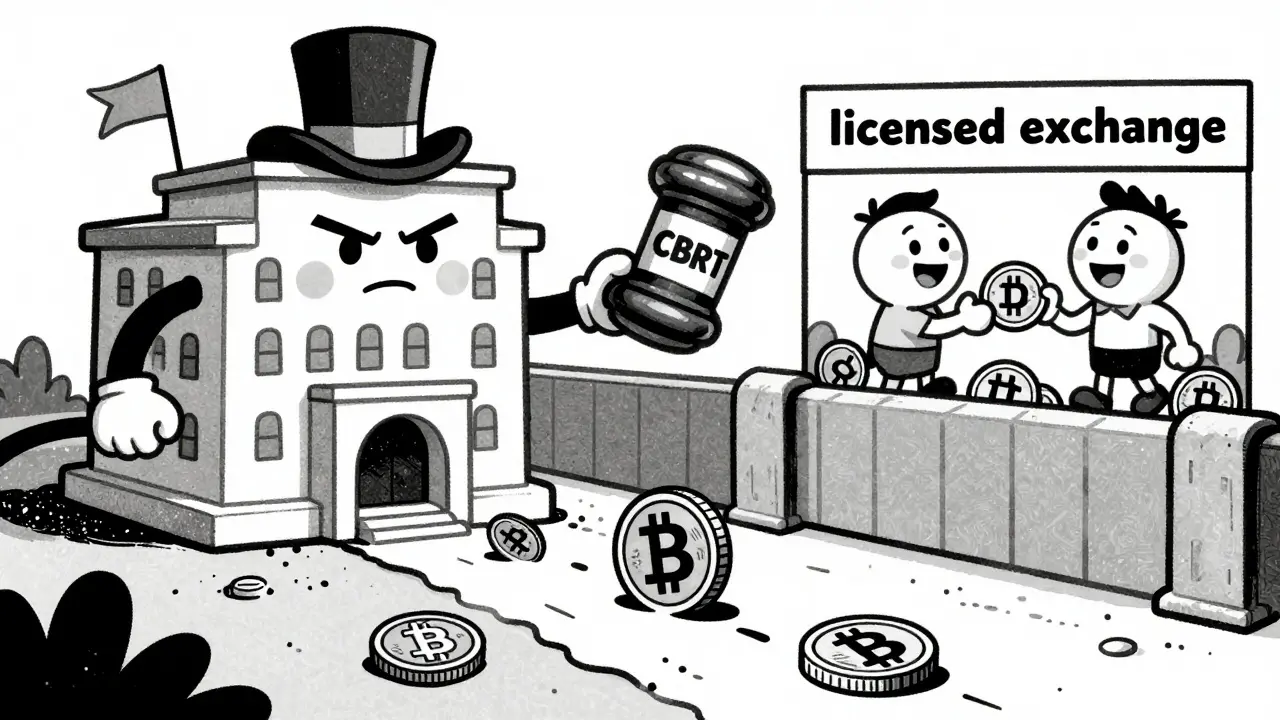
The Turkish market is finding its balance. It is neither a wild west nor a closed door. It is a gated community with high walls, strict ID checks, and a thriving internal economy. Understanding these gates is the key to navigating it successfully.
Can I use Bitcoin to buy goods in Turkey?
No. Since April 2021, the Central Bank of the Republic of Turkey (CBRT) has prohibited the use of cryptocurrency as a direct or indirect payment method for goods and services. Merchants and payment processors cannot accept crypto for transactions.
Is it illegal to own cryptocurrency in Turkey?
No. Owning, buying, selling, and trading cryptocurrency is legal in Turkey. The ban applies specifically to using crypto as a medium of exchange for payments. You can hold crypto assets in licensed wallets and trade them on authorized exchanges.
Do I need a license to run a crypto exchange in Turkey?
Yes. As of July 2024, all Crypto Asset Service Providers (CASPs), including exchanges and custodians, must obtain an operating license from the Turkish Capital Markets Board (CMB). Exchanges must also meet a minimum capital requirement of TRY 150 million.
What is the transaction limit for anonymous crypto transfers?
There is no true anonymity for larger amounts. Under regulations effective February 2025, identity verification is mandatory for transactions exceeding 15,000 Turkish lira (approx. $425). Transactions involving unregistered wallets may also be flagged and suspended.
Will the crypto payment ban be lifted?
It is possible but uncertain. A landmark legal challenge led by lawyer Sima Baktaş is scheduled for May 2025, arguing that lifting the ban would boost the economy. However, recent enforcement actions by the CMB in 2025 suggest regulators are currently focused on tightening control rather than relaxing it.

5 Comments
Daniel J. Cox
Man, that 'trade-but-don't-spend' paradox is just wild. :/ It’s like they want you to gamble on the volatility but then slap your hand if you try to actually use the winnings for a coffee. I guess protecting the Lira takes precedence over convenience, even if it feels a bit contradictory to have such a huge market with zero utility. Just another day in the global crypto circus, huh? :)
Emma Rémond
The sheer intellectual laziness of this regulatory framework is palpable, yet one must acknowledge the sophisticated macroeconomic rationale underpinning the Central Bank's decision. To suggest that anonymity and irrevocability are mere inconveniences rather than existential threats to financial stability reveals a profound misunderstanding of systemic risk. The implementation of stringent KYC protocols for transactions exceeding the nominal threshold of 15,000 TRY is not merely bureaucratic overreach; it is a necessary epistemological boundary against illicit capital flight. Furthermore, the capitalization requirements for CASPs serve as an effective filter, ensuring that only entities with sufficient fiscal fortitude can navigate the labyrinthine compliance landscape. One might argue that this stifles innovation, but such a view ignores the precarious nature of unregulated speculative assets. The distinction between investment vehicles and mediums of exchange is fundamental, and blurring these lines invites chaos. Thus, while the user experience may suffer from friction, the structural integrity of the national currency remains paramount. It is a nuanced dance between technological adoption and monetary sovereignty, executed with a heavy hand but perhaps with justified intent. The upcoming legal challenges by Sima Baktaş are intriguing, yet likely futile against the entrenched apparatus of state control. Ultimately, the Turkish model serves as a cautionary tale for other nations contemplating similar hybrid approaches. We must remain vigilant against the siren song of decentralized utopias that ignore the harsh realities of geopolitical economics. The data regarding the 19.3% adoption rate is impressive, yet it highlights a population desperate for alternatives rather than one embracing true financial freedom. This is not liberation; it is managed dissent within a rigidly controlled sandbox. The blocking of DeFi platforms further cements this narrative of centralized oversight masquerading as regulation. One cannot help but feel a sense of melancholy for the idealistic vision of Bitcoin when confronted with such pragmatic, albeit restrictive, implementations. The future will tell whether this gated community thrives or becomes a relic of transitional economic anxiety. For now, we observe with detached curiosity.
Scott Miller
GET A GRIP! You people are complaining about rules that save you from losing your shirt! If they let you spend crypto freely, the whole system would collapse overnight because of scams and hacks! The government is doing its job to keep you safe, so stop whining and start trading responsibly! Wake up and smell the coffee, folks! Regulation is GOOD! It stops the bad guys and keeps the market clean! Don't be stupid and try to bypass it! Follow the law or get blocked! Simple as that!
Rob Morton
It is fascinating to consider the philosophical implications of separating value storage from value transfer. When we strip away the ability to spend, does cryptocurrency cease to be money in any meaningful sense, becoming purely a speculative instrument akin to collectible art or rare commodities? This bifurcation forces us to question the very definition of currency. Is a medium of exchange valid if it cannot facilitate immediate trade? The Turkish experiment offers a unique case study in this regard. By allowing ownership but prohibiting utility, the state creates a psychological disconnect for users who hold assets they cannot practically utilize in daily life. This tension between possession and application might reveal deeper truths about human trust in institutional versus decentralized systems. Perhaps the resistance to spending isn't just about regulation, but about a lack of confidence in the underlying asset's stability for everyday transactions. The high adoption rates despite these restrictions suggest that people are seeking refuge from inflation more than they are seeking a new payment method. This raises the question: are we building a new financial system, or merely creating a parallel shadow economy that exists at the mercy of state tolerance? The answer may lie in how these regulations evolve over time. Will the walls come down, or will they become higher? Only time will tell, but the current path seems to favor control over freedom.
Routh Middaugh
I think... it's really interesting... how they balance things out! On one hand... you have all this tech potential! But on the other hand... security is super important! So... maybe it's not so bad? They just want to make sure everyone is safe! And... hey... at least you can still trade! That's something! Right? :)