
Remember when mobile games were just about killing time on your commute? Now, a new breed of apps promises you can actually earn money while playing match-3 puzzles or endless runners. Enter Sugarverse, a candy-themed Web3 gaming ecosystem built around its native cryptocurrency, the CNDY token. But is this just another flashy play-to-earn scheme that will crash in a month, or does it have a real shot at sustainability?
If you’ve seen the ticker symbol CNDY pop up on crypto trackers and wondered what the fuss is about, you’re not alone. The crypto space is flooded with gaming tokens, but Sugarverse tries to do something different: fix the broken economics of early blockchain games by making them fun first and profitable second. Let’s break down exactly what Sugarverse is, how the CNDY token works, and whether it’s worth your attention in mid-2026.
The Core Concept: Candy, Chains, and Circles
At its heart, Sugarverse isn’t just one game; it’s a studio building a saga of casual mobile games. Think of it as a metaverse made of candy planets, where each planet hosts a different type of game. Originally, the team pitched seven planets and seven games, but by 2025, they streamlined this into a focused saga of five integrated titles. The goal? To bridge the gap between traditional Web2 mobile gaming (which everyone knows how to play) and Web3 blockchain ownership (where you actually own your stuff).
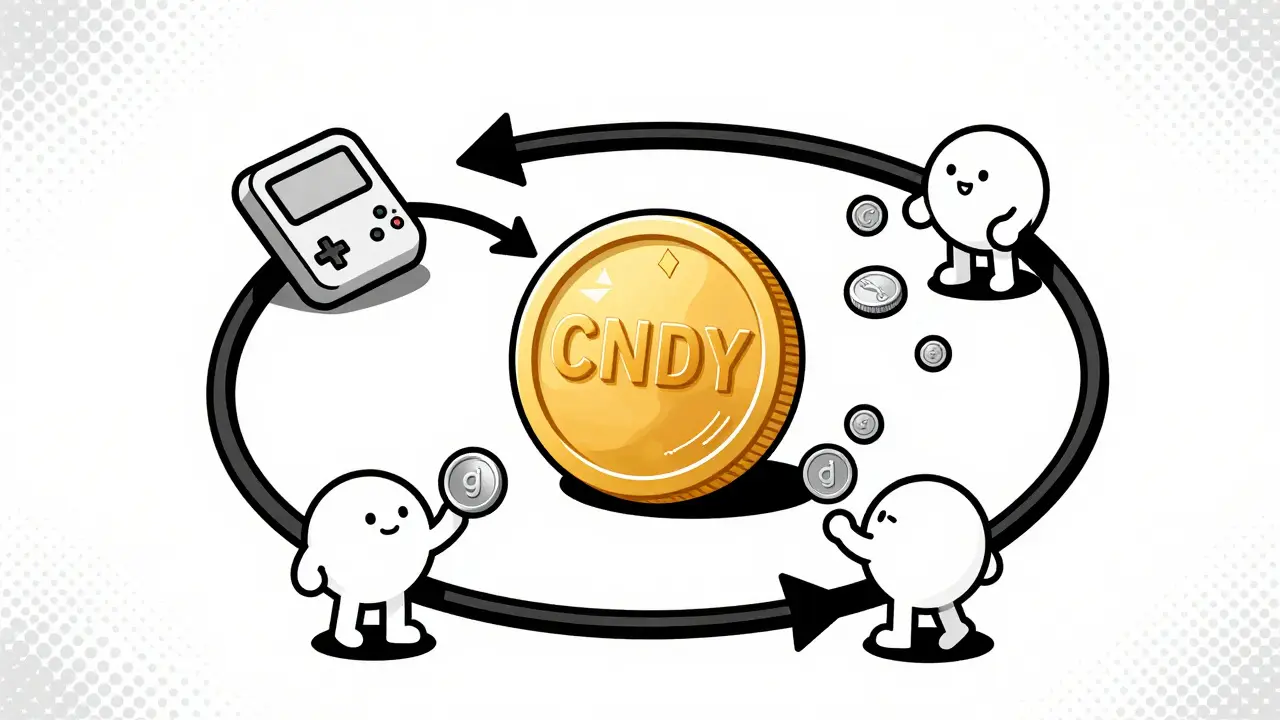
The key innovation here is the economy. Early play-to-earn games often collapsed because they printed too many tokens, causing inflation that wiped out player earnings. Sugarverse claims to solve this with a circular model. Instead of handing out free tokens endlessly, they use a dual-currency system involving CNDY and gCNDY. This setup aims to keep rewards sustainable for loyal players rather than rewarding bots who grind for quick cash.
Understanding the Tokens: CNDY vs. gCNDY
To navigate Sugarverse, you need to understand the two main assets involved. They serve very different purposes, and confusing them is a common mistake for newcomers.
- CNDY (The Main Token): This is the utility and governance token. You buy it on exchanges, stake it to earn rewards, use it to pay for entry fees in competitive modes, and vote on ecosystem decisions. It’s the hard currency of the universe.
- gCNDY (Game Points): These are earned purely through gameplay. You get them by completing levels, winning matches, or achieving daily goals. Crucially, gCNDY has limits-you can only earn so much per day to prevent farming abuse. You can later swap gCNDY for CNDY via an in-game portal, but the exchange rate and conditions are controlled to maintain balance.
This separation is vital. If every action gave you direct CNDY, the price would plummet. By gating the conversion and capping daily earnings, Sugarverse tries to create a steady demand for CNDY (needed for buy-ins and purchases) while limiting the supply pressure from rewards.
Where Does It Live? The Etherlink Advantage
One of the biggest hurdles for crypto gamers has always been gas fees. Paying $5 in Ethereum gas to win $0.10 in a puzzle game makes no sense. That’s why Sugarverse chose Etherlink, a Layer-2 network built on top of Tezos.
Etherlink offers near-zero transaction costs and high speed, which is essential for a casual mobile game where actions happen constantly. When you move an NFT bear or claim a reward, the transaction happens instantly without draining your wallet. This technical choice allows Sugarverse to target mainstream mobile users who aren’t willing to deal with complex crypto wallets or high fees. As of 2026, the flagship title, Sugar Match PvP, runs smoothly on this infrastructure, available on both Android and iOS.

The Games: More Than Just Hype
A crypto project is only as good as its product. If the game sucks, nobody stays, and the token dies. Sugarverse started with Sugar Match PvP, a three-player match-3 battle royale. Imagine classic Candy Crush, but you’re competing against two other humans in real-time, trying to sabotage their boards while protecting your own. It’s chaotic, fast, and designed to be addictive.
Another title in the saga is SugarRush, an endless runner where you control NFT bears navigating a world called Candytopia. The strategy here is genre diversity. By offering different types of casual games, they hope to attract varied audiences-some people love matching gems, others prefer running and jumping. Each game integrates the CNDY/gCNDY economy, allowing players to export and trade their NFT avatars and land plots on open markets.
| Feature | Sugarverse (CNDY) | Metaland CANDY | Candy Pocket CANDY |
|---|---|---|---|
| Primary Use Case | Multi-game Web3 Saga & Governance | In-game currency for Cooking Adventure | Web3 Wallet & Dapp Store Payments |
| Blockchain Network | Etherlink (Tezos L2) | Varies (often single-chain) | Multiple chains (Wallet focus) |
| Economy Model | Dual Token (CNDY + gCNDY) | Single In-Game Currency | Payment Utility Token |
| Total Supply | 1 Billion CNDY | 800 Million CANDY | 2.1 Billion CANDY |
| Key Differentiator | PvP Competitive Mechanics & Sustainability Focus | Specific to One Cooking Game | Focus on Online Payments |
Tokenomics and Market Reality
Let’s talk numbers, because that’s what investors care about. CNDY launched via an Initial DEX Offering (IDO) on TrustSwap in December 2024. The total supply is capped at 1 billion tokens, with roughly 466 million circulating by May 2026. However, be careful with data sources. Some early reports mentioned a 6 billion supply during planning phases, but official listings like CoinMarketCap confirm the 1 billion cap. Always check the latest contract details before buying.
As of mid-2026, CNDY is considered a micro-cap asset. Its market capitalization is small compared to giants like Bitcoin or even major GameFi tokens like AXS or GALA. This means high volatility. A small amount of buying or selling can swing the price significantly. For example, if the price hovers around $0.000012, the fully diluted valuation is under $12,000. While this sounds tiny, it also means there’s room for growth if the user base expands-but equally, there’s a risk of illiquidity.
The team secured a $1 million funding round in March 2025 to develop the remaining games in the saga. This shows some financial backing, but remember: funding doesn’t guarantee success. Many well-funded GameFi projects have failed to retain users after the initial hype faded.
How to Get Started with CNDY
If you want to try Sugarverse, here is the practical path:
- Acquire CNDY: Look for centralized or decentralized exchanges listing CNDY. Since it’s on Etherlink, you may need to bridge assets from Tezos or other compatible networks. Check current listings on aggregators like CoinGecko or CoinMarketCap for the most active pairs.
- Set Up a Wallet: You’ll need a wallet compatible with Etherlink/Tezos. Trust Wallet or Taquito-based wallets are common choices. Ensure you securely store your seed phrase.
- Download the Game: Install Sugar Match PvP from the Google Play Store or Apple App Store. Create an account and connect your wallet.
- Play and Earn gCNDY: Start playing single-player or multiplayer modes. Remember, you earn gCNDY first. Respect the daily caps to maximize long-term gains.
- Swap for CNDY: Once you’ve accumulated enough gCNDY, use the in-game swap portal to convert it into CNDY. You can then hold, stake, or sell these tokens.
Note: Multiplayer modes require a buy-in. You might lose your entry fee if you don’t win. Treat this like gambling stakes, not guaranteed income. Only spend what you can afford to lose.
Risks and Considerations
No crypto investment is safe, and Sugarverse is no exception. Here are the red flags to watch:
- Micro-Cap Volatility: With low trading volume, prices can swing wildly. Liquidity might dry up quickly if interest wanes.
- Execution Risk: The roadmap promises five games. So far, only one is live. Delays are common in game development. If subsequent titles fail to launch or lack quality, the ecosystem could stagnate.
- Regulatory Uncertainty: Play-to-earn models face scrutiny globally. Changes in laws regarding digital assets or gambling mechanics could impact operations.
- Smart Contract Risks: While Etherlink is secure, bugs in the game’s smart contracts could theoretically lead to exploits. Always verify audit reports if available.
Also, beware of confusion. There are physical candy shops named "Sugarverse" in places like Florida and Oregon. Reviews for those brick-and-mortar stores have nothing to do with the crypto project. Don’t mix them up!
Is Sugarverse Worth Your Time?
Sugarverse represents an interesting experiment in fixing play-to-earn economics. By focusing on fun, using a dual-token system, and leveraging low-cost Etherlink, it addresses many past failures in the sector. The team has experience in Web2 mobile gaming, which gives them an edge in creating engaging products rather than just financial schemes.
However, it remains a niche, high-risk venture. It’s not a blue-chip investment. If you’re a gamer who enjoys casual mobile titles and wants to experiment with Web3 ownership, it’s worth downloading and trying. If you’re looking for a safe place to park large sums of money, look elsewhere. The future of CNDY depends entirely on whether players find joy in the games themselves, not just the promise of profit.
What is the current price of CNDY?
As of mid-2026, CNDY trades as a micro-cap asset, often priced fractions of a cent (e.g., ~$0.000012). Prices fluctuate rapidly based on trading volume and market sentiment. Always check real-time data on CoinMarketCap or CoinGecko before making any decisions.
Is Sugarverse a scam?
There is no evidence suggesting Sugarverse is a scam. It has a registered company background, public funding rounds, and a live product on major app stores. However, all crypto investments carry risk, including the possibility of losing value due to market dynamics or project failure.
Which blockchain does CNDY use?
CNDY operates on Etherlink, a Layer-2 scaling solution for the Tezos blockchain. This choice allows for low transaction fees and fast processing, ideal for mobile gaming applications.
Can I earn CNDY without spending money?
Yes, you can earn gCNDY (game points) for free by playing single-player modes. However, converting gCNDY to CNDY may have limitations or require specific conditions. Competitive PvP modes usually require a CNDY buy-in, which involves spending.
What is the total supply of CNDY?
The maximum total supply of CNDY is 1 billion tokens. Approximately 466 million were in circulation as of May 2026. Be wary of outdated sources citing higher supplies from earlier planning stages.
How does Sugarverse prevent inflation?
Sugarverse uses a dual-token system (CNDY and gCNDY), daily earning caps, and competitive PvP mechanics where losers’ buy-ins replenish the treasury. This creates a circular economy that burns tokens rather than just printing them indefinitely.

8 Comments
Jay Sharma
They tell you it's about 'fun' and 'gaming' but look closer at the tokenomics. The dual currency system is just a sophisticated Ponzi structure designed to harvest liquidity from late adopters while early insiders dump their bags. The 'Etherlink' narrative is smoke and mirrors to hide the fact that the underlying smart contracts are likely riddled with backdoors for the devs to rug pull whenever they want. I've seen this script before, always ends with retail getting rekt.
Scott Miller
You need to wake up and smell the coffee! This is exactly the kind of negativity that kills innovation. Sugarverse is actually fixing the biggest problem in GameFi: sustainability. If you think every new project is a scam, you're missing out on the next moonshot. The team has funding, a live product, and a real roadmap. Get on board or stay poor!
Melissa L
i dunno man, sounds kinda sus to me lol. i tried playing sugar match pvp last week and my phone overheated after like 10 mins. also the wallet connection was a total nightmare, took me forever to figure out which browser extension to use. maybe its cool for crypto nerds but for regular people it feels too complicated. plus the graphics look like they came from 2015 :/
ross harris
The duality of man is reflected in the duality of tokens. CNDY represents the soul, the governance, the eternal struggle for control. gCNDY is the flesh, fleeting, earned through the sweat of digital brows, destined to be sacrificed at the altar of conversion. It is not merely a game; it is a microcosm of our capitalist hellscape, where even leisure must be monetized, commodified, and burned in the fires of inflationary pressure. We are all just bears running on Candytopia, chasing a carrot that dissolves into ash.
Carl Belgrave
Look, I don't care about your foreign scams or whatever Etherlink is. But if this thing is going to drain American wallets with hidden fees, we have a problem. Our developers should be building games here, not relying on Tezos L2s from who-knows-where. It's weak. Real gaming doesn't need blockchain bloat. Keep your crypto away from our kids.
Carl Hanzel
I'm so tired of everyone hyping up these 'play-to-earn' garbage projects. You guys are desperate for validation. The moment you attach a financial incentive to a game, you destroy the fun. It becomes work. Slavery. And you're cheering for it because you can't handle being broke without a excuse. Pathetic. The whole ecosystem is built on sand and greed.
Daniel J. Cox
Hey folks! As someone who follows the global mobile gaming scene closely, I think Sugarverse is trying something interesting by bridging Web2 habits with Web3 ownership. In many Asian markets, this hybrid model is gaining traction because players are already accustomed to microtransactions and asset trading. The key will be whether they can maintain the casual vibe without alienating non-crypto users. 🍬🎮
Emma Rémond
It is frankly embarrassing how little understanding most of you have regarding decentralized application architectures. The implementation of a dual-token economy on a Layer-2 solution like Etherlink is standard procedure for mitigating hyperinflationary pressures inherent in naive single-token models. Those complaining about 'complexity' simply lack the cognitive bandwidth to engage with modern fintech paradigms. Do not confuse simplicity with sophistication. The burn mechanisms are elegantly designed to ensure long-term viability, unlike the primitive economies you are accustomed to.