
You’ve probably seen the ticker UNW pop up in your wallet or on a decentralized exchange aggregator and wondered what it actually does. Is it another meme coin with no substance, or a serious piece of DeFi infrastructure? The answer lies in understanding that Uniwhale isn’t just a token; it’s the utility asset behind a specific type of trading platform known as a perpetual decentralized exchange (DEX). If you are looking for high-leverage trading without handing over your keys to a centralized broker, this might be the niche you’re exploring.
But here is the catch: "UNW" is a crowded ticker. You need to be absolutely sure you are looking at Uniwhale, not UniWorld Unicash. They are two completely different projects with similar names. This guide breaks down exactly what Uniwhale is, how its unique dual-token system works, and why its market cap tells a story of a small but persistent community rather than a hype-driven pump-and-dump.
The Core Concept: Oracle-Based Perpetual Trading
Uniwhale is a protocol built on the BNB Smart Chain that allows users to trade cryptocurrencies like Bitcoin (BTC) and Ethereum (ETH) with leverage. Unlike traditional spot exchanges where you buy the actual coin, a perpetual DEX lets you bet on price movements without an expiration date. Uniwhale distinguishes itself by using oracle-based pricing mechanisms to determine these prices, aiming to reduce manipulation and provide fairer execution for traders.
The platform offers up to 200x leverage, which is massive. For context, many centralized exchanges cap retail leverage at 50x or 100x. While this offers huge profit potential, it also means a tiny price move against you can liquidate your position instantly. The protocol relies on liquidity providers (LPs) to back these trades. When you open a long position, you are essentially betting against the pool of stablecoins provided by other users. If the market moves in your favor, you take from the pool; if it moves against you, the pool absorbs the loss. This structure requires a robust incentive model to keep LPs interested, which brings us to the token itself.
Understanding the UNW Token Utility
The UNW token is a BEP-20 asset deployed on the BNB Smart Chain. Its contract address is consistently reported as 0x5b65cd9feb54f1df3d0c60576003344079f8dc06. Don’t let the technical jargon scare you off; this string of characters is simply the digital fingerprint of the token. It ensures you aren’t buying a fake copy.
So, what do you actually use UNW for? In the Uniwhale ecosystem, the token serves three primary functions:
- Liquidity Provision: Users stake UNW or pair it with BNB to provide liquidity. This helps ensure there is enough capital in the pools to support leveraged trades.
- Emissions Participation: Staking UNW allows holders to participate in token emissions. Think of this as earning rewards for helping secure and support the network’s economic activity.
- Counterparty Role: In certain trading mechanics, UNW acts as a counterparty asset, facilitating the complex derivatives calculations required for perpetual swaps.
It is crucial to note a distinction made in the project’s documentation: holding and staking UNW gets you into the emission game, but it doesn’t automatically grant you a share of the protocol’s fee revenue. That benefit is reserved for a separate governance token, which we will discuss shortly. This separation prevents dilution of value for those who prefer active participation over passive holding.
The Dual-Token Model: UNW vs. esUNW-v2
Most DeFi projects struggle with governance. If everyone has a vote, nothing gets done. If only whales have a vote, the community feels ignored. Uniwhale attempted to solve this with a dual-token architecture introduced in their "Tokenomics V2" update in July 2023. This shift moved away from a single token doing everything to a specialized system involving esUNW-v2.
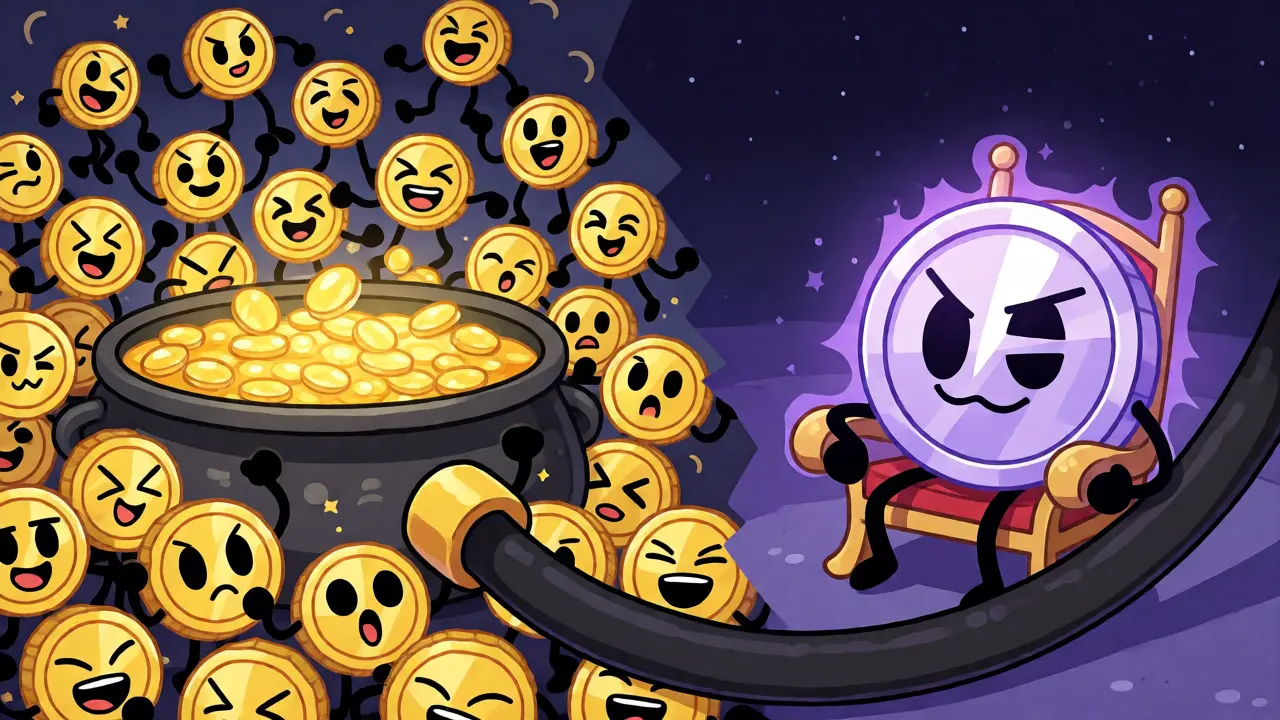
Under this new model, UNW became the primary emission and utility token, widely distributed to encourage adoption and liquidity. Meanwhile, esUNW-v2 was designed as an ultra-scarce governance instrument. Let’s look at the numbers, because they reveal the strategy clearly:
| Feature | UNW (Utility) | esUNW-v2 (Governance) |
|---|---|---|
| Maximum Supply | 100,000,000 | 2,000 |
| Transferability | Yes (Tradeable) | No (Non-transferable) |
| Primary Function | Liquidity & Emissions | Governance & Fee Accrual |
| Acquisition Method | Buy on DEX/CEX | Auction/Burn UNW |
The scarcity of esUNW-v2 is extreme. With a max supply of only 2,000 units compared to UNW’s 100 million, each unit represents a significant stake in the protocol’s future. To get esUNW-v2, users must burn UNW tokens in weekly auctions. One unit of esUNW-v2 is auctioned per week. This creates a direct sink for UNW: as people want more governance power, they destroy UNW, potentially reducing circulating supply and supporting its price. Additionally, esUNW-v2 holders are redeemable at the intrinsic value of the "Fee Vault," meaning they share in the actual trading fees generated by the platform, unlike UNW holders who rely on emissions.
Market Performance and Liquidity Reality Check
If you are used to seeing Bitcoin trade billions of dollars a day, Uniwhale’s stats might shock you. As of mid-2026, data aggregators place UNW in the lower tiers of cryptocurrency rankings, often hovering around rank #6000-#6500. The price has fluctuated between roughly $0.0009 and $0.0025 over the last few years. While these numbers seem low, they reflect the reality of a micro-cap asset.
Liquidity is the biggest concern here. Daily trading volumes often range from under $100 to a few thousand dollars. On some days, volume drops below $50. What does this mean for you? It means slippage. If you try to sell $500 worth of UNW, you might move the price significantly against yourself. It also means exit strategies can be tricky. You cannot assume you will always find a buyer at the displayed price. Always check the order book depth before entering a large position.
Circulating supply figures also vary across trackers, ranging from approximately 8.37 million to 25.08 million UNW. These discrepancies usually stem from how different platforms account for locked tokens, vesting schedules, or recent emissions. Given the maximum supply of 100 million, a significant portion remains either locked or yet to be emitted, suggesting that inflationary pressure could increase as more tokens enter circulation over time.

How to Buy and Store Uniwhale (UNW)
Since Uniwhale is native to the BNB Smart Chain, acquiring it requires interacting with DeFi tools rather than just clicking "Buy" on a major bank app. Here is the practical path most users take:
- Set Up MetaMask: Ensure your wallet is configured for the BNB Smart Chain network.
- Fund Your Wallet: Deposit BNB into your wallet. You need BNB both to swap for UNW and to pay gas fees.
- Choose a Venue: The primary decentralized exchange for UNW is PancakeSwap, specifically the v2 or v3 versions. Other options include Thena and the centralized exchange MEXC.
- Execute Swap: Select the UNW/WBNB pair. Paste the official contract address (
0x5b65...dc06) to verify you are selecting the correct token. - Confirm Transaction: Approve the transaction in your wallet. Due to low liquidity, set your slippage tolerance slightly higher (e.g., 1-2%) to avoid failed transactions.
Once purchased, you can add the token to your wallet view manually using the contract address if it doesn’t appear automatically. Remember, keeping your assets in a self-custody wallet like MetaMask gives you full control, but it also puts the responsibility of security squarely on your shoulders.
Risks and Considerations Before Investing
Investing in micro-cap DeFi tokens like UNW carries inherent risks that go beyond standard market volatility. First, smart contract risk is ever-present. While the protocol has been operational since at least 2022, smaller projects may not undergo the same rigorous, multi-firm audits as top-tier protocols. Always check for the latest audit reports if available.
Second, regulatory uncertainty looms over all DeFi derivatives. The SEC and other global bodies are increasingly scrutinizing leveraged trading products. If regulations tighten on decentralized exchanges, protocols like Uniwhale may face compliance hurdles that impact their operations or token utility.
Finally, beware of the ticker confusion. As mentioned earlier, UniWorld Unicash also uses UNW. UniWorld launched via an IEO in 2020 with a 1 billion token supply, vastly different from Uniwhale’s 100 million cap. Checking the blockchain explorer (BscScan) for the contract address is the only foolproof way to ensure you are buying the right asset. Never trust the name alone; trust the code.
Is Uniwhale (UNW) the same as UniWorld (UNW)?
No, they are distinct projects. Uniwhale is a perpetual DEX on the BNB Smart Chain with a max supply of 100 million UNW. UniWorld is a separate ecosystem originally based on Ethereum with a much larger supply of 1 billion UNW. Always verify the contract address to distinguish them.
Can I earn passive income with UNW?
Yes, primarily through staking and providing liquidity. By staking UNW, you participate in token emissions. However, direct fee revenue sharing is tied to the esUNW-v2 governance token, not the standard UNW token.
Where is the best place to buy UNW?
The most common venue is PancakeSwap on the BNB Smart Chain, using the UNW/WBNB pair. MEXC is also listed as a centralized exchange option, though liquidity on PancakeSwap is typically deeper for this specific pair.
What is the maximum supply of UNW?
The maximum supply of the Uniwhale UNW token is capped at exactly 100,000,000 tokens. This fixed cap contrasts with inflationary models found in many other DeFi projects.
Why is the trading volume for UNW so low?
Uniwhale is a micro-cap asset with a niche user base focused on high-leverage perpetual trading. Low volume reflects limited mainstream awareness and speculative interest compared to top-100 cryptocurrencies, leading to higher slippage risks during trades.
