
Walk into any major financial hub or scroll through your favorite market tracker today, and you’ll see the same truth: Centralized Exchanges (CEXs) are still running the show. Despite years of hype around Decentralized Exchanges (DEXs) promising a trustless revolution, platforms like Binance, Coinbase, and Kraken continue to process the vast majority of global cryptocurrency trading volume. Why? Because when it comes down to speed, liquidity, and ease of use, centralized infrastructure just works better for most people.
You might think that after all this time, the tech would have caught up. But here’s the reality: trading is not just about philosophy; it’s about execution. If you’re trying to buy Bitcoin at 3 AM because a news headline just dropped, you don’t want to worry about gas fees spiking on Ethereum or figuring out which bridge to use for Solana. You want to click "Buy," enter an amount, and be done. That friction-or lack thereof-is the primary reason CEXs remain dominant. Let’s break down exactly why these platforms hold their ground against the decentralized challengers.
The Liquidity Advantage: Deep Order Books Matter
Liquidity is the lifeblood of trading. It determines how easily you can buy or sell an asset without causing a drastic change in its price. This is where centralized exchanges crush their decentralized counterparts. When you trade on a platform like Binance, you’re tapping into a massive, aggregated pool of buyers and sellers. The order book is deep, meaning there are thousands of orders waiting at every price level.
Compare this to many DEXs, where liquidity is fragmented across different blockchains and automated market makers (AMMs). If you try to make a large trade on a less liquid DEX, you might suffer from significant slippage. Slippage is the difference between the expected price of a trade and the price at which the trade is actually executed. On a thin DEX, selling $1 million worth of a token could move the market price by several percentage points against you. On a major CEX, that same trade barely moves the needle. For institutional traders and whales, this stability is non-negotiable.
| Feature | Centralized Exchange (CEX) | Decentralized Exchange (DEX) |
|---|---|---|
| Order Matching | Off-chain, instant matching via central server | On-chain, subject to network congestion |
| Slippage Risk | Low due to deep order books | Higher, especially for large trades |
| Trade Frequency | Tens of thousands of transactions per second | Limited by blockchain throughput |
Speed and Performance: Off-Chain Efficiency
Have you ever tried to swap tokens on a congested network? You pay a premium fee, wait for confirmation, and pray the transaction doesn’t fail. Now, compare that to clicking "Sell" on Coinbase. It feels instantaneous. That’s because CEXs handle order matching off-chain. They maintain a private database that updates instantly when you place an order. Only when you withdraw funds do you interact with the blockchain.
This architecture allows CEXs to support high-frequency trading strategies that are simply impossible on most current DEXs. While Layer 2 solutions and new blockchains like Solana have improved DEX speeds, they still face bottlenecks during peak activity. A CEX’s proprietary matching engine can handle millions of requests per second without breaking a sweat. For day traders who rely on millisecond advantages, this performance gap is decisive. You cannot scalp profits effectively if half your gains are eaten by latency or failed transactions.
User Experience: The Barrier to Entry
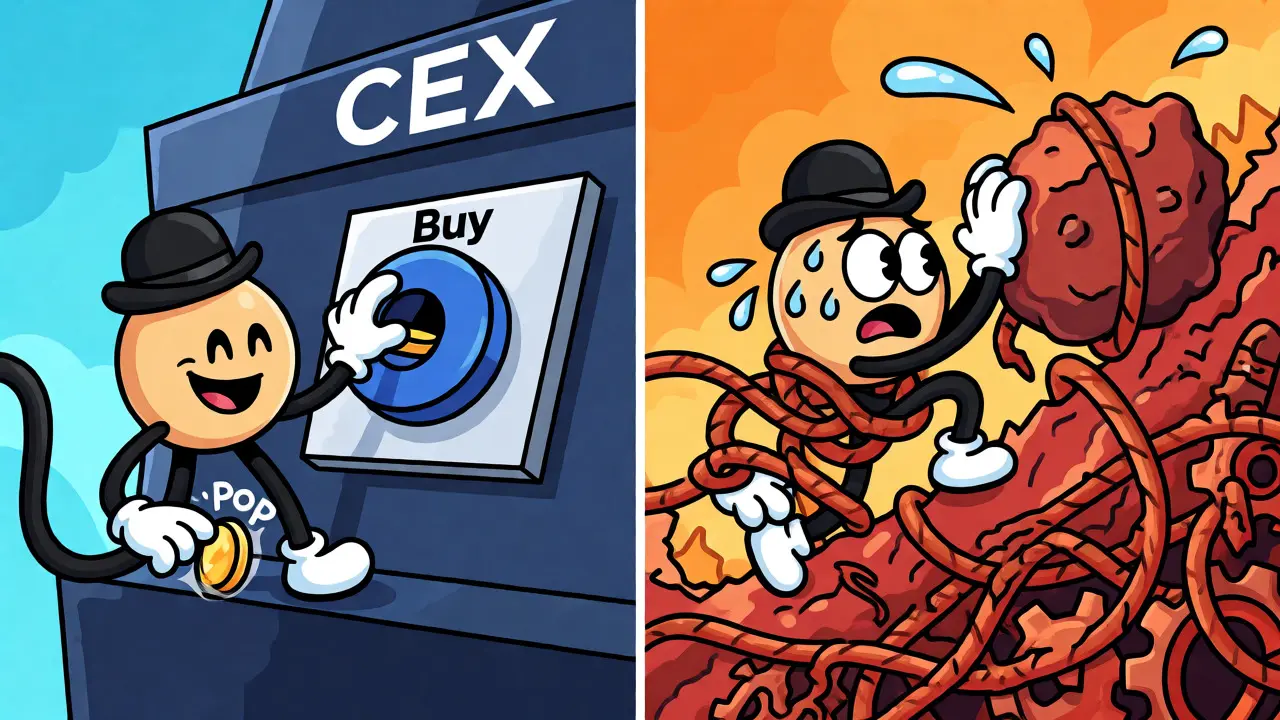
Let’s be honest: managing private keys scares people. For the average investor, the idea of losing access to their life savings because they forgot a 12-word seed phrase is terrifying. Centralized exchanges remove this burden. You sign up with an email, verify your identity, and start trading. If you forget your password, you reset it. If you lose your phone, you call support.
DEXs require a higher degree of technical literacy. You need to understand wallets, gas fees, network selection, and smart contract approvals. One wrong click can lead to a lost fund transfer. Reddit threads are filled with stories of users sending ETH to the wrong address or interacting with malicious contracts on DEXs. CEXs offer a "walled garden" experience that prioritizes convenience over sovereignty. For mainstream adoption, this simplicity is a feature, not a bug. People want apps that work like Venmo or PayPal, not command-line interfaces.
- Account Recovery: CEXs offer password resets and 2FA recovery options. DEXs offer no recourse if you lose your key.
- Fiat Integration: CEXs allow direct bank transfers and credit card purchases. DEXs usually require pre-funded crypto wallets.
- Customer Support: CEXs have live chat and ticket systems. DEXs rely on community forums and documentation.
Regulatory Compliance and Institutional Trust
Governments aren’t going away, and neither are regulations. As cryptocurrency matures, institutional money-pension funds, hedge funds, corporate treasuries-is entering the space. These entities cannot operate in regulatory gray zones. They need compliance, audit trails, and legal clarity. Centralized exchanges provide this through Know Your Customer (KYC) and Anti-Money Laundering (AML) protocols.
When BlackRock or Fidelity invests in Bitcoin, they often do so through regulated products backed by compliant custodians. These institutions prefer CEXs because they can prove the source of funds and ensure tax compliance. DEXs, being permissionless, struggle to meet these requirements. While privacy is valuable, it comes at the cost of accessibility for large capital allocators. Until DEXs can offer institutional-grade compliance tools without compromising their decentralized nature, big money will stay on centralized platforms.

Advanced Trading Features
If you’re just buying and holding, a simple swap interface might suffice. But active traders need more. They need leverage, futures, options, margin trading, and stop-loss orders. Centralized exchanges have spent years building robust derivatives markets. You can short Bitcoin, go long on Ethereum with 10x leverage, or hedge your portfolio using options-all on one platform.
Most DEXs are still focused on spot swaps. While some advanced DEXs like dYdX or GMX offer perpetual futures, they often lack the depth and variety of instruments found on CEXs. Furthermore, executing complex strategies on a DEX requires managing multiple positions across different smart contracts, which increases complexity and risk. CEXs consolidate these features into a single, intuitive dashboard. For professional traders, having all tools in one place is essential for efficiency.
The Future: Coexistence, Not Replacement
Will DEXs eventually take over? Maybe, but not soon. The trend we’re seeing in 2026 is hybridization. Some centralized exchanges are introducing self-custody options, while some DEXs are integrating fiat on-ramps. However, the core advantages of CEXs-speed, liquidity, and ease of use-remain hard to replicate in a fully decentralized model without significant technological breakthroughs.
Think of it like banking. Online-only banks (neobanks) disrupted traditional finance, but brick-and-mortar branches didn’t disappear. They adapted. Similarly, CEXs and DEXs will likely coexist. CEXs will serve the masses and institutions who value convenience and compliance. DEXs will serve the DeFi enthusiasts, privacy advocates, and those who prioritize censorship resistance. For now, though, the data is clear: if you want to trade efficiently, you’re probably using a centralized exchange.
Are centralized exchanges safer than decentralized exchanges?
It depends on what you define as "safe." CEXs protect you from losing your private keys and offer insurance against hacks, but you face counterparty risk-if the exchange goes bankrupt, you might lose your funds. DEXs eliminate counterparty risk since you hold your own keys, but you face smart contract risks and user error (like sending to the wrong address). For beginners, CEXs are generally considered safer due to easier recovery options.
Why do DEXs have lower trading volumes?
DEXs suffer from fragmented liquidity across multiple blockchains and slower transaction speeds compared to off-chain CEX matching engines. Additionally, the user experience is more complex, requiring wallet management and gas fee understanding, which deters mainstream users. Regulatory uncertainty also keeps institutional investors away from DEXs.
Can I trade futures on decentralized exchanges?
Yes, platforms like dYdX, GMX, and Jupiter offer perpetual futures and other derivatives. However, the liquidity and variety of assets available on DEX futures markets are still significantly lower than on centralized exchanges like Binance Futures or Bybit. The user interface and execution speed also lag behind CEX standards.
Do I need KYC to use a centralized exchange?
In most jurisdictions, yes. To comply with anti-money laundering laws, major CEXs require identity verification (KYC) before allowing withdrawals or higher trading limits. Some smaller or offshore exchanges may offer limited services without full KYC, but this is becoming rarer as global regulations tighten.
What is slippage and why is it worse on DEXs?
Slippage is the difference between the expected price of a trade and the actual executed price. It occurs when there isn't enough liquidity to fill your order at the quoted price. DEXs often have thinner liquidity pools, so large trades can move the price significantly, resulting in higher slippage costs compared to the deep order books of centralized exchanges.
