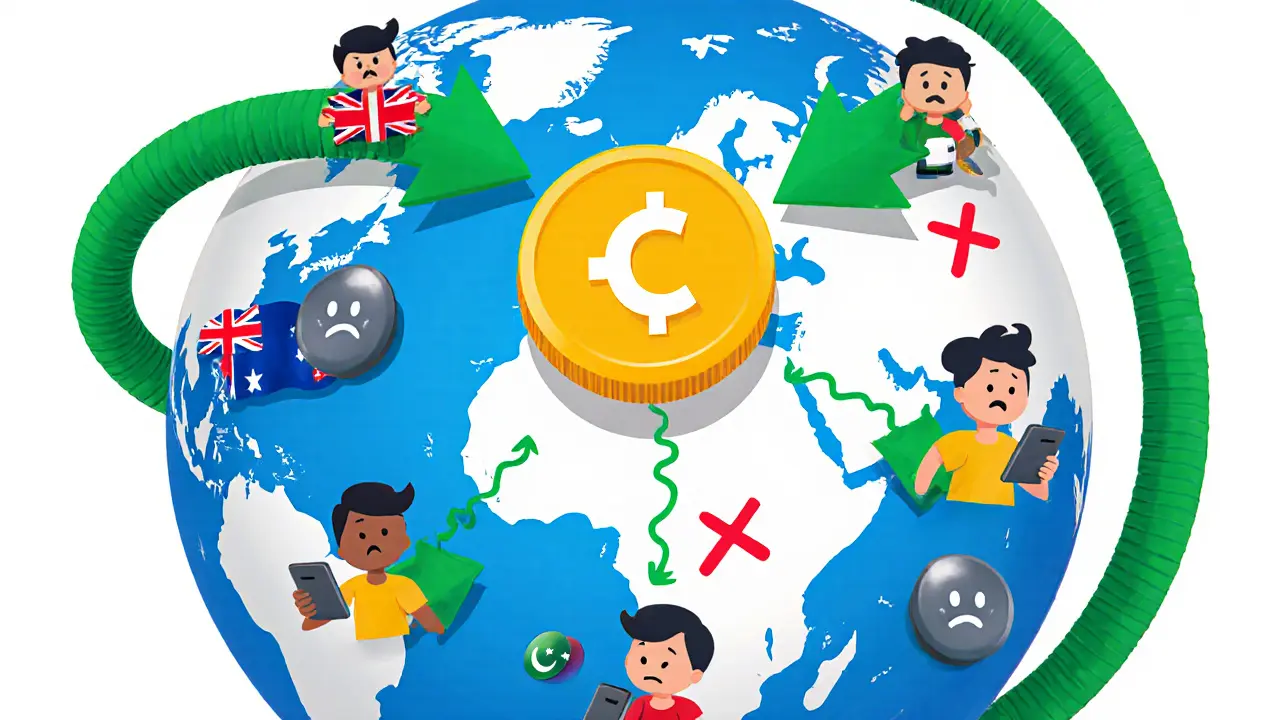
If you're trying to buy Bitcoin or Ethereum on Coinbase and got blocked, you're not alone. Millions of people around the world hit a wall when they try to use Coinbase - not because their card failed, but because their country is on the list. Coinbase doesn't operate everywhere. It doesn't even come close. And the reason isn't technical. It's legal. Every restriction, every grayed-out button, every error message saying "Service not available in your region" is tied to a government rule, a sanctions list, or a regulatory fight that Coinbase can't afford to lose.
What Coinbase Actually Blocks - And Why
Coinbase offers two main products: the Coinbase App and the Coinbase Wallet. They’re not the same thing. The App lets you buy crypto with your bank account, debit card, or PayPal. The Wallet lets you hold crypto and use decentralized apps - but you can't deposit dollars, euros, or pesos into it. That’s the key difference. The App is only available in 48 countries as of early 2025. That includes the U.S., Canada, the U.K., Germany, France, Australia, Japan, and Singapore. But it’s blocked in places like Russia, Pakistan, Nigeria, Egypt, Bangladesh, and the Philippines - even though people in those countries are actively using crypto. Why? Because Coinbase follows U.S. sanctions rules set by the Treasury Department’s Office of Foreign Assets Control (OFAC). If a country is on OFAC’s list, Coinbase shuts down fiat access. Full stop. But here’s the twist: the Wallet still works in most of those same countries. You can download it, create a wallet, and send Bitcoin or Ethereum to it from another exchange. You just can’t buy it directly with your local currency. That’s why users in Pakistan or Colombia often end up using Binance P2P or local exchanges - even if they pay 8% in fees instead of Coinbase’s 0.5%.Where You Can Use Coinbase (With Fiat)
If you’re in one of the 48 supported countries, you can deposit money and trade crypto with low fees and fast processing. Here’s how it breaks down:- United States: Full access. ACH transfers, debit cards, Apple Pay, Google Pay. Daily limits up to $50,000 after full verification.
- European Union: 30 countries including Germany, France, Spain, Italy, Netherlands. SEPA bank transfers work reliably. MiCA compliance means strict rules, but also legal clarity.
- United Kingdom: Full access. Bank transfers, debit cards. No major restrictions.
- Australia, Canada, Japan, Singapore: All supported. Local bank integration, debit card purchases, and crypto-to-fiat cashouts available.
- UAE: Limited access. Apple Pay deposits allowed, but bank transfers blocked. This inconsistency confuses users - and it’s not clearly explained on Coinbase’s site.
Where You Can’t Use Coinbase (And Why It Hurts)
The real pain points show up in countries that aren’t on the approved list - and many of them are developing economies with high crypto adoption.- Pakistan: Over 200,000 daily crypto transactions happen here, mostly on Binance. Coinbase blocks the App entirely. Wallet works, but you can’t deposit rupees. Users report paying 8-10% premiums on P2P platforms just to get started.
- Philippines: 83% of crypto users here want to buy with pesos. Coinbase doesn’t allow it. Local exchanges like PDAX charge 3.5% fees. Coinbase’s 0.5% fee looks great - if you can use it.
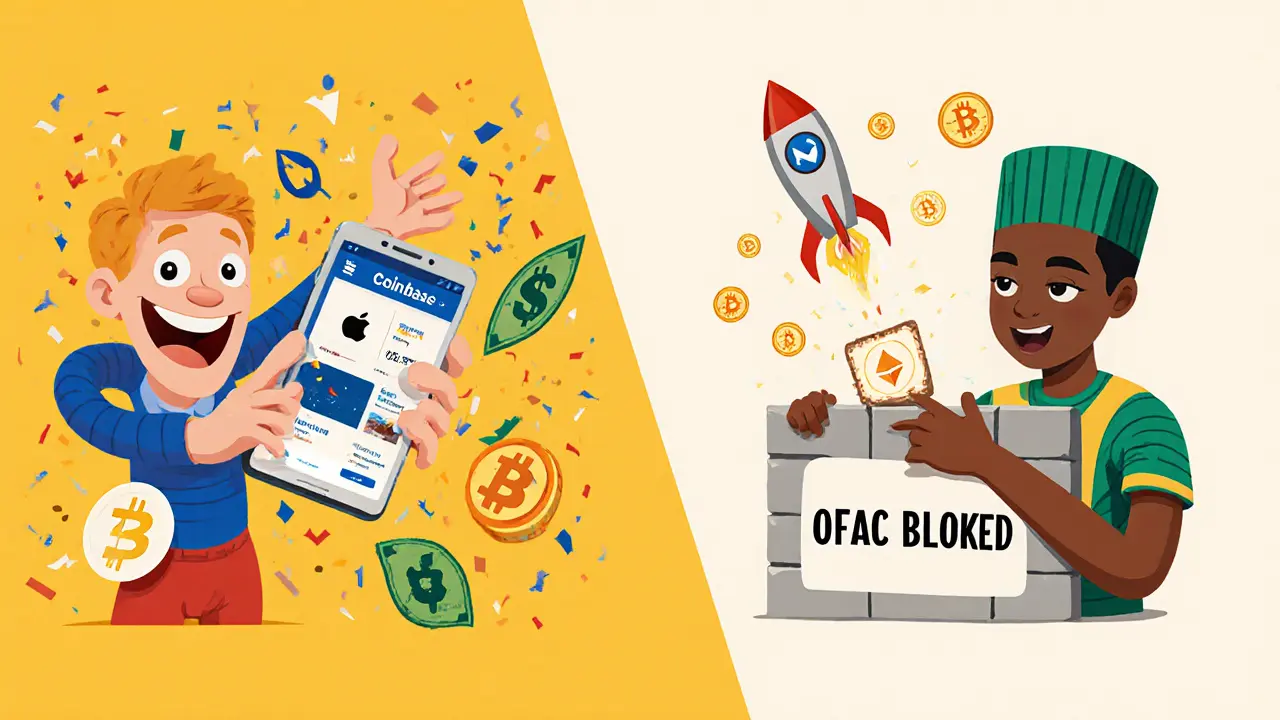
- Nigeria and Egypt: Both added to the restricted list in early 2025. Crypto is huge here, but Coinbase says it’s legally unsafe to offer services. Many users switch to Binance or local peer-to-peer apps.
- Russia: All fiat services cut off since February 2022. Wallet still works, but you can’t deposit rubles. If you’re trying to send crypto to Russia, you’re stuck using offshore channels.
- Bangladesh: Not sanctioned by OFAC. No legal reason to block it. But Coinbase still does. Experts call this an overreach.
Why Coinbase Makes These Choices
Coinbase isn’t being arbitrary. It’s being cautious - and expensive. The company is registered with the U.S. Securities and Exchange Commission (SEC) as a broker-dealer. That means it’s under constant legal scrutiny. In June 2023, the SEC sued Coinbase, accusing it of operating an unregistered exchange. That lawsuit forced Coinbase to pull back even harder in uncertain markets. If they let one user in a gray-area country make a trade and the SEC later says that crypto is a security, Coinbase could face millions in fines. They also have to comply with MiCA (Markets in Crypto-Assets Regulation) in Europe. That’s a new EU law that came into full effect in 2025. It requires strict licensing, reporting, and investor protections. Coinbase had to restructure its European operations, shifting users in Malta, Iceland, and Liechtenstein to a new entity - Coinbase Luxembourg S.A. - just to stay legal. And then there’s OFAC. If Coinbase even accidentally processes a transaction involving a sanctioned entity - say, a wallet linked to a Russian terrorist group - it could lose its U.S. banking licenses. That’s why they block entire countries, not just specific wallets. It’s safer, cheaper, and easier to say "no" to 63 countries than to build a system that checks every single transaction against a constantly changing list.What About Other Exchanges? How Do They Compare?
Coinbase isn’t the only player. Here’s how it stacks up:| Exchange | Fiat Access Countries | Global Wallet Access | Key Restriction |
|---|---|---|---|
| Coinbase | 48 | 195+ (except OFAC) | Blocks fiat in 63+ countries, even where legal |
| Binance | 100+ | 195+ | Restricted in 32 countries (Canada, Netherlands, etc.) |
| Kraken | 55 | 190+ | Strong compliance, but fewer fiat options in emerging markets |
| MetaMask | 0 (non-custodial) | 195+ | No fiat on-ramps - you need another exchange to buy crypto first |
How to Check If You’re Blocked - And What to Do
You can’t guess. You have to check. 1. Go to Coinbase Help Center and log into your account. 2. Try to click "Buy Crypto." If it’s grayed out or says "Not available," your country is restricted. 3. Check your country’s status on the updated FAQ page (last updated January 30, 2025). If you’re blocked:- Use Coinbase Wallet: Download it. You can still receive crypto from other exchanges. Just don’t expect to deposit fiat.
- Use local exchanges: In the Philippines, use PDAX. In Nigeria, use Binance P2P or Luno. In Pakistan, use Binance or Paxful.
- Don’t use a VPN: Coinbase detects IP mismatches. If you’re in the UAE but using a U.S. IP, your account could be frozen - and you could lose access to your funds. There are real cases of users losing thousands this way.
- Wait for change: India’s status is under review. Pakistan might get access if regulatory pressure grows. But don’t count on it.
The Bigger Picture: Who Gets Left Behind?
MIT’s Digital Currency Initiative found that Coinbase’s geo-blocks prevent 12.7 million unbanked people in restricted countries from accessing crypto easily. These are people who don’t have banks, but do have smartphones. Crypto could be their financial lifeline. But because Coinbase follows U.S. law, not local need, they’re shut out. Meanwhile, in Germany, users get SEPA transfers in two hours. In the U.S., they get instant Apple Pay buys. The gap isn’t just about technology. It’s about power. The rules are written in Washington, D.C. - and they favor users in wealthy, Western nations. Coinbase isn’t evil. It’s a public company with $6.2 billion in regulatory capital. It can’t afford to take risks. But that doesn’t make its restrictions fair. It just makes them legal.What’s Next?
The SEC lawsuit is expected to be resolved in late 2025. If Coinbase loses, more countries could be cut. If it wins, it might expand cautiously into places like India. For now, the message is clear: if you want to use Coinbase with fiat, you need to live in the right place. If you don’t, you’ll need to find another way - and pay more for it.Why can’t I buy crypto on Coinbase in my country?
Coinbase blocks fiat access in countries where it doesn’t have legal permission to operate. This is usually because of U.S. sanctions (like OFAC rules), lack of local licensing, or regulatory uncertainty. Even if crypto is legal in your country, Coinbase may still restrict it to avoid legal risk.
Can I use Coinbase Wallet in a restricted country?
Yes. Coinbase Wallet is a non-custodial wallet and works in nearly every country except those on the OFAC sanctions list (like Syria, North Korea, Cuba, and Crimea). You can receive, send, and store crypto - but you cannot deposit or withdraw fiat currency like USD, EUR, or PHP through it.
Is Coinbase banned in Pakistan or Nigeria?
Coinbase doesn’t officially say "banned," but it blocks all fiat services in both countries. You can download the Wallet app, but you can’t buy crypto with local currency. Many users in these countries rely on Binance P2P or local exchanges instead.
Why does Coinbase block UAE bank transfers but allow Apple Pay?
This is a regulatory gray area. UAE banks are considered high-risk for money laundering by U.S. standards, so Coinbase blocks direct transfers. Apple Pay, however, is processed through a U.S.-based payment processor, which makes it easier to comply with U.S. rules. It’s not consistent - and it confuses users.
Can I use a VPN to access Coinbase?
Technically, you might get in - but don’t. Coinbase actively detects VPN use. If your IP doesn’t match your ID or bank details, your account can be frozen or permanently closed. There are documented cases of users losing thousands of dollars this way. It’s not worth the risk.
Will Coinbase ever expand to more countries?
Maybe - but slowly. Coinbase is focused on staying compliant in the U.S. and EU. Expansion into emerging markets depends on local regulations and legal risk. India is under review, but countries like Pakistan and Bangladesh are unlikely to get access unless there’s major regulatory change or pressure from users and governments.

7 Comments
Michael Fitzgibbon
It’s wild how a company that calls itself "crypto for everyone" makes it so hard for billions to even try. I get the legal stuff, but when your app works in Luxembourg but not in Lagos, you’re not just following rules-you’re reinforcing a digital colonialism. The Wallet works? Cool. But if I can’t buy in, it’s like having a library with no books.
And don’t even get me started on UAE-Apple Pay works but bank transfers don’t? That’s not compliance, that’s chaos dressed up as policy.
Komal Choudhary
India is literally on fire with crypto adoption and Coinbase still won’t come? Bro. We have more crypto users than the entire EU. We pay taxes, we file KYC, we use UPI. But nope-Coinbase thinks we’re too risky? Meanwhile, Binance P2P is running on WhatsApp. Guess who’s winning? 😒
Tina Detelj
Let’s be real-this isn’t about regulation, it’s about control. Coinbase doesn’t want to be the first to break the mold, because then the SEC will come after them like a rabid dog with a subpoena. So they play it safe… by locking out the people who need it most.
Meanwhile, in Nigeria, a single mom buys Bitcoin with her phone to send money home-no bank, no credit card, just crypto. But Coinbase? Nope. Not in the 48. Why? Because the algorithm doesn’t care about survival. It only cares about liability.
And let’s not forget: the SEC sued them for being too bold… so now they’re too timid. And we’re the ones paying the price in lost opportunity, in financial exclusion, in silence.
It’s not a tech problem. It’s a moral failure wrapped in compliance paperwork.
And yes-I’m mad. And I have every right to be.
Wilma Inmenzo
OFAC? Please. This is all a front. Did you know that Coinbase’s legal team has a backdoor deal with the Treasury? They’re not blocked because of sanctions-they’re blocked because they’re paid to keep crypto out of certain countries so Wall Street can monopolize the market.
Why does Apple Pay work in UAE but not bank transfers? Because Apple pays them. That’s it. The rest? Just smoke and mirrors. They’re scared of real decentralization. They want crypto… but only if it’s their crypto.
And don’t even think about using a VPN. They’ll freeze your account, then laugh while they sell your ETH to their hedge fund partners. It’s all rigged.
Wake up. This isn’t finance. It’s surveillance capitalism with a blockchain logo.
George Kakosouris
Let’s dissect this with some hard metrics: Coinbase’s geo-restrictions are a direct function of regulatory risk exposure per capita (RREPC), which is inversely proportional to GDP per capita in emerging markets. In layman’s terms: they avoid places where compliance costs exceed marginal revenue.
Also, the 63-country block is a proxy for AML/CFT risk scores from FATF’s grey list-except they’re applying it retroactively to non-sanctioned jurisdictions like Bangladesh, which is a regulatory overreach bordering on economic protectionism.
And the Wallet vs. App dichotomy? That’s a classic product segmentation play: non-custodial = zero liability, custodial = maximum compliance burden. It’s not a bug-it’s a feature designed to extract value from high-risk markets without owning the risk.
Bottom line: this isn’t about legality. It’s about arbitrage. And the people losing? They’re the ones who can least afford it.
stephen bullard
I see the frustration. I really do. But let’s not forget-Coinbase is a public company. They have shareholders, auditors, lawyers, and a board that doesn’t sleep. They didn’t wake up one day and say, "Let’s leave out Pakistan." They woke up after a lawsuit and said, "Let’s not get sued again."
That doesn’t make it right. But it makes it understandable.
Maybe the real answer isn’t to blame Coinbase. Maybe it’s to push for global crypto regulations that aren’t written in Washington. Maybe we need a new kind of exchange-one that’s decentralized, community-governed, and built by people who’ve been blocked too.
For now? Use the Wallet. Use Binance P2P. Use local apps. Keep going. The system’s broken-but the movement isn’t.
And hey-if you’re reading this from Nigeria or the Philippines: you’re not alone. We’re rooting for you.
SHASHI SHEKHAR
Bro, I live in India and I’ve tried everything-Coinbase, Kraken, Binance, KuCoin, OKX, even local ones like ZebPay and CoinSwitch. Let me tell you, the real hero here is Binance P2P. You can buy BTC with UPI in 3 minutes, no KYC needed if under 10k INR. Coinbase? They blocked me even though I have a PAN card, Aadhaar, and a bank statement from SBI. 🤦♂️
And guess what? I don’t even need the App. I use MetaMask + Binance P2P + Trust Wallet. I buy crypto with my phone, store it in cold storage, and send it to my cousin in Nepal. No bank. No middleman. Just crypto. 🚀
Also, the UAE thing? Totally makes sense. Apple Pay is processed through a US-based processor, so it’s treated like a US transaction. Bank transfers? Direct from UAE banks = higher risk = blocked. It’s not random, it’s risk-tiered.
And yes, I’ve seen people get banned for using VPNs. One guy lost $12k. Don’t be that guy.
Bottom line: Coinbase isn’t the enemy. The system is. But we can still win. Use the tools available. Stay safe. Keep learning. And maybe one day, India will get its own Coinbase license. Until then… we adapt. 💪🌍