
You might think that because cryptocurrency is decentralized, it’s the perfect loophole for bypassing international financial restrictions. It feels like a digital wild west where no one is watching. But here is the hard truth: that era is over. The idea that you can move money around the globe using Bitcoin or Ethereum without triggering alarms is not just outdated; it is legally dangerous. Governments and regulators have spent the last few years building sophisticated tools to track every single transaction on the blockchain. Trying to use crypto to evade sanctions is now one of the most heavily monitored activities in finance.
If you are considering navigating these gray areas, whether for business operations or personal transfers, you need to understand the specific legal traps waiting for you. This isn’t about theoretical risks anymore. We are seeing real criminal prosecutions, massive fines, and frozen assets. Let’s look at exactly how the law applies to your wallet and why the "anonymity" of crypto is mostly an illusion.
The Myth of Anonymity vs. Blockchain Transparency
Most people confuse pseudonymity with anonymity. When you send Bitcoin, you aren’t sending cash from an envelope. You are broadcasting a transaction to a public ledger that anyone can read. Your identity might be hidden behind a string of characters (your wallet address), but that address is permanently linked to every coin that ever touched it. This creates what experts call a "digital paper trail." Unlike traditional bank records, which might be purged after seven years, blockchain data is immutable. It lasts forever.
Regulators know this. The Financial Action Task Force (FATF) has repeatedly stated that virtual assets are far from anonymous. In fact, blockchain analytics firms like Chainalysis and Elliptic have developed software that can trace approximately 98% of transactions on major networks like Bitcoin and Ethereum. They don’t just see the money moving; they can cluster addresses to identify who owns them. If you try to mix your funds or hop between exchanges, these tools map the flow. For privacy-focused coins like Monero, traceability drops to about 65%, but even that is enough to flag suspicious activity for further investigation by agencies like the U.S. Treasury’s Financial Crimes Enforcement Network (FinCEN).
| Cryptocurrency Type | Estimated Traceability | Primary Risk Factor |
|---|---|---|
| Bitcoin (BTC) | ~98% | Public ledger clustering |
| Ethereum (ETH) | ~98% | Smart contract interaction logs |
| Monero (XMR) | ~65% | Exchange off-ramp KYC requirements |
| Centralized Exchange Wallets | 100% | Mandatory Identity Verification (KYC) |
The takeaway is simple: if you interact with any regulated service, your anonymity breaks instantly. The moment you buy crypto on Coinbase, Binance, or Kraken, you are linking your real-world identity to your blockchain history. From that point on, every future transaction is potentially traceable back to you.
Global Regulatory Frameworks: OFAC, MiCA, and FATF
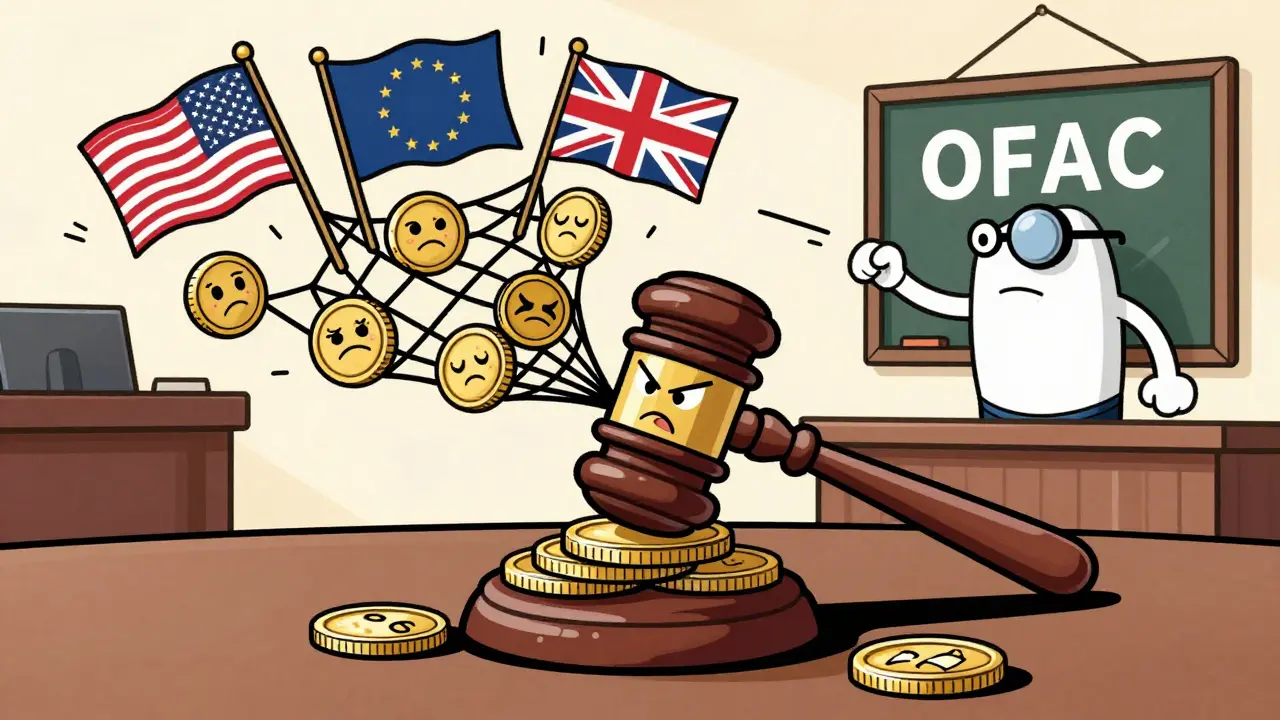
The legal landscape for crypto sanctions is no longer fragmented. Major jurisdictions have aligned their rules to treat digital assets exactly like traditional money when it comes to restrictions. In the United States, the Department of the Treasury’s Office of Foreign Assets Control (OFAC) published specific guidance in October 2021. This document made it clear: if you are a virtual currency industry operator, you must comply with all existing sanctions programs. This means screening your customers against the Specially Designated Nationals (SDN) list. As of late 2023, this list included over 1,500 specific crypto wallet addresses. Sending funds to any of these addresses is a federal crime.
In Europe, the Markets in Crypto-Assets Regulation (MiCA), adopted in April 2023, takes this even further. MiCA mandates that crypto-asset service providers implement robust transaction monitoring systems. These systems must be capable of identifying addresses associated with sanctioned entities in real-time. The goal is to close the loopholes that existed before. If you operate a business or hold significant assets in the EU, you are subject to these strict compliance standards. Failure to comply doesn’t just mean losing your license; it can lead to severe criminal penalties.
Even the UK’s Financial Conduct Authority (FCA) and the Bank of England issued joint statements reiterating that the crypto sector must play its part in ensuring sanctions compliance. There is no safe harbor. Whether you are in New York, London, or Frankfurt, the message is consistent: bypassing restrictions via crypto is a criminal offense under multiple jurisdictions.
Real-World Enforcement: Fines, Freezes, and Prosecutions
Let’s look at what happens when people ignore these rules. The consequences are swift and expensive. Following the invasion of Ukraine in February 2022, major exchanges moved quickly to enforce sanctions. Coinbase froze 25,000 Russian accounts containing roughly $225 million in assets within 48 hours. Binance implemented proof-of-address verification for all Russian users holding more than €10,000. These weren’t voluntary acts of goodwill; they were necessary steps to avoid being shut down by regulators.
For individuals and smaller entities trying to circumvent these blocks, the results have been disastrous. In November 2023, the U.S. Department of Justice charged two Russian nationals with attempting to evade $1.3 billion in sanctions through cryptocurrency transactions. This was a landmark case because it marked the first criminal prosecution specifically focused on crypto-based sanctions evasion. The defendants didn’t just lose their money; they faced prison time.
We also see heavy financial penalties for companies. Nexo Inc. settled with five state coalitions for $22.5 million in January 2023 after being accused of offering unregistered securities and failing adequate compliance checks. Nine states, including California and New York, filed coordinated enforcement actions against Coinbase in June 2023. These cases show that regulators are willing to go after both the platforms and the users who exploit them.
Why Crypto Is Actually Harder to Use for Evasion Than Cash
Counterintuitively, cryptocurrency is often a worse tool for sanctions evasion than physical cash or traditional banking loopholes. A 2023 report by the Center for Strategic and International Studies (CSIS) found that cryptocurrency represented only 0.01% of the estimated $148 billion in sanctions evasion attempts related to Russia as of September 2023. Compare that to commodity trading (42%) or third-country intermediaries (38%). Why? Because cash leaves no digital footprint. Commodity trades can be obscured through complex supply chains. Crypto leaves a permanent, transparent record.
Furthermore, the volatility of crypto adds risk. During the first three months of 2022, frozen Russian crypto assets fluctuated by 35% in value. If you are trying to move money to preserve wealth, crypto introduces market risk on top of legal risk. Traditional methods, while harder to execute anonymously, offer more stability. The decentralized nature of blockchain, which proponents claim makes it censorship-resistant, actually makes it easier for governments to coordinate globally. They don’t need to raid a bank vault; they just need to blacklist an address on the ledger.

The Rising Threat to Decentralized Finance (DeFi)
You might think that using Decentralized Finance (DeFi) protocols avoids these issues because there is no central company to regulate. Protocols like Uniswap or Aave don’t have a CEO to subpoena. However, regulators are closing this door too. The U.S. Congress introduced the Digital Asset Sanctions Compliance Act in September 2023, aiming to extend sanctions requirements to decentralized applications. The strategy is to target the developers, the front-end interfaces, and the liquidity providers.
Experts predict that the next frontier of enforcement will focus heavily on DeFi and privacy-enhancing technologies. The FATF projects that by 2026, traceability for major cryptocurrencies will reach 99.8% through coordinated international efforts. This means that even if you use a non-custodial wallet, if you eventually want to convert those tokens back into fiat currency or spend them in the real world, you will hit a regulated choke point. That choke point will ask for your ID. And once you provide it, the entire history of your DeFi interactions becomes visible to authorities.
Practical Steps for Compliance and Risk Mitigation
If you are operating in the crypto space, your best defense is proactive compliance. Here is what you need to do to stay out of legal trouble:
- Conduct Comprehensive Risk Assessments: Understand the jurisdictions you are dealing with. Know which countries are under sanctions and which wallets are blocked.
- Use Real-Time Screening Tools: Don’t rely on manual checks. Implement automated software that screens counterparties and wallet addresses against OFAC’s SDN list and other global sanction lists in real-time.
- Monitor Geolocation: Be aware of where transactions are originating. Transfers from IP addresses in high-risk jurisdictions are major red flags for FinCEN.
- Train Your Staff: Human error is a common cause of compliance failures. Ensure your team understands the specific "red flags" for crypto sanctions evasion, such as unusual transaction patterns or usage of mixers.
- Avoid Privacy Coins for Business: While Monero offers some privacy, using it can itself be seen as suspicious behavior by banks and exchanges, leading to account freezes.
Major exchanges like Kraken have shown that combining blockchain analytics with traditional Know Your Customer (KYC) procedures works. Between 2021 and 2023, Kraken reduced false positives in sanctions screening from 22% to 3.7% while increasing detection rates of sanctioned entities from 68% to 94.2%. This level of diligence is now the industry standard. Anything less puts you at significant risk.
Is it illegal to use cryptocurrency if I live in a sanctioned country?
It depends on the specific sanctions. Generally, U.S. persons cannot engage in transactions with sanctioned countries. If you are in a sanctioned country, you may still access crypto, but U.S.-based exchanges and services will likely block your account. Using crypto to bypass these blocks is a violation of U.S. law and can lead to criminal charges if you interact with the U.S. financial system.
Can I use a decentralized exchange (DEX) to avoid sanctions screening?
Technically, yes, but it is risky. DEXs do not perform KYC checks. However, if you withdraw funds to a centralized exchange or a bank account, you will be screened then. Additionally, regulators are increasingly targeting DEX operators and liquidity providers. Using a DEX to intentionally evade sanctions can be considered complicity in a crime.
What happens if I accidentally send crypto to a sanctioned wallet?
You should immediately cease all further transactions involving those funds and consult with a legal expert specializing in financial sanctions. Do not try to "clean" the coins by mixing them, as this can worsen the situation. Reporting the incident to relevant authorities may mitigate penalties, depending on the jurisdiction and circumstances.
Does MiCA apply to me if I am just holding crypto personally?
MiCA primarily regulates service providers (exchanges, custodians). However, if you are buying or selling through these providers, they will enforce stricter KYC and sanctions screening on you. Indirectly, MiCA increases the scrutiny on your transactions because the platforms you use must comply.
Are privacy coins like Monero completely untraceable?
No. While they are harder to trace than Bitcoin, they are not untraceable. Analytics firms estimate ~65% traceability. Moreover, many major exchanges delisted privacy coins due to regulatory pressure. Using them can flag your account for enhanced due diligence.
